

If a collection agency won't delete after payment, you still have real options. You can file a dispute with the credit bureaus. You can submit a CFPB complaint. You can send a goodwill deletion letter. You can also escalate to legal action under the FCRA. Payment closes the debt. It does not close your right to fight the record.
Running a credit repair company, I see this exact situation every week. One of the most unforgettable accounts I can share is a client who paid a $340 medical collection in full. She got a zero balance confirmation. Then the entry sat on all three bureaus for two more years. She called the agency six times before coming to us. We got it removed in 38 days using a bureau dispute and a CFPB complaint filed on the same day.
This is not rare. The CFPB's consumer complaint database shows debt collection is one of the top complaint categories in the U.S. each year. Tens of thousands of those complaints involve reporting errors and failures to delete after payment. You can search the database yourself at consumerfinance.gov.
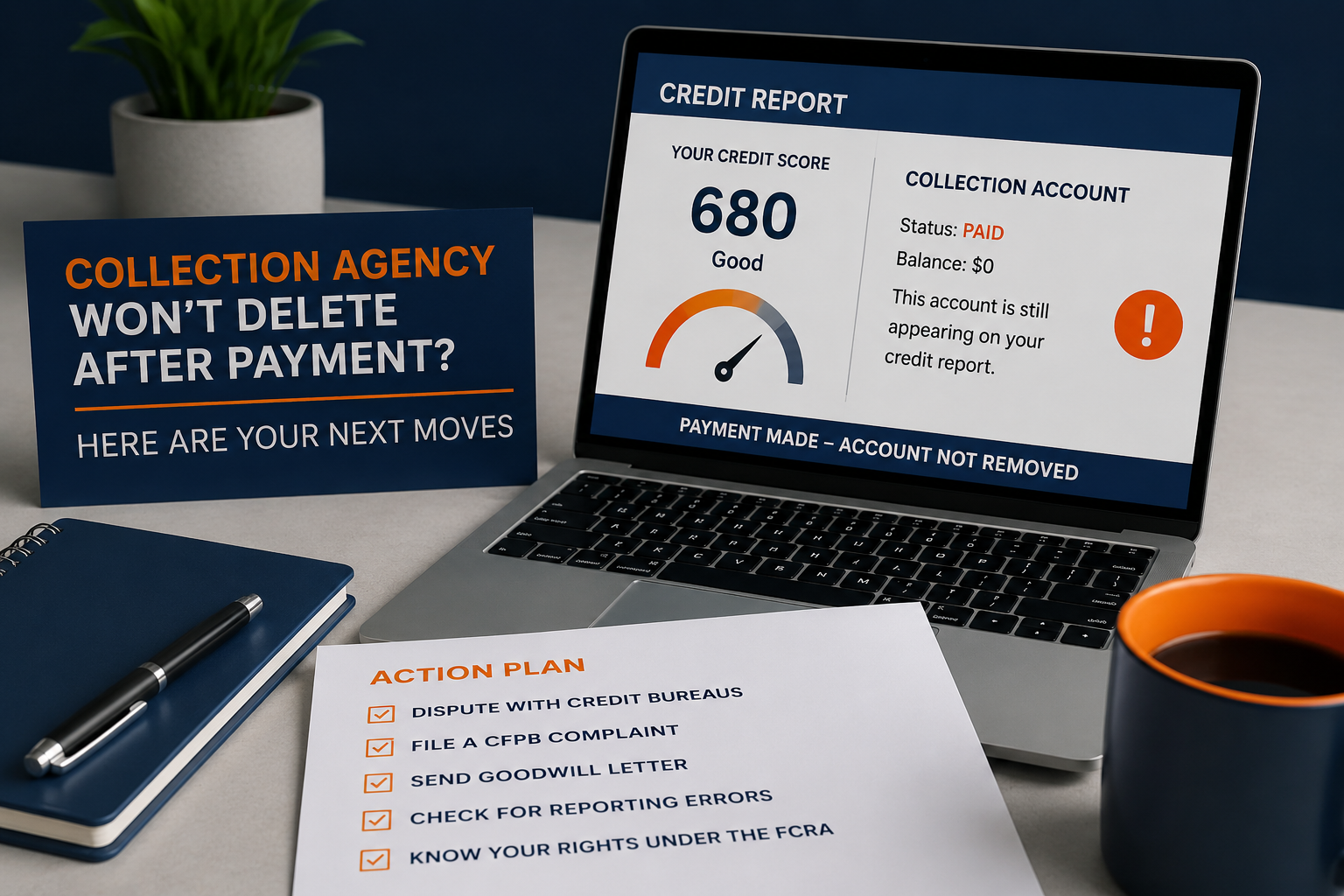
Why Collection Agencies Refuse to Delete After Payment
Most agencies refuse for one core reason. The Fair Credit Reporting Act (FCRA) requires them to report accurate information. Deleting an accurate, verified collection account breaks that rule.
Large national agencies rarely agree to delete. They hold contracts with Experian, Equifax, and TransUnion. A bureau can end that contract if it finds the agency removing valid accounts too often. Most agencies will not take that risk.
Roughly 10% of agencies, usually smaller and independent ones, will agree to pay-for-delete. They want the money more than they want to protect the bureau relationship. That number is shrinking. Credit bureaus have tightened their enforcement over the past several years.
Timing matters too. Many people pay first, then ask for a deletion. Once you pay, your leverage disappears. The agency already has the money. They have little reason to negotiate. The right time to request deletion in writing is before any payment clears.
Does Paying a Collection Help Your Credit Score?
It depends on the scoring model your lender uses.
FICO Score 8 is the most widely used model by lenders today. It still counts a paid collection against your score. Paying changes the status to "paid," but the entry stays and hurts your score until it ages off or gets deleted.
FICO Score 9 and VantageScore 3.0 and 4.0 ignore paid collection accounts. If your lender uses one of these newer models, paying the collection may already give you score relief without a deletion.
The problem is that most mortgage and auto lenders still use FICO 8 or older models. For those loans, a paid collection with no deletion still hurts. That is why deletion matters beyond the payment itself.
One important update: medical debt under $500 was removed from all three major credit bureau reports in 2023. Paid medical collections of any amount no longer appear following policy changes by Equifax, Experian, and TransUnion. If your collection is for paid medical debt, dispute it now. It should come off.
How to Dispute a Paid Collection with the Credit Bureaus
A credit bureau dispute is your strongest tool after payment. The FCRA gives you the right to dispute any information you believe is inaccurate, incomplete, or unverifiable. Under Section 611 of the FCRA, each bureau must investigate within 30 days.
Here is how to do it:
Pull your credit reports from all three bureaus at annualcreditreport.com.
Find the collection entry. Note the account number, balance shown, date of first delinquency, and the name of the reporting agency.
Write a dispute letter to each bureau where the entry appears. State the account has been paid in full. Attach your payment confirmation or zero balance letter.
Send it by certified mail with a return receipt. This starts the 30-day clock and creates a paper trail.
The bureau contacts the collection agency to verify. If the agency cannot verify within 30 days, the bureau must delete it.
Common dispute angles that work on paid collections:
The balance still shows as owed after payment
The date of first delinquency is wrong (re-aging a debt is illegal under the FCRA)
The account appears twice under different names
The account belongs to someone else with a similar name or Social Security number
You do not need to prove the record is wrong to dispute it. You only need to challenge it and force the agency to verify. If they fail within the window, it comes off.
How to Write a Goodwill Deletion Letter That Gets Results
A goodwill letter is a direct request to the collection agency. You ask them to remove the paid account as a courtesy. It works best when you have a strong history of on-time payments and the missed payment had a clear reason, like a job loss, medical event, or billing error.
A goodwill letter is not a legal tool. It is a human appeal. The agency has no obligation to respond. But it costs nothing. At our credit repair office, about 1 in 5 goodwill letters sent to smaller agencies get a positive result.
What to include:
Your full name, address, and the account number tied to the collection
Confirmation that the account is paid with a zero balance
A brief, honest explanation of why the debt happened
A reference to your overall positive credit history if it applies
A clear request to delete the tradeline from all three bureaus
A professional, non-threatening tone throughout
Send it by certified mail. Address it to a specific person, not just "To Whom It May Concern." Look up the agency's address on your credit report and find a compliance officer or manager's name if you can.
Do not threaten legal action in a goodwill letter. Save that for separate correspondence. Mixing a legal threat with a goodwill appeal kills the tone and usually kills the response.
How to File a CFPB Complaint Against a Collection Agency
A CFPB complaint puts official regulatory pressure on the agency. Agencies respond to CFPB complaints because repeated filings can trigger federal reviews.
The steps are simple:
Select "Debt collection" as your issue.
Describe the situation clearly. State that you paid the debt and have proof, and that the agency has not updated or deleted the account.
Attach your payment confirmation and any written communication from the agency.
Submit. The CFPB forwards it to the company and requires a response within 15 days.
Last year alone, we filed CFPB complaints for 22 clients with paid collections that were not being updated. In 17 of those cases, the agency resolved the issue within the 15-day window. Some deleted. Others updated to a zero balance paid status.
You can also file with the Federal Trade Commission at reportfraud.ftc.gov and with your state attorney general. Filing with more than one agency at the same time adds more pressure.
When to Check for FCRA and FDCPA Violations
Sometimes the collection agency has already broken the law. If that is true, you may have grounds to sue. A lawsuit can force deletion and result in the agency paying you money damages.
FCRA Violations Worth Checking
Reporting the collection past the 7-year limit from the original date of first delinquency
Re-aging the debt by listing a newer delinquency date than the actual first missed payment
Reporting a balance that does not match your payment records
Failing to update the account after receiving proof of payment
Reporting an account that is not yours
Under Sections 616 and 617 of the FCRA, you can sue both the credit bureau and the collection agency. Damages can include actual losses, up to $1,000 in statutory damages per violation, and attorney fees.
FDCPA Violations Worth Checking
Continuing to report a debt after receiving written notice that it is disputed
Using false or misleading language about the status of the debt
Failing to mark a debt as disputed after written notice from you
You have one year from the date of the violation to file an FDCPA lawsuit. Many consumer protection attorneys take these cases on contingency. That means you pay nothing unless you win.
Document everything before you pursue legal action. Keep every payment confirmation, letter, email, and note from phone calls with dates and names.
What If the Agency Promised to Delete and Did Not
This is one of the most common situations we handle. A client calls the agency. Someone on the phone promises to delete after payment. The payment clears. Nothing happens.
A verbal promise from a collection agent is nearly impossible to enforce. Agents sometimes say what people want to hear to close the payment. Some intend to follow through but lack the authority. Either way, you are left with a paid account and a broken promise.
If you have a written pay-for-delete agreement and the agency did not delete, you have stronger grounds. Send a follow-up letter that references the agreement and the payment date. Give them 15 days to comply. If they do not, file a CFPB complaint immediately. Attach the written agreement as evidence.
If you only have a verbal promise and no written record, your path forward is to file a bureau dispute, send a goodwill letter, and file a CFPB complaint at the same time. A written agreement is stronger, but you still have tools without one.
Paid Collection Still Showing?
A Collection Agency Won’t Delete After Payment? Don’t Stop There.
Paying the debt does not always remove the damage. ASAP Credit Repair can help review your report, dispute reporting errors, and guide your next steps.
Start Your Free Credit ReviewNo pressure. Just clear the next steps for your credit report.
How Long Does a Paid Collection Stay on Your Credit Report
A paid collection stays on your report for seven years from the date of first delinquency. That clock starts on the date you first missed the payment that led to the collection. It does not start when the account is sent to collections. It does not reset when you pay.
If the account is 5 years old when you pay, it falls off in 2 more years. Paying does not add time. It only changes the status from unpaid to paid.
The only ways to remove a paid collection before the 7-year mark:
A bureau dispute where the agency fails to verify within 30 days
A goodwill deletion granted by the collection agency
A pay-for-delete agreement that the agency actually honors
Proof of an FCRA violation that legally requires removal
A court order from a successful FCRA or FDCPA lawsuit
If the collection has less than 1 to 2 years left before it ages off, weigh the effort against the time remaining. Focus your energy on collections with 3 or more years left on the clock.
Frequently Asked Questions
Can a collection agency refuse to delete a paid collection? Yes. Agencies are not required to delete accurate information after payment. They must update the balance to zero and mark the account as paid. Deletion is separate and must be requested or won through a dispute, complaint, or legal action.
Does a pay-for-delete agreement hold up legally? Not fully. Pay-for-delete exists in a legal gray area. The FCRA requires accurate reporting. Deleting an accurate account can violate that standard. A written agreement adds some weight, but your legal recourse is limited if the agency takes your payment and does not delete.
What is the fastest way to remove a paid collection? File a credit bureau dispute and a CFPB complaint on the same day. Bureau disputes trigger the 30-day verification window. CFPB complaints require an agency response within 15 days. Running both at once shortens the timeline and adds pressure from two directions.
Can I sue a collection agency for not deleting a paid account? Not for the refusal alone. You can sue if the agency violated the FCRA or FDCPA. Re-aging the debt, reporting the wrong balance, or ignoring a written dispute can all support a lawsuit. A consumer protection attorney can review your case for free.
Will removing a paid collection raise my credit score? Usually, yes, especially under FICO Score 8 or older models. Removing any negative tradelines tends to lift your score. The size of the increase depends on the age of the collection and what else appears on your report.