

Does credit repair always involve lawyers? Because of the word "always", the answer is No. Most credit repair cases are handled through credit report analysis, dispute investigations, creditor communication, and credit bureau verification processes.
In many situations, consumers can improve their credit profiles without filing lawsuits or retaining legal counsel.
According to Consumer Financial Protection Bureau data, credit reporting issues remain one of the most common consumer finance complaints in the United States. Many of these complaints involve inaccurate account information, reporting errors, collection accounts, or identity-related issues that can often be addressed through established dispute procedures.
At ASAP Credit Repair, one of the most common questions clients ask is whether an attorney is required to fix bad credit. The answer depends on the circumstances. While most credit repair work does not require a lawyer, certain situations involving legal violations, creditor disputes, identity theft, or litigation may benefit from legal assistance.
Understanding when lawyers become involved helps consumers choose the right approach for their situation.
Does Credit Repair Always Involve Lawyers?
No, credit repair does not always involve lawyers. Most credit repair cases focus on reviewing credit reports, identifying inaccurate information, preparing disputes, and communicating with credit bureaus.
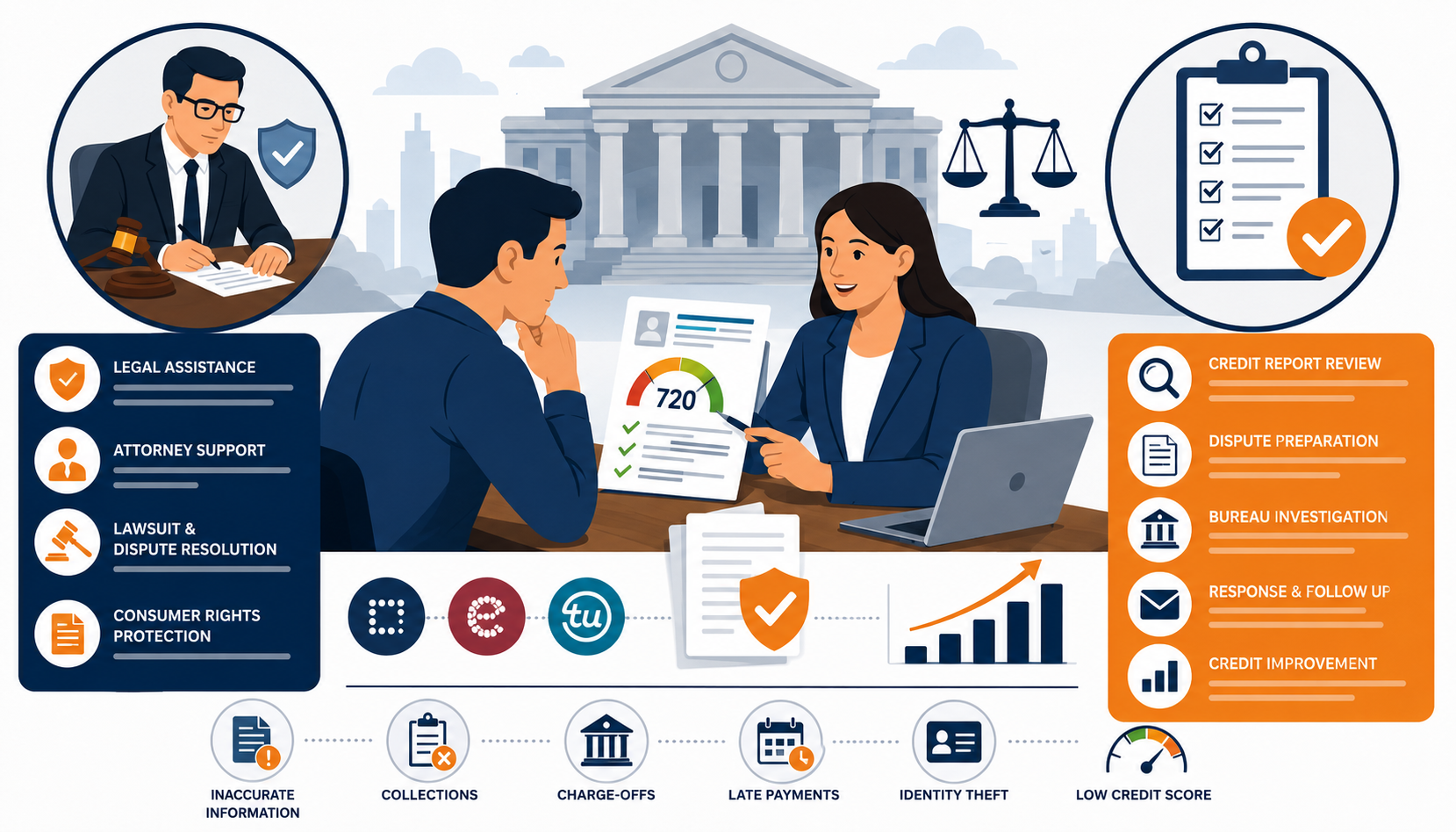
However, lawyers may become involved when consumers face identity theft, Fair Credit Reporting Act violations, debt collection disputes, lawsuits, or other legal matters that require legal representation.
"The most common question new clients ask is whether they need to hire a lawyer before we can help them. The answer, in the vast majority of cases, is no. The FCRA gives every consumer , and every CROA-registered company acting on their behalf , the same dispute rights that an attorney would use. What lawyers provide is additional value in specific situations: when a bureau violates the law after a dispute, when identity theft produces fraudulent accounts bureaus won't remove, or when a debt buyer files a lawsuit requiring a court response. Those situations exist. But they are not the norm."
What Is Credit Repair
Credit repair is the process of reviewing credit reports from Equifax, Experian, and TransUnion to identify inaccurate, incomplete, or unverifiable negative items, then disputing those items through the legal process established by the Fair Credit Reporting Act (FCRA). The goal is to remove items that should not be there, correct items reported incorrectly, and build a more accurate credit profile that lenders can evaluate fairly.
What Credit Repair Actually Addresses
Credit reports are not always accurate. The Federal Trade Commission found in a landmark study that approximately 1 in 5 consumers has at least one error on a credit report significant enough to affect credit decisions. These errors include:
- Collection accounts with wrong original delinquency dates
- Duplicate collection entries for the same underlying debt
- Accounts that do not belong to the consumer (mixed files or identity theft)
- Balances that do not reflect actual amounts owed
- Accounts that remain past the 7-year FCRA reporting window
- Charge-offs reported with inaccurate payment status
Why Consumers Seek Credit Repair
Most people seek credit repair when credit damage blocks a financial goal. A mortgage application gets denied. An auto loan comes back at a rate too high to afford. A rental application fails a credit check. These situations create urgency , and create the question of whether a lawyer is required to address the underlying credit file issues.
Does Credit Repair Require a Lawyer
No. The Fair Credit Reporting Act gives consumers the direct legal right to dispute any inaccurate or unverifiable item on their credit report without an attorney. Credit repair companies operate under those same rights as agents for the consumer. Bureaus investigate disputes within 30 days. Items that cannot be verified must come off the report. This entire process executes without legal representation in the overwhelming majority of cases.
How Most Credit Repair Cases Get Handled
The standard credit repair process involves no courtrooms, no legal filings, and no attorney involvement. It runs through three federal laws:
- Fair Credit Reporting Act (FCRA). Gives consumers the right to dispute inaccurate or unverifiable information. Requires bureaus to investigate within 30 days. Items that cannot be verified must come off the report.
- Fair Debt Collection Practices Act (FDCPA). Requires debt collectors to validate debts within 30 days of initial contact when requested in writing. Documentation failures create dispute grounds independent of court proceedings.
- Credit Repair Organizations Act (CROA). Governs how credit repair companies operate , requiring written contracts, prohibiting upfront fees, and mandating full disclosure of consumer rights.
As the CFPB confirms, consumers can dispute credit report errors directly with the bureaus at no cost , and credit repair companies help manage that process without legal representation.
The Credit Bureau Dispute Process
When a dispute goes to a bureau, the bureau must investigate within 30 days (35 when new information is submitted). The bureau contacts the creditor or debt buyer that reported the item. The creditor verifies the information or does not respond. If the creditor cannot verify , because documentation is incomplete, the debt changed hands multiple times, or records are inconsistent , the bureau must delete or correct the item.
No attorney appears in this process. No court filing occurs. The dispute, investigation, and response all run through the consumer rights structure the FCRA establishes.
What Does a Credit Repair Company Do
A CROA-registered credit repair company reviews credit reports from all three bureaus to identify inaccurate, incomplete, or unverifiable items. It prepares written dispute letters identifying each item and the specific inaccuracy. It sends FDCPA debt validation requests to collection agencies. It tracks bureau investigation responses. It submits follow-up disputes when items return "verified" with documentation gaps. It monitors credit changes across all three bureaus throughout the process. A credit repair company manages this process on the consumer's behalf , using the same rights the consumer possesses under federal law.
Equifax, Experian, and TransUnion each maintain separate credit files that may show the same account with different dates, balances, or statuses. A three-bureau review identifies every negative item and every inconsistency across all three simultaneously , finding dispute opportunities a single-bureau review misses.
Not all negative items are equal. A charge-off with the wrong original delinquency date has a different 7-year removal timeline than one reported correctly. A collection from a debt buyer who cannot produce chain-of-title documentation is legally challengeable even when the underlying debt is legitimate. This distinction , between accurate items and disputable items , determines what the dispute strategy targets.
Each dispute identifies the specific item, the specific bureau reporting it, and the specific reason the information is inaccurate or unverifiable. Supporting documentation accompanies each dispute where relevant. Disputes go to each bureau separately , because each bureau maintains its own file and runs its own investigation independently of the others.
Under the FDCPA, consumers have the right to request written validation of any debt within 30 days of initial collection contact. Debt buyers who purchased accounts through multiple transfers frequently cannot produce complete chain-of-title documentation. When validation fails, the collection account becomes disputable across all three bureaus , sometimes producing deletion without any additional action.
Bureau investigations close within 30 to 45 days. Items deleted produce immediate score improvement. Items returned as "verified" , but where the collector's supporting documentation contains gaps , qualify for escalated disputes citing the specific documentation failure. Multiple dispute cycles often address items that survived the first round.
Credit file changes are tracked across all three bureaus throughout the process. Deletions are confirmed. New negative items that appear during the repair process are identified and addressed. Score changes reflect the cumulative impact of completed dispute cycles, utilization changes, and positive payment history building simultaneously.
Understanding the full process , and when the FCRA gives consumers the right to act independently versus when legal representation adds value , is covered in depth in the guide to how credit repair works.
When Can a Lawyer Help With Credit Repair
Attorneys add value in four specific credit-related situations: when a bureau or creditor violates the FCRA after a dispute (statutory damages of $100 to $1,000 per violation are recoverable through litigation), when identity theft creates fraudulent accounts that bureaus refuse to remove after dispute, when a debt collector violates the FDCPA through harassment or false statements (up to $1,000 in statutory damages per violation), and when a debt buyer files a civil lawsuit requiring a court defense with a specific response deadline.
FCRA Violations That May Warrant Legal Action
The FCRA gives consumers rights , and it gives courts the authority to enforce those rights when bureaus and creditors fail to meet their legal obligations. Specific violations that may produce legal remedies include:
- Re-insertion of deleted information without proper notice. If a bureau deletes an item after a dispute and then re-inserts it later without notifying the consumer within five business days, this violates the FCRA. Statutory damages are available per violation.
- Failure to investigate disputed items within the 30-day window. Bureaus that close disputes without conducting the required investigation violate the FCRA's investigation mandate.
- Creditors that provide false information to bureaus. A creditor that knowingly reports inaccurate information to a bureau after a consumer dispute may face FCRA liability under Section 1681s-2.
Identity Theft Cases
Identity theft creates fraudulent accounts that the consumer never opened. When bureaus refuse to remove these accounts despite FTC identity theft affidavits, police reports, and documented disputes, an attorney can pursue legal remedies available under the FCRA specifically for identity theft victims. These include extended fraud alerts, security freezes, and in severe cases, FCRA litigation against the bureaus or creditors who continued reporting fraudulent information.
FDCPA Violations by Debt Collectors
The Fair Debt Collection Practices Act prohibits specific collection behaviors: calling before 8am or after 9pm, threatening legal action they cannot take, using harassment or abusive language, and making false statements. These violations produce statutory damages up to $1,000 per violation plus attorney fees. A consumer attorney who identifies FDCPA violations can file claims that sometimes exceed the original debt balance , creating counterclaim value that changes the dynamics of any collection lawsuit.
Debt Buyer Lawsuits
When a debt buyer like LVNV Funding, Portfolio Recovery, or Midland Credit Management files a civil lawsuit, a court response deadline applies , typically 20 to 30 days from service. Missing this deadline produces a default judgment with enforcement consequences. A consumer defense attorney can file an answer, pursue discovery on ownership documentation, raise statute of limitations defenses, and negotiate settlements , all within the legal process the lawsuit creates.
Lawyer vs Credit Repair Company
- Multiple inaccurate or unverifiable items appear across Equifax, Experian, and TransUnion
- Collections from debt buyers with documentation gaps are disputable through the FCRA process
- Time savings from professional management justify the monthly cost
- A mortgage or major loan is 3 to 6 months away and score improvement needs to happen quickly
- Identity theft created accounts that are still within the standard dispute window
- A bureau repeatedly re-inserts deleted items in violation of FCRA Section 1681i(a)(5)
- Identity theft produced accounts that bureaus refuse to delete after dispute
- A debt collector violated FDCPA in a way that produces statutory damages
- A civil lawsuit from a debt buyer requires a formal court response before a specific deadline
- A creditor knowingly reported false information after receiving a documented dispute
Common Credit Problems That Usually Do Not Need a Lawyer
Most credit problems resolve through the FCRA dispute process without legal representation. Late payments, collection accounts from debt buyers with documentation gaps, reporting errors with wrong dates or balances, high utilization, and duplicate account entries all address through the standard dispute framework that credit repair companies and consumers use directly. No attorney filing or court appearance is required.
- Late payments. Late payments that are accurate do not remove before 7 years through any process , legal or otherwise. Late payments with wrong dates, wrong amounts, or incorrect severity (30-day reported as 60-day) dispute through FCRA on accuracy grounds. No attorney needed.
- Collection accounts from debt buyers. Accounts purchased from original creditors through multiple transfers often lack complete ownership documentation. Debt validation requests and FCRA disputes address these through the standard process. No attorney needed for the dispute stage.
- Reporting errors , wrong dates, wrong balances. These are the most straightforward disputes. A wrong original delinquency date changes the 7-year removal timeline. A wrong balance misrepresents the debt. Both dispute through a written letter with documentation. No attorney needed.
- High credit card utilization. Utilization is not a dispute issue at all , it responds to balance paydown, not dispute letters. No attorney provides any value here. The fix is paying the card balance before the statement closes.
- Duplicate collection entries. Two entries for one underlying debt , one from the original creditor, one from a buyer , create two negative entries for one event. FCRA disputes address this on accuracy grounds. No attorney needed.
Common Credit Problems That May Need Legal Help
Four situations may benefit from legal representation: mixed credit files (where another consumer's accounts appear in your file and bureaus fail to correct despite disputes), fraudulent accounts from identity theft that bureaus refuse to remove after proper documentation, repeated FCRA violations after completed disputes, and civil lawsuits from debt collectors requiring a court defense.
- Mixed files. Credit bureaus sometimes merge files from different people with similar names, addresses, or Social Security numbers. When the bureau identifies the mix and fails to correct it despite disputes and documentation, this becomes an FCRA violation that an attorney can pursue in court with statutory and actual damages available.
- Fraudulent accounts from identity theft. An identity theft affidavit, police report, and documented dispute process should remove fraudulent accounts. When they do not, the FCRA provides specific legal remedies for identity theft victims that require attorney involvement to access fully.
- Repeated re-insertion of deleted items. The FCRA specifically prohibits re-inserting deleted information without consumer notice. When a bureau deletes an item and then re-inserts it later, this violation produces statutory damages that an attorney can pursue in federal court without the consumer needing to prove specific financial harm.
- Debt buyer lawsuits with upcoming deadlines. A civil summons from a debt collector has a response window of 20 to 30 days in most states. Missing this window produces a default judgment. A consumer attorney can file an answer, pursue documentation through discovery, raise statute of limitations defenses, and negotiate settlements , all within the legal process the lawsuit creates.
What Joe Mahlow and the ASAP Team See During Credit Reviews
"At ASAP Credit Repair, many consumers assume an attorney must be involved before their credit can improve. This comes up constantly in initial consultations. In reality, most credit reports we review contain issues that address through dispute investigations, documentation reviews, and bureau communications , all through the FCRA process that does not require a lawyer. The situations where we tell clients to also speak with a consumer attorney are specific: when a bureau has re-inserted something we successfully deleted, when identity theft produced accounts that dispute processes alone couldn't remove, or when a debt collector has filed a civil lawsuit with a court deadline approaching. Those cases exist. But they represent a small fraction of the files we review."
From reviewing over 100,000 consumer credit files, Joe Mahlow's team at ASAP Credit Repair observes these patterns:
- 85%+ of credit files contain at least one disputable item. Wrong dates, wrong balances, unverifiable debt buyer accounts, or duplicate entries appear on most consumer credit reports. These address through FCRA disputes without legal involvement.
- The most common first-round success: debt buyer collection accounts. Accounts purchased through multiple transfers frequently contain documentation gaps. First-round disputes produce deletion in many of these cases without attorney involvement.
- The situations that prompt referrals to attorneys. Re-inserted deleted accounts, identity theft that dispute alone cannot resolve, and civil lawsuit summons with approaching deadlines. These represent a minority of credit repair files but do appear , and they require legal expertise the dispute process alone cannot provide.
A professional credit report review helps identify the most effective next steps. Joe Mahlow's team at ASAP Credit Repair reviews the three-bureau file and distinguishes which items address through the FCRA dispute process and which may warrant legal consultation.
Get a Free Credit Report Review →Should You Hire a Lawyer for Credit Repair
For most credit repair situations , reporting errors, unverifiable collection accounts, duplicate entries, outdated items , a credit repair company handles the work without legal representation. A consumer attorney becomes valuable when the situation involves legal violations that courts can remedy, identity theft that standard disputes cannot resolve, or civil lawsuits requiring a formal defense. Asking three questions identifies which path fits: Has a bureau re-inserted a deleted item? Is there a fraudulent account that disputes could not remove? Did a debt collector file a lawsuit with a response deadline?
Questions to Ask Before Deciding
- Has a credit bureau or creditor violated the FCRA specifically , re-inserting deleted items, failing to investigate within 30 days, or knowingly reporting false information after a documented dispute?
- Did identity theft create accounts that bureau disputes alone could not remove despite an FTC identity theft affidavit and police report?
- Did a debt collector violate the FDCPA through harassment, false statements, or threatening legal actions they could not legally take?
- Did a debt buyer file a civil lawsuit with an approaching court response deadline?
If the answer to all four questions is no, a credit repair company addresses the situation without legal involvement.
If the answer to any is yes, consulting a consumer protection attorney is worth the initial conversation , many consumer attorneys offer free consultations for FCRA and FDCPA cases and work on contingency (fee paid only if the case produces recovery).
Signs You Probably Do Not Need Legal Assistance
- The credit problems are inaccurate reporting, old collections, or duplicate entries
- No bureau has violated FCRA timelines or re-inserted deleted information
- No civil lawsuit summons arrived with a court deadline
- Identity theft, if present, is in early stages and responding to dispute process
- The goal is score improvement, not legal damages recovery
As the Federal Trade Commission's credit repair guide confirms, the rights that credit repair companies use are the same rights consumers hold directly under the FCRA and FDCPA , no attorney is needed to dispute inaccurate credit report information, and the process is available to any consumer at no cost through AnnualCreditReport.com and written dispute letters to each bureau.
The debt validation guide covers what collectors must prove when challenged under the FDCPA , the consumer right that applies both to standard debt collection disputes and to cases where a collector's failure to validate creates the foundation for FCRA disputes and, in some cases, FDCPA claims.
As Experian's FCRA overview confirms, the Fair Credit Reporting Act gives consumers the right to dispute errors, request investigations, and have unverifiable information removed , rights that operate through the bureau system, not through courts, in the overwhelming majority of cases.
Can attorneys sue credit bureaus?
Yes. Consumer protection attorneys can file FCRA lawsuits against credit bureaus (Equifax, Experian, TransUnion) and against creditors who report false information. Statutory damages under the FCRA range from $100 to $1,000 per willful violation. Actual damages, punitive damages, and attorney fees are also available depending on the severity and willfulness of the violation. These lawsuits require documented FCRA violations , not just unfavorable credit report entries. Standard inaccurate reporting that responds to the standard dispute process typically does not rise to the level of FCRA litigation.
What laws protect consumers during credit repair?
Three federal laws provide the framework for credit repair consumer protections. The Fair Credit Reporting Act (FCRA) governs credit report accuracy, investigation requirements, and consumer dispute rights. The Fair Debt Collection Practices Act (FDCPA) governs how debt collectors communicate and what collection behaviors are prohibited. The Credit Repair Organizations Act (CROA) governs how credit repair companies operate , requiring written contracts, prohibiting upfront fees, mandating a three-day cancellation right, and prohibiting false claims about the ability to remove accurate information. Together, these three laws define the complete consumer protection framework for credit reporting and credit repair.
How much does a credit repair lawyer cost?
Consumer protection attorneys who handle FCRA and FDCPA cases frequently work on contingency , meaning no fee until the case produces a recovery. Initial consultations are often free for FCRA and FDCPA matters. When hourly billing applies, consumer protection attorneys typically charge $150 to $400+ per hour. For straightforward credit disputes (inaccurate reporting, unverifiable collections), the hourly cost of an attorney far exceeds the cost of a credit repair company for the same outcome. The attorney's fee structure becomes favorable when statutory damages or actual damages are available , because the fee comes from the recovery rather than from the consumer's pocket.
-
Is It Worth Paying Someone to Fix My Credit? Honest Cost vs Results The decision between DIY credit repair, professional credit repair, and attorney involvement starts with whether paying for professional help makes financial sense at all. This covers the honest answer from Joe Mahlow as a credit repair company owner , when the ROI is clear (multiple disputable items, mortgage timeline, identity theft complexity) and when the DIY path is sufficient. The cost-vs-results calculation makes the professional help decision concrete rather than abstract.
-
LVNV Funding Lawsuit: What to Do If You're Being Sued A civil lawsuit from a debt buyer is one of the specific situations where attorney involvement becomes most valuable , particularly when a court response deadline is approaching and the legal defense involves documentation requests, statute of limitations arguments, and settlement negotiation. This covers what happens at each stage of an LVNV Funding civil lawsuit, what defenses apply, and when to seek legal counsel versus when the dispute process alone addresses the underlying credit report entry.
-
Should You Use a Personal Loan to Pay Off Collections? Collections are the most common target of credit repair work , and the decision of whether to dispute, pay-for-delete, or consolidate is one of the most consequential choices in the credit repair process. This covers the correct sequence (dispute first, then pay what cannot be deleted) and why paying without a deletion agreement leaves the bureau entry intact for seven years regardless of whether a lawyer, credit repair company, or the consumer handled the dispute.