
Evidence for a credit dispute does not have to start with an original payment receipt. If your credit report shows a late payment or unpaid balance you believe is wrong, bank statements, confirmation emails, and creditor account histories can help reconstruct what happened. The key is connecting the payment to the disputed account: who received it, how much you paid, and when it was processed.
A missing receipt creates a records problem you can work through by tracing the transaction. This guide explains where to request replacement documents, which details to check, and how to organize your evidence into a clear dispute. You will also learn how to follow up when the reported information remains unchanged, so your next step addresses the specific error with the records available.
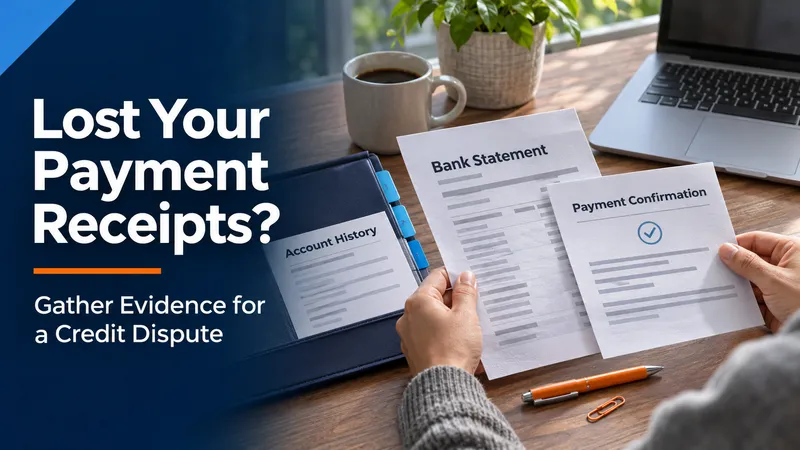
Lost Your Payment Receipts? How to Gather Evidence for a Credit Dispute Without the Original Proof
Lost payment receipts do not end a credit dispute. You gather evidence for a credit dispute from the records other people still hold. Bank statements, card statements, and payment app history all prove a payment. Creditor letters and account payment histories work just as well as a paper receipt. Credit bureaus must investigate your dispute either way, and those replacement records give the investigation something to check. The demand for this help keeps growing. The CFPB's 2025 Consumer Response Annual Report counted about 6.6 million complaints in 2025. Credit or consumer reporting made up about 5.8 million of them, or 88 percent. Most of those consumers needed the same thing you need now: proof.
Can You Dispute a Credit Report Without Proof of Payment?
Yes. You can dispute a credit report without proof of payment, and the bureau still has to investigate. The Fair Credit Reporting Act requires a reasonable investigation of every dispute that clearly names the error. Proof makes the investigation faster and harder to brush off.
Credit bureaus reject vague disputes. The FCRA at 15 U.S.C. § 1681i lets a bureau end an investigation when you fail to give enough information to investigate. A letter that says "I paid this" with no dates or amounts invites that answer. A strong letter names the payment date, the amount, and the method. The bureau and the creditor then have a record to match.
ASAP Credit Repair sees this split every month. Last quarter alone, we took on 85 clients who had no receipts for the payment they wanted to dispute. We found replacement records for 71 of them within three weeks.
Missing Receipts? We Find the Proof That Still Exists.
A free 3-bureau analysis shows which late payments you have grounds to dispute and which records back you up.
Claim My Free Credit Analysis Now → Secure · 2 minutes · No credit card requiredWhat Counts as Evidence for a Credit Dispute?
Evidence for a credit dispute is any record that shows the payment left your account or reached the creditor. Paper receipts are only one option. These records carry the same weight.
Bank and Credit Union Statements
Bank statements show the date, the amount, and often the payee name. A statement line that matches the creditor and the due date proves an on-time payment. Check images work too, because the back of a cleared check shows the creditor's deposit stamp.
Card Statements and Payment App History
Credit card statements prove payments you charged to a card. Payment apps like PayPal, Venmo, Zelle, and Cash App keep transaction logs with timestamps. Export the log as a PDF or take a screenshot that shows the date, amount, recipient, and transaction ID.
Creditor Letters, Emails, and Account Histories
Creditors leave a paper trail of their own. Payment confirmation emails, paid-in-full letters, and settlement letters all count. An online account page that shows your payment history counts too, so save it before the account closes.
Your Own Written Account
A signed, dated statement from you adds context. List what you paid, when, how, and to whom. A personal statement alone rarely wins a dispute, but it ties your other records into one clear story.
Those first two sections set the base. You dispute with or without receipts, and the records above replace them. The next question is where to get those records when you no longer have them on hand.
How Do You Prove You Paid a Debt Without a Receipt?
You prove a payment without a receipt by requesting records from the people who handled the money. Your bank, the creditor, and any collector each keep their own copy of the transaction. Ask each one in writing.
Request Old Statements From Your Bank
Banks keep deposit account records for years. The OCC's HelpWithMyBank.gov explains that banks must keep records of deposits over $100 for at least five years. Call or visit your bank and ask for statements or check images for the months you need. Some banks charge a small research fee for older records.
Ask the Creditor for a Full Payment History
Creditors track every payment they post. Send a written request for a complete payment history on the account. Ask for posting dates, amounts, and any late fees. The payment history often shows the exact error, such as a payment posted to the wrong month.
Send a Debt Validation Letter to Collectors
Collection accounts follow a separate rule. The Fair Debt Collection Practices Act at 15 U.S.C. § 1692g gives you 30 days from the collector's first notice to dispute the debt in writing. The collector then stops collecting until it mails you verification. Ask for the payment history it received from the original creditor.
Use a Request for Information on Mortgages
Mortgage servicers answer to their own rule. Regulation X at 12 CFR 1024.36 covers a written request for information. The servicer must respond, usually within 30 business days. Ask for the full payment and escrow history on the loan.
ASAP Credit Repair tracks which source pays off. Last year, creditor payment histories closed about 6 in 10 lost-receipt cases. Bank statements closed most of the rest.
How Long Does a Credit Dispute Take?
A credit dispute takes about 30 days. The FCRA gives the bureau 30 days to finish its investigation. The bureau gets 15 more days if you send new information during that window. Results reach you within five business days after the bureau finishes.
Timing changes how you send evidence. Send every record with the first letter. A late document stretches the review to 45 days. Gather first, then file.
Here is where you stand. You know where replacement proof lives and how long the review runs. The last piece is what happens when the creditor comes back empty-handed.
What Happens If the Creditor Cannot Verify the Debt?
The bureau deletes or corrects the item. Under 15 U.S.C. § 1681i(a)(5), information that the bureau finds inaccurate, incomplete, or unverifiable comes off your report. The bureau then notifies the creditor of the change.
Creditors lose old records too. A creditor that sold the account or switched systems sometimes holds no payment detail at all. Your bank statement then becomes the only clear record in the file, which puts you in the stronger position.
Ask How the Bureau Verified the Item
Verified results deserve a second look. The same section of the FCRA lets you request a description of the procedure the bureau used. The bureau must send it within 15 days of your request. The bureau's answer shows whether anyone checked your evidence or only matched a name and balance.
Accurate late payments stay, though. Some records hold up, and the balance still needs a plan. Our breakdown on how to overcome credit card debt covers that next move.
What Should You Send With a Credit Dispute Letter?
Send a short letter and copies of your evidence. The CFPB's dispute guide tells consumers to send copies, not originals, and to keep a copy of everything. Use this checklist:
- Your full name, address, and date of birth.
- The account name and number for each item you dispute.
- A clear reason, such as "Paid $142 on March 3. Not late."
- Copies of the bank statement, card statement, or creditor letter that proves it.
- A copy of your credit report with the error circled.
- Your signed personal statement, if your records need context.
Mail the packet by certified mail with a return receipt. File the same dispute with the creditor too. Furnishers generally must investigate a direct dispute within 30 days.
Records matter beyond one dispute. A clean file protects the score behind your rent and loan rates. Our guide on why credit is important explains the stakes. Start a payment folder today. Receipts tend to vanish during surprise bills. Our guide to paying for emergency home repairs covers those moments.
Quick Answers on Lost Receipts
Does a screenshot count as proof of payment?
Yes, when it shows the date, amount, recipient, and a transaction or confirmation number. Pair the screenshot with a bank or card statement that shows the same payment for the strongest proof.
What if my bank closed or merged with another bank?
The bank that took over holds the old records. Contact the new bank's records department. The FDIC handles record requests for many failed banks.
Should I file a CFPB complaint instead of a dispute?
File the dispute first. Send a CFPB complaint when the bureau or creditor ignores your evidence or misses its deadline. The CFPB forwards your complaint to the company and tracks its response.
Let Us Build Your Evidence Packet.
Our team requests your statements and payment histories and matches them to your reports. Every dispute names the exact error. No fees before work, as federal law requires.
Start My Free 3-Bureau Review Now → Secure · 2 minutes · No credit card required