

The Fair Credit Billing Act (FCBA) gives you the right to dispute wrong charges on your credit card. The law sets clear rules for creditors. It also caps what you owe for fraud at just $50.
As the owner of a credit repair company, I have seen this law protect clients in ways they never expected. One case stays with me. A client came to us after her card issuer refused to look into a $1,200 fraud charge for over three months. She had no idea the law gave her the right to force a fix within 90 days.
The numbers show how common this problem is. According to the CFPB's 2023 Consumer Response Annual Report, the Bureau received nearly 70,000 credit card complaints that year. That is a 38% jump from 2022. Of those complaints, 23% were about wrong or fraudulent charges. Most of those people did not need a lawyer. They needed to know what the FCBA says.
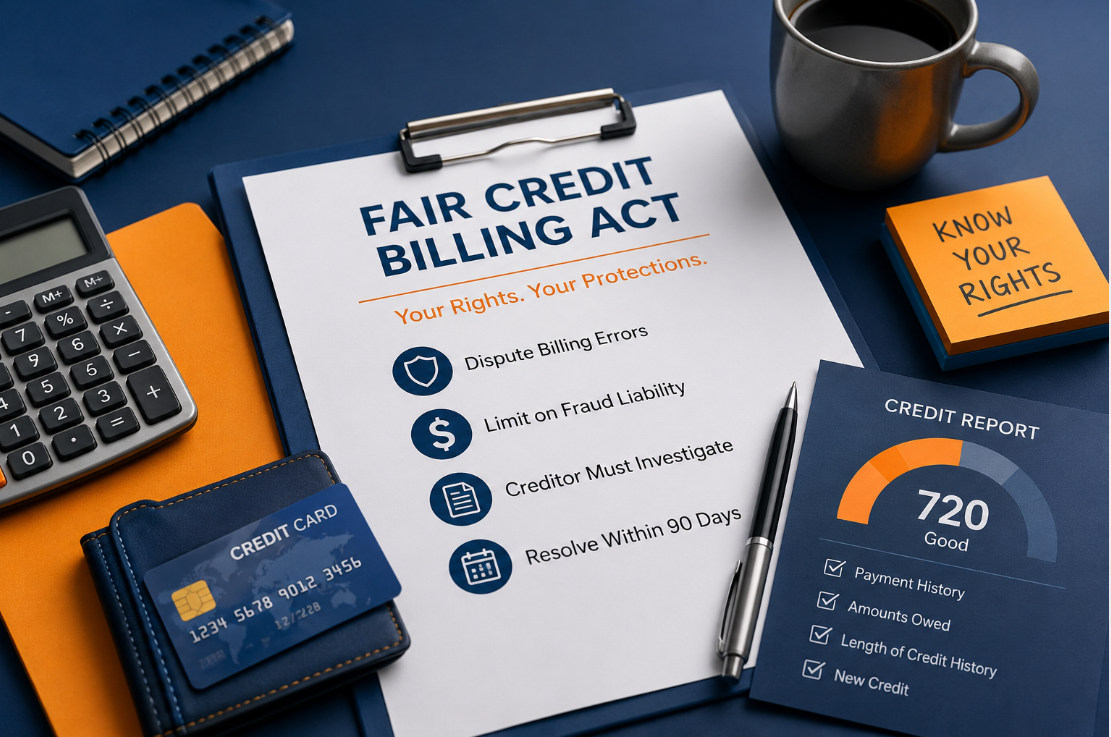
What Is the Fair Credit Billing Act (FCBA)?
The Fair Credit Billing Act is a federal law passed in 1974. Congress wrote it as an update to the Truth in Lending Act. The FCBA targets unfair billing on open credit accounts. These include credit cards and home equity lines of credit.
The law does three things. First, it gives you the right to dispute billing errors. Second, it limits what you owe for fraud charges to $50. Third, it requires creditors to follow a set process when you file a dispute.
The Federal Trade Commission enforces the FCBA. Bank regulators handle compliance for banks.
How Does the Fair Credit Billing Act Work?
The FCBA sets up a formal dispute process. It starts when you spot a wrong charge and write to your creditor.
How to File a Dispute
Write a dispute letter to the billing address on your statement. Do not send it to the payment address. Include your name, account number, the charge amount, and why you think it is wrong. Mail it within 60 days of the statement date that shows the error. Use certified mail with a return receipt. Keep a copy for yourself.
What Your Creditor Must Do
Your creditor must write back to confirm they got your letter. They have 30 days to do this. Then they have two full billing cycles to finish their review. The max time allowed is 90 days.
During the review, your creditor cannot report that charge as past due to any credit bureau. They also cannot try to collect it. You still need to pay the rest of your bill on time. This avoids late fees and credit damage.
If they find an error, they must fix the bill and remove any related fees. If they find no error, they must send you a written reason and tell you what you owe.
What Types of Billing Errors Does the FCBA Cover?
The FCBA covers specific types of errors. Not all complaints qualify.
Covered errors include charges you did not make. They also include charges with the wrong date or amount. Charges for goods or services you never got are covered too. So are duplicate charges and math errors. If your creditor failed to credit a payment or return, that qualifies as well.
Bills sent to the wrong address are also covered. But you must have given written notice of your new address at least 20 days before the billing period ended.
One key limit: the FCBA does not cover disputes about product quality. If your item arrived but you were unhappy with it, that is not a billing error. You may need to try a chargeback or another route for that.
How Long Do You Have to Dispute a Charge?
You have 60 days from the date on your billing statement. The clock starts when the statement is sent, not when you read it. Missing this window can cost you your FCBA rights for that charge.
Fraud cases work slightly differently. Many card issuers offer zero liability for fraud reported within 60 days, even past 60 days. But to get FCBA protections, you must send written notice within that window.
After you send the letter, your creditor must confirm it within 30 days. They must resolve it within 90 days. All collection calls and late reporting must stop during that time.
You now know what the FCBA covers and how the process works. Next, we look at how this law compares to the FCRA and what you can do if a creditor breaks the rules.
What Is the Difference Between the Fair Credit Billing Act and the FCRA?
Many people mix up the FCBA and the Fair Credit Reporting Act (FCRA). They protect different parts of your financial life.
FCBA vs. FCRA: A Clear Breakdown
The FCBA deals with your monthly credit card bill. It lets you fight errors on that statement.
The FCRA deals with your credit report. It governs how Equifax, Experian, and TransUnion report your data.
Here is a simple way to think about it. Wrong charge on your bill? Use the FCBA. Wrong item on your credit report? Use the FCRA.
Both laws give you dispute rights. But the steps, the parties involved, and the outcomes differ. The FCBA goes directly to your creditor. The FCRA goes to the credit bureaus. In many cases, you may need to use both at once.
Does the Fair Credit Billing Act Apply to Debit Cards?
No. The FCBA only covers open credit accounts. It does not apply to debit cards, auto loans, mortgages, student loans, or installment loans.
Debit card charges fall under the Electronic Fund Transfer Act (EFTA). That law works differently. Under the EFTA, what you owe can go up the longer you wait to report a lost or stolen card. With debit cards, time matters even more.
To recap: the FCBA only covers credit cards and similar revolving accounts. For debit cards, a different law applies. Knowing which law fits your case tells you which steps to take.
What Happens If a Creditor Violates the Fair Credit Billing Act?
Creditors who break the FCBA face real legal risk. Last year alone, our firm helped three clients file formal complaints after their creditors missed the 90-day deadline. In each case, the client had legal grounds they did not know about.
If a creditor breaks the FCBA, you can sue. You can recover your actual losses from the breach. You can also recover twice the finance charge tied to the error. The law sets a floor of $100 and a cap of $1,000 for these damages. If you win, the court may also make the creditor pay your legal fees.
Class Action Liability
When a violation affects many people, a class action suit is also an option. Damages in a class action cap at $500,000 or 1% of the creditor's net worth, whichever is less. This is defined under 15 U.S.C. § 1601.
You can also file a complaint with the Consumer Financial Protection Bureau or the FTC. It costs nothing. It also creates a record that regulators can use later.
One thing to know: the FCBA is about process. Courts look at whether your creditor followed the right steps. A creditor who skipped steps faces the full range of penalties. A creditor who followed the steps but got the answer wrong may face less risk.
Can Your Credit Score Drop After Filing an FCBA Dispute?
Your score should not drop while your dispute is under review. The FCBA stops creditors from reporting that charge as past due during the process.
What Happens After the Review Ends
If the creditor finds an error, they must fix it. No late mark gets added to your report. If they find no error, you have 10 days to pay or write back saying you still disagree. If you do not pay, they can report the account as past due. But they must also note that you disputed the charge.
That note matters. Anyone who reads your credit report will see that you challenged it. You can also file a separate dispute with the credit bureau under the FCRA if the report is still wrong.
The FCBA and FCRA work as a pair here. The FCBA handles the billing dispute. The FCRA handles how the result shows up on your credit file. Using both gives you the most protection.