

A FICO score is a credit score, but not every credit score is a FICO score. That distinction matters more than most people realize, especially when you apply for a mortgage, a car loan, or a new credit card. The term "credit score" is the category. FICO is one brand within that category, and it happens to be the one lenders check most often.
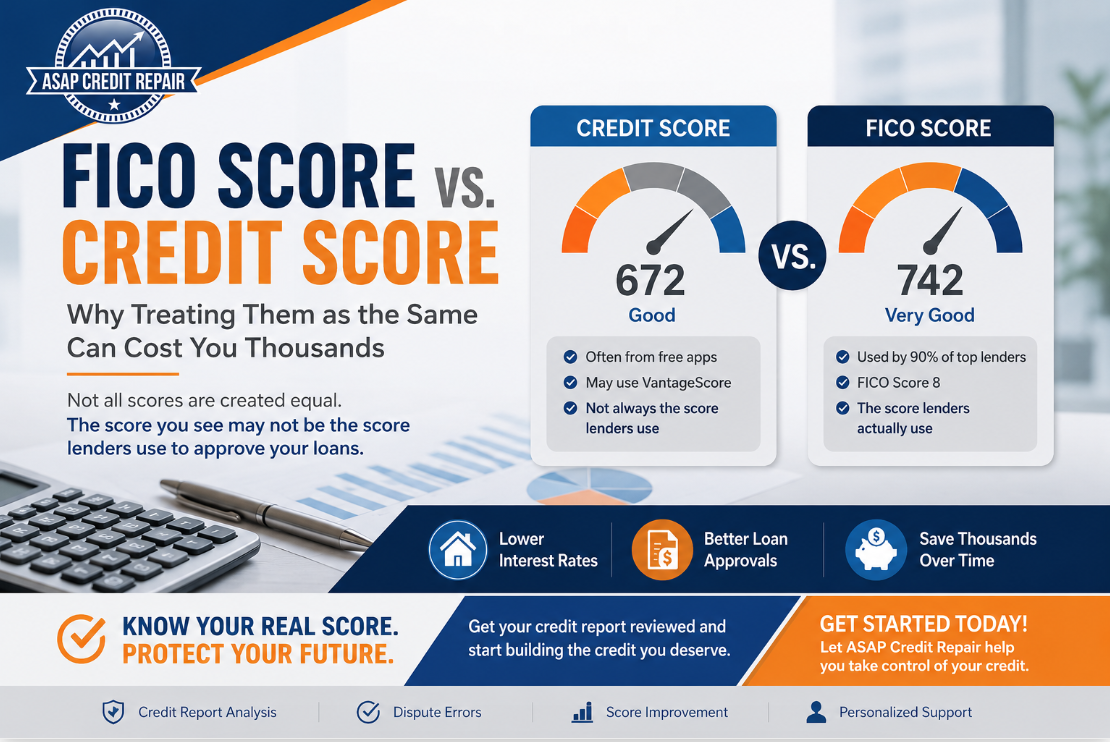
I am running a credit repair company, and I hear this confusion constantly. One of the most common calls I get goes something like this: a client checks their score on a free app, sees a 700, walks into a bank for a mortgage, and gets quoted a rate based on a 672. They are furious. They are not wrong. They just checked the wrong score.
The Consumer Financial Protection Bureau (CFPB) confirms this gap is real. Their study found a meaningful score difference for 1 in 4 consumers when comparing the scores sold to them versus the scores lenders actually pull (CFPB source). That gap can be the difference between an approval and a rejection.
What Is a Credit Score?
A credit score is a three-digit number that predicts how likely you are to repay borrowed money on time. Lenders, landlords, insurers, and even some employers use it to assess your financial risk.
The CFPB defines a credit score as a prediction of your credit behavior based on information from your credit reports. Multiple companies create their own scoring models. Each model weighs your credit data differently. That is why you do not have one single credit score. You have dozens, and they can vary by model, bureau, and even the day you check them.
Most scoring models factor in five things: payment history, credit utilization, length of credit history, new credit applications, and credit mix.
What Is a FICO Score?
A FICO score is a specific type of credit score built by the Fair Isaac Corporation, founded in 1956. FICO launched its first scoring model in 1989, and it became the standard lenders relied on to make faster, more consistent lending decisions.
Today, 90% of top lenders use FICO scores when evaluating credit applications. That includes mortgage companies, auto lenders, and credit card issuers. Base FICO scores range from 300 to 850. Industry-specific FICO scores range from 250 to 900.
FICO builds its score from five weighted factors. Payment history carries 35% of the total score. Amounts owed carries 30%. Length of credit history carries 15%. New credit carries 10%. Credit mix carries the final 10%. Payment history holds the most weight by far. One missed payment can drop a strong score by 60 to 110 points, depending on your overall profile.
What Is the Difference Between a Credit Score and a FICO Score?
Think of it this way. A credit score is a broad category, like the word "vehicle." A FICO score is a specific brand within that category, like "Toyota." All Toyotas are vehicles. Not all vehicles are Toyotas.
All FICO scores are credit scores. Not all credit scores are FICO scores.
The key difference comes down to the scoring model. FICO uses its own proprietary formula. Other companies, like VantageScore, use different formulas. VantageScore was created jointly by Equifax, Experian, and TransUnion in 2006. The same credit file can produce different scores depending on which model calculates it.
One practical difference worth knowing: VantageScore can generate a score with just one month of credit history. FICO requires at least one account open for six months and at least one account reported within the past six months. That makes FICO stricter, but also more widely trusted by lenders. When a free app shows your score, check which model it uses. Many apps display a VantageScore, not a FICO score. Both are real scores. But the lender will almost certainly pull your FICO.
Are All Credit Scores FICO Scores?
No. Several companies produce credit scores that lenders and consumers can access. VantageScore is the most notable alternative. Some lenders also build their own internal scoring models for their specific products. These proprietary models can pull in data points beyond your standard credit report.
The CFPB also notes that many scores sold to lenders are never offered for sale to consumers. So the number a credit monitoring service shows you may not be the same model your bank uses when you apply for a loan. When you prepare for a major loan, check your actual FICO score from a verified source, not just any number on a free dashboard.
Can You Have Different FICO Scores?
Yes. You can have dozens of different FICO scores at any given time, and all of them are technically correct.
FICO releases updated models over time. Since 1989, the company has released six major versions: FICO 95, FICO 98, FICO 04, FICO Score 8, FICO Score 9, and FICO Score 10. Each version uses a slightly different formula. Lenders choose which version to use, and many have not upgraded to the latest model.
On top of that, each of the three major credit bureaus (Equifax, Experian, TransUnion) may hold different information on file for you. Not all lenders report to all three bureaus. So your FICO Score 8 from Equifax and your FICO Score 8 from Experian can show different numbers.
Industry-specific FICO models add another layer. Mortgage lenders typically use FICO Score 2 (Experian), FICO Score 4 (TransUnion), and FICO Score 5 (Equifax). Auto lenders often use FICO Auto Score 8. Credit card issuers often use FICO Bankcard Score 8.
In a myFICO community thread, one user reported seeing a 71-point gap between their FICO Score 8 and their FICO Bankcard Score 9 from the same bureau on the same day. Both scores were real. Both were accurate. They just measured different risk profiles for different lending purposes.
Why Is My FICO Score Different From My Credit Score?
This is the most common question I hear from new clients. Someone sees a 715 on Credit Karma, then a lender pulls a 688. Both numbers are based on the same underlying credit file. Three reasons drive most of these gaps.
Different scoring models weigh your credit data differently. VantageScore and FICO do not use the same formula, so the same file produces different outputs.
Different bureaus may carry different data. If a creditor reports to Experian but not TransUnion, your scores from those two bureaus will differ.
Timing also plays a role. Credit scores recalculate at the moment a lender requests them. Your card balance two days before the lender pulls your report is different from your balance after a payment posts.
The CFPB study cited above found that one in four consumers sees a meaningful gap between the score a consumer product shows them and the score a lender uses. For those consumers, that gap directly affects loan approval odds and the interest rate offered.
Which Credit Score Do Lenders Actually Use?
Most lenders use a FICO score. The version depends on the loan type.
Mortgage Lenders
Mortgage lenders follow Fannie Mae and Freddie Mac guidelines, which require older FICO models: Score 2 (Experian), Score 4 (TransUnion), and Score 5 (Equifax). Mortgage lenders typically pull all three bureaus and use the middle score. On a joint application, they use the lower of the two middle scores.
Auto and Credit Card Lenders
Auto lenders and credit card issuers have more flexibility. Many use FICO Score 8 or an industry-specific version tailored to their product category.
The best approach before applying for any major loan is to pull all three of your FICO scores from myfico.com or request them through your bank if they offer free access. Do this 60 to 90 days before you apply, so you have time to address any errors you find.
How Is a FICO Score Calculated?
FICO calculates your score by pulling data from one credit bureau at a time and applying the five-factor formula.
Payment history at 35% has the biggest single impact. One late payment of 30 days or more can lower a 780 score by more than 90 points, according to FICO's published impact data.
Amounts owed at 30% centers on your credit utilization rate. Keeping utilization below 30% helps. Below 10% is better. Paying off balances before your statement closing date keeps the reported utilization low on your file.
The remaining three factors, credit history length at 15%, new credit at 10%, and credit mix at 10%, matter less individually. But together they influence nearly a third of your total score.
What Is a Good FICO Score?
FICO places scores into five ranges. Exceptional is 800 and above. Very good is 740 to 799. Good is 670 to 739. Fair is 580 to 669. Poor is 579 and below.
A score of 670 or higher generally qualifies you for competitive rates on most loan products. But what counts as "good enough" shifts by lender and loan type.
To put the cost in concrete terms: on a $391,800, 30-year fixed mortgage, a borrower with a FICO score between 620 and 639 pays roughly $422 more per month than a borrower scoring between 760 and 850, based on rate difference data from myFICO. Over 30 years, that is more than $151,000 in extra interest paid on the same loan amount.
A higher FICO score is not just a number. It is a direct lever on what you pay to borrow money.
How to Get Your FICO Score for Free
Several options exist to access your FICO score without paying.
First, check if your bank or credit card issuer participates in FICO's Open Access Program at ficoscore.com. Many major issuers including Discover, Wells Fargo, and Citibank provide free FICO score access to cardholders.
Second, create a free account at myfico.com to access your FICO Score 8 based on your Equifax credit data.
Third, Experian's website provides a free FICO Score 8 based on your Experian report.
If you need all three bureau scores for mortgage preparation, a paid myFICO plan gives you access to all 28 score versions across all three bureaus. That level of detail matters most when you are 60 to 90 days out from a major loan application.
How to Improve Your FICO Score
Check the Score Lenders Actually Use
Confused About Your FICO Score vs Credit Score?
The score you see on a free app may not be the same score lenders use. Get your credit report reviewed and find out what may be hurting your real approval chances.
Get My Credit Report ReviewASAP Credit Repair can help you spot errors, understand score gaps, and build a smarter credit repair plan.
The five factors FICO uses are also the five levers you can act on directly.
Pay every bill on time. Set up autopay for at least the minimum payment on each account to avoid late marks from showing up on your report.
Reduce credit card balances. Get utilization below 30% overall. Aim for below 10% on individual cards when possible.
Avoid opening multiple new accounts in a short window. Each hard inquiry causes a small drop. Several in a short period signals elevated risk to the scoring model.
Keep older accounts open. A 10-year-old credit card with a zero balance still supports your average account age. Closing it removes that benefit permanently.
Dispute errors on your credit report. Check your reports at AnnualCreditReport.com weekly at no cost. Errors on one bureau's report but not another directly lower the score tied to that bureau.
Last quarter alone, clients at our firm successfully disputed and removed errors that had been dragging FICO scores down by 40 to 80 points. Inaccurate late payments, duplicate accounts, and wrongly attributed collection accounts are far more common than most people expect. Checking your report is not optional. It is the starting point for every credit improvement plan.
FICO scores are the scores lenders use. Credit scores are the broader category. Knowing the difference, tracking the right number, and understanding why your score varies across sources are the three moves that keep you in control of your credit.