
Free credit monitoring matters a lot more once your score actually affects something important.
Maybe you are applying for a mortgage. Maybe you are rebuilding after collections. Maybe you just want to know the second something changes on your credit report.
A lot of people wait TOO LONG to monitor their credit.
They find out about fraud after the damage is done. Or they discover a collection account weeks before closing on a house. I’ve seen people lose loan approvals because they had no alert system running while their reports changed in the background.
That is why credit monitoring tools exploded over the last few years.
The good ones warn you fast. New inquiry? Alert. Balance spike? Alert. New collection account? Alert.
But there is a problem.
Most “best credit monitoring” lists online are weak. They repeat the same apps without explaining:
which ones update daily
which ones show real FICO scores
which ones only show VantageScore
which ones help during active credit repair
which ones actually catch fraud quickly
That is what this guide fixes.
Best Free Credit Monitoring Sites for 2026
In this article, I’ll show you what nearly 20 years of working in credit repair and credit monitoring has taught me about the tools that actually help people stay ahead of problems.
Some monitoring services look good at first. But many barely update or fail to catch important changes fast enough.
Others can alert you quickly when:
your score drops
a new inquiry appears
a collection hits your report
suspicious activity shows up
That early warning can make a huge difference.
Below are some of the platforms I personally trust and recommend most often. We’ll go through what each one does well, who it works best for, and where some tools fall short depending on your situation.
What Are Free Credit Monitoring Sites
Free credit monitoring sites track your credit score and report and alert you when something changes. They notify you about new accounts, hard inquiries, score drops, address changes, and collection entries. Many include some level of identity protection. The best ones update daily, cover all three bureaus, and send real-time alerts.
A credit monitoring service sits between you and your credit file.
Without one, you only see your credit when you actively check it. Most people check once or twice a year. That gap leaves months of unauthorized activity undetected. With monitoring, any significant change triggers an alert to your phone or email within hours.
The services vary significantly in what they actually offer.
- Score tracking. How often the score updates. Daily vs weekly vs monthly.
- Bureau coverage. One bureau or all three. Mortgage lenders pull all three , if you only monitor one, you miss two-thirds of your credit profile.
- Alert types. New accounts, hard inquiries, balance changes, address changes, public records, collection entries.
- Identity monitoring. Dark web scanning, Social Security number monitoring, data breach alerts.
- Score type. FICO Score or VantageScore. These differ by 10-50 points and are not interchangeable for loan planning.
As Experian's free credit monitoring guide explains, monitoring tools alert you to hard inquiries, new accounts, and score changes in real time. This gives you the earliest possible warning when something abnormal appears on your file.
Best Free Credit Monitoring Services for 2026
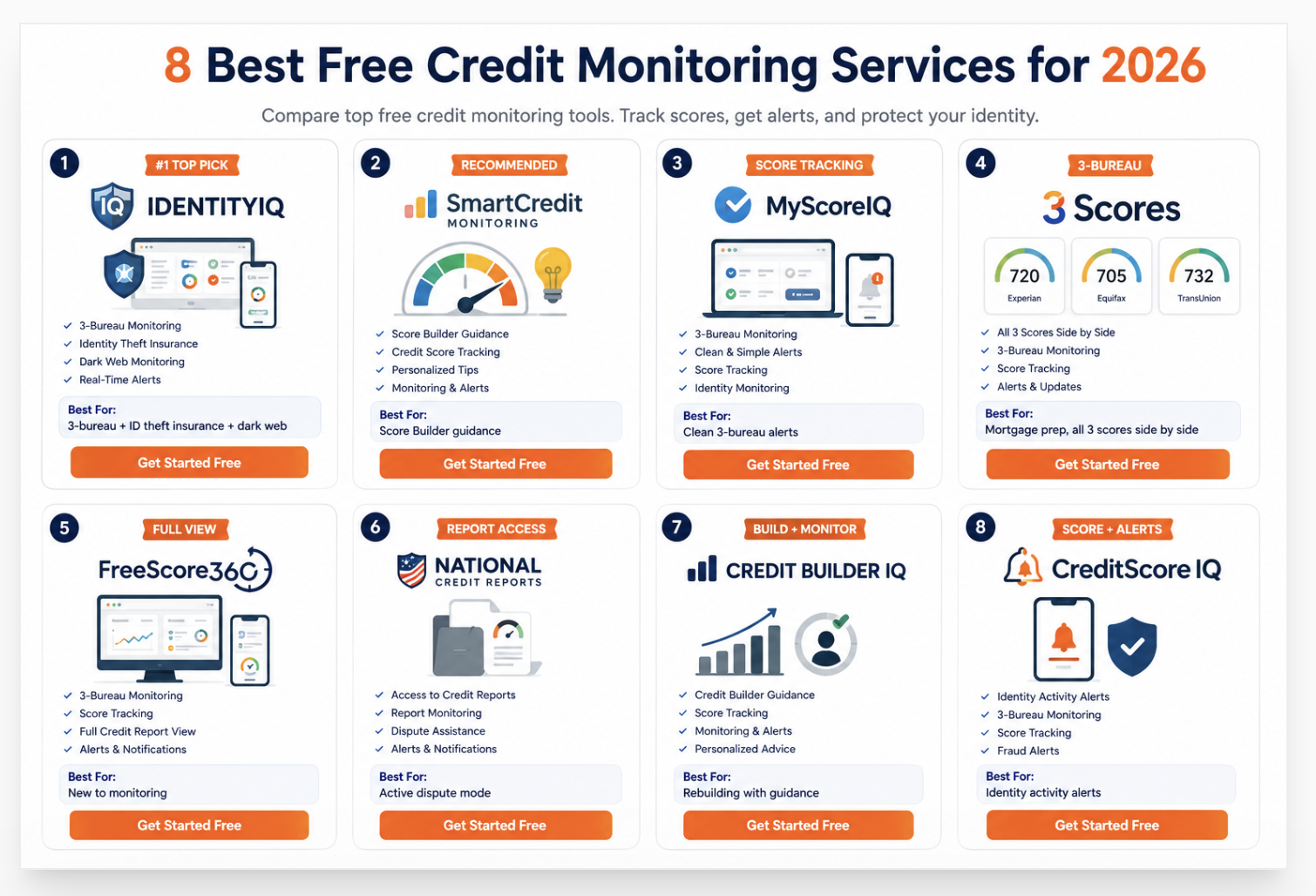
These are the credit monitoring services we recommend at ASAP Credit Repair. Each one covers different needs. Read the descriptions to match the right service to your situation.
🔍 Recommended Credit Monitoring ServicesWhich Free Sites Update Daily
Daily score updates matter most when you are actively rebuilding credit, paid down a balance and are waiting to see the score impact, or are approaching a loan application and watching score movement in real time. Services like IdentityIQ, Smart Credit, and 3 Scores update more frequently than most free consumer apps. Weekly or monthly updates are fine for passive monitoring but miss the day-to-day changes that matter during an active rebuild.
Update frequency is one of the most underrated factors when picking a monitoring service.
If you paid a credit card balance from 70% utilization to 8% before the statement closed, you want to see that improvement post to your score within days , not wait weeks to confirm the change registered. The same applies when you dispute a collection and it gets removed. Daily monitoring shows the improvement as soon as it posts.
| Platform | Score Type | Update Frequency | Bureau Coverage | Best Feature |
|---|---|---|---|---|
| IdentityIQ | FICO | Frequent | All 3 bureaus | ID theft insurance + dark web scanning |
| Smart Credit | 3-Bureau | Frequent | All 3 bureaus | Score Builder guidance |
| 3 Scores | All 3 Bureaus | Regular | All 3 bureaus | Side-by-side bureau comparison |
| FreeScore 360 | 3-Bureau | Regular | All 3 bureaus | 360-degree credit overview |
| Credit Builder IQ | 3-Bureau | Regular | All 3 bureaus | Monitoring + improvement guidance |
| CreditScoreIQ | Score + Alerts | Regular | Monitored | Identity activity alerts |
| Experian (free) | FICO Score 8 | Daily | Experian only | Real FICO access |
| Credit Karma (free) | VantageScore 3.0 | Daily | TransUnion + Equifax | Strong alert system |
FICO Score vs VantageScore , What Free Sites Actually Show
Most free credit monitoring apps show VantageScore, not the FICO models lenders pull. Approximately 90% of top lenders use FICO. Both use the 300-850 scale and similar factors, but the algorithms differ. Your VantageScore and FICO Score may be 10-50 points apart. This matters most when applying for a mortgage or auto loan. The score a lender pulls may be meaningfully different from the score your monitoring app shows.
This is the most common source of confusion in credit monitoring.
A borrower checks their score on a free app. It shows 712. They apply for a mortgage. The lender pulls 689. They cannot understand the discrepancy. The answer is almost always the score model difference , VantageScore on the app, FICO 5 (Equifax) on the mortgage pull.
Here is what the two models measure differently.
- Trended data. VantageScore 4.0 uses trended data , how your balances moved over time. FICO 8 does not. This can produce different scores even from the same credit report snapshot.
- Medical debt. VantageScore 4.0 ignores paid medical collections entirely. FICO 8 still factors in all collection accounts. Borrowers with paid medical collections may score higher on VantageScore.
- Thin file handling. VantageScore can score borrowers with as little as one month of credit history. FICO requires at least six months. A thin file may have a VantageScore but no FICO score at all.
- Collection thresholds. FICO 9 and VantageScore both ignore paid collections. FICO 8 does not. If you paid an old collection, your FICO 9 and VantageScore may be significantly higher than your FICO 8.
The practical takeaway: use your monitoring app score to track direction and pace of improvement. Use a FICO-specific tool , or request your actual FICO score through your bank or card issuer , before any major loan application. Do not use a VantageScore app score to predict what a mortgage lender will see.
Free Credit Monitoring vs Paid Monitoring
Free monitoring covers score tracking and basic alerts. Paid monitoring adds identity theft insurance, dark web surveillance, Social Security number monitoring, three-bureau report access, and dedicated fraud resolution support. For most borrowers, the free or trial-based services on this page cover the essentials. Paid services are worth it when identity theft is a real risk , previous theft, high-profile data breaches, or sensitive professional situations.
| Feature | Free Monitoring | Paid Monitoring |
|---|---|---|
| Credit score tracking | Yes | Yes |
| New account alerts | Yes | Yes |
| Hard inquiry alerts | Yes | Yes |
| 3-bureau monitoring | Varies by service | Usually yes |
| Dark web scanning | Limited or no | Yes |
| Identity theft insurance | No | Yes , up to $1M+ some plans |
| SSN monitoring | No | Yes |
| Fraud resolution assistance | No | Yes , dedicated team |
| Monthly cost | $0 or trial period | $10-$30+ per month |
As NerdWallet's 2026 identity theft protection comparison explains, identity theft protection services can be worth the cost in the right situation , but freezing your credit and using free monitoring handles most of the risk for most consumers without a monthly fee.
What Credit Monitoring Features Matter Most
Not every feature in a credit monitoring tool is equally useful. These are the ones that actually change outcomes.
Real-time fraud alerts
The most valuable feature in any monitoring service. A real-time alert for a new hard inquiry or new account gives you the chance to catch unauthorized activity within hours rather than months. Contact the lender immediately if you see an inquiry or new account you did not initiate.
Three-bureau coverage
Mortgage lenders pull all three bureaus. If you monitor only one, you miss what the other two report. A collection account on Experian but not TransUnion or Equifax still affects your mortgage rate if the lender uses Experian. Three-bureau monitoring is not optional for anyone preparing for a major loan.
Collection entry alerts
New collection accounts post quickly and drop scores immediately. An alert the day a collection posts gives you 30 days to send a debt validation letter to the collector , the window where you have the strongest FDCPA rights. Missing that window limits your options significantly. Real-time collection alerts let you respond before the account ages.
Address and public record monitoring
Identity thieves often change the address on a credit account before opening new fraudulent accounts. An address change alert on an account you did not update is one of the earliest signals of account takeover. Public record alerts for judgments and liens provide similar early warning before these entries affect the score.
Score trend tracking over time
A single score number tells you where you are. A trend chart showing the score over 12-24 months tells you whether you are moving in the right direction and how fast. Trend tracking helps you measure the impact of specific actions , a balance paydown, a dispute win, a new account , against the score timeline.
Understanding what a credit score estimator reveals about your current profile factors pairs well with monitoring , the estimator shows why your score sits where it is, and the monitoring tool tracks whether it is moving.
Best Free Sites for Identity Theft Alerts
For identity theft specifically, IdentityIQ is the top pick on this list because it combines credit monitoring with dark web surveillance and identity theft insurance. Credit monitoring alone catches unauthorized credit accounts. Dark web monitoring catches when your personal data appears for sale before a fraudster uses it. For maximum identity protection, you want both layers running simultaneously.
Identity theft and credit monitoring are related but not the same problem.
Credit monitoring catches what already appeared on your credit file. A new account opened fraudulently. An inquiry you did not authorize. A collection from an account you did not know existed.
Identity monitoring catches the data before it reaches your credit file. Your Social Security number appearing on a dark web marketplace. A data breach exposing your personal information. Your email and password combinations sold in a criminal forum.
The gap between data exposure and credit damage can be months. Dark web monitoring closes that gap by alerting you to a breach before the fraudster acts on the stolen data.
Do Free Monitoring Sites Hurt Your Credit
No. Checking your own credit through a monitoring service generates a soft inquiry. Soft inquiries never affect the credit score and never appear on the report that lenders see. Only hard inquiries from formal credit applications cost points. You can check your credit score through monitoring tools every day without any scoring impact.
This is one of the most persistent credit myths.
The FCRA distinguishes between hard inquiries (from lender applications, which affect scores) and soft inquiries (from consumers checking their own credit, background checks, and pre-approval offers). Soft inquiries appear on a version of the report you can see but not on the version lenders pull.
No matter how often you log into a monitoring dashboard, view your score, or pull your report, none of those actions create a hard inquiry. Sign up for monitoring, check your score daily, review your reports monthly. Your score is unaffected.
Are Free Credit Monitoring Sites Safe
Reputable credit monitoring services are safe. They use encryption, comply with federal data protection laws, and are authorized by the credit bureaus to access your data. The risk is not in the established services , it is in phishing sites that impersonate monitoring tools or send fraudulent "free credit check" emails. Use direct URLs, never click credit monitoring links from unsolicited emails, and confirm any service is registered before entering personal information.
Legitimate credit monitoring services require your Social Security number because that is how they pull your credit file. This creates an obvious target for fraud.
A few safety checks before using any monitoring service:
- Use direct URLs, not email links. Phishing sites mimic monitoring platforms. Type the URL directly or use the official app store download, not a link in an email you did not request.
- Look for HTTPS and a clear privacy policy. Any site that collects your SSN must have encryption and a published data use policy. No policy visible is a red flag.
- Check the Better Business Bureau profile. Established monitoring services have verifiable business histories. New or unverifiable services with no track record deserve extra scrutiny.
- Read the terms before entering billing information. Many monitoring services use a trial model that transitions to a paid subscription. Know the cancellation terms before you enter a card number.
As the CFPB's credit reports and scores resource center explains, you have the right to review your credit information and dispute inaccuracies at no cost. Legitimate monitoring tools complement these rights , they do not replace or override them.
How Often Should You Check Your Credit
At minimum, check your full credit report quarterly and your score monthly. During active rebuilding, check your score weekly or more often. Before any major application , mortgage, auto loan, apartment rental , check all three bureau reports to catch any errors, inaccurate collections, or outdated entries that could hurt the application outcome. A monitoring service automates most of this by alerting you when something changes rather than requiring manual checks.
The right frequency depends on what you are trying to accomplish.
Passive monitoring (score is stable, no active rebuilding). Monthly score check and quarterly full report review. Turn on alerts for new accounts and inquiries so you catch fraud without needing to actively check every week.
Active rebuilding (working to improve score). Weekly score checks to track the impact of specific actions. Monitor around statement close dates to see if utilization changes are registering. Pull a full report whenever you win a dispute to confirm the inaccurate entry was actually removed.
Pre-application window (30-90 days before a major loan). Review all three bureau reports for inaccuracies. Check each bureau's score separately. Identify and dispute any errors immediately , you need 30-45 days for a dispute to complete before the lender pulls your file.
Knowing what each credit score range means for your loan access and rates helps you set a realistic monitoring target. Tracking the score with monitoring tells you if you are moving toward that target at the pace you expect.
What is the best free credit monitoring site?
For three-bureau monitoring with identity theft protection, IdentityIQ is the top pick. For score improvement guidance alongside monitoring, Smart Credit's Score Builder feature is strongest. For borrowers who specifically need all three bureau scores side by side for mortgage preparation, 3 Scores delivers exactly that. For people actively rebuilding who want monitoring and credit guidance in one tool, Credit Builder IQ combines both. The best option depends on what problem you are solving , tracking scores, catching fraud, or improving a specific factor.
Are free credit monitoring sites accurate?
The underlying credit data is accurate , it comes directly from the credit bureaus. The score shown may differ from what a lender sees because most free apps use VantageScore while most lenders use FICO models. Both scores use the same credit data but different algorithms, producing scores that can differ by 10-50 points. Use monitoring app scores to track direction and improvement pace. Use a FICO-specific tool or your card issuer's free FICO Score access when preparing for an actual loan application.
Does Credit Karma hurt your credit?
No. Credit Karma and all other credit monitoring services use soft inquiries when pulling your credit data. Soft inquiries do not affect the credit score and do not appear on the report that lenders see. Checking your own credit through any monitoring service, as often as you want, carries zero scoring impact. The confusion comes from conflating soft inquiries (harmless, from monitoring) with hard inquiries (cost 5-10 points, from credit applications).
Which apps show real FICO scores for free?
Experian's free tier provides FICO Score 8 based on Experian credit data. Many major credit card issuers provide free FICO Score access through their apps , including Discover, Capital One, Chase, Citibank, and American Express. The card issuer's FICO score is typically the same model used for credit card underwriting decisions. For mortgage-specific FICO scores (FICO Score 2, 4, and 5), myFICO.com offers paid access to the specific models mortgage lenders pull.
Can credit monitoring improve your score?
Not directly. Monitoring shows you the score but does not change it. What monitoring enables is faster response to events that affect the score , catching a fraudulent account before it ages, identifying a collection the day it posts so you can dispute it within the FDCPA window, or seeing a utilization spike when a balance reports high. The monitoring itself does nothing. But the faster response to information that monitoring provides can prevent score damage from compounding and accelerate recovery from derogatory events.
Monitoring Your Score Is Step One. Fixing the File Is Step Two.
Monitoring shows you what changed. A 3-bureau audit shows you what is actually in your file , inaccurate entries, wrong dates, outdated collections, and items that should not be there. A free audit shows exactly what each bureau currently reports so you know what to dispute before it suppresses your score any further.
Get My Free 3-Bureau Audit → Secure · 2 minutes · No credit card required-
Credit Score Estimator , Get Your Estimated Range Before setting up monitoring, understand where your score likely sits and which of the five FICO factors is holding it back the most. This tool asks five questions about your payment history, utilization, account age, credit mix, and recent applications , and returns an estimated score range with a breakdown of which factor needs the most attention first.
-
Credit Score Ranges , What Is Good and What Each Tier Gets You Credit monitoring tells you your score. This covers what each score range actually opens in the real world , which mortgage programs, auto loan rates, and credit cards become accessible at 580, 620, 670, 700, 720, and 740. Knowing the target makes monitoring data actionable rather than just informational.
-
Good Credit Building Credit Cards That Can Help Raise Your Score Monitoring shows the score. These credit building accounts move it. This covers the specific installment and revolving products that report to all three bureaus and how to use them correctly , including the statement close date strategy that most people miss , to build the payment history and utilization record that monitoring tools will start tracking upward within 90 days.