

A good length of credit history starts at 7 years, but most top-tier lenders and credit scoring models reward borrowers most between 7 and 10 years. FICO marks more than 7 years as "good," while VantageScore sets "excellent" at over 9 years. Both scoring models agree: the longer, the better.
Running a credit repair company, I see this pattern repeat every week. One of the most unforgettable cases we handled was a client with a 740 credit score who kept getting rejected for prime mortgage rates. His score looked strong on paper. But his average account age sat at just 3.2 years. Lenders saw a short credit file and priced in the risk.
A 2024 Reddit thread in r/personalfinance sparked a real debate on this exact issue. Dozens of users reported having "good" scores in the 700s but still facing loan penalties. The common thread? Short credit histories, most under 5 years. One user with an 818 FICO score shared that his average account age was 6 years and 4 months and that his oldest account was just 23 years old. Meanwhile, LendingTree analyzed 100,000 users with 800+ scores and found their oldest active accounts averaged nearly 22 years old.

Length of Credit History Definition: What It Actually Measures
Length of credit history is not just one number. FICO breaks it into three parts:
Age of your oldest account
Age of your newest account
Average age of all open accounts
All three numbers appear on your credit report. FICO uses them together to build a picture of your credit experience over time. The goal is simple: predict whether you will make a severe late payment (90 days or more) in the next 24 months. A longer track record of on-time payments gives scoring models more data and more confidence.
Length of credit history makes up 15% of your FICO score. VantageScore bundles it with credit mix under "depth of credit," which accounts for about 20% of your score. Either way, this factor carries real weight. If your credit score is 700, 15% of that total equals over 100 points.
How to Calculate Credit Age
Credit age calculation is straightforward. Add up the age (in months) of every open account on your credit report. Then divide by the total number of accounts.
Example:
You have three open accounts:
Credit card opened 5 years ago (60 months)
Auto loan opened 3 years ago (36 months)
Student loan opened 1 year ago (12 months)
Total: 108 months divided by 3 accounts = 36 months, or 3 years average age.
Opening a new account drops this average immediately. Closing an old account can actually keep or shorten your credit age (a closed account stays on your report for up to 10 years, but removing it later shrinks the average). Check your credit report for free at AnnualCreditReport.com to see the ages of all your accounts in one place.
What Counts as a Good Credit Score With a Short History?
You can have a good credit score even with a shorter credit history, but your score will face ceilings. According to FICO, you need at least 6 months of credit usage on one account before a FICO score is generated. VantageScore is faster; it can generate a score after just one month.
Here is what the data shows by credit history length:
Less than 2 years: Thin file. Most lenders treat this as "limited history." Approval odds drop for mortgages and premium cards.
2 to 5 years: Fair. Scores in the 680–720 range are achievable with good habits, but lenders often add risk premiums.
5 to 7 years: Good. Solid approval odds for auto loans and personal loans at competitive rates.
7 to 10 years: Very good. FICO sees this range as strong for most credit products.
10+ years: Excellent. Borrowers in this range qualify for the best rates across most lenders.
People with 800+ credit scores have the oldest accounts, averaging 22 to 30 years, according to both LendingTree and FICO data. Their average account age sits around 11 years.
Credit Score Average by Age: What the Numbers Show
Age and credit score correlate directly, but not because your birthday matters. Older people have simply had more time to build credit history.
Here is the breakdown from Experian's 2025 FICO data:
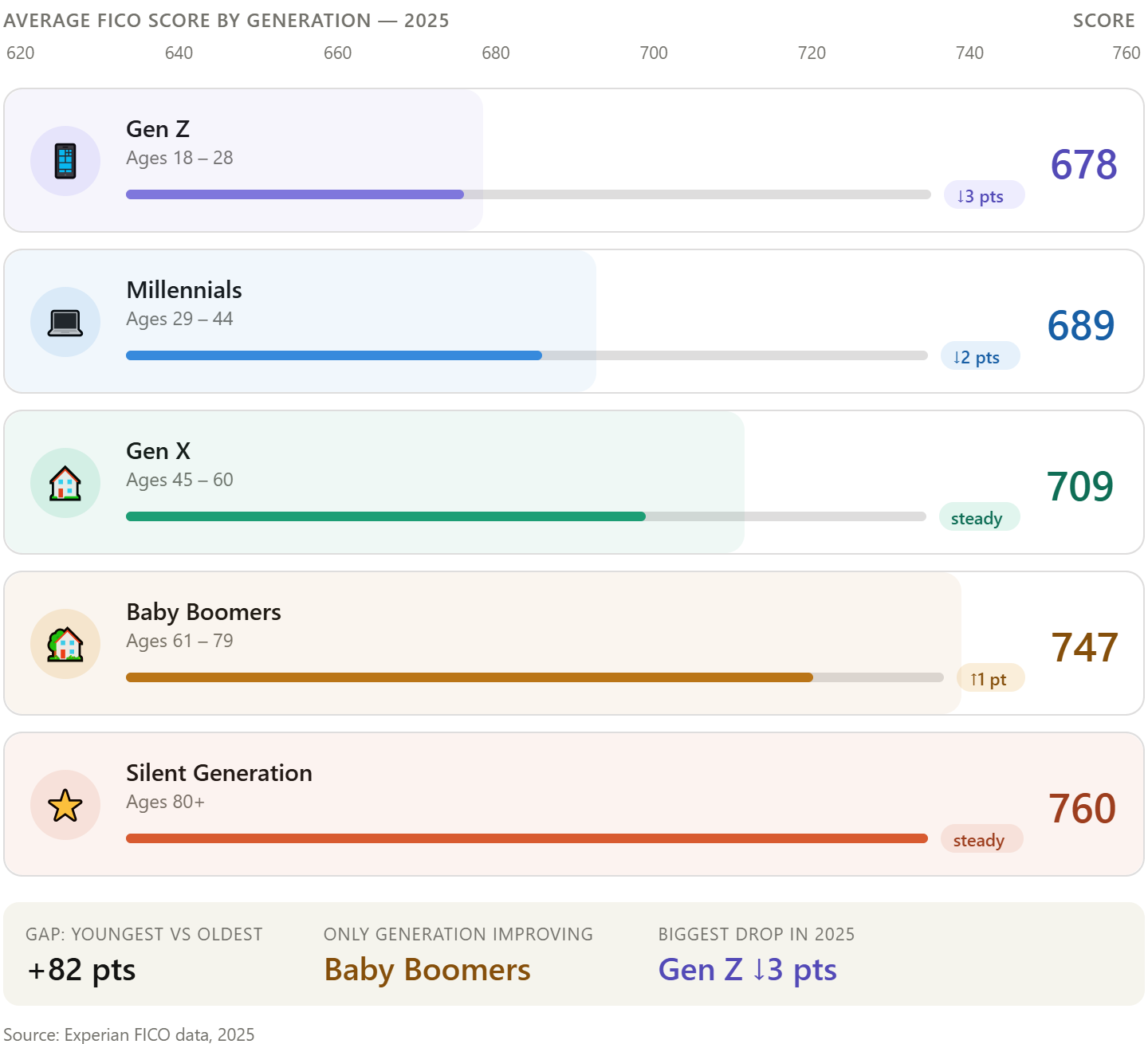
The average U.S. FICO score dropped to 713 in 2025, down two points from 2024, the first annual decline since 2013. Student loan delinquency reporting restarted after a federal pause, which pulled down Gen Z scores the most (down 3 points to 678).
The gap between Gen Z and Baby Boomers is 69 points. A large part of that gap comes from credit history length alone. A 25-year-old cannot have 20 years of history, no matter how responsibly they manage credit. Time is the only fix.
Good Credit Score But Short History: Why the Gap Exists
Many people carry a 720+ score but still get turned down for top-tier products. A short credit history is the most common cause. Here is why this happens:
Payment history (35%) and credit utilization (30%) together make up 65% of a FICO score. A borrower can score well on both and still cap out because the length of credit history (15%) and credit mix (10%) hold them back. Last year alone, our office handled over 40 cases where clients had strong scores but thin files, and every single one of them had an average credit age under 4 years.
The fix is not to game the system. The fix is time and strategic account management. Keep old accounts open. Do not close your first credit card just because you do not use it. That old account is doing real work for your score.
Insufficient Length of Credit History: What Happens on Applications
"Insufficient length of credit history" is an actual denial reason lenders list under the Fair Credit Reporting Act. Lenders can use it to decline credit or offer worse terms. A mortgage underwriter, for example, often requires a minimum of 2 years of credit history, and many prefer 4 or more years. Premium credit cards from issuers like Chase or American Express set informal requirements around average account age as well.
When a lender reports insufficient history, your credit report carries what is called a "thin file" flag. This limits your ability to get approved for mortgages, auto loans, and even some apartment rentals.
The fastest legal way to build history faster is to become an authorized user on a family member's long-standing account. When added, you inherit that account's full age. A card open for 15 years adds 15 years of history to your profile, immediately raising your average account age in one step.
How Long Does It Take to Have the Highest Credit History Score?
A perfect 850 FICO score takes decades. FICO data shows the average oldest account for 850-score holders is 30 years old. But you do not need a 30-year file to access the best rates.
Here is what matters by milestone:

The key number for most borrowers is 7 years. Hit that mark with clean payment history and low credit utilization, and you qualify for most financial products at good rates. Beyond that, every added year strengthens your score further slowly, but steadily.
Length of Credit History Calculator: How to Estimate Your Credit Age
No single public calculator from FICO or Experian gives a real-time credit age estimate, but you can calculate it yourself in three steps:
Pull your free credit report from AnnualCreditReport.com.
List every open account and the date it was opened.
Calculate the number of months each account has been open. Add those numbers. Divide by the total number of open accounts.
The result is your average credit age. For your overall credit history length, look at the date your oldest account opened. That single date defines the outer edge of your credit timeline.
Some credit monitoring tools like myFICO, Credit Karma, and Experian's app display your average account age automatically. These tools update in real time, so you can see exactly how a new account drops your average before you apply.
Ready to Build Stronger Credit?
Your credit history grows with time, but the right strategy can help you move faster.
If your credit score looks good but lenders still say your file is too thin, ASAP Credit Repair can help you review what is holding you back and build a smarter plan.
Get Your Free Credit Report ReviewNo pressure. Just a clear look at your credit report, account age, and next best steps.
What You Can Do Right Now
Length of credit history rewards patience more than any other credit factor. But three actions move the needle faster than waiting alone:
Keep your oldest accounts open. Even cards you do not use protect your credit age.
Ask to be added as an authorized user. Inherit an older account's age without opening a new credit.
Avoid opening multiple new accounts at once. Each new account drops your average age and adds a hard inquiry.
Your credit history cannot grow overnight. But it grows every single month you hold accounts in good standing, and that consistency is exactly what lenders reward most.