

If you’ve just been served a lawsuit by Grant and Weber, time is not on your side. Ignoring it can lead to serious consequences. This includes a default judgment and long-term damage to your credit. But if you take the right steps now, you may be able to fight the case, settle the debt, and even remove the account from your credit report.
Here’s exactly what to do.
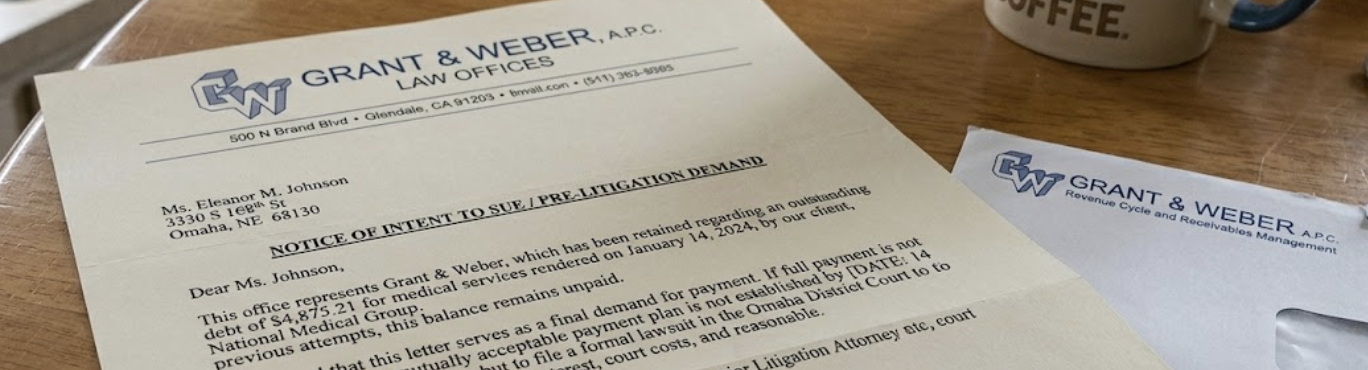
Grant and Weber · Debt Lawsuit · San Antonio TX · Bexar County
Getting served with a lawsuit from Grant and Weber in San Antonio can feel like the floor dropping out from under you. This guide walks you through exactly what happens next, what Texas law says, and how to protect yourself before the clock runs out.
Updated March 2026 · 9 min read · Sources: Texas Appleseed, SoloSuit, Bexar County Courts, FDCPA
Facing a Grant and Weber Lawsuit in San Antonio? File a written Answer with the Bexar County Justice of the Peace court listed on your citation before the 14-day deadline. Do not ignore the papers. Request that Grant and Weber prove they own the debt. If the debt is older than 4 years, raise the Texas statute of limitations as a defense. Filing your Answer does not mean you are admitting anything. It means you are showing up. And showing up changes everything.
The summons arrived on a Wednesday. A San Antonio client called our office the following Monday, which left him eight days to respond. He had been served at his door by a Bexar County constable. The citation named Grant and Weber as the plaintiff and listed a $1,240 medical balance from a hospital visit three years earlier. He had never received a single letter from them before the lawsuit arrived.
He wanted to know if he could just ignore it and see what happened. We told him the truth: in Texas, ignoring a debt lawsuit is one of the most expensive decisions a person can make. If you do not file an Answer, the court enters a default judgment. Grant and Weber becomes a judgment creditor. And as a judgment creditor in Texas, they can freeze your checking account the same day your direct deposit lands.
He filed his Answer. We worked with him on the credit report side separately. The balance was settled for less than half the original amount with a pay-for-delete agreement. The collection never appeared permanently on his report. That outcome was only possible because he responded in time.
This guide covers everything San Antonio residents need to know when Grant and Weber files against them: the Texas-specific rules, the deadlines, your defenses, and the step-by-step plan to protect yourself and your credit.
Who Is Grant and Weber and Why Are They Suing?
Grant and Weber is a debt collection agency based in Calabasas, California, in business since 1977. They specialize in healthcare and medical debt and have an in-house legal team along with a nationwide network of attorneys. They sue when collection calls and letters fail to produce payment, particularly on balances large enough to justify legal costs. In San Antonio, their cases are typically filed in Bexar County Justice of the Peace courts.
If you are just seeing Grant and Weber for the first time and a lawsuit has not yet been filed, start with this guide on how to remove Grant and Weber from your credit report before the situation escalates to legal action. Validation letters and FCRA disputes are significantly more effective before a suit is filed than after.
Grant and Weber is not a passive collector. Their own website states they have in-house legal counsel and a nationwide attorney network specifically to pursue collections through formal legal channels. They have been party to over 130 federal court cases. When they file in San Antonio, they come prepared.
Why You Are Being Sued by Grant and Weber
Grant and Weber typically sues San Antonio residents for one of three reasons: the debt has been unpaid long enough that phone and letter collection have failed, the balance is large enough to make litigation cost-effective, or they purchased a charged-off account from an original creditor and are now using legal action as their collection tool. In all three cases, the lawsuit is not necessarily confirmation the debt is valid. It is a legal claim that requires a response.
The three most common reasons Grant and Weber files a debt lawsuit in San Antonio:
- Unpaid debt over 90 to 180 days. Once an account goes delinquent long enough, the original creditor writes it off and either retains a collector or sells the debt outright. Grant and Weber pursues legal action when standard collection has not produced payment.
- Purchased charged-off accounts. Grant and Weber buys debt portfolios from original creditors. As the legal owner of the debt, they have the same right to sue as the original creditor. The balance may have changed, the records may be incomplete, and the original agreement may not even name Grant and Weber anywhere.
- Balance justifies litigation costs. Suing costs money. Grant and Weber is more likely to file on accounts over $500 and considerably more aggressive on accounts over $1,000. Smaller balances are still sued but less commonly.
What Happens When You Get a Lawsuit in Texas
In Texas, a debt lawsuit arrives as a "citation" attached to a "petition." The citation tells you the court, the case number, the plaintiff, and your response deadline. In Justice of the Peace courts, that deadline is 14 days from the date of service. If you do not file a written Answer by that date, the court may grant a default judgment against you at the first hearing without you present.
Step-by-Step: What To Do Immediately After Being Served
The Lawsuit and the Credit Report Are Two Different Problems. Start on Both Now.
While you handle the court response, your credit report needs attention too. Errors in Grant and Weber's credit bureau entry are disputable whether or not a lawsuit is pending. A free 3-bureau audit tells you exactly what their entry says and whether it is accurate before you agree to any settlement amount.
Can Grant and Weber Garnish My Wages in Texas?
No. The Texas Constitution prohibits wage garnishment for private consumer debts including credit card and medical debt. However, Grant and Weber can freeze your bank account after obtaining a court judgment through a writ of garnishment. Once your paycheck is deposited into your bank account, it loses its wage protection. This is why responding to a lawsuit before a judgment is entered is critical for San Antonio residents.
| Debt Type | Can Wages Be Garnished in Texas? | Can Bank Account Be Frozen? | Notes |
|---|---|---|---|
| Medical debt | No | Yes (after judgment) | Texas Constitution Art. XVI Sec. 28 |
| Credit card debt | No | Yes (after judgment) | Same constitutional protection applies |
| Child support | Yes | Yes | Court-ordered support is exempt from wage protection |
| Federal student loans | Yes | Yes | Federal law overrides state wage protection |
| Unpaid taxes (IRS) | Yes | Yes | Federal and state tax agencies have broader authority |
What Legal Defenses Can You Use Against Grant and Weber in San Antonio?
The most effective legal defenses against a Grant and Weber lawsuit in San Antonio are the Texas 4-year statute of limitations, failure to prove chain of ownership from the original creditor, an inaccurate or unsupported balance, a debt that was already paid, identity error, or FDCPA violations by Grant and Weber during the collection process. Any one of these raised in a written Answer forces Grant and Weber to produce documentation they may not have.
- Statute of limitations (most powerful). Texas gives creditors 4 years to sue on written contracts from the date of the last payment or account activity. If the last activity on your account was more than 4 years ago, the debt is time-barred. Grant and Weber cannot obtain a valid judgment on a time-barred debt in Texas courts. You must raise this in your Answer or it is waived.
- Lack of standing: no chain of ownership. If Grant and Weber purchased the debt, they must prove with documentation that the account was properly transferred from the original creditor to them. Purchased debt portfolios frequently have incomplete or missing chain-of-title paperwork. Requesting this documentation in discovery can result in the case being dismissed.
- Inaccurate balance. Grant and Weber must prove the amount they are suing for is accurate. If the balance includes fees or interest not authorized under the original agreement, or if insurance adjustments were not applied, the stated balance is incorrect and cannot support a judgment.
- FDCPA violations as counterclaims. If Grant and Weber used threatening language, refused to validate the debt after a written request, or continued collection after a cease-and-desist, those are FDCPA violations worth up to $1,000 in statutory damages each. Counterclaims can offset the balance or even exceed it, making settlement in your favor possible.
Can You Still Remove Grant and Weber After a Lawsuit?
Yes. Removing Grant and Weber from your credit report and resolving the lawsuit are two separate processes. Even after a lawsuit is filed, you can still file FCRA disputes for errors in the credit bureau entry, negotiate a pay-for-delete settlement as part of resolving the case, or have the entry removed if Grant and Weber cannot validate the underlying debt. The lawsuit ending does not automatically fix your credit report. You have to pursue that separately.
The best outcome combines both tracks at once: resolving the lawsuit through a negotiated settlement that includes a pay-for-delete agreement, while simultaneously disputing any errors in the credit entry through the FCRA process. Consumers who handle only the lawsuit and assume the credit damage disappears on its own often find the collection still sitting on their report years later.
For the complete breakdown of removing collections like Grant and Weber from all three credit bureaus, see our step-by-step removal guide with letter templates and dispute strategies.
How a Grant and Weber Lawsuit Affects Your Credit Score
The lawsuit itself does not appear on your credit report, but the Grant and Weber collection account that triggered it almost certainly already does. If Grant and Weber wins a judgment, that judgment may appear as a public record on your credit file, causing additional long-term damage. Resolving the case with a pay-for-delete agreement that covers the underlying collection account is the most credit-protective resolution available.
The four possible outcomes and what each means for your credit:
- Default judgment entered: Grant and Weber gains enforcement power over your bank account. The underlying collection stays on your report. The judgment may also appear. Your score does not recover without additional dispute work.
- Case dismissed: The lawsuit ends but the collection entry on your credit report stays in place unless you separately file FCRA disputes and achieve removal.
- Settlement without deletion: The case is resolved but the collection marks as "paid" on your report. Paid collections still suppress your score for up to 7 years under FICO 8.
- Settlement with pay-for-delete: You settle for an agreed amount with a written commitment from Grant and Weber to remove the tradeline from all three bureaus. This is the only outcome that both resolves the lawsuit and restores your credit simultaneously.
When to Get Help in San Antonio
Most people can file a basic Answer themselves using Texas Law Help (texaslawhelp.org) free templates. But there are situations where professional help, legal or credit repair, makes a significant difference.
Get a debt defense attorney if: the balance is over $2,000, you have identified FDCPA violations that could support counterclaims, you received the summons with fewer than 7 days remaining, or the case has already moved past the Answer stage. San Antonio has several debt defense attorneys who charge flat fees starting around $500 and some handle FDCPA cases on contingency.
Get credit repair help if: the Grant and Weber entry on your credit report contains errors, you have settled the lawsuit but the collection is still showing, or you have multiple negative accounts alongside this one that are compounding the damage.
At ASAP Credit Repair USA, we handle the credit side. We audit your 3-bureau report, identify the specific errors or grounds for removal in the Grant and Weber entry, and manage the dispute and pay-for-delete process from start to confirmed deletion. That runs parallel to whatever is happening in court and does not interfere with your legal defense.
The Court Case Ends. The Credit Damage Does Not. Let Us Handle That Part.
Most consumers who resolve a Grant and Weber lawsuit find the collection entry still on their report months later. We manage every step of the credit side so both problems get solved at the same time.
Full 3-bureau audit of every Grant and Weber entry and error
FCRA disputes filed simultaneously with all three bureaus
Pay-for-delete negotiation coordinated with your settlement
Bureau deletion confirmed and monitored across all three reports
Start with a free credit review. Most clients see the first confirmed bureau updates within 30 to 45 days.
Start My Free Credit Review → No obligation · Secure · San Antonio, TX residents welcomeFrequently Asked Questions
Can Grant and Weber sue me in San Antonio?
Yes. Grant and Weber has an in-house legal team and a nationwide attorney network. They file debt collection lawsuits in Bexar County Justice of the Peace courts and district courts. If you receive a citation and petition from Grant and Weber in San Antonio, you have 14 days to file a written Answer. Do not ignore the papers.
What happens if I ignore a Grant and Weber lawsuit in Texas?
The court enters a default judgment against you, typically at the first scheduled hearing. With a judgment, Grant and Weber can freeze your bank account through a writ of garnishment. You cannot be ordered to pay, but 100% of your bank account deposits can be seized. Texas wage garnishment protections do not apply once money is deposited into a bank account.
How long do I have to respond to a debt lawsuit in Texas?
In Texas Justice of the Peace courts, you have 14 days from the date of service. In district courts, you typically have until the first Monday after 20 days from service. Check the deadline on your specific citation. Missing it results in automatic loss by default regardless of whether the debt is valid.
Can Grant and Weber garnish my wages in Texas?
No. The Texas Constitution prohibits wage garnishment for private consumer debts including credit card and medical debt. However, after obtaining a court judgment, Grant and Weber can freeze your bank account. Once your wages are deposited, they lose their wage protection. This is why preventing a judgment from being entered is the most important step.
What is the statute of limitations on debt in Texas?
Texas has a 4-year statute of limitations on most consumer debts including medical and credit card balances. If the last payment or account activity was more than 4 years ago, the debt is time-barred and Grant and Weber cannot obtain a valid judgment in Texas court. You must raise this as a defense in your written Answer or it is considered waived.
Can I still remove Grant and Weber from my credit report after a lawsuit?
Yes. The lawsuit and the credit report entry are handled separately. You can file FCRA disputes for errors in the entry at any time during or after the lawsuit. Settling the case with a written pay-for-delete agreement removes both the legal claim and the credit bureau entry simultaneously. See our guide on dealing with Grant and Weber on your credit report for the full process.
Related Reads
- What to Do If You Have Been Sued by Debt Collectors — The broader playbook for responding to any debt collection lawsuit, with Texas-specific deadlines and Answer templates.
- Gurstel Law Firm: What to Do If They Sue You — Another aggressive debt collection law firm active in Texas. The same response framework applies to both.