

Credit score protection during the holidays starts with controlling how much debt you add, when your balances get reported, and whether every payment reaches your creditors on time.
The holiday season is coming up, and if you are already thinking about gifts, travel, family dinners, or year-end shopping, now is the right time to think about credit score protection too.
You do not need to stop using your credit cards or cut every holiday expense. You just need to know what can affect your score before the spending starts.
That matters because holiday purchases can pile up faster than you expect. You might put gifts on one card, book travel on another, and use Buy Now, Pay Later for a larger purchase. Each decision may seem manageable on its own. Together, they can leave you entering January with higher balances and several payments to track.
One number deserves particular attention: your credit utilization.
Your utilization shows how much of your available revolving credit you are using. If you have a $5,000 credit limit and your reported balance reaches $2,000, your utilization is 40%. Higher reported balances can affect your credit score even when you have not missed a payment.
This is why waiting until January to think about your credit can be a mistake.
Before holiday shopping gets busy, check your card balances, available credit, statement closing dates, and upcoming payment due dates. Decide how much you can realistically spend without carrying more debt than you can manage.
Think of credit score protection as part of your holiday budget. You are not only deciding what you can afford to buy today. You are deciding what you want your finances and credit profile to look like when the holidays are over.
Credit Score Protection During Holidays: Why Its Important
The holidays are coming up. Just a couple of months and that usually means more spending than normal. Gifts, travel, dinners, and last-minute purchases can quickly add to your credit card balances. If you are not watching those balances, holiday spending can raise your credit utilization and make January harder than it needs to be.
That is why credit score protection should be part of your holiday planning. Before you start shopping, know what you can afford, keep your payments on time, and pay attention to how much of your available credit you are using. A little planning now can help you enjoy the holidays without putting your credit score at unnecessary risk.
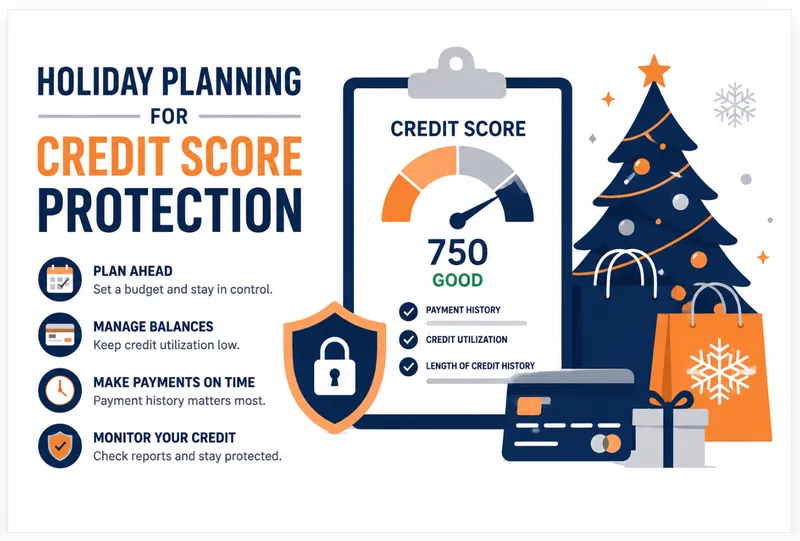
Credit score protection during the holidays is not about skipping the season, it is about knowing exactly where your spending crosses the line from festive to damaging. If your score is not where you want it for Christmas, that is okay, it is not too late to plan ahead. The average American who took on holiday debt in 2025 added $1,223 to their balances, up from $1,181 in 2024, and nearly half of holiday shoppers expected to carry some debt into the new year. You can protect the score you already have while making real progress on raising it, once you understand how holiday spending actually interacts with your credit report.
How Does Holiday Spending Affect Credit Score Protection?
Holiday spending mainly threatens credit score protection through credit utilization. New charges on existing cards raise your balance-to-limit ratio right before it gets reported to the bureaus, and utilization makes up roughly 30 percent of a FICO score. In 2025, 62 percent of holiday debt came from credit cards and 35 percent from buy now, pay later loans.
Your credit score does not know the difference between a holiday gift and any other purchase. It reacts to the balance sitting on your statement when your issuer reports to the bureaus, usually once a month. Charge $2,000 on a card with a $5,000 limit and utilization jumps to 40 percent, even if you plan to pay it off before the due date. The bureaus see the balance, not your intention.
Nearly half of 2025 holiday shoppers and travelers expected to go into debt from gifts, food, and travel combined, and 42 percent planned to spend over $1,000 on the season, according to a Harris Poll survey conducted for the American Institute of CPAs. And 10 percent of 2025 shoppers were still carrying credit card debt from multiple previous holiday seasons.
What Credit Utilization Ratio Protects Your Score During the Holidays?
Keep total credit utilization under 30 percent for basic safety and under 10 percent for the strongest protection, since utilization accounts for roughly 30 percent of a FICO score. Paying down balances before your statement closing date, not just the due date, is what actually lowers the number that gets reported.
| Utilization Range | Effect on Score | Holiday Risk Level |
|---|---|---|
| 0-9% | Strongest positive effect | Low risk, ideal target |
| 10-29% | Generally safe, minor drag | Moderate, common during shopping |
| 30-49% | Noticeable score decrease | High, common after big gift purchases |
| 50%+ | Significant score decrease | Very high, flags lenders as risk |
One tactic most people miss: your statement closing date, not your due date, is usually what gets reported to the bureaus. Pay off a balance by the due date and the bureaus may have already reported the higher, pre-payment amount. Making an extra payment a few days before your statement closes is one of the simplest ways to protect your score through a heavy spending month.
Is It Smart to Open a New Store Credit Card for Holiday Deals?
Generally no. A new store card adds a hard inquiry, lowers your average account age, and only saves you money on that one purchase. The short-term score dip from a new account plus inquiry often outweighs a one-time 10 to 20 percent discount.
Average account age and inquiry history stay untouched. The only thing that moves is utilization, which recovers once the balance is paid down.
Both factors can shave points off your score for months, right when lenders may be reviewing your file for other financing.
Store cards do have a place, particularly for someone building credit from scratch. But 32 percent of 2025 holiday debt came from store cards, which often carry higher interest rates than a general-purpose card, making that debt more expensive to unwind afterward.
How Can You Check Your Credit Score for Free Before the Holidays?
Equifax, Experian, and TransUnion permanently extended free weekly credit report access through AnnualCreditReport.com in September 2023, according to the Federal Trade Commission. That gives you more than 150 free credit report pulls a year, on top of the score tracking many card issuers already provide for free.
Do you know what your actual credit score is right now? If you have not checked in the last few months, the honest answer is probably no, and scores shift constantly. Before you build a holiday budget, pull a current report from all three bureaus at AnnualCreditReport.com and confirm there is nothing unexpected already dragging your score down.
What Should You Do If You Already Have Holiday Debt?
- ✓ Pull your report from all three bureaus and list every balance with its APR
- ✓ Pay the highest-APR card first while making minimums on the rest
- ✓ Make an extra payment before your statement closes to lower reported utilization
- ✓ Set a specific payoff date instead of a vague "pay it off eventually" plan
- ✓ Pause new credit applications until balances are back under 30% utilization
- ✓ Talk to a credit repair professional if collections or errors are also involved
Credit score protection is not about avoiding credit or skipping the holidays. It is about knowing your numbers, capping utilization before it gets reported, and not letting one season undo months of progress.
Holiday debt is common, with 47% of shoppers expecting to carry some into the new year and the average balance sitting at $1,223 in 2025. Most credit score damage comes from utilization spiking right before it gets reported, not from the spending itself. A budget, a check on your current score, and a plan for any balance you carry separate a temporary dip from a lasting setback.
How does holiday spending affect credit score protection?
Holiday spending mainly threatens credit score protection through credit utilization. New charges on existing cards raise your balance-to-limit ratio right before it gets reported to the bureaus, and utilization makes up roughly 30 percent of a FICO score. In 2025, 62 percent of holiday debt came from credit cards and 35 percent from buy now, pay later loans.
What credit utilization ratio protects your score during the holidays?
Keep total credit utilization under 30 percent for basic safety and under 10 percent for the strongest protection, since utilization accounts for roughly 30 percent of a FICO score. Paying down balances before your statement closing date, not just the due date, is what actually lowers the number that gets reported.
Is it smart to open a new store credit card for holiday deals?
Generally no. A new store card adds a hard inquiry, lowers your average account age, and only saves you money on that one purchase. The short-term score dip from a new account plus inquiry often outweighs a one-time 10 to 20 percent discount.
How can you check your credit score for free before the holidays?
Equifax, Experian, and TransUnion permanently extended free weekly credit report access through AnnualCreditReport.com in September 2023, according to the Federal Trade Commission. That gives you more than 150 free credit report pulls a year, on top of the score tracking many card issuers already provide for free.
What should you do if you already have holiday debt?
Pull your credit report, list every balance and its APR, and pay the highest-interest card first while making minimums on the rest. Nearly a third of 2024 holiday shoppers who used credit cards still had not paid off that balance heading into 2025, so building a specific payoff date matters more than a vague plan to pay it off eventually.
Want to Know Exactly Where Your Score Stands Before the Holidays?
Utilization, an old collection, or a reporting error could already be costing you points. A free 3-bureau audit shows exactly what all three bureaus currently report before your holiday spending begins.
Get My Free 3-Bureau Audit → Secure · 2 minutes · No credit card required-
Credit Utilization Traps: How Small Spending Spikes Can Crush Your Score Fast Breaks down exactly how a single concentrated purchase, like holiday gifts, can spike utilization and drag a score down fast.
-
Discretionary vs Non-Discretionary Spending: Protect Your Credit Score Covers the 50/30/20 budgeting approach that makes it easier to separate holiday "wants" from real financial obligations.
-
Does Requesting a Higher Credit Limit Hurt Your Score? Explains the short-term inquiry tradeoff against the long-term utilization benefit of a higher limit before a big spending season.