

A Houston resident who finds a credit card, loan, or collection account they never opened should not start by disputing random negative items. The first priority is identifying exactly which information resulted from identity theft and stopping additional accounts from being opened.
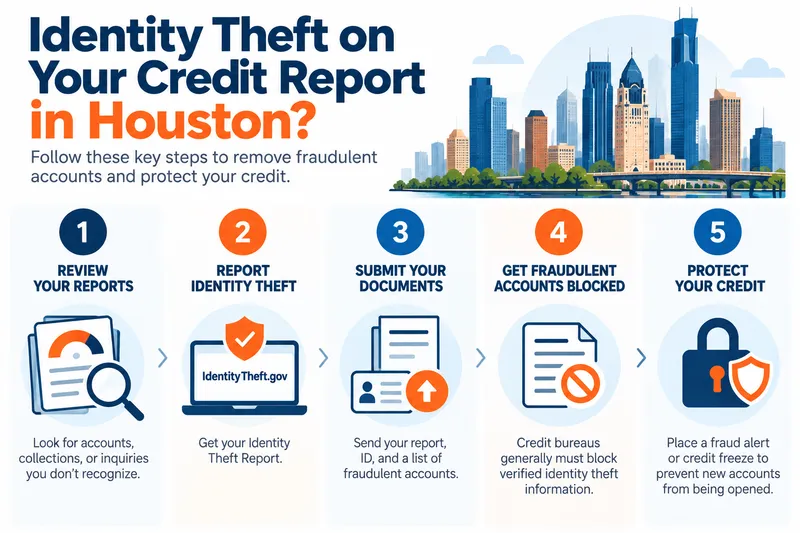
Federal law gives identity-theft victims protections that go beyond a standard credit-report dispute. After receiving an Identity Theft Report, proof of identity, and identification of the fraudulent information, a credit reporting company generally must block qualifying identity-theft information within four business days.
Texas consumers can also place a fraud alert or freeze their credit. The Texas Attorney General recommends contacting compromised financial institutions, reporting the theft, reviewing credit reports for accounts you did not open, and considering a security freeze to prevent additional unauthorized credit.
“When someone finds an account they never opened, the first question should be whether other information on the report came from the same identity theft,”
“You want to separate fraudulent information from legitimate negative accounts before deciding what needs to be challenged.”
So, if identity theft put accounts on your credit report in Houston, start with the accounts that are clearly not yours, document the fraud, and then trace any related collections, inquiries, or balances.
Identity Theft Put Accounts on My Credit Report in Houston: What Should I Dispute First?
Start with the accounts you know you did not open. Then review any collections tied to those accounts, unfamiliar hard inquiries, incorrect balances, and personal information you do not recognize. For confirmed identity theft, document the fraudulent items before requesting that the credit bureaus block or remove them.
Texas ranks 4th in the nation for identity theft reports, and Houston, as the state's largest metro, absorbs a meaningful share of that volume. When fraudulent accounts show up on a credit report, the instinct is to dispute everything at once. The data on how FCRA remedies actually work suggests a more efficient order. This analysis breaks down what to dispute first, why, and which legal mechanism moves fastest.
What Should You Dispute First?
Prioritize the highest-balance fraudulent account first, since it does the most damage to your credit utilization ratio, followed by any account already in collections, then hard inquiries tied to the fraud, and finally any incorrect personal information such as an unfamiliar address or employer. This order targets the items doing the most score damage before the items that are mainly cosmetic.
Not every fraudulent item on a credit report carries equal weight in a FICO or VantageScore calculation. Ranking disputes by scoring impact, rather than by the order items appear on the report, produces faster score recovery.
| Priority | Item Type | Why It Ranks Here |
|---|---|---|
| 1 | Highest-balance fraudulent account | Drives utilization ratio up, one of the two heaviest-weighted scoring factors |
| 2 | Fraudulent accounts already in collections | Collections carry independent negative weight beyond the balance itself |
| 3 | Hard inquiries tied to the fraud | Smaller scoring impact individually, but multiple inquiries compound |
| 4 | Incorrect personal information | Does not directly affect score, but must be corrected to prevent re-reporting |
Personal information ranks last for a specific reason. An unfamiliar address or employer name does not lower a score on its own, but leaving it uncorrected gives the fraudulent accounts a path to reappear if a bureau later re-verifies the data against outdated records.
How Common Is Identity Theft in Houston and Texas?
Texas ranks 4th in the nation for identity theft reports per capita, with 116,484 reports and a rate of 393 per 100,000 residents, according to the FTC's Consumer Sentinel Network Data Book. Houston, as the state's largest metro area, contributes a significant share of that volume, though the FTC does not break out a city-specific total in its public data book.
Credit card fraud accounts for the largest share of identity theft reports in Texas, ahead of other account types, which lines up with why disputing the highest-balance fraudulent credit account first produces the fastest measurable score recovery for most Houston cases.
What Is an FCRA Section 605B Block, and How Is It Different From a Normal Dispute?
A standard dispute under FCRA Section 611 gives a credit bureau up to 30 days to investigate. A Section 605B block, built specifically for identity theft, requires a bureau to block the fraudulent information within 4 business days of receiving an FTC identity theft report, proof of identity, and a written statement, making it significantly faster than a standard dispute.
| Factor | Standard Dispute (§611) | Identity Theft Block (§605B) |
|---|---|---|
| Response deadline | Up to 30 days | 4 business days |
| What the bureau does | Investigates and verifies with the furnisher | Blocks the information directly, no investigation required |
| Required documentation | Explanation of the error | FTC identity theft report, proof of identity, written statement |
| Best used for | Reporting mistakes, outdated info, clerical errors | Accounts confirmed to result from identity theft |
The FTC identity theft report at the center of a 605B block comes from IdentityTheft.gov and typically takes about 20 minutes to complete. That single report becomes the documentation basis for blocking fraudulent accounts across all three bureaus, notifying furnishers directly, and, if needed, extending the same block to specialty reporting agencies like ChexSystems.
Find Out Which Accounts on Your Report Are Actually Fraudulent
A free 3-bureau review shows every account currently reporting under your name, so you can confirm exactly what to include in an identity theft block before submitting anything.
Claim My Free Credit Analysis Now → Secure · 2 minutes · No credit card requiredDo You Need a Police Report in Texas?
Not necessarily for an FCRA 605B block, which primarily requires a report filed through IdentityTheft.gov rather than a local police report. The Texas Attorney General's office still recommends filing a police report as a documentation step, and some creditors or furnishers may separately request one before removing an account.
The Texas Attorney General's identity theft guidance recommends a broader sequence than the 605B process alone requires: contacting affected companies directly, placing a fraud alert with one bureau, filing a police report, then filing the FTC report through IdentityTheft.gov. A police report is not the legal trigger for a 605B block, but it strengthens a case if a furnisher pushes back or if the fraud needs to be reported for criminal investigation.
- ✓ File a report at IdentityTheft.gov to generate the FTC identity theft affidavit
- ✓ File a Houston-area police report for a documented paper trail, even though it is not always required for a 605B block
- ✓ Place a fraud alert or credit freeze with at least one of the three bureaus
- ✓ Submit the affidavit and ID proof to each bureau to trigger the 4-business-day block
- ✓ Send the same affidavit directly to furnishers, since they have independent obligations under FCRA §623
How Long Does the Full Process Take?
A Section 605B block can remove the fraudulent information from a credit report within 4 business days once a complete affidavit and identity proof are submitted. Getting individual furnishers, such as the original creditor or collections agency, to close their records can take longer, often another 30 to 45 days per follow-up round.
Once the affidavit and ID are complete, the credit report itself shows the block quickly.
The original creditor or collections agency closing its own internal record can lag behind the credit report block.
Disputing in the order items appear on a report is not the same as disputing in the order that helps a score fastest. The highest-balance fraudulent account and any related collections consistently move a score more than inquiries or personal information corrections, so they belong first in line.
Texas's above-average identity theft rate makes this a recurring issue for Houston credit files, and the fastest resolution path runs through FCRA Section 605B, not a standard 30-day dispute. Prioritizing the highest-balance fraudulent account, then collections, then inquiries, then personal information, produces the quickest measurable score recovery based on how each item type is weighted in a credit score calculation.
What should I dispute first if identity theft accounts appear on my credit report?
Prioritize the highest-balance fraudulent account first, since it does the most damage to your credit utilization ratio, followed by any account already in collections, then hard inquiries tied to the fraud, and finally any incorrect personal information such as an unfamiliar address or employer. This order targets the items doing the most score damage before the items that are mainly cosmetic.
How common is identity theft in Houston and Texas?
Texas ranks 4th in the nation for identity theft reports per capita, with 116,484 reports and a rate of 393 per 100,000 residents, according to the FTC's Consumer Sentinel Network Data Book. Houston, as the state's largest metro area, contributes a significant share of that volume, though the FTC does not break out a city-specific total in its public data book.
What is an FCRA Section 605B block and how is it different from a normal dispute?
A standard dispute under FCRA Section 611 gives a credit bureau up to 30 days to investigate. A Section 605B block, built specifically for identity theft, requires a bureau to block the fraudulent information within 4 business days of receiving an FTC identity theft report, proof of identity, and a written statement, making it significantly faster than a standard dispute.
Do I need a police report to dispute identity theft accounts in Texas?
Not necessarily for an FCRA 605B block, which primarily requires a report filed through IdentityTheft.gov rather than a local police report. The Texas Attorney General's office still recommends filing a police report as a documentation step, and some creditors or furnishers may separately request one before removing an account.
How long does it take to remove identity theft accounts from a credit report?
A Section 605B block can remove the fraudulent information from a credit report within 4 business days once a complete affidavit and identity proof are submitted. Getting individual furnishers, such as the original creditor or collections agency, to close their records can take longer, often another 30 to 45 days per follow-up round.
Let Us Prioritize the Dispute Order for You
A free 3-bureau audit identifies exactly which accounts are doing the most damage to your score, so the fraudulent items with the biggest impact get disputed first, not last.
Claim My Free Credit Analysis Now → Secure · 2 minutes · No credit card required-
How to Dispute Credit Report Errors (Step-by-Step Guide) A complete walkthrough of the standard FCRA dispute process, including bureau mailing addresses and letter templates.
-
How to Dispute Errors on Your Credit Report With a 609 Letter Explains how a Section 609 request forces a bureau to verify an account's documentation directly.
-
How to Eliminate Hard Inquiries From Your Credit Report Covers how to identify and dispute unauthorized hard inquiries tied to fraudulent applications.
-
Understanding the 30-45 Day Credit Repair Cycle Sets realistic expectations for how long standard bureau investigations take compared to faster identity theft remedies.
-
IdentityTheft.gov The official FTC portal for filing an identity theft report and generating a personalized recovery plan.
-
Texas Attorney General: What to Do If Your Identity Is Stolen State-specific guidance on reporting identity theft and protecting accounts in Texas.
-
FTC: Credit Freezes and Fraud Alerts Explains the difference between a credit freeze and the three types of fraud alerts available to identity theft victims.