

Is it worth paying a credit repair company? I'd honestly say this.
Sometimes, but not because a company has special authority to erase bad credit. You can dispute inaccurate information on your own for free, and accurate negative information generally cannot be removed simply because you pay someone to challenge it.
What you are paying for is the work around the dispute process: reviewing reports, identifying potential inaccuracies, organizing supporting documents, preparing disputes and tracking what happens next.
That distinction changes the value calculation.
Experian estimates that credit repair services commonly charge about $50 to $150 per month, with some companies charging additional fees depending on the service. A simple reporting error may not justify months of fees when you can dispute it yourself. A more complicated file involving several reports, furnishers, conflicting balances or previously unsuccessful disputes can require considerably more organization.
There are also limits no legitimate company can bypass. The CFPB states that accurate negative information generally cannot be removed from your credit report, while inaccurate information can be disputed at no cost.
At ASAP Credit Repair, working with hundreds of thousands of clients across U.S. has shown us that the better question is not simply whether credit repair costs money. It is whether the work required on your specific credit file justifies paying someone else to handle part of the process.
This guide breaks down that decision by cost, complexity, time commitment and expected value so you can decide when professional credit repair makes sense and when DIY is the better option.
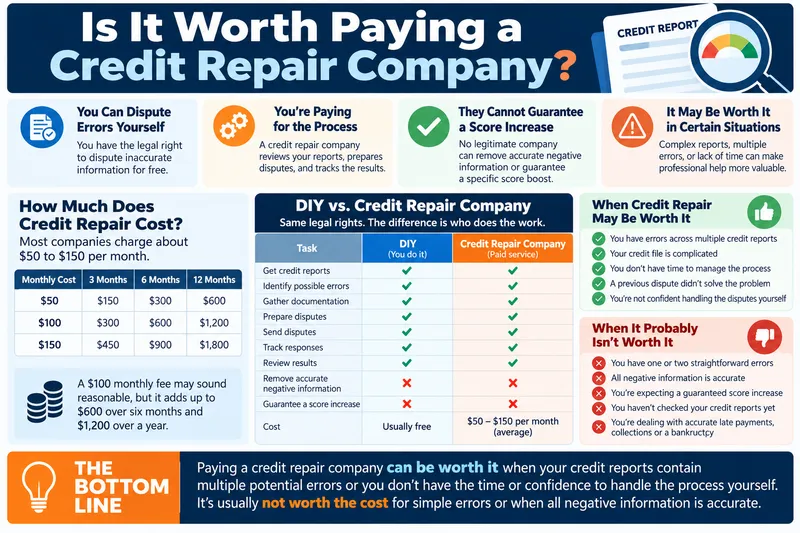
Is It Worth Paying a Credit Repair Company? A Cost-Benefit Analysis
Paying a credit repair company is worth considering if your credit reports contain several potential errors and you don't have the time or confidence to manage the dispute process yourself. It is rarely worth the cost for one or two straightforward errors, since you have the legal right to dispute inaccurate information yourself for free. No legitimate company can guarantee removal of accurate negative information.
The Credit Repair Value Equation
Most comparisons on this query stop at "you can dispute errors yourself for free, so probably not." That's legally correct and analytically incomplete. It skips the actual decision: when does paying for administrative work on your file produce more value than it costs?
(Time saved + organization + expertise applied to legitimate reporting issues)
− (Fees + work you could reasonably do yourself + risk of a low-quality provider)
Run your own file through that equation before you run it through a sales page. The rest of this guide tests it against real scenarios.
What Are You Actually Paying a Credit Repair Company to Do?
You are not buying any of the following, no matter what a contract implies:
- A guaranteed score increase
- A new credit identity
- Automatic deletion of negative accounts
- A loophole around the Fair Credit Reporting Act
- Special access to Experian, Equifax, or TransUnion
- The legal right to dispute information — you already have that right, for free
You are potentially paying for:
- Credit-report review
- Identification of potentially inaccurate information
- Dispute preparation
- Documentation organization
- Correspondence management
- Progress tracking
- Review of investigation results
- Follow-up on unresolved reporting issues
Every item in the second list is administrative work. None of it requires a license you don't have.
How Much Does Credit Repair Cost?
Credit repair services commonly charge $50 to $150 per month, plus a setup fee of $70 to $200 once your account is established. Monthly fees legally cannot be collected before services are performed — so the charge covers work already completed, not work promised.
| Monthly Fee | 3 Months | 6 Months | 12 Months |
|---|---|---|---|
| $50 | $150 | $300 | $600 |
| $100 | $300 | $600 | $1,200 |
| $150 | $450 | $900 | $1,800 |
A $100 monthly fee reads differently once it's $1,200 over a year. Price the decision at the total you'd pay, not the number on the landing page.
Credit Repair Company vs. DIY: What Does Your Money Buy?
| Task | DIY | Credit Repair Company |
|---|---|---|
| Pull credit reports | You do it | Reviews what you provide |
| Identify possible errors | You do it | Reviews reports for you |
| Gather evidence | You do it | You still supply most documents |
| Prepare disputes | You do it | Company prepares them |
| Send disputes | You do it | Company handles it |
| Track responses | You do it | Company handles it |
| Review results | You do it | Company reviews, follows up |
| Remove accurate negative info | Not possible | Not possible |
| Guarantee a score increase | Not possible | Not possible |
| Cost | Free | Service fee |
The legal rights are identical in both columns. The only variable is who performs the work.
Not Sure What's on Your Credit Report Right Now?
Before pricing out a service, see exactly what's reporting across all three bureaus — free. You can't run this analysis on a file you haven't looked at yet.
Get My Free Credit Analysis Now →When Paying a Credit Repair Company Can Be Worth It
1. Errors Span Multiple Credit Reports
Experian shows a wrong balance. Equifax shows an incorrect late payment. TransUnion shows a duplicate collection. That is not one dispute — it is three bureaus, potentially several furnishers, separate documentation, separate responses, and separate deadlines running at once. Common errors worth checking for include duplicate debts, incorrect balances, wrong credit limits, accounts that aren't yours, incorrect delinquency dates, and accounts incorrectly reported as late. That is where paying for organization starts to earn its fee.
2. You Don't Have Time to Manage the Process
→ prepare dispute → send dispute → track investigation → review result → contact furnisher → follow up
That chain is what you're outsourcing — not a vague promise of "saved time," but ten specific steps someone else now tracks against a federal deadline instead of you.
3. A Previous Dispute Didn't Resolve the Problem
A dispute that comes back "verified" doesn't automatically mean the information is correct. It also doesn't mean filing the identical, unsupported dispute again is productive. A credit reporting company can decline to investigate a dispute it reasonably determines is frivolous or irrelevant — including one that doesn't provide enough information to identify the problem. If a dispute result still seems wrong, you can add a statement to your file explaining your side, and you retain the right to pursue the matter further. That's where a professional second look at what evidence is missing has a real function.
4. Your Credit File Is Genuinely Complicated
"Complicated" is not a synonym for "bad credit." It means:
- Mixed-file information
- Multiple collections from different furnishers
- Duplicate accounts
- Conflicting balances between bureaus
- Incorrect delinquency dates
- Identity-related errors
- Reinsertion of information you already got corrected once
When Credit Repair Probably Isn't Worth Paying For
1. You Have One Obvious Error
One account with a wrong balance, backed by your own documentation, does not justify months of fees. The CFPB publishes free dispute guidance and sample letters for exactly this situation.
2. Everything Negative Is Accurate
If the negative information is accurate, belongs to you, is properly reported, and is within the legal reporting period, a credit repair company cannot make it disappear, however much you pay. In that case, money is better directed toward current obligations, lowering revolving debt, preventing new late payments, building positive history, or an emergency fund — not a dispute service with nothing to dispute.
3. You're Expecting a Guaranteed Score Increase
Not: credit repair company → changes score. A company edits report information where there's a legitimate basis to. The scoring model, not the company, decides what that does to your number. Any service promising "we'll raise your score 100 points" is making a claim it cannot deliver.
4. You Haven't Checked Your Credit Reports Yet
Don't buy a solution before you've identified the problem. Pull your reports first and find out what's on them.
The $600 Question: Would You Pay Someone to Handle This?
Take the midpoint: $100 a month for six months is $600. Run that figure against three real scenarios.
Case A: One Wrong Late Payment
- You have documentation
- You know which bureau reports it
- DIY difficulty: Low
- Professional value: Low
Case B: Errors Across 3 Reports
- Multiple accounts, two furnishers
- Conflicting balances
- Prior dispute unsuccessful
- Professional value: Higher
Case C: Everything Is Accurate
- Two genuine late payments
- High card balances
- One legitimate collection
- Dispute value: None — rebuild instead
Credit Repair ROI Is Not a Score Calculation
Don't do this math: $600 ÷ 80 points = $7.50 per point. Score outcomes aren't guaranteed, so that ratio is fiction dressed up as analysis. Define ROI correctly instead:
vs. total fees paid
That version is defensible. The point-per-dollar version is not.
How Long Does Credit Repair Take?
A credit reporting company must investigate a dispute within 30 days of receiving it, extending to 45 days in specific circumstances. Results must be communicated within five business days after the investigation closes. One dispute cycle is not the same as a complete credit repair — a complicated file runs review, dispute, investigation, result, and follow-up, sometimes across several rounds. That cycle is why monthly fees stack up on a complex file.
Can Credit Repair Companies Remove Accurate Negative Information?
No. Accurate negative information cannot be removed from a credit report simply because someone is paid to dispute it. Inaccurate information, and information resulting from identity theft, can be disputed — that's the entire scope of what any company is legally doing on your behalf.
What Credit Repair Companies Cannot Legally Promise
The Credit Repair Organizations Act prohibits untrue or misleading representations, bars companies from demanding advance payment, requires written contracts, and gives consumers specific cancellation rights. Be skeptical of any company that says:
- "We guarantee a 100-point increase."
- "We can delete anything."
- "Don't contact the credit bureaus yourself."
- "Dispute every account, even the ones that are yours."
- "Report a legitimate debt as identity theft."
- "Pay us upfront before we do any of the work."
Why This Matters More in 2026
In August 2026, the FTC obtained a court order freezing a credit-repair network accused of scamming consumers out of nearly $200 million. The complaint alleges the operation collected illegal advance fees, impersonated debt collectors and creditors, and filed false identity-theft reports on consumers' behalf without their knowledge — targeting vulnerable consumers, including military servicemembers, through paid search ads.
The lesson is not "credit repair companies are scams." It's this: evaluate the method a company uses, not just the result it promises. A legitimate company's process looks exactly like the checklist above — review, document, dispute, track. A scheme's process looks like advance fees and fabricated identity-theft claims.
7 Questions to Ask Before Paying a Credit Repair Company
- What exactly will you do for me?
- What will I pay in total if I'm enrolled for three, six, or twelve months?
- Which specific items on my reports do you believe are inaccurate, and why?
- What documents will you need from me?
- What happens if the bureau verifies the account as accurate?
- How do I cancel the service?
- Are you promising to delete information that is accurate?
Question three is the one that separates a real analysis from a sales pitch. A company that can name specific items and the reason they're disputable is doing the work. A company that answers "we dispute everything negative" is not.
Credit Repair vs. Credit Counseling: Don't Confuse Them
These solve different problems. Credit repair disputes information on your credit reports. Credit counseling covers budgeting and debt management more broadly. Debt settlement negotiates paying less than the full balance owed. Debt consolidation combines or refinances existing obligations into one. If your real problem is unmanageable debt rather than inaccurate reporting, a credit repair contract is the wrong tool — counseling is the right one.
DIY vs. Credit Repair Company: Decision Matrix
| Your Situation | DIY | Professional Help |
|---|---|---|
| One simple reporting error | Strong fit | Likely unnecessary |
| Clear supporting documents | Strong fit | Optional |
| Multiple errors across bureaus | Possible, but heavier | More useful |
| Several furnishers involved | More work | More useful |
| Previous dispute unresolved | Possible | Fresh review can help |
| Little time for correspondence | Difficult | More useful |
| All negative info is accurate | No dispute fixes this | No dispute fixes this |
| Want a guaranteed score increase | Not possible | Not possible |
| Real problem is debt, not reporting | Consider counseling | Credit repair is the wrong service |
When Professional Credit Repair Adds Value
The number of negative accounts on a report doesn't determine whether professional help is worth it. The amount of legitimate investigation and follow-up required does.
Nearly 20 years of credit repair work at ASAP Credit Repair has shown us the real difference between a simple error and a genuinely complicated reporting problem. One incorrect balance with clear documentation is usually straightforward enough to dispute independently. Several conflicting accounts spread across multiple credit reports require considerably more review, documentation, and follow-up — that's where the value of professional assistance should be measured.
A credit repair company doesn't gain special authority to delete accurate information. Its value is in identifying potentially inaccurate reporting, organizing the dispute process, and following through on results. If your reports are accurate and the real problem is high debt or a genuine history of late payments, paying someone to send disputes won't address the problem you need to solve.
Not Sure Whether Your Reports Need Professional Help?
Start by identifying the problem before paying for a solution. Review your credit reports for incorrect balances, accounts that don't belong to you, duplicate debts, and inaccurate payment histories. If your reports show several potential issues, or you've already tried and failed to resolve an error, ASAP Credit Repair can help you review the information and determine what warrants further action. If the information is accurate, the next step is rebuilding, not disputing.
Get My Free Credit Analysis Now →Frequently Asked Questions
Is it worth paying a credit repair company?
Paying a credit repair company is worth considering when your credit reports contain several potential errors across multiple bureaus and you don't have the time to manage the dispute process yourself. It is rarely worth the cost for one or two straightforward errors, since you have the legal right to dispute inaccurate information yourself for free. No legitimate company can guarantee removal of accurate negative information.
How much should I pay for credit repair?
Credit repair services typically charge $50 to $150 per month, with setup fees of $70 to $200. Over six months, that is $300 to $900 before any setup fee. Weigh that total against the complexity of your specific file before enrolling.
Is paying someone to fix your credit worth it?
It depends on what's wrong with your credit file. For one documented error, DIY disputing costs nothing and takes little time. For errors spread across multiple bureaus and furnishers, or a previously unresolved dispute, professional organization has more value.
Can I repair my credit myself for free?
Yes. The CFPB confirms you have the right to dispute inaccurate information on your credit reports directly with the credit bureau and the furnisher, at no cost.
What does a credit repair company do?
A legitimate credit repair company reviews your credit reports, identifies potentially inaccurate information, prepares and sends disputes, organizes documentation, tracks responses, and reviews investigation results. It does not have special authority to delete accurate information.
Can credit repair companies remove collections?
A credit repair company can dispute a collection that is inaccurate, unverifiable, or not yours. It cannot remove an accurate, properly reported collection simply because you paid for the service.
Can credit repair companies remove late payments?
An incorrect late payment can be disputed and corrected. An accurate late payment is not removable through a dispute, by a credit repair company or by you.
Can a credit repair company remove accurate information?
No. Accurate negative information cannot legally be removed from a credit report simply because a company is paid to challenge it.
How long does professional credit repair take?
One dispute cycle runs up to 30 or 45 days under federal investigation deadlines. A complicated file with multiple rounds of review, dispute, and follow-up can take several months, which is why monthly fees accumulate.
Can a credit repair company raise my score 100 points?
No company can guarantee a specific point increase. Credit repair changes report information where appropriate; a scoring model then evaluates that information. The company does not directly edit your score.
Is credit repair legal?
Yes, legitimate credit repair is legal and regulated under the Credit Repair Organizations Act, which bans advance fees, requires written contracts, and gives consumers cancellation rights. Illegal practices include advance fees, false identity-theft claims, and guarantees to remove accurate information.
How do I know if a credit repair company is legitimate?
A legitimate company gives you a written contract, never demands payment before performing services, never promises to remove accurate information, and never tells you to dispute accounts you know are yours or to file a false identity-theft report.
What is the difference between credit repair and credit counseling?
Credit repair focuses on disputing information on your credit reports. Credit counseling focuses on budgeting and debt management. Debt settlement negotiates paying less than owed. Debt consolidation combines or refinances existing debts. Each solves a different problem.
What are the disadvantages of credit repair?
You pay for work you could do yourself for free, fees accumulate monthly whether or not an investigation resolves in your favor, and no company can remove accurate negative information, no matter what it promises.
When should I hire a credit repair company?
Consider professional help when you have multiple potential errors across different bureaus or furnishers, a previous dispute that didn't resolve the issue, or genuinely no time to manage the correspondence and deadlines yourself.
Can I cancel a credit repair contract?
Yes. The Credit Repair Organizations Act gives consumers specific contract cancellation rights, and requires the contract to be in writing so those terms are documented.
Related Reads
- CFPB: What Do I Need to Know If I'm Thinking About Credit Repair?
- CFPB: What Can I Do if I Disagree With the Results of a Credit Report Dispute?
- CFPB: How Long Does It Take to Repair an Error on a Credit Report?
- FTC: The Credit Repair Organizations Act
- FTC (August 2026): FTC Stops Sprawling Credit Repair Scheme
- Experian: How Much Does Credit Repair Cost?