

Judgment Collection Specialists is a Texas company that performs asset searches and civil judgment recovery. If the company contacted you after a judgment, the important question is not only what information it may be able to find. It is what a judgment creditor can legally do with that information.
Those are two different things.
Judgment Collection Specialists says its asset searches can locate information involving bank accounts, real and personal property, current employment, brokerage and investment accounts, vehicle registrations, business affiliations, liens, judgments, bankruptcies and UCC filings. Finding an asset, however, does not automatically make that asset available to satisfy a judgment.
Texas provides significant protections for certain property. Current wages for personal services generally cannot be garnished for an ordinary consumer judgment, subject to exceptions established by state or federal law. Texas also exempts categories of personal property from seizure and provides a turnover procedure that applies to certain nonexempt property.
That means a Texas consumer facing judgment collection needs to answer three separate questions:
Is the judgment valid and still enforceable?
What assets or financial information is the creditor trying to locate?
And is the property they find legally subject to collection?
This guide explains who Judgment Collection Specialists is. How Texas judgment collection works, which property may be protected, and what to review before responding or paying.
Judgment Collection Specialists Contacted You in Texas: What Can They Find and Collect?
Judgment Collection Specialists says its asset searches can locate bank accounts, employment, real estate, vehicles, investments, business affiliations, liens, judgments, and other financial records.
But an asset showing up in a search does not automatically make it available for collection. Texas law protects certain wages and property while allowing creditors to pursue some nonexempt assets after a judgment.
The infographic below shows the critical difference: what they may be able to find versus what a Texas judgment may actually allow them to collect.
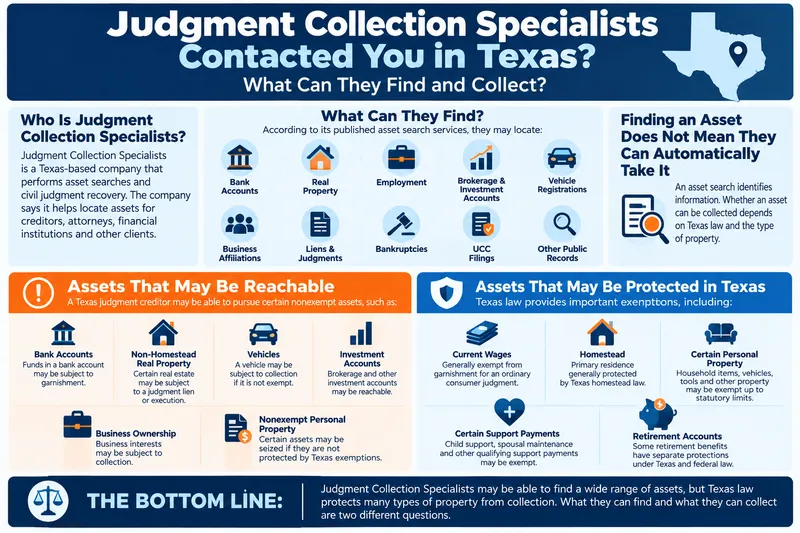
Judgment Collection Specialists Contacted You in Texas: What Can They Find and Collect?
Judgment Collection Specialists, Inc. is a Texas-based asset-search and judgment-recovery company. Its site says it helps locate assets including bank accounts, real property, vehicles, employment, brokerage accounts, and business affiliations. If it contacts you about a Texas judgment, finding an asset does not mean that asset can legally be seized. Those are two separate questions, governed by two separate sets of rules.
Who Is Judgment Collection Specialists, and Why Are They Looking for You?
Judgment Collection Specialists, Inc. operates from Spring, Texas, in the Houston metro area. The company's own site states it has operated for more than 20 years and has held an A+ Better Business Bureau rating since 2005. It describes itself as an asset-search and judgment-recovery company — not a debt collector in the traditional sense, and not a law firm.
Its clientele is attorneys and law firms (it cites relationships with hundreds of firms nationwide), creditors, businesses, and corporations pursuing collectible judgments. It operates largely on contingency: it states it does not get paid until a judgment is collected.
A judgment-recovery company gets involved for one reason: a creditor or client is trying to locate a judgment debtor, identify assets, or enforce a judgment a court already entered. That is a different situation from a company simply claiming you owe money.
Pre-judgment collection is a creditor saying "you owe us $8,000." Post-judgment enforcement is a court having already entered an $8,000 judgment. The second situation opens legal enforcement tools the first one does not have yet. Know which one you're in before you respond to anything.
What Can Judgment Collection Specialists Find?
According to its own asset-search page, JCS's researchers locate information involving:
- Bank accounts — banking relationships and account balances
- Real property — property ownership records
- Personal property — non-real-estate assets
- Current employment — where you work now
- Brokerage and investment accounts — potential investment relationships
- Vehicle registrations — vehicles registered to you
- Business affiliations — businesses connected to you
- Liens and judgments — existing recorded obligations
- Bankruptcies — bankruptcy filing records
- UCC filings — Uniform Commercial Code filings that can reveal secured interests
- Fraudulent conveyances / voidable transfers — transfers made to improperly move property out of reach
That list is wide. It is also just a list of what can be located. None of it answers whether a specific item is legally available to satisfy your specific judgment.
Finding an Asset Is Not the Same as Being Able to Take It
An asset search answers one question: what property or financial information can be located?
Texas exemption and judgment-enforcement law answers a different question: can that property legally be used to satisfy this judgment?
A search can identify your employer, vehicle, bank relationship, or property ownership. None of that makes any single item automatically available to a judgment creditor. The creditor still has to use a lawful enforcement procedure, and Texas law protects specific categories of property from garnishment, execution, or turnover. This distinction — not the list of what JCS can find — is what should drive your next move.
Not Sure What's On Your Credit Report?
A judgment and a credit-report problem are not automatically the same thing. See what's reporting on your credit, free, before deciding what you need to address.
Get My Free Credit Analysis Now →Can Judgment Collection Specialists Garnish Your Wages in Texas?
For an ordinary consumer judgment, current Texas wages are not subject to garnishment.
The Texas Constitution states current wages for personal service are never subject to garnishment, with two listed exceptions: court-ordered child support and spousal maintenance. Texas Civil Practice and Remedies Code §63.004 and Texas Property Code Chapter 42 both reinforce the same protection for current wages, subject to the same narrow statutory exceptions.
Current wages for personal services generally cannot be garnished in Texas to satisfy an ordinary consumer judgment, though exceptions exist under state and federal law for specific obligations like child support.
What Happens After Your Paycheck Reaches Your Bank Account?
Wages and bank-account funds are not automatically the same legal category. Texas protects current wages before payment from ordinary garnishment. Once that money is deposited and sitting in a bank account, it can become a target of post-judgment remedies if the creditor pursues a writ of garnishment and meets the statutory requirements. Exemptions can still apply to particular funds, depending on their source.
If a bank account has been frozen or garnished, identify the source of the money and get individualized Texas legal advice promptly — exemption questions are fact-specific, and the clock on contesting a garnishment doesn't wait.
Can Judgment Collection Specialists Find Your Bank Account?
Bank accounts and bank account balances are explicitly listed among the categories its research covers. Locating a bank relationship is not the same as a court ordering that account frozen or turned over. That next step requires its own legal process.
Can a Texas Judgment Creditor Freeze a Bank Account?
Potentially, through the correct legal process. Texas Civil Practice and Remedies Code Chapter 63 permits post-judgment garnishment once a creditor holds a valid, subsisting judgment and the statutory requirements are satisfied. Once a bank is served with the writ, it generally cannot release covered funds in violation of that writ.
→ writ served on the bank → funds restrained → exemption/ownership issues can still be raised
Judgment Collection Specialists locating a bank relationship does not give it unilateral authority to freeze that account. That authority comes from the court, through the writ process, not from the research company.
Can They Take Your House in Texas?
Not automatically, and not with a one-paragraph yes. Texas homestead protections are among the strongest in the country, but they are not absolute. A properly qualified homestead is generally protected from most ordinary judgment creditors. A judgment lien, an existing mortgage or security interest, non-homestead real property, and specific statutory exceptions each change the analysis. Don't treat "Texas protects homesteads" as a guarantee with no exceptions, and get Texas-specific legal advice if real property is at risk.
Can They Take Your Car?
"Maybe" isn't an answer — here's the actual framework. Texas Property Code §42.001 sets an aggregate personal-property exemption of up to $100,000 in fair market value for a family, or $50,000 for a single adult who isn't part of a family, excluding qualifying liens. Chapter 42 then lists the categories that count toward that cap, including one motor vehicle per licensed driver in the household.
That does not mean every Texan automatically keeps a $100,000 car. It means one vehicle per licensed driver counts within the aggregate exemption limit alongside everything else you're claiming — home furnishings, tools of trade, and the rest of the Chapter 42 list.
What Personal Property Is Protected From Judgment Collection in Texas?
| Property or Funds | General Texas Treatment |
|---|---|
| Current wages | Exempt, with narrow exceptions (child support, spousal maintenance) |
| Home furnishings, food, clothing | Can qualify under the Chapter 42 aggregate cap |
| One vehicle per licensed driver | Can qualify under the aggregate cap |
| Tools, equipment, books of a trade | Can qualify under the aggregate cap |
| Prescribed health aids | Exempt |
| Certain support payments | Exempt |
| Retirement benefits | Separate statutory protections can apply |
| Nonexempt cash and assets | Potentially reachable |
| Non-homestead real estate | Potentially reachable |
Whether a specific asset is exempt depends on the statute and your actual facts. Don't assume something is protected just because it falls into a broad category on this list — confirm it.
What Is a Texas Turnover Order?
Texas Civil Practice and Remedies Code §31.002 gives a court a turnover remedy for enforcing a judgment. A court can order a judgment debtor to surrender nonexempt property, or appoint a receiver with authority to take and sell qualifying nonexempt property and pay the proceeds toward the judgment. The same statute expressly bars courts from ordering the turnover of property that is exempt under applicable law.
→ creditor seeks turnover relief → court determines what qualifies
→ qualifying nonexempt property can be turned over
Judgment Collection Specialists locating your property is not the same as a turnover order existing. Court process sits between those two steps.
What Is a Judgment Receiver?
A receiver is a court-appointed person with legal authority to take possession of a judgment debtor's nonexempt property and sell it, under a turnover order. A collection or asset-search company is not automatically a receiver. It only has that authority if a court specifically appoints it in that role in your case.
If paperwork you receive mentions a receiver, turnover order, receivership, writ of garnishment, or writ of execution, treat it differently than an ordinary collection letter — these terms mean court-level enforcement is already underway or being sought.
Can Judgment Collection Specialists Find Where You Work?
Current employment is one of the categories its research covers. Finding your employer does not mean an ordinary Texas consumer judgment automatically allows garnishment of your current paycheck — that circles back to the wage protections above.
Can They Find Property in Your Spouse's Name?
Texas is a community-property state, which makes this fact-specific rather than a simple rule. Ownership matters, how the property is characterized matters, separate versus community property matters, and liability rules can depend on the specific debt and circumstances. If jointly held or spousal property is implicated, get Texas-specific legal advice rather than assuming either that it's protected or that it's exposed.
Can They Find a Business You Own?
Business affiliations and UCC filings are both listed among the categories its asset searches cover. Finding that you own a business is a separate question from whether that business's assets can be seized. Entity structure matters — an LLC's assets are not automatically identical to its member's personal assets, and the analysis depends on how the entity is organized and operated.
How Do You Know Whether the Judgment Is Real?
Verify before you respond to any demand for payment. Identify:
- Court — which court entered the judgment?
- Case number — does it match an actual filed case?
- Plaintiff / judgment creditor — who obtained the judgment?
- Defendant — is the judgment against you?
- Judgment date — when was it entered?
- Judgment amount — what did the court award?
- Current owner — who presently has the right to enforce it?
- Balance — how was the current amount calculated, including interest?
This turns a frightening letter into something you can check against a public court record.
Judgment Collection Specialists Is Not a Law Firm
The company's own contact page states it directly: it is not a law firm and does not provide legal advice. If you've received actual court documents — a citation, a writ, a notice of judgment — evaluate the legal deadlines on those documents independently of anything a collection or asset-search company tells you. Those deadlines run regardless of what any non-attorney communicates to you.
What Should You Do If Judgment Collection Specialists Contacts You?
- Don't ignore court documents. They are different from an ordinary collection letter and often carry deadlines.
- Identify the judgment. Get the court, case number, creditor, date, and amount.
- Confirm who is collecting. Determine the relationship between JCS and whoever holds the judgment.
- Compare the balance. Check principal, interest, credits, and any payments already made.
- Identify what stage you're in. Initial contact, asset investigation, garnishment, execution, turnover, or receivership are different situations requiring different responses.
- Identify exemptions before moving or surrendering anything. Don't assume property is collectible just because it's been located.
- Get Texas legal advice when court enforcement is underway — especially if bank funds are frozen, a receiver is appointed, a turnover order is issued, a property levy is threatened, an exemption is disputed, or the judgment isn't yours at all.
Should You Move Money After a Judgment Collector Finds Your Bank Account?
Do not transfer or conceal property to frustrate lawful judgment enforcement — that step can create legal exposure of its own, and JCS itself lists fraudulent conveyances and voidable transfers among the things its searches investigate. If you believe specific funds are exempt, identify the source of those funds and seek advice about asserting that exemption through the proper legal process instead of moving money around it.
Can You Settle a Judgment After Judgment Collection Specialists Contacts You?
Potentially. First verify who has settlement authority — the research company, the attorney, or the judgment creditor itself. Get any agreement in writing, addressing the settlement amount, payment deadline, installment terms if any, interest treatment, remaining balance, the satisfaction or release of judgment, any pending garnishment or receiver actions, and who is responsible for filing the necessary documents with the court. Paying money does not resolve anything on its own — the paperwork closing out the judgment is what matters.
Does a Judgment Appear on Your Credit Report?
The three nationwide credit bureaus removed civil judgments and tax liens from standard consumer credit reports years ago under the National Consumer Assistance Plan. A judgment not showing up on a standard credit report does not mean the judgment doesn't exist. It is a court record, and it can remain fully enforceable even when it isn't displayed as a public-record item on your report.
Can ASAP Credit Repair Remove a Judgment?
No. Credit repair does not vacate a court judgment — that's the direct answer. If a separate account tied to the underlying debt is being reported inaccurately on your credit file, that credit-report information can be reviewed and disputed on its own merits. A court judgment, a credit-report tradeline, and a collection account are three related but legally distinct things, and each one needs its own review.
Separate the Judgment From the Credit Report
A judgment collection problem and a credit reporting problem are not automatically the same thing.
Nearly 20 years of credit repair work at ASAP Credit Repair has shown us why that distinction matters. A court judgment can exist even when it doesn't appear as a public-record item on a standard consumer credit report. At the same time, an account connected to the underlying debt can still appear on one or more of your reports.
Review each issue on its own. If Judgment Collection Specialists is attempting to enforce a judgment, verify the court record, the creditor, the balance, and the current enforcement activity. If an associated account is showing up on your credit reports, review that reporting for accuracy as a separate matter. Credit repair cannot cancel a valid court judgment, but inaccurate credit reporting should not be ignored just because a judgment also exists.
Is There Also a Credit Reporting Problem Here?
A judgment and a credit-report tradeline aren't the same thing. Review your credit reports for the account connected to this debt and check whether the balance, status, and dates being reported are accurate. ASAP Credit Repair can help you review that reporting as its own issue, separate from the court process.
Get My Free Credit Analysis Now →Frequently Asked Questions
Who is Judgment Collection Specialists?
Judgment Collection Specialists, Inc. is a Texas company based in Spring, Texas, operating from the Houston metro area. It performs asset searches and civil judgment recovery for attorneys, law firms, businesses, creditors, and in some cases individuals. It states on its own site that it is not a law firm and does not give legal advice.
Is Judgment Collection Specialists legitimate?
Judgment Collection Specialists is a real, operating company that has held an A+ Better Business Bureau rating since 2005. Legitimate does not mean every claim made during a specific contact is accurate — verify the underlying judgment independently.
Why is Judgment Collection Specialists contacting me?
A judgment-recovery company gets involved when a creditor or client is trying to locate a judgment debtor, identify assets, or enforce an existing civil judgment. Contact typically means someone already holds, or believes they hold, an enforceable judgment against you.
What can Judgment Collection Specialists find?
The company's own site lists bank accounts, real and personal property, current employment, brokerage and investment accounts, vehicle registrations, business affiliations, liens, judgments, bankruptcies, UCC filings, and fraudulent conveyances among the categories its asset searches cover.
Can Judgment Collection Specialists find my bank account?
Bank accounts and bank account balances are listed among its search categories. Locating a bank account is a different step from a court ordering that account garnished.
Can Judgment Collection Specialists find where I work?
Current employment is one of the categories its asset searches target. Finding an employer does not mean an ordinary Texas consumer judgment can garnish your current paycheck — Texas protects current wages from garnishment in most cases.
Can Judgment Collection Specialists garnish my wages in Texas?
No, not directly, and generally not at all for an ordinary consumer judgment. Current wages for personal services are exempt from garnishment under the Texas Constitution and Texas Civil Practice and Remedies Code §63.004, with narrow exceptions for court-ordered child support and spousal maintenance.
Can a judgment creditor freeze my bank account in Texas?
A judgment creditor can seek a writ of garnishment against a bank account once a valid judgment exists and statutory requirements are met. Once the bank is served with the writ, it generally cannot release covered funds in violation of it. Exemption and ownership issues can still be raised.
What property is exempt from judgments in Texas?
Texas exempts current wages, and under Property Code Chapter 42, personal property up to $100,000 in aggregate fair market value for a family or $50,000 for a single adult, covering categories including home furnishings, tools of trade, one vehicle per licensed driver, and specific other items.
Can a judgment creditor take my car in Texas?
One motor vehicle per licensed household member generally falls within Texas's personal property exemption, subject to the aggregate dollar cap and existing liens. A vehicle beyond the exemption limit, or one with no protecting lien within the cap, can potentially be reached.
Can a judgment creditor take my house in Texas?
Texas homestead protections are strong but not absolute. A properly qualified homestead is generally protected from most ordinary judgment creditors, while non-homestead real property, existing liens, and specific statutory exceptions change the analysis. Get Texas-specific legal advice before assuming either outcome.
What is a Texas turnover order?
A turnover order under Texas Civil Practice and Remedies Code §31.002 lets a court require a judgment debtor to surrender nonexempt property, or appoint a receiver to take and sell it. Courts cannot order the turnover of property that is exempt under statute.
What is a judgment receiver in Texas?
A judgment receiver is a court-appointed person with authority to take possession of a judgment debtor's nonexempt property and sell it to satisfy the judgment, under a turnover order. A collection company is not automatically a receiver unless a court specifically appoints it in that role.
Can a collector take money from a joint bank account?
It depends on ownership and whose funds are in the account. Joint accounts, spousal property, and community-property rules in Texas make this fact-specific. Get individualized legal advice before assuming funds in a joint account are automatically reachable or automatically protected.
Can I settle a judgment in Texas?
Settlement is possible, but confirm who has authority to settle and release the judgment before paying anything. Get any agreement in writing, covering the amount, deadline, remaining balance, and who will file the satisfaction of judgment with the court.
What happens if I ignore a judgment collector?
Ignoring a valid judgment does not make it go away. It can lead to continued asset searches, garnishment, turnover proceedings, or receivership, while interest continues accruing on the unpaid balance under the judgment.
Does a civil judgment appear on my credit report?
The three nationwide credit bureaus removed civil judgments and tax liens from standard consumer credit reports under the National Consumer Assistance Plan. A judgment not appearing on your credit report does not mean it doesn't exist or can't be enforced — it is still a court record.
Can credit repair remove a court judgment?
No. Credit repair cannot vacate a valid court judgment. It can address inaccurate information on a separate credit-report account connected to the underlying debt, which is a different issue from the judgment itself.
Related Reads
- Judgment Collection Specialists, Inc. — Official Site
- Judgment Collection Specialists — Asset Search Services
- Judgment Collection Specialists — Contact / Not a Law Firm Disclosure
- Texas Constitution, Article 16, §28 — Current Wages Exempt From Garnishment
- Texas Civil Practice and Remedies Code, Chapter 63 — Garnishment
- Texas Property Code, Chapter 42 — Personal Property Exemptions
- Texas Civil Practice and Remedies Code §31.002 — Turnover Statute
- CFPB: Retrospective on Removing Public Records From Credit Reports