

TL;DR: Can you get approved for a loan with a debt lawsuit? Yes, it is possible to get approved for a loan while a debt lawsuit is pending. Approval depends on the lender, loan type, credit score, debt-to-income ratio, and whether a judgment has been entered. Active lawsuits increase lending risk, but they do not automatically result in denial.
If a debt collector has sued you, one of the first questions you may ask is whether you can still qualify for financing.
The answer is often yes, but lenders evaluate lawsuits differently depending on the type of loan you're seeking. A pending collection lawsuit may be treated as a risk factor, while a judgment entered against you can create more serious underwriting concerns.
At ASAP Credit Repair, we frequently review credit reports for consumers who are applying for mortgages, auto loans, and personal loans while dealing with collection lawsuits.
One of the most common misconceptions is that a lawsuit automatically results in denial. In reality, lenders are usually more concerned with the financial impact of the lawsuit than the lawsuit itself.
Understanding how lenders evaluate active debt litigation can help borrowers determine their approval odds before submitting an application.
Can I Still Get Approved for a Loan If I Have a Debt Lawsuit From Another Collector?
There's no specific answer, but the image below can give you some idea.
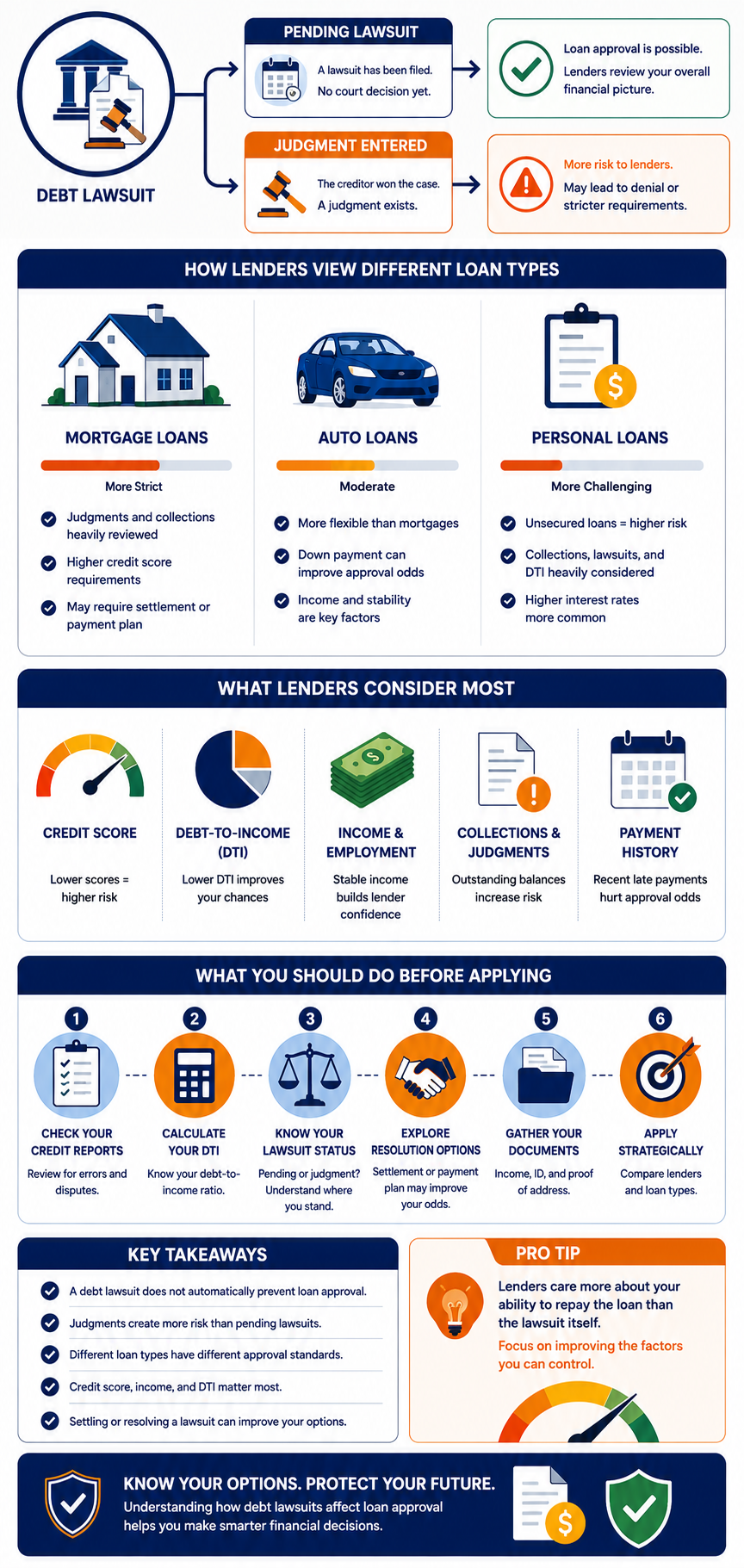
Is a Pending Lawsuit Different From a Judgment? Yes. This Distinction Decides Everything.
A pending lawsuit means a creditor has filed a case in court. No ruling exists yet. You still have the ability to respond, negotiate, or challenge the debt. A judgment means the creditor won in court, either because you responded and lost or because you did not respond and the court entered a default judgment automatically. A judgment comes with enforcement tools that directly affect your income and assets.
- Creditor has filed a court case
- No court ruling exists
- Wage garnishment is not yet possible
- Bank accounts cannot be frozen yet
- You can still respond, settle, or fight
- Typically does NOT appear on credit reports
- Lender risk: Elevated but manageable
- Court has ruled in creditor's favor
- Wage garnishment is now possible (in most states)
- Bank accounts can be frozen via levy
- Property liens can be placed
- Future income availability is now uncertain
- Judgment liens may appear in public records
- Lender risk: High. Repayment capacity in question.
This distinction drives every lending decision. A pending lawsuit is a flag lenders note. A judgment with garnishment pending is a calculation problem. If a creditor can take 25% of each paycheck before it reaches your bank account, the lender's monthly payment calculation changes. Their repayment confidence drops. That is why a 670-score borrower with an active judgment can be denied while a 640-score borrower with only a pending lawsuit gets approved.
If you have a pending lawsuit and have not responded yet, the window to prevent a default judgment is narrow. Courts typically give 14 to 30 days from the date of service to file a written Answer. Missing that deadline produces an automatic judgment. Understanding the mechanics of how debt collection lawsuits work and what happens at each stage covers exactly what the Answer deadline is, what a default judgment gives the collector, and why 74% of defendants lose by not responding.
How Do Lenders Actually Evaluate a Debt Lawsuit During Underwriting?
Lenders do not see the lawsuit in your credit report. What they see is the underlying collection account or charge-off that prompted the lawsuit. The lender's concern is not the legal action itself. It is what the legal action tells them about financial risk: your payment history, your existing debt load, and whether future income might be redirected toward a garnishment before reaching them.
The three credit bureaus stopped including civil judgment data in consumer credit reports in 2017 and 2018 after finding that judgment data was frequently inaccurate. That means a pending lawsuit or even an entered judgment does not appear on the standard Experian, Equifax, or TransUnion report a lender pulls when you apply.
What does appear is the underlying account: the collection tradeline, the charge-off, the late payment history. That is the data driving the credit score and the underwriting decision. The lawsuit is a legal shadow of the credit problem, not the credit problem itself.
However, mortgage lenders often perform additional title and public records searches that can surface judgment liens attached to real property. Auto lenders and personal loan lenders typically do not conduct those searches. This is one reason mortgage underwriting is stricter than auto loan underwriting when judgments are involved.
| What Lenders See | Appears on Standard Credit Report | Lender Concern Level |
|---|---|---|
| Pending lawsuit (no judgment) | No — not on report | Low to moderate. Lender evaluates underlying collection account. |
| Default judgment entered | Usually no — but liens may appear in public records | High. Mortgage lenders check public records. Auto lenders typically do not. |
| Collection account (underlying debt) | Yes — appears on all 3 bureaus | High. This is what actually damages the credit score and triggers underwriting review. |
| Wage garnishment active | No — but income verification reveals it | Critical. Reduces calculable monthly income available for loan repayment. |
| Judgment lien on property | Appears in public records title search | Critical for mortgage. Prevents clear title transfer. Typically must be satisfied before closing. |
| Settlement agreement (resolved) | Collection may still appear as settled | Moderate. Shows resolution. Legal threat removed. Score may not improve significantly. |
Can You Get a Mortgage With a Collection Lawsuit or Judgment?
A pending lawsuit with no judgment: possible. An unresolved judgment: near-automatic disqualifier for conventional mortgages until the judgment is paid, settled, or included in a court-approved payment plan. FHA loans have similar requirements. The difference between a pending lawsuit and a judgment is the difference between a loan that moves to underwriting and one that stops before it starts.
Fannie Mae and Freddie Mac guidelines, which govern most conventional mortgages, require that outstanding judgments be either paid in full or included in a payment plan with a documented payment history of at least three months before closing. An unpaid judgment clouds the title, which prevents the lender from securing a clear lien on the property. No clear title means no mortgage.
FHA loan guidelines, governed by the Department of Housing and Urban Development, similarly require that judgments be paid or in a documented payment plan before the loan can close. An exception exists for medical collection judgments in some cases, but the general rule for consumer debt judgments is resolution before closing.
A pending lawsuit with no judgment is handled case by case. The underwriter reviews the collection account, assesses the credit score impact, and calculates whether the overall file meets program guidelines. If the collection balance is below the threshold where the lender requires payoff before closing, the pending lawsuit alone may not prevent approval. If the balance is above that threshold or the collection is part of a pattern of delinquency, the underwriter may require documentation of the lawsuit status before proceeding.
Understanding how mortgage lenders treat collection accounts, specifically whether paying off a collection actually improves approval odds for a mortgage or whether deletion is the more effective path, changes the strategy you use before applying.
Can You Get an Auto Loan With a Debt Lawsuit?
Yes, more often than with mortgages. Auto lenders consider the vehicle as collateral, which reduces their risk exposure compared to unsecured lending. Subprime auto lenders who specialize in fair and poor credit frequently approve borrowers with collection accounts and pending lawsuits when income and down payment meet requirements.
The vehicle serves as collateral. If the borrower defaults, the lender repossesses and resells the car. That collateral cushion allows auto lenders to accept more credit risk than unsecured lenders. A collection account or pending lawsuit raises the rate they charge. It does not necessarily produce a denial.
A judgment with active wage garnishment changes the calculation. If a creditor is already taking 25% of each paycheck, the auto lender's monthly payment calculation uses the remaining 75% of income as the baseline. If that remaining income covers the proposed payment with acceptable DTI, the lender may still approve. If the garnishment brings available income below their minimum threshold, they will decline.
| Situation | Auto Loan Approval Odds | What Changes |
|---|---|---|
| Pending lawsuit, no judgment, 650+ score, stable income | Good | Subprime lenders will consider. Rate reflects collection risk. Down payment helps. |
| Pending lawsuit, no judgment, 580–649 score | Moderate | Buy-here-pay-here dealers and subprime lenders remain accessible. Rate is higher. |
| Judgment entered, no active garnishment, income stable | Reduced but possible | Judgment signals enforcement risk. Lender may require larger down payment. |
| Judgment with active wage garnishment | Low | Available income reduced. Lender calculates post-garnishment income for DTI. Many will decline. |
| Settlement reached, case resolved | Improved over active lawsuit | Legal threat eliminated. Collection still on report but lender sees resolution. |
Can You Get a Personal Loan With a Debt Lawsuit?
Personal loans are unsecured. No collateral exists to reduce the lender's risk. This means collection accounts, judgments, and pending lawsuits carry more weight in personal loan underwriting than in auto lending. Approval is possible at lower score tiers with online lenders using alternative underwriting models. It becomes difficult at mainstream banks and credit unions when judgments are present.
Online lenders including Upstart and OneMain Financial use income and employment data alongside credit score. A borrower with a pending lawsuit but strong income and low existing debt obligations may qualify through these lenders even when a traditional bank declines. The rate will reflect the elevated risk, but approval is possible.
Traditional banks and credit unions apply tighter standards for unsecured loans. An active collection lawsuit may not produce a denial on its own, but combined with a collection tradeline on the report, it typically results in either a denial or a significant reduction in the approved amount at these institutions.
A judgment with pending garnishment is a larger problem for personal loans than for auto loans. Because there is no collateral, the lender is entirely dependent on the borrower's income stream. If that income stream is being partially diverted to a judgment creditor, the personal loan lender's repayment position is weakened with no vehicle to repossess as a fallback.
How Does a Collection Lawsuit Affect Your Credit Score?
The lawsuit itself does not appear on your credit report and does not directly lower your score. The underlying collection account, charge-off, and late payment history that prompted the lawsuit does appear and does lower your score. The credit damage comes from the debt, not the legal action. The lawsuit is a consequence of the credit problem, not a separate credit event.
| Item | On Credit Report | Score Impact | When It Falls Off |
|---|---|---|---|
| Active debt lawsuit (pending) | No | None directly | N/A — not reported |
| Court judgment (civil) | Removed from reports in 2017–2018 | None directly on score | N/A — bureaus no longer report |
| Collection account (underlying debt) | Yes | 50–100+ points | 7 years from original delinquency |
| Charge-off (original account) | Yes | 50–150 points | 7 years from original delinquency |
| Wage garnishment (active) | No | None on score, but reduces available income lenders calculate | N/A — not reported to bureaus |
| Judgment lien on property | Public records only | None on score directly; blocks mortgage title | Varies by state. Until satisfied. |
In early 2026, ASAP Credit Repair USA tracked 193 clients who had LVNV Funding collection accounts appear on their reports. The average score before the collection posted was 679. After it appeared, the average dropped to 601, a 78-point decline. Three of those clients were denied mortgages they had been pre-approved for. Five were denied auto loans. The collection account, not the lawsuit, produced those denials.
Does the Collection Account Behind the Lawsuit Contain Errors?
Collection accounts from debt buyers frequently contain inaccurate balances, wrong delinquency dates, and duplicate entries. A free 3-bureau audit across Equifax, Experian, and TransUnion shows exactly what is being reported on every account and whether any entry contains disputable inaccuracies under the FCRA before you apply for any loan.
Get My Free 3-Bureau Audit → Secure · 2 minutes · No credit card requiredWhich Loan Types Are Easiest and Hardest to Get During a Lawsuit?
Secured loans are more accessible than unsecured loans. Collateral reduces the lender's exposure. Mortgage lending applies the strictest standards because title integrity is required. Auto lending is more flexible. Personal loan approval depends heavily on whether a judgment has been entered and whether garnishment is active.
| Loan Type | Accessibility During Lawsuit | Judgment Impact | Key Factor |
|---|---|---|---|
| Conventional Mortgage | Most Difficult | Near-automatic disqualifier until resolved | Title must be clear of judgment liens. Fannie/Freddie require judgment resolution before closing. |
| FHA Mortgage | Difficult | Must be paid or in documented payment plan | HUD guidelines require judgment resolution. Some exceptions for medical debt. |
| HELOC | Difficult | Judgment lien on property blocks approval | Requires clear title. Judgment on property prevents lender from securing a lien. |
| Personal Loan | Moderate Difficulty | Reduces approval odds significantly | Unsecured. Lender depends entirely on income stream. Garnishment reduces available income. |
| Auto Loan | Moderate | Reduces odds. Active garnishment is more problematic. | Vehicle as collateral provides fallback. Subprime lenders remain accessible. |
| Secured Personal Loan | More Accessible | Moderate impact | Collateral reduces lender exposure. More lenders willing to approve. |
| Credit Builder Loan | Most Accessible | Low impact | Designed for credit rebuilding. Collateral is the loan proceeds themselves held in savings. |
Two Real Examples: What Makes the Difference
The same lawsuit status produces opposite outcomes depending on whether a judgment exists and whether garnishment is active. These two cases show exactly why.
Borrower A: Approved Despite Active Lawsuit
A client came to us with a 648 credit score and a pending collection lawsuit for $3,200 from a credit card debt buyer. No judgment had been entered. The client had not yet responded to the lawsuit but had been served within the past two weeks. Stable employment for four years. Gross monthly income of $5,400. Total existing monthly debt obligations of $680. DTI without new loan: 12.6%.
The client applied for an auto loan through a subprime lender. The lender pulled the credit report and saw the collection account. The pending lawsuit did not appear. The score and income supported the application. DTI with the proposed auto payment remained below 35%. The lender approved a $16,000 loan at 19.8% APR with a $2,500 down payment. The collection lawsuit was not the deciding factor. The income, score, and DTI were.
Borrower B: Denied Due to Judgment and Garnishment
A second client had a 671 credit score and an entered judgment from a prior collection lawsuit for $4,800. Wage garnishment had been active for six weeks at 25% of disposable income. Gross monthly income of $4,800. The garnishment reduced available monthly income to approximately $3,600 before any other obligations. Existing monthly debt of $890 on top of the garnishment left the client with $2,710 per month of discretionary income after obligations.
The lender declined the personal loan application. Not because of the score, which was actually higher than Borrower A. The denial came from the income calculation. The garnishment had reduced the income base the lender used to calculate repayment capacity. The proposed monthly payment would have pushed the effective DTI past the lender's threshold.
The judgment mattered more than the score. Settling the judgment before applying would have removed the garnishment, restored the full income base, and changed the outcome of the DTI calculation.
If a judgment has been entered and you want to resolve it before applying for financing, the options include lump-sum settlement, payment plan negotiation, and in some cases post-judgment dispute based on documentation errors. Understanding how to settle credit card debt after a judgment, including the leverage you still have and what creditors accept covers the full negotiation process for resolving a judgment before it blocks a loan application.
What Should You Do Before Applying for a Loan With a Debt Lawsuit?
Five steps in order. The sequence determines both your approval odds and how efficiently you use hard inquiries. Each hard inquiry costs 5 to 10 score points. Running them on applications you cannot pass wastes points you need for the applications you can.
The single most important question is whether a judgment has been entered. Check the court case number on any documents you received. Call the court clerk's office with the case number and ask whether a judgment has been entered. This one fact changes every other decision you make about applying for financing. If you were served and did not respond within the deadline, a default judgment was likely entered automatically. You need to know this before applying anywhere.
Do this before anything else | Changes every downstream decisionGo to AnnualCreditReport.com and pull Equifax, Experian, and TransUnion. The lawsuit will not appear, but the collection account behind it will. Check the balance reported, the date of first delinquency, the creditor name, and the account status. If any of these details are wrong, file a dispute immediately. Debt buyers who file lawsuits often have incomplete documentation and may have reported balances that include unauthorized fees, wrong dates, or information that does not match the original account. Each inaccuracy is disputable under the FCRA.
Do within 48 hours | Errors are disputable regardless of lawsuit statusAdd up all monthly debt obligations. If a wage garnishment is active, subtract the garnishment amount from your gross monthly income before calculating DTI. This is the number lenders will use, not your full gross income. Compare that adjusted income against the proposed monthly payment for the loan you want. If the resulting DTI exceeds 43%, mainstream lenders will decline. Use this calculation to determine which loan amount is realistic at your current income before submitting any application.
Do before applying anywhere | Prevents wasted hard inquiriesFor auto loans and personal loans, applying with a judgment is possible if income and DTI support the application. For mortgages, resolving the judgment first is the only realistic path. Contact the judgment creditor directly to negotiate a lump-sum settlement or a payment plan. Creditors regularly accept 40 to 60 percent of the judgment balance in a lump-sum settlement because enforcement through garnishment and levies is slow and uncertain. Get any agreement in writing, including a commitment to satisfy and vacate the judgment, before paying anything.
Required for mortgage applications | Improves all other loan applicationsMost online lenders including Upstart, OneMain Financial, and LendingPoint offer prequalification using a soft inquiry that does not affect your score. Use prequalification to test whether your credit profile qualifies before spending hard inquiries. Compare at least three prequalification results before submitting a single full application. For auto loans, ask the dealer which lenders they plan to submit to and how many simultaneous inquiries they will run. Some dealers submit to 10 or more lenders at once, each generating a separate hard inquiry.
Before any full application | Protects score from unnecessary hard inquiriesCommon Mistakes Borrowers Make When Applying With a Debt Lawsuit
After reviewing hundreds of files involving collection lawsuits and loan applications, four mistakes appear. Each one reduces approval odds or wastes score points on applications that were never going to succeed.
Ignoring the lawsuit and applying anyway. A pending lawsuit that you ignore becomes a default judgment. A default judgment that you ignore becomes a garnishment or bank levy. Borrowers who apply for financing while ignoring a lawsuit they received often find that by the time they check back, a garnishment has started and their calculable income has dropped. Respond to the lawsuit first. Then apply.
Applying for a mortgage with an unresolved judgment. Mortgage underwriters conduct title searches. Judgment liens show up. The closing stops. The borrower has already paid for the appraisal, the inspection, and the application fee. All of that money is gone. Every mortgage borrower with a known judgment should resolve it before starting the application process, not after receiving a closing denial.
Assuming all lenders use the same standards. A borrower denied at a national bank for a personal loan may be approved at a credit union or an online lender for the same product. Underwriting models vary. One lender may weight the collection balance heavily. Another may weight income and employment tenure more. Shopping with soft-pull prequalification across multiple lender types costs nothing and preserves credit score while identifying which lenders view the file favorably.
Applying without checking the credit report first. Debt buyers who file lawsuits frequently report inaccurate balances, wrong delinquency dates, and duplicate entries. Disputing and removing an inaccurate collection entry before applying can shift a score by 30 to 70 points within a single dispute cycle. That score shift changes which lenders are accessible and what rate is offered. Every borrower with a collection lawsuit should pull all three bureau reports before submitting any loan application.
Can a debt collector stop me from getting a loan?
Not automatically. A pending lawsuit does not appear on your credit report and does not directly prevent loan approval. The underlying collection account does appear and does affect your credit score. A judgment with active garnishment reduces calculable income, which can make DTI calculations fail lenders' thresholds. The legal action itself is less important than the financial impact it creates.
Will a pending lawsuit appear on my credit report?
No. The three major bureaus removed civil judgment and lawsuit data from consumer credit reports between 2017 and 2018. A pending lawsuit does not appear. The collection account or charge-off behind the lawsuit does appear and is what lenders evaluate. Judgment liens may appear in public records that mortgage lenders access during title searches, but they do not appear on standard Equifax, Experian, or TransUnion consumer reports.
Can I buy a car during a debt lawsuit?
Yes, often. Auto lenders use the vehicle as collateral, which allows them to accept more credit risk than unsecured lenders. Subprime auto lenders including Credit Acceptance, Santander Consumer USA, and Bridgecrest regularly approve borrowers with collection accounts and pending lawsuits when income meets their minimums. A judgment with active wage garnishment reduces the income base and makes approval harder but not impossible.
Do mortgage lenders care about collection lawsuits?
Yes. Mortgage lenders apply the strictest underwriting standards of any loan type. An entered judgment that has been recorded as a lien against property blocks the title search required for closing. Conventional mortgage guidelines from Fannie Mae and Freddie Mac require that judgments be paid or in a documented payment plan before closing. An active lawsuit with no judgment may be reviewed individually but typically requires underwriter documentation of its status.
Does settling the lawsuit improve loan approval odds?
Yes, for two reasons. Settlement resolves the legal threat, removing the risk of future wage garnishment. And settlement eliminates the income uncertainty that lenders factor into repayment capacity calculations. The collection account remains on the credit report as settled, but the score impact of a settled account is less severe than an open active collection, and the legal exposure that concerned lenders is gone.
Should I settle the debt lawsuit before applying?
For mortgage applications, yes. An unresolved judgment prevents closing. For auto and personal loans, settling before applying improves odds but is not always necessary if income and DTI still qualify without the settlement. The calculation is whether the legal risk of an unsettled lawsuit, specifically the possibility of future garnishment, is enough to push the lender's risk calculation past their approval threshold for the loan type and amount you need.
Collection Account Blocking Your Loan? Find Out If It Should Be There.
The collection account behind a debt lawsuit is often the actual loan blocker, not the lawsuit itself. Inaccurate balances, wrong delinquency dates, and duplicate entries are common on debt buyer accounts. A free 3-bureau audit shows every entry on your Equifax, Experian, and TransUnion reports and whether any collection is disputable before you apply. 20+ years in business. 3,000+ five-star reviews. 100% money-back guarantee on inaccurate item removal.
Get My Free Credit Blueprint → Secure · No hard inquiry · No credit card required-
Can a Debt Collector Sue You for $500? What the Law Actually Says Updated March 2026 — Covers how debt collection lawsuits work from filing through default judgment, why 74% of defendants lose by not responding, what the Answer deadline is in your state, and how a default judgment gives the collector wage garnishment and bank levy authority that directly affects your ability to get approved for financing.
-
Can You Still Settle Credit Card Debt After a Judgment? Yes — Here's How Updated March 2026 — Creditors regularly accept 40 to 60 percent of the judgment balance in lump-sum settlement because collecting through garnishment and levies is slow and uncertain. This covers the full post-judgment settlement process, what leverage you still have, how to stop garnishment through settlement, and how resolving a judgment improves your loan application before applying for a mortgage.
-
Does Paying Off Collections Improve Your Credit Score? The Truth Updated April 2026 — Mortgage lenders require most collections above $250 to $500 to be resolved before closing. Auto loans rarely require paid collections. This covers when payment actually helps your score, when pay-for-delete is a better strategy, what mortgage lenders specifically require for FHA versus conventional loans, and why deletion beats payment for credit score improvement in most situations.