

Phoenix Financial Services is reporting a medical collection, but the balance on your credit report should match what you actually owe after insurance and payments are applied.
Start with three records: your medical bill, your insurance Explanation of Benefits (EOB), and your credit report.
Your EOB shows how your health plan processed the claim. It can show the amount billed, the amount insurance allowed, what the plan paid, and the amount assigned to you. Your medical provider may also have records of payments or later adjustments that reduced the balance.
Compare that final amount with what Phoenix Financial Services is reporting.
For example, if your EOB shows that you were responsible for $800 and you already paid $300, you would want to know why a $800 collection balance is still being reported.
At ASAP Credit Repair, nearly 20 years of credit repair experience has shown us that the key is identifying the exact difference. A medical collection can involve the right patient and provider while still showing a balance that needs closer review.
This guide explains how to compare the records, find a balance mismatch, and decide whether inaccurate information should be disputed.
Key Takeaways
A medical collection balance should match the amount you actually owe after insurance, payments, and adjustments.
Compare the Phoenix Financial Services balance with the provider's final bill and your insurance EOB.
A balance mismatch can be a reason to investigate and, when appropriate, dispute inaccurate credit-report information.
Debt validation and a credit-report dispute are separate processes.
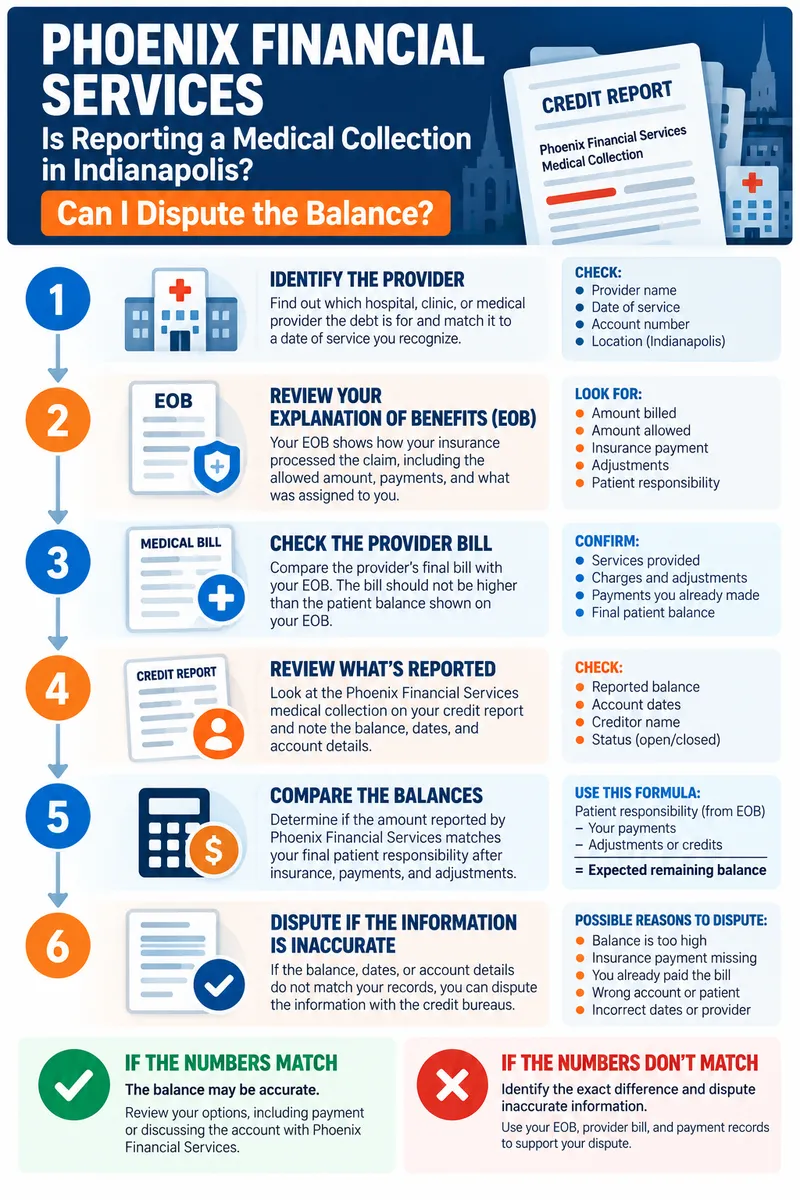
Phoenix Financial Services Is Reporting a Medical Collection in Indianapolis: Can I Dispute the Balance?
You have the right to dispute a Phoenix Financial Services medical collection if information being reported is inaccurate or incomplete. Compare the collection balance with your provider's final bill, insurance Explanation of Benefits, payments, and adjustments. If the amounts don't match, document the specific difference before submitting a credit-report dispute.
Phoenix Financial Services is reporting a medical collection, but the balance on your credit report should match what you owed after insurance and payments were applied. Start with three records: your medical bill, your insurance Explanation of Benefits, and your credit report.
Your EOB shows how your health plan processed the claim - the amount billed, what insurance allowed, what the plan paid, and the amount assigned to you. Your provider's own records also show payments or later adjustments that reduced the balance. Compare that final figure with what Phoenix Financial Services is reporting.
For example, if your EOB shows a patient responsibility of $800 and you already paid $300, that's a reason to ask why an $800 balance is still listed.
Nearly 20 years of credit repair work at ASAP Credit Repair has shown the key is identifying the exact difference. A medical collection often names the right patient and provider while still carrying a balance that needs closer review. This guide compares the records, finds a mismatch, and decides whether inaccurate information should be disputed.
Key Takeaways
- A medical collection balance should match what you owed after insurance, payments, and adjustments.
- Compare the Phoenix Financial Services balance with the provider's final bill and your insurance EOB.
- A balance mismatch is a reason to investigate and, when warranted, dispute inaccurate credit-report information.
- Debt validation and a credit-report dispute are separate processes.
Who Is Phoenix Financial Services?
Phoenix Financial Services is a collection agency that pursues accounts referred by creditors, including medical providers with unpaid balances. Its presence on a credit report shows an account was referred to collections - it doesn't confirm the listed balance is accurate. The bigger question isn't who Phoenix Financial Services is. It's whether the balance it's reporting is accurate.
Can I Dispute a Phoenix Financial Services Medical Collection?
Yes. You have the right to dispute a Phoenix Financial Services collection if information on your credit report is inaccurate or incomplete. Start by identifying the specific detail you believe is wrong - the balance, account ownership, payment status, or another account detail.
The CFPB states that consumers have the right to dispute errors on their credit reports, and that both credit reporting companies and furnishers carry responsibilities for investigating those disputes. The company receiving your dispute must investigate, forward it with your supporting information to the furnisher, and report the results back to you. The furnisher generally must investigate and respond within 30 days; if the information is inaccurate, it must update or remove it and notify the credit reporting companies.
Is Phoenix Financial Services Showing on Your Credit Report?
Check whether the balance, account ownership, and payment status are accurate. Our team reviews reports and flags what needs attention.
Get My Free Credit Analysis Now →Compare the Phoenix Financial Services Balance With Your Medical Records
Run a simple three-record comparison before assuming the reported balance is correct.
| Record | What to Check |
|---|---|
| Medical provider bill | Final amount billed to you |
| Insurance EOB | Patient responsibility after claim processing |
| Credit report | Phoenix Financial Services collection balance |
If all three show the same final patient balance, the amount is consistent. If they don't, find out why before assuming the collection balance is correct.
See a related example of disputing an unfinished-treatment balanceStart With Your Explanation of Benefits
CMS explains that an EOB isn't a bill. It shows how your health plan processed the claim and what amount the patient is responsible for. Your EOB generally shows:
- The amount the provider charged
- The allowed amount
- The insurance payment
- Adjustments
- The amount assigned to you
Use one formula to check the medical balance:
| Medical Balance Check | |
|---|---|
| Patient responsibility | start |
| − Payments already made | reduces |
| − Later credits or adjustments | reduces |
| = Remaining medical balance | compare to collection |
Compare that result with the Phoenix Financial Services amount.
What If the Phoenix Financial Services Balance Is Higher?
Don't move straight to disputing. First find the cause.
- Missing insurance payment - was the claim processed before the account went to collections?
- Missing patient payment - did you already pay part of the bill?
- Missing adjustment - did the provider reduce the balance after insurance processed the claim?
- Duplicate charge - does the same service appear more than once?
- A separate provider - is the collection from a physician, lab, radiologist, or anesthesiologist rather than the hospital itself?
A difference is far more useful once you know exactly which number is wrong.
What If Insurance Paid After the Account Went to Collections?
If insurance later paid or adjusted the claim, compare the old balance, the insurer's payment or adjustment, and the resulting new patient balance. Then compare that new balance with what Phoenix Financial Services is reporting.
The CFPB's medical debt collection advisory opinion notes that amounts due on a medical bill are often adjusted multiple times as payments post from consumers or third parties such as insurers, and that collecting an amount already paid by insurance - fully or partially - is a basis for liability.
What If I Already Paid the Hospital?
Gather your receipt, bank or card statement, provider confirmation, and updated medical statement. Match the payment amount, date, and account number. The question becomes whether that payment was included when the collection balance was calculated.
Read how collection-balance verification works for a different agencyWhat If I Don't Recognize the Medical Bill?
Use a short verification sequence: provider, patient, date of service, account number, insurance claim. If one point doesn't match, investigate that point rather than assuming a generic dispute. One hospital visit involves more than one provider - a physician, a lab, and a facility fee are often billed separately.
Is a Medical Billing Dispute the Same as a Credit Report Dispute?
No. A medical billing problem asks whether the hospital or provider calculated your patient balance correctly. A credit-report problem asks whether Phoenix Financial Services is reporting accurate information about the collection. The underlying billing issue sometimes explains the reporting error, but the two aren't the same process.
What Should I Dispute If the Balance Is Wrong?
Skip "I dispute everything." Identify the exact error.
| What Phoenix Financial Services Reports | What the Supporting Records Show |
|---|---|
| $1,200 balance | Provider's corrected balance: $650 |
| $900 balance | Provider records show a $400 payment; expected balance: $500 |
That precise framework - reported versus records - gets investigated, not dismissed.
Read the full guide to disputing credit report errorsDoes Phoenix Financial Services Reporting Mean I Still Owe the Hospital?
Not necessarily, based on the credit-report entry alone. Establish four things before assuming the account is fully settled or fully owed:
- Who the creditor is
- Who currently handles the account
- What the provider's records show
- What amount is being reported
Don't assume the collection agency owns the debt unless your records establish that.
Can Medical Collections Appear on My Credit Report?
Medical collections generally still appear on a credit report. A federal court vacated the CFPB's broader 2025 rule that would have removed medical debt from credit reports, in July 2025. This isn't a full history of medical-debt reporting - it's the current baseline: standard rules apply unless a specific error is found.
Phoenix Financial Services Balance Verification Checklist
Check these five numbers in order, and stop once something breaks:
Verify the balance before you dispute the balance.
What Should I Do If the Balance Doesn't Match?
- Get your records. Collect the EOB, provider statement, payment proof, and credit report.
- Calculate the correct balance. Determine what remains after insurance and payments.
- Identify the exact difference. Name the specific line that's wrong, not just the total.
- Use the right process. Address a billing problem with the provider or insurer, and inaccurate credit reporting through the credit-report dispute process.
Verify the Number, Not Just the Name
Nearly 20 years of credit repair work at ASAP Credit Repair has shown that a medical collection involving the correct patient and provider still needs its balance checked on its own. The question isn't only whether the debt is yours - it's whether the reported balance matches the final amount your own records say you owed.
Found a Mismatch Between Your Records and the Report?
If the balance doesn't reconcile, or the entry doesn't match what you verified, our team helps identify what warrants a dispute.
Get My Free Credit Analysis Now →Frequently Asked Questions
What is Phoenix Financial Services?
Phoenix Financial Services is a collection agency that pursues consumer accounts, including medical debt referred by healthcare providers. Its appearance on a report shows an account was referred to collections - it doesn't confirm the balance is correct.
Why is Phoenix Financial Services on my credit report?
A medical provider generally refers an unpaid balance to a collection agency after billing and insurance processing are complete. The listing reflects that referral, not an independent check of the final amount.
Can I dispute a Phoenix Financial Services collection?
Yes. You have the right to dispute a Phoenix Financial Services entry if information on your credit report is inaccurate or incomplete, such as the balance, account ownership, or payment status.
How do I know if the medical collection balance is correct?
Compare three records: the provider's final bill, your insurance Explanation of Benefits, and the collection balance. If the final patient responsibility in all three matches, the amount is consistent. If not, the gap identifies what to document.
What if insurance already paid part of the bill?
Compare the old balance, the insurer's payment or adjustment, and the resulting new patient balance against what Phoenix Financial Services is reporting. A payment or adjustment that posted after the referral is a common source of a mismatch.
What if I already paid the hospital?
Gather your receipt, bank or card statement, and provider confirmation. Match the payment amount, date, and account number, then check whether that payment was included when the collection balance was calculated.
What if my EOB shows a different balance?
Your Explanation of Benefits shows the amount billed, the allowed amount, what insurance paid, and the amount assigned to you. If that final figure differs from the reported balance, the difference is the specific detail to raise in a dispute.
Can Phoenix Financial Services report medical debt?
Medical collections generally still appear on a credit report. A federal court vacated the CFPB's broader rule removing medical debt from credit reports in July 2025, so standard credit-reporting rules continue to apply to medical collections.
Does paying a medical collection remove it from my credit report?
Not automatically. Paying resolves the balance, but whether the entry is removed, updated, or marked paid depends on the furnisher's reporting practice and any agreement reached before payment.
What documents should I send with a medical collection dispute?
Send your Explanation of Benefits, the provider's final itemized bill, proof of any payments, and a written statement identifying the specific balance discrepancy you found.
Related Reads
- CMS - How to Read an Explanation of Benefits (EOB)
- CFPB - How do I dispute an error on my credit report?
- CFPB - Medical Debt Collection Advisory Opinion
- AccountsRecovery.net - Judge Vacates CFPB Medical Debt Credit Reporting Rule (July 2025)