
Universal Fidelity LP contacted you about a debt. Before you decide whether to pay it, check how the amount was calculated.
Start with a simple question: Does the balance in the collection notice match your records?
Universal Fidelity LP, or UFLP, is a Houston-based collection agency that has operated since 1991. The company says it provides collection services for creditors in areas such as auto loans and healthcare accounts.
But knowing who contacted you is only the first step. You also need to verify the debt itself.
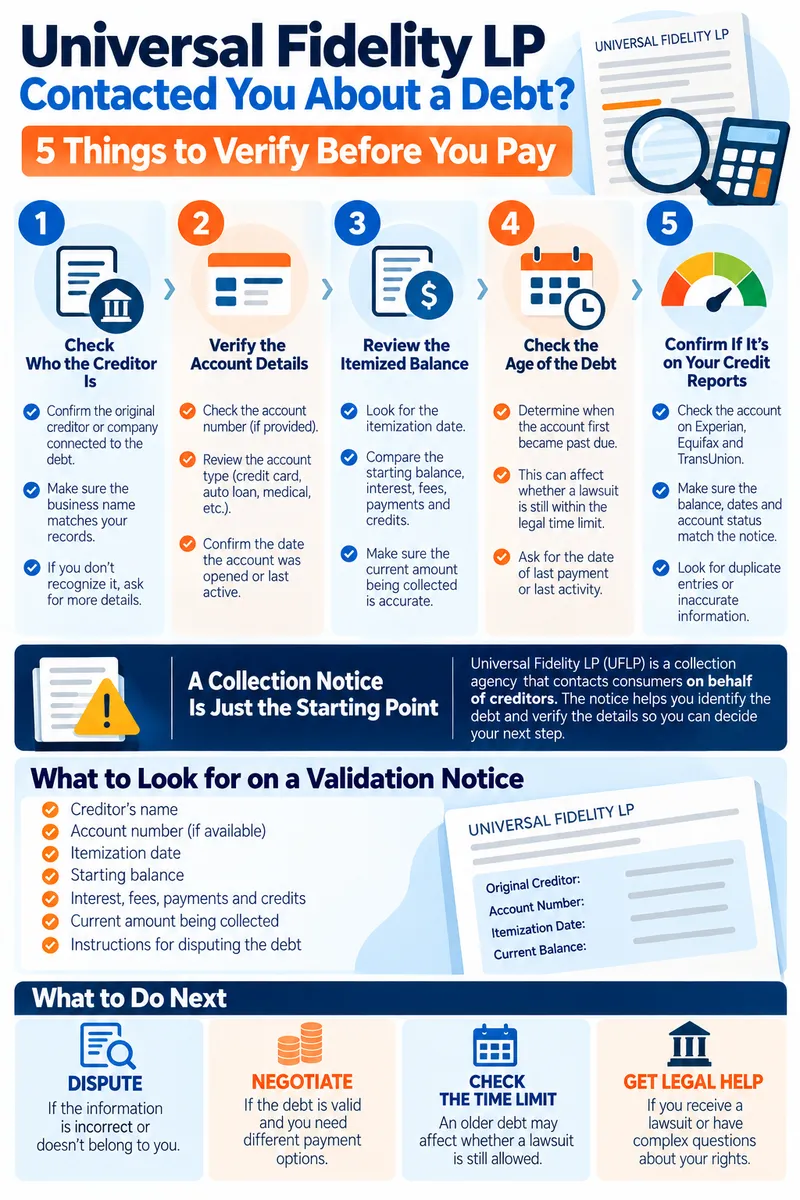
Federal debt collection rules require validation information to include key details about the account. This generally includes the current creditor, account information, starting balance, interest, fees, payments, credits, and the amount currently claimed.
Think of it as a basic balance check:
Starting balance + interest + fees − payments − credits = current balance
If the numbers do not add up, that tells you where to look next. For example, a payment may be missing. A credit may not have been applied. Or you may not recognize the account at all.
Timing also matters. Federal rules provide a 30-day validation period. A qualifying written dispute sent during this period generally requires the collector to stop collecting the disputed amount until it provides verification.
At ASAP Credit Repair, working with debt collectors almost every day, has shown us why this distinction matters. You may recognize an account and still find a problem with its balance, payment history, or credit reporting.
This guide breaks a Universal Fidelity LP collection into its individual parts. You will learn how to verify the creditor, trace the balance, compare the notice with your records, and decide what to do when something does not match.
Universal Fidelity LP Contacted Me About a Debt: How Do I Verify What I Owe?
A notice from Universal Fidelity LP (UFLP) means the company is attempting to collect an account for a creditor. UFLP describes itself as a collection agency that provides receivables and collection services. Its physical office is in Houston, Texas.
That distinction matters because Universal Fidelity LP may not be the company where the debt started. The collection notice should help you connect three separate entities:
You → Universal Fidelity LP → Creditor
The creditor is the company connected to the debt. UFLP is the company contacting you about collection. Your job is to confirm that the account linking the three parties is correct.
Look for the creditor's name, account details, itemization date, and current amount on the validation notice. If you do not recognize the creditor, do not stop there. A debt can sometimes be associated with a business name that differs from the name you remember seeing on an older bill or account.
The CFPB's debt collection rules require collectors to provide specific validation information so consumers can identify the debt and decide whether to dispute it. This makes the notice more than a payment request. It is also the starting point for tracing the collection back to the underlying account.
The infographic below shows the five pieces of information to match before you treat a Universal Fidelity LP collection as verified.
Universal Fidelity LP Contacted Me About a Debt: How Do I Verify What I Owe?
To verify a debt from Universal Fidelity LP, compare the collection notice with your own records. Check the creditor, account number, itemized balance, interest, fees, payments, credits, and current amount. If information is missing or incorrect, use the validation and dispute process that applies to your account before deciding whether to pay.
Universal Fidelity LP, also called UFLP, is a Houston, Texas-based collection agency that has provided collection and receivables services to creditors since 1991. It identifies itself as a debt collector and contacts consumers about accounts assigned to it for collection. Being contacted by UFLP establishes that an account was placed with them - it does not establish that every detail in the notice is correct.
Key Takeaways
- Universal Fidelity LP is a debt collection agency. Being contacted does not by itself confirm that every detail or amount in the notice is correct.
- Verify more than your name. Check the creditor, account, starting balance, interest, fees, payments, credits, and current amount.
- Federal rules provide a 30-day validation period. A timely written dispute requires the collector to pause collection of the disputed amount until it responds with verification.
- Debt collection and credit reporting are separate issues. Verify the amount being collected, then separately review what's on your credit reports.
- Don't pay solely because you recognize the creditor. Reconcile the current balance with your own records first.
Creditor, Collector, and Debt Buyer Are Not the Same Thing
Before deciding anything about a Universal Fidelity LP contact, separate four roles that often get collapsed into one:
These roles can overlap on a single account, but don't assume they do in your case. UFLP's published business lines show it collecting for creditors across automotive, education, financial, retail, government, and healthcare receivables - an agency-for-hire model, not necessarily a debt-buying one. Confirm which role applies to your account.
Step OneStart With the Validation Notice
This comes before reviews, complaints, or credit scores. Federal rules require a debt collector to provide specific validation information, either in the initial communication or within five days of it.
| Information | What You're Checking |
|---|---|
| Consumer name | Is the debt associated with you? |
| Collector | Who is contacting you? |
| Creditor | Who is the debt currently owed to? |
| Account number | Which account is involved? |
| Itemization date | What date starts the current calculation? |
| Starting amount | What was owed at that point? |
| Interest / fees | What was added since then? |
| Payments / credits | Were they applied to the balance? |
| Current amount | What are they asking you to pay? |
| Validation deadline | When does your 30-day window end? |
Don't Verify One Number. Reconstruct the Balance.
Most people verify a collection by asking one question: "Do I remember this account?" That answers whether the debt exists. It doesn't answer whether the amount is correct. Those are separate questions, and the second one requires math, not memory.
Example. Suppose a validation notice shows a balance of $1,250 at the itemization date, $35 in interest, $20 in fees, $200 in payments received, and $50 in credits or adjustments. That reconstructs to a current balance of $1,055. The question isn't whether you recognize "$1,055." It's whether you can independently account for how the notice arrived at that number.
Does Universal Fidelity LP Appear on Your Credit Reports?
Verify the debt first, then compare what you confirmed against what the credit bureaus are reporting. Our team can help you review your reports for information that doesn't match.
Get My Free Credit Analysis Now →The 5-Part Universal Fidelity LP Verification Test
Run every contact through these five checks, in order, before deciding whether to pay anything.
- Verify the consumer. Is this your account? Check the name, prior addresses, and account identifiers. Don't hand over sensitive financial information just because someone calls claiming to collect a debt.
- Verify the original account. What purchase, service, loan, membership, or account created this balance? That's more precise than asking who the original creditor is - connect the transaction to the account to the creditor to the collection, not just a name.
- Verify the creditor. Separate the original creditor, the current creditor, and UFLP as the contacting entity. Don't collapse all three into one.
- Verify the balance. Does the starting balance match your records? Were interest and fees added correctly? Were payments and credits reflected? Does the math reach the claimed amount? This is where "how do I verify what I owe" gets answered.
- Verify UFLP's role. Why is UFLP collecting this specific account? Don't assume collection agency means owner. Establish who owns the debt, who placed it, who can accept payment, and where disputes go.
What Happens If I Dispute the Debt Within 30 Days?
What If More Than 30 Days Have Passed?
You haven't lost every right - that framing is too broad. The automatic pause-on-dispute protection tied to a timely written dispute is specific to that 30-day window, but other rights, including disputing inaccurate information on your credit reports, can still apply afterward. You can still ask the collector for information; the response just isn't bound by the same automatic pause.
What If I Don't Recognize the Creditor?
Don't jump to identity theft. Several explanations are far more common:
- A different billing name than the one on your statement
- The account was transferred to a new creditor or collector
- A collection agency acting for a creditor you do recognize
- An old account you've lost track of
- A service provider billing separately from the company you dealt with
Investigate the specific explanation before assuming the worst case - and before ruling it out entirely.
What If I Recognize the Creditor but Not the Amount?
This is a different problem than not recognizing the debt, and it deserves a different response. Say you recognize a $900 account, but UFLP says $1,275 is due. Disputing "not mine" is the wrong move - your actual issue is a balance discrepancy. Compare principal, interest, fees, payments, and credits line by line against the claimed balance. That reconciliation is a far stronger dispute than a general denial.
What If I Already Paid the Debt?
Treat this as its own path. Gather your receipt, bank statement, confirmation email, payment history, settlement agreement, or zero-balance statement. Then compare the payment date against when the account was placed for collection and the amount currently being claimed. Provide that documentation in writing rather than relying on a phone call alone.
What If the Debt Isn't Mine?
Check for a similar name, an address mismatch, a mixed credit file, or identity theft. Document why the account isn't yours, then use the appropriate dispute or identity-theft process - don't simply ignore the contact and hope it resolves itself.
LegitimacyIs Universal Fidelity LP a Legitimate Collection Agency?
UFLP operates an official collection-agency website with debt-collector disclosures and consumer resources, and describes itself as a woman-owned agency operating since 1991. That establishes the company is real - not that a specific call, balance, or caller claiming to represent it is accurate. Someone can impersonate a real company, so verify independently.
How Do I Confirm I'm Actually Talking to Universal Fidelity LP?
Don't rely exclusively on the phone number shown on an incoming call.
- Compare against official contact information. Check the notice against UFLP's own listed address and phone numbers.
- Verify independently. Call the number on UFLP's own site, not a callback number the contact gave you.
- Have account information ready. Keep reference numbers on hand before the conversation starts.
- Ask which creditor and account this concerns. A specific answer is a good sign; vagueness isn't.
- Don't provide unnecessary sensitive information before establishing who you're dealing with.
Should I Pay Universal Fidelity LP?
Don't answer this before you've worked through verification. What you find determines the next step - not a blanket yes or no.
| What You Find | Sensible Next Step |
|---|---|
| Debt isn't yours | Investigate and dispute |
| Creditor is unfamiliar | Verify the account's origin |
| Balance is wrong | Document and dispute the discrepancy |
| Payment is missing | Provide proof and request correction |
| Debt appears accurate | Evaluate payment options |
| Debt is old | Check the applicable statute of limitations |
| Credit reporting is inaccurate | Address the reporting issue separately |
| You've received a lawsuit | Respond through the legal process |
Can I Negotiate With Universal Fidelity LP?
Potentially, once verification is complete. Get any settlement terms in writing first, including the amount, deadline, remaining balance, and how the account will be reported after payment. Confirm who has authority to accept the settlement before sending money.
Age of the DebtWhat If the Debt Is Old?
Don't confuse old with invalid. A debt doesn't generally expire until it's paid, but statutes of limitations restrict when legal action can collect it, and the period varies by debt type and state. Collectors can't sue or threaten to sue once that period has passed. A payment, or even acknowledging an old debt, can restart the clock in many states - confirm the applicable rule before paying on a debt that is potentially time-barred.
Can Universal Fidelity LP Report a Debt to the Credit Bureaus?
Don't assume every UFLP account gets reported. Federal rules restrict a debt collector from furnishing information about a debt to a consumer reporting agency before communicating with the consumer about it. Check your own reports rather than assuming either way.
What Should I Check If Universal Fidelity LP Appears on My Credit Report?
| Credit Report Field | What to Compare |
|---|---|
| Collector | Is UFLP identified correctly? |
| Original creditor | Does it match your records? |
| Balance | Does it match your verification? |
| Account status | Is it accurate? |
| Dates | Consistent with your account history? |
| Payment / settlement status | Updated correctly? |
| Duplicate listing | Is the same collection reported more than once? |
Debt Verification and Credit Reporting Are Two Different Processes
Verify the Debt Before You Focus on the Credit Score
A collection account involves two separate sets of records: the collector's account records and your credit reports. Nearly 20 years of credit repair work at ASAP Credit Repair has shown us why those records deserve separate comparison, not treatment as one number.
Start with the debt: creditor, account, starting balance, payments, credits, interest, fees. Determine whether the current amount reconciles. Then review the credit reports separately, comparing the creditor, balance, status, and dates against what you verified. An account can belong to you while individual details about it are still inaccurate.
The goal isn't to dispute an account simply because it's negative. The goal is to identify information that doesn't match the underlying records and address that specific problem.
Example: your records show you owe $800, while your report incorrectly shows $1,100. The debt can be legitimate while the reported amount is still inaccurate - "Is this my debt?" and "Is what's being reported accurate?" overlap, but they aren't identical questions.
Universal Fidelity LP Debt Verification Worksheet
| Verification Question | Notice Says | My Records Say | Match? |
|---|---|---|---|
| Original creditor | ____ | ____ | Yes / No |
| Current creditor | ____ | ____ | Yes / No |
| Account number | ____ | ____ | Yes / No |
| Starting balance | ____ | ____ | Yes / No |
| Interest | ____ | ____ | Yes / No |
| Fees | ____ | ____ | Yes / No |
| Payments | ____ | ____ | Yes / No |
| Credits | ____ | ____ | Yes / No |
| Current balance | ____ | ____ | Yes / No |
| Account status | ____ | ____ | Yes / No |
The first "No" tells you exactly where to investigate.
A Simple Universal Fidelity LP Decision Tree
Verify First. Then Decide What to Do About Universal Fidelity LP.
If the balance doesn't reconcile, or the credit-report entry doesn't match what you've verified, our team can help you examine the reporting and identify what warrants further action.
Get My Free Credit Analysis Now →Frequently Asked Questions
What is Universal Fidelity LP?
Universal Fidelity LP, or UFLP, is a Houston, Texas-based collection agency operating since 1991. It provides collection and receivables services to creditors across automotive, education, financial, retail, government, and healthcare accounts.
Why is Universal Fidelity LP calling me?
UFLP contacts consumers about accounts creditors assign to it for collection. Being contacted doesn't confirm every detail or amount in the notice is correct. Identify the account before deciding how to respond.
Is Universal Fidelity LP a legitimate company?
UFLP operates an official collection-agency website with debt-collector disclosures, and has operated in Texas since 1991. That proves the company is real - not that a specific call, balance, or caller claiming to represent it is accurate. Verify independently.
What does Universal Fidelity LP collect?
UFLP's published service lines include automotive, education, government, healthcare, commercial, and consumer retail receivables. Identify which category applies to your account rather than assuming.
Who does Universal Fidelity LP collect for?
UFLP collects on behalf of creditors across several industries. The entity contacting you, the original creditor, and the current debt owner can be one party or three - confirm which applies to your account.
Is Universal Fidelity LP a debt buyer?
Not necessarily. A collection agency can work an account for a creditor without owning the debt. Confirm whether UFLP is collecting for a creditor or has purchased the account before assuming either way.
How do I verify a debt from Universal Fidelity LP?
Compare the notice against your own records: creditor, account number, itemized balance, interest, fees, payments, credits, and current amount. If something is missing or doesn't match, use the validation and dispute process before paying.
What proof should a debt collector provide?
A validation notice should identify the collector and creditor, your account number if applicable, an itemization reflecting interest, fees, payments, and credits since a specific date, the current amount, and dispute instructions.
How long do I have to request debt verification?
You have 30 days from receiving the validation notice to dispute the debt in writing. A timely written dispute requires the collector to pause collecting the disputed amount until it provides verification.
What happens when I dispute a debt within 30 days?
The collector must stop collecting the disputed amount until it sends verification responding to your dispute. Collection can resume once verification is sent, unless you've taken other steps.
Can I dispute a debt after 30 days?
You can still ask for information after the 30-day window, but the automatic pause-on-dispute protection only applies to a timely written dispute. Other rights, including credit-reporting disputes, can still apply afterward.
What if I don't recognize the original creditor?
Don't immediately conclude identity theft. The account can be listed under a different billing name, can have been transferred, or can involve a separate service provider. Investigate the specific explanation first.
What if Universal Fidelity LP has the wrong balance?
Document the exact discrepancy between what UFLP reports and your records, then request supporting documentation. Comparing the starting balance, interest, fees, payments, and credits line by line beats a general denial.
What if I already paid the debt?
Gather your receipt, bank statement, confirmation email, or settlement agreement. Compare the payment date against when the account was placed for collection and the current amount claimed, then submit that in writing.
Should I pay Universal Fidelity LP?
Only after verifying the debt is yours, the creditor is identified, the balance reconciles against your records, and you know the debt's age. What you find determines the next step - not a blanket yes or no.
Can I negotiate with Universal Fidelity LP?
Potentially, after verification. Get settlement terms in writing - amount, deadline, remaining balance, and post-payment reporting status - before sending money.
Can Universal Fidelity LP report to credit bureaus?
Federal rules restrict a collector from furnishing debt information to a consumer reporting agency before communicating with the consumer about it. Check your own reports rather than assuming either way.
How do I dispute Universal Fidelity LP on my credit report?
Compare the collector, original creditor, balance, status, and dates on your report against what you verified with UFLP. If something doesn't match, dispute the specific discrepancy with that bureau.
Will paying Universal Fidelity LP remove the collection?
Not automatically. Payment and deletion are separate events. A paid or settled collection can stay on your report as historical information if it's otherwise accurate. Get any deletion agreement in writing first.
Will paying a collection improve my credit score?
There's no universal score increase from paying a collection. The effect depends on the scoring model, the rest of your credit file, the account's age, and your other balances and payment history.
Can Universal Fidelity LP sue me?
A creditor or an authorized party can pursue a lawsuit where the law permits it. Whether a specific debt can be sued on depends on the debt type, the documentation, and whether the statute of limitations has expired.
What happens if the debt is too old?
An old debt doesn't disappear on its own, but collectors can't sue or threaten to sue once the statute of limitations has passed. A payment or acknowledgment can restart the clock in many states, so confirm the rule before paying.
Related Reads
- Universal Fidelity LP - official site
- Universal Fidelity LP - disclosures page
- CFPB - What is a debt collection validation notice?
- CFPB - Can a debt collector still collect after I've disputed it?
- CFPB - What is time-barred debt?
- CFPB - How do I know if a debt collector is legitimate?
- CFPB Regulation F - 12 CFR 1006.30, furnishing information to consumer reporting agencies