

If a deleted collection came back on your credit report, the account may have been reinserted after verification, reported by a new debt buyer, or added again through a credit bureau error. The reason matters because each situation creates a different dispute path.
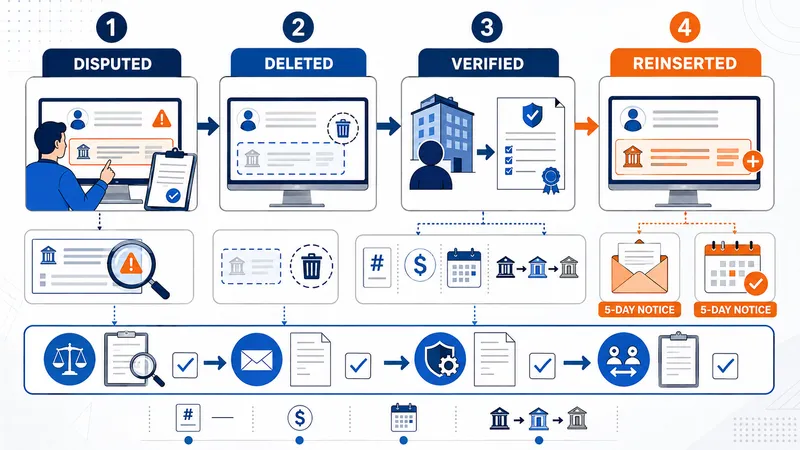
A deletion does not always mean the debt was proven invalid. The bureau may have removed the collection because the furnisher did not verify it within the investigation period. If the collector later certifies that the account information is complete and accurate, the bureau may reinsert it. Under the Fair Credit Reporting Act, the bureau must generally notify you within five business days of a qualifying reinsertion.
The most important document is often the original dispute result, not the new collection entry. When we review these cases at ASAP Credit Repair, that result helps separate a temporary deletion from a collector-approved removal, an identity theft block, or an account that returned under a different company name. Treating every reappearance as the same problem can lead to another failed dispute.
Do not assume the returning collection is automatically accurate or automatically illegal. Compare the account number, balance, original delinquency date, collector, and deletion notice first. This guide explains how to identify what changed, check whether the reinsertion rules were followed, and challenge information that remains inaccurate or unverifiable.
What To Do When a Deleted Collection Came Back
When a deleted collection comes back, compare the new entry with your original dispute results before disputing it again. Check the collector, balance, account number, and delinquency date, then request the reinsertion notice and verification details.
The process below shows what to review and where to challenge inaccurate information.
Why Did a Deleted Collection Come Back on My Credit Report?
A deleted collection can legally reappear, called reinsertion, if the furnisher later certifies to the credit bureau that the information is accurate and complete. It can also reappear illegally if the bureau skips that certification, fails to send you the required notice, or a debt buyer re-reports the same account under a different name after purchasing it.
The word for this is reinsertion, and it catches almost everyone off guard because a deletion feels final. It rarely is, by design. The dispute process is meant to remove information the furnisher cannot verify in time, not information that is permanently gone. If the original creditor or a debt buyer later comes back with certification that the debt is theirs and accurate, the bureau is allowed to put it back.
The problem is that "allowed to" comes with hard requirements the bureaus frequently skip. That gap between what the law requires and what actually happens in practice is where most reinsertion complaints originate.
See Exactly What Came Back and Why
A reinserted collection often means a paper trail was skipped somewhere. A free credit analysis shows what changed on your report and whether the reinsertion followed the law.
Start My Free Credit Analysis Now → Secure · 2 minutes · No credit card requiredIs Reinsertion Even Legal Under the FCRA?
It can be, but only under narrow conditions. Under 15 U.S.C. Section 1681i(a)(5)(B), a credit bureau may not reinsert previously deleted information unless the furnisher certifies the information is complete and accurate, and the bureau notifies the consumer in writing within 5 business days of the reinsertion.
The statute itself is specific: information deleted after a dispute cannot go back on your file unless the furnisher certifies, in writing, that it is complete and accurate. That certification is not optional paperwork. It is the entire legal basis for putting the item back. Without it, the reinsertion is unlawful on its face, regardless of whether the underlying debt is real.
The furnisher certifies the debt is accurate in writing, and the bureau sends you notice within 5 business days naming who certified it.
The account reappears with no certification on file, no notice sent, or a notice that arrives well past the 5-day window.
What Notice Are Credit Bureaus Required to Send You?
The bureau must send written notice within 5 business days of the reinsertion, including a statement that the information was reinserted, the name, address, and phone number of the furnisher who certified it, and a notice of your right to add a statement disputing the information's accuracy.
In practice, this notice is the piece most people never receive. A real forum post from the myFICO community captures the exact pattern: a consumer disputed and won a deletion, the account reappeared weeks later, and neither the collection agency nor any of the three bureaus ever sent a reinsertion notice.
A missing notice is not a technicality. It is the exact failure the statute exists to prevent, and it is one of the easiest reinsertion violations to prove, since the absence of a letter is straightforward to document.
Why Do Debt Buyers Reinsert Collections Under a New Name?
When a debt is sold to a new collection agency or debt buyer, the new owner can report it as a fresh tradeline under its own company name. Because the account now looks different to the bureau's system, it can slip back onto a report even though the original version was disputed and removed.
This is one of the most common ways a deleted debt effectively comes back without technically triggering the reinsertion rules on paper. The original creditor's tradeline stays deleted. A debt buyer that purchased the account afterward reports it as a brand-new collection, under its own name, with a new account number. To the bureau's matching system, it can look like an unrelated debt rather than the same one you already fought to remove.
| Scenario | Is It Reinsertion? | What Applies |
|---|---|---|
| Same furnisher, same account, reappears | Yes, classic reinsertion | Certification and 5-day notice required |
| Debt sold, new agency reports it fresh | Functionally, often not on paper | Still disputable as inaccurate or unverifiable |
| Bureau system error restores old data | Yes, and unlawful without certification | Demand deletion and file a fresh dispute |
| Identity theft account resurfaces | Yes, and a distinct violation | FCRA identity theft block provisions apply |
What Should You Do If a Collection Comes Back Illegally?
Pull your credit reports to confirm the reinsertion, check whether you ever received the required 5-day notice, and send a new dispute demanding proof of certification. If the bureau cannot produce it, the item must come down again, and the missing notice itself can become the basis of a separate complaint.
- ✓ Pull all three reports and screenshot or save the reinserted entry with the date it reappeared
- ✓ Check your mail and bureau account for the 5-day reinsertion notice; if it never arrived, document that gap
- ✓ Dispute again, specifically demanding the furnisher's written certification of accuracy
- ✓ File a complaint with the CFPB if the bureau cannot produce certification or notice
- ✓ Keep every letter, dispute confirmation, and report pull with dates, this is your evidence trail
Can You Sue Over an Illegal Reinsertion?
Yes. Under 15 U.S.C. Section 1681n, a willful FCRA violation can entitle you to statutory damages between $100 and $1,000 per violation, actual damages, and attorney's fees. Courts have awarded five-figure judgments in related credit reporting accuracy cases.
These cases are not hypothetical. In one 2025 federal case, a court awarded a consumer more than $17,000 in damages and attorney's fees after a collection agency continued reporting a delinquent account well past its legal reporting window, despite the consumer's dispute. The court found the agency's continued reporting after notice of the dispute was a willful violation, not an innocent mistake. Reinsertion cases follow the same legal logic: once a bureau or furnisher is on notice of a problem, continuing to report or reinsert without following the rules stops looking like a clerical error.
The CFPB itself has taken this seriously at the highest level. In January 2025, the agency sued Experian directly, alleging the company failed to properly investigate disputes and failed to prevent the improper reinsertion of previously deleted information, among other FCRA violations. That litigation was still active as of mid-2026, underscoring that reinsertion failures are not a fringe complaint but a documented, ongoing pattern at the largest bureaus.
A deletion is not a guarantee, but reinsertion is not a free pass either. The law requires proof and paperwork before an item comes back, and when that paperwork is missing, you have real leverage, not just a complaint.
Reinsertion is legal only when the furnisher certifies accuracy in writing and the bureau sends you notice within 5 business days. Both requirements are frequently skipped, and CFPB complaint data and active litigation against Experian confirm this is a widespread, documented problem. When either step is missing, you have grounds to dispute again and, in serious cases, pursue statutory damages.
Why did a deleted collection come back on my credit report?
A deleted collection can legally reappear, called reinsertion, if the furnisher later certifies to the credit bureau that the information is accurate and complete. It can also reappear illegally if the bureau skips that certification, fails to send you the required notice, or a debt buyer re-reports the same account under a different name after purchasing it.
Is reinsertion of a deleted collection legal under the FCRA?
It can be, but only under narrow conditions. Under 15 U.S.C. Section 1681i(a)(5)(B), a credit bureau may not reinsert previously deleted information unless the furnisher certifies the information is complete and accurate, and the bureau notifies the consumer in writing within 5 business days of the reinsertion.
What notice are credit bureaus required to send after reinsertion?
The bureau must send written notice within 5 business days of the reinsertion, including a statement that the information was reinserted, the name, address, and phone number of the furnisher who certified it, and a notice of your right to add a statement disputing the information's accuracy.
Why do debt buyers reinsert collections under a new name?
When a debt is sold to a new collection agency or debt buyer, the new owner can report it as a fresh tradeline under its own company name. Because the account now looks different to the bureau's system, it can slip back onto a report even though the original version was disputed and removed.
Can you sue over an illegal reinsertion?
Yes. Under 15 U.S.C. Section 1681n, a willful FCRA violation can entitle you to statutory damages between $100 and $1,000 per violation, actual damages, and attorney's fees. Courts have awarded five-figure judgments in related credit reporting accuracy cases.
Don't Let an Illegal Reinsertion Sit on Your Report
If a deleted collection came back without the certification or notice the law requires, you may have grounds to get it removed again, and more. Get your free credit analysis and find out exactly what happened.
Claim My Free Credit Analysis Now → Secure · 2 minutes · No credit card required-
How to Dispute Credit Report Errors (Step-by-Step Guide) Walks through the full dispute process, useful for filing a fresh dispute after an illegal reinsertion.
-
Collection Agency Won't Delete After Payment? What to Do Next Covers your FCRA and FDCPA rights, including statutory damages, when a collector won't honor an agreement.
-
Credit Corp Solutions: Scam or Legit Collector? Explains how debt buyers report purchased accounts, directly relevant to the new-name reinsertion pattern above.