
Are Texans drowning in debt?
A client came to us recently with a problem I have seen many times over my 15 years in credit repair. He had a steady income and paid his bills, but his debt kept growing anyway. A car repair went on a credit card. Then came a medical bill. Minimum payments took care of neither, and interest kept adding to the balance each month. Within a short period, he was using one card to cover expenses that his paycheck used to handle.
He did not have one major financial disaster. Several smaller debts had simply started working against him at the same time.
Being in the finance industry and reviewing credit reports for more than 22,000 clients, this is one of the clearest patterns I see among people struggling with debt.
Credit card balances, medical expenses, auto payments, and everyday living costs begin competing for the same paycheck. Once high-interest debt enters that cycle, making every payment on time does not always mean the balance is going down.
The statewide numbers show that this is not an isolated household problem. Texans collectively carry billions of dollars in credit card debt, while mortgages, auto loans, medical bills, and other obligations add another layer to household finances. But the amount owed is only part of the story. The reasons Texans fall into debt often explain more than the balance itself.
Below, I break down the most common debt patterns I see in real credit files, why they become difficult to escape, and what tends to help once the balances start piling up.
Are Texans Drowning in Debt?
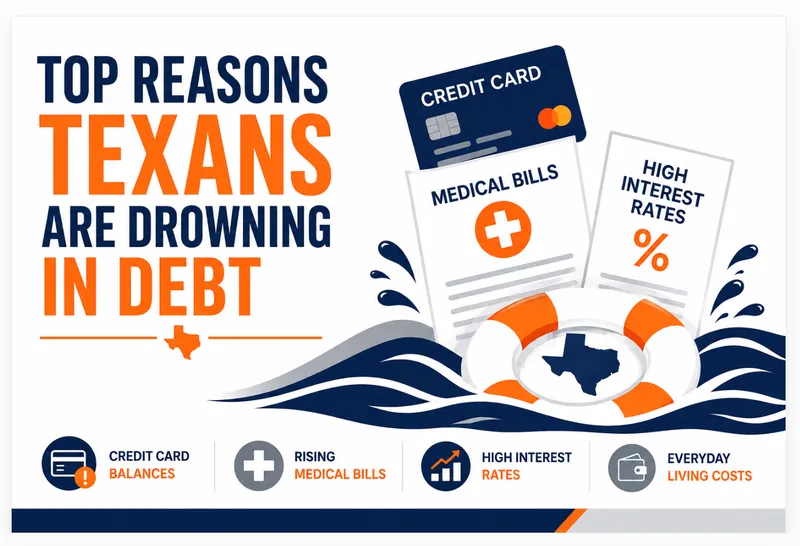
Texans are drowning in debt because credit card balances, medical bills, and high interest rates are rising faster than most household incomes. The average Texas household now carries $12,485 in credit card debt, and Texans collectively owe over $119 billion just in credit card balances. That number does not even include mortgages, auto loans, or medical bills. Texas ranks second in the nation for the largest increase in credit card debt, and eight Texas cities sit in the top ten nationally for collection account problems. This article breaks down the real reasons behind that debt, city by city, and what actually helps once it piles up.
Why Is Texas Debt Growing So Fast?
Texas debt is growing because cost of living is outpacing wage growth, credit card APRs average 23.4 percent, and Texas has the highest uninsured rate in the country at 18 percent, pushing medical costs onto credit cards. Rising property taxes and fluctuating energy sector income add further pressure.
A few forces are driving Texas debt growth at once. Rising cost of living is outpacing wage growth in most Texas metro areas. High interest rates mean credit card balances grow faster even when spending stays flat, and the average Texas credit card APR sits around 23.4 percent. Texas has the highest uninsured rate in the country at 18 percent, which pushes more medical costs onto credit cards and payment plans.
Energy sector income often fluctuates, making it harder to build a steady debt payoff plan. Property taxes in Texas run higher than many states, averaging $3,872 a year per resident, adding pressure to household budgets that already carry other debt. Debt collection activity is climbing fast too. Houston saw a 179.4 percent year-over-year increase in debt collection complaints, and Dallas-Fort Worth saw a 167.9 percent increase over the same period.
How Does Texas Debt Compare City by City?
Austin carries the highest non-mortgage debt among major Texas cities at $45,920 per resident, followed by San Antonio at $44,812 and Houston at $44,640. Every major Texas metro sits above the $37,827 national average, with auto loans as the leading driver in each city.
| City | Avg. Non-Mortgage Debt | Avg. Auto Loan Debt | Notable Driver |
|---|---|---|---|
| Austin | $45,920 | $17,144 | Highest credit card debt among major TX cities |
| San Antonio | $44,812 | $18,303 | Highest auto loan burden in the state |
| Houston | $44,640 | $16,357 | Highest student loan debt among top TX cities |
| Dallas | $43,901 | Not separately reported | 6th highest non-mortgage debt nationally |
| National Average | $37,827 | — | For comparison |
What Types of Debt Are Texans Carrying the Most?
Credit card debt is the most common form of debt in Texas, held by nearly 60 percent of adults. Medical debt affects roughly one in four Texas consumers. Collections accounts appear on 32 percent of Texas credit files, and 13.3 percent of Texas student loan balances are 90 or more days past due.
The average Texan owed $60,000 in total debt in 2025, according to USAFacts. That figure includes mortgages, auto loans, student loans, and credit cards.
| Debt Type | Texas Figure | Notes |
|---|---|---|
| Credit card debt | $8,200 – $12,485 per household | Varies by data source |
| Medical debt | ~25% of TX consumers | Higher than the national average |
| Collections accounts | 32% of TX credit files | One of the highest rates nationally |
| Student loan debt (90+ days past due) | 13.3% of TX balances | Nearly tripled since 2006, adjusted for inflation |
| Credit card holders | ~60% of TX adults | Most common loan type in the state |
Which Texas Cities Struggle Most With Collections?
Garland, Fort Worth, and Arlington lead the nation in collection account problems. Garland residents average 3.6 collection accounts each, the highest rate in the United States. Eight Texas cities rank in the national top ten for this metric.
Collection accounts are one of the clearest warning signs of household financial strain, and Texas cities dominate the national rankings in this category. Collection account balances in some Texas metro areas have risen more than 4 percent in just three months.
Why Does Medical Debt Hit Texans So Hard?
Texas has not expanded Medicaid eligibility, leaving more residents uninsured or underinsured than in expansion states. Emergency room visits often run $1,500 to $3,000 for uninsured patients, and about 41 percent of U.S. adults nationally carry some form of medical or dental debt.
That coverage gap shows up directly in medical debt numbers. A single hospital stay can push a family into thousands of dollars of debt almost overnight. Texas consistently ranks among the states with the highest medical debt burden in the country, alongside Mississippi, Alabama, and Georgia, all states that share the same non-expansion status under the Affordable Care Act.
This is where medical debt starts to look different from other kinds of debt. A credit card balance builds gradually. A medical bill can appear all at once, often after an emergency the person never planned for or could have prevented.
Can Debt From an Accident Be Different From Other Debt?
Yes. Debt caused by a car accident often results from something that happened to a person, not a spending decision. If another driver's negligence caused the crash, a personal injury claim can sometimes recover compensation covering those exact medical costs, a different resolution path than negotiating with a collections agency.
This is one of the more overlooked categories. Emergency care, follow-up treatment, and lost income while recovering can stack up fast, and that debt frequently ends up on a credit report the same way any other unpaid bill would, even though the person never chose to take it on.
If that debt resulted from someone else's negligence, the person may have options beyond simply paying it off. A personal injury attorney, such as Sutliff & Stout in Houston, can investigate whether the at-fault driver's insurance should be covering those medical costs directly, which is a very different path than negotiating a settlement with a collections agency after the fact.
Typically negotiated directly with the provider or collections agency, or addressed through a debt management program.
Worth reviewing with a personal injury attorney before assuming the bill is the injured person's sole responsibility.
What Can Texans Actually Do About Mounting Debt?
- ✓ Pull a full credit report and check every account for accuracy, especially medical collections
- ✓ Dispute any account that is inaccurate, outdated, or unverifiable under the Fair Credit Reporting Act, as outlined by the Consumer Financial Protection Bureau
- ✓ Prioritize high-interest debt first, since Texas APRs average above 23 percent
- ✓ Separate accident-related medical debt from ordinary debt, since it may have a different resolution path
- ✓ Consider a debt management program for unsecured debt
- ✓ Work with a credit repair company or nonprofit credit counselor if collections accounts are dragging down your score
Debt does not disappear overnight, and no legitimate company can promise a guaranteed score increase or the removal of accurate negative information. What actually helps is understanding exactly where the debt came from, correcting what is wrong, and building a realistic plan for what is left.
Texans are carrying some of the highest household debt totals in the country, and the numbers back it up at every level, statewide, city by city, and account by account. Medical debt plays an outsized role, and not all of it comes from financial mismanagement. Some of it, especially debt tied to an accident, may not even be the injured person's financial responsibility to begin with.
Why is Texas debt growing so fast?
Cost of living is outpacing wage growth, credit card APRs average 23.4 percent, and Texas has the highest uninsured rate in the country at 18 percent, pushing medical costs onto credit cards. Property taxes and fluctuating energy sector income add further pressure. Texas ranks second nationally for the largest increase in credit card debt.
What types of debt do Texans carry the most?
Credit card debt is the most common, held by nearly 60 percent of Texas adults, averaging $8,200 to $12,485 per household. Auto loan debt follows at around 40 percent of adults. Medical debt affects roughly one in four Texas consumers, and collections accounts appear on 32 percent of Texas credit files.
Which Texas cities have the worst debt problems?
Garland, Fort Worth, and Arlington lead the nation in collection account problems, with Garland residents averaging 3.6 collection accounts each. Austin carries the highest non-mortgage debt among major Texas cities at $45,920 per resident, followed by San Antonio and Houston.
Can debt from a car accident be different from other debt?
Yes. Debt caused by a car accident or injury often results from something that happened to a person rather than a spending choice. If another driver's negligence caused the accident, a personal injury claim may cover those medical costs directly, which is a different resolution path than negotiating with a collections agency.
What can Texans do about mounting debt?
Pull a full credit report and dispute inaccurate or unverifiable accounts under the Fair Credit Reporting Act, prioritize high-interest debt first, separate accident-related medical debt from ordinary debt, and consider a debt management program or credit repair service for collections accounts dragging down a score.
Want to Know What Is Actually Dragging Your Score Down?
A collections account, a reporting error, or high utilization could be costing you more points than you realize. A free 3-bureau audit shows exactly what Equifax, Experian, and TransUnion currently report before you make any financial decision.
Get My Free 3-Bureau Audit → Secure · 2 minutes · No credit card required-
Why Credit Is Important: What Your Score Really Controls Explains what a stronger score unlocks in practice, from mortgage rates to housing approvals and job screening, once debt is under control.
-
Empower Your Wallet: Overcome Credit Card Debt Breaks down how late payments and charge-offs snowball, and the strategies that help rebuild credit once a balance has gone to collections.
-
Emergency Home Repairs: How to Pay Without Hurting Your Credit Covers how to handle a sudden, unplanned expense, medical, home, or otherwise, without letting it turn into long-term credit damage.