

Removing dispute comments before a mortgage approval. This is an instruction worth questioning before you act, especially with a closing date approaching.
Ask your loan officer to identify the account and explain the requirement behind the request.
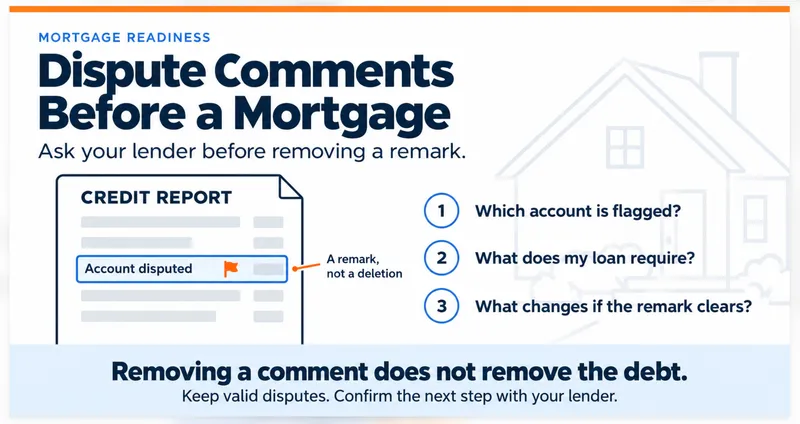
A dispute remark tells a lender that you challenged information on your credit report. Removing that remark leaves the underlying account in place, including its reported balance and payment history.
Not every mortgage file requires removal. Fannie Mae’s August 2026 guidance says no further action on disputed accounts is necessary when Desktop Underwriter issues an Approve recommendation with those accounts included.
For borrowers, that makes the lender’s explanation more useful than a blanket instruction to clear every dispute. The next step depends on the underwriting result, the account’s accuracy and any additional lender requirements.
If you disputed a payment that was reported late incorrectly, clearing the comment does not correct the payment record. Withdrawing the dispute simply to move toward closing leaves that reporting problem unresolved.
At ASAP Credit Repair USA, our reviews examine account records, supporting documents and previous investigation results. Those details help establish what needs correction before a borrower requests changes.
Here’s what to ask your lender, how to check the status of each disputed account and when to pursue an update, finish an investigation or leave the remark alone.
Removing Dispute Comments Before a Mortgage: What to Ask Your Lender First
Remove dispute comments for mortgage approval only after you learn whether your lender's underwriting system treats the disputed account as a problem.
Here is how it usually goes. You disputed a collection months ago.
You applied for a mortgage, and your loan officer says the file shows "consumer disputes this account information" and needs it cleared.
That sentence is a dispute comment, also called a dispute remark or flag. It sits on one account.
It does not remove the account, erase the debt, or prove the dispute was wrong.
The remark is one of three separate things people mix up. The dispute comment is a note on the account.
The account itself is the debt and its payment history. The dispute is the legal process that questions whether the account is accurate.
You end the comment without touching the account. Or you win a dispute, delete the account, and watch the comment disappear with it.
Each path leads somewhere different for your score and your loan.
ASAP Credit Repair USA reviews disputed entries on credit reports every day, and we promise no approval and no deletion. This guide explains what dispute comments are, why lenders care, when removal helps and when it hurts, and the exact questions to ask your lender before you act.
A dispute comment is a note on a credit report account that tells lenders the consumer disputes it. Remove it only after your lender confirms the disputed account is blocking your approval. Then finish the dispute, or withdraw it in writing if the account is accurate and yours, and ask the lender to rescore. Never withdraw a valid dispute just to speed up closing.
What Is a Dispute Comment on a Credit Report?
A dispute comment is a remark the data furnisher attaches to an account after you dispute it. The remark tells anyone reading the report that the completeness or accuracy of the account is contested. It stays until the investigation ends and the furnisher updates the code, or until the dispute is withdrawn.
The Fair Credit Reporting Act (FCRA) is the reason these remarks exist. Under 15 U.S.C. § 1681s-2(a)(3), a furnisher that learns of your direct dispute must give notice of it when it keeps reporting the information.
Furnishers report the remark with a Metro 2 compliance condition code. A summary of the Metro 2 manual by the law firm Bryan Cave Leighton Paisner describes the three codes you will see most.
| Code | What It Says | When It Appears |
|---|---|---|
| XB | Account information disputed by consumer | While the furnisher is still investigating |
| XC | Investigation complete, consumer disagrees | After the investigation ends and you still disagree |
| XH | Previously disputed, investigation complete | After the investigation ends |
The Score Twist Nobody Mentions
The same summary reports that scoring models ignore the payment history and debt metrics of an entry carrying the XB code. The remark protects your score while the dispute is open.
That has a sharp consequence. When an XB remark clears on an accurate account, the late payment or high balance it was hiding starts counting again, and your score drops.
Removing a dispute comment is not a free win. It strips away protection the remark was giving your score. Ask your lender to run the numbers both ways before you decide.
Why Do Mortgage Lenders Care About Dispute Comments?
Underwriting systems cannot judge a disputed account the same way as an undisputed one. Fannie Mae's Desktop Underwriter re-runs the loan without disputed accounts, and FHA moves a loan to manual underwriting when disputed derogatory balances reach $1,000. Each outcome pushes work onto the lender and the borrower.
How Conventional Loans Handle Disputed Accounts
Fannie Mae's Selling Guide, section B3-5.3-09 (updated August 5, 2026), lays out a three-step process for Desktop Underwriter (DU) loans.
- DU assesses every account. It first evaluates the loan with the disputed accounts included. If it issues an Approve recommendation, no further documentation or action is necessary.
- DU re-runs without the disputed accounts. If the first pass is not an Approve, DU runs again without them. An Approve on the second pass sends the lender to investigate.
- The lender investigates. The lender checks whether you are responsible for each account and whether the reported information is accurate and complete.
If the account is yours and the information is accurate and complete, the loan is not eligible for delivery as a DU loan. The lender manually underwrites it if the transaction qualifies, and the monthly payments on the accounts go into your debt-to-income ratio.
Manual underwriting follows its own rule in section B3-5.2-03. When the credit reporting company confirms disputed information is incorrect and the file cannot be corrected before underwriting ends, the lender cannot use the credit score and judges your traditional credit history instead.
Fannie Mae also states that lenders are not required to investigate disputed medical tradelines. Medical accounts do not appear in the disputed-tradeline message.
How FHA Loans Handle Disputed Accounts
FHA draws a hard line. HUD Mortgagee Letter 2013-25 requires a downgrade to manual underwriting when disputed derogatory accounts total $1,000 or more.
Derogatory means disputed charge-offs, disputed collections, and disputed accounts with late payments in the last 24 months. Disputed medical accounts and documented identity theft disputes are excluded from the limit.
| Loan Type | What Happens With a Disputed Account | Source |
|---|---|---|
| Conventional, DU | DU re-runs without disputed accounts if the first pass is not an Approve. The lender then investigates | Fannie Mae B3-5.3-09 |
| Conventional, manual | If a confirmed error is not corrected in time, the lender cannot use the credit score | Fannie Mae B3-5.2-03 |
| FHA | Disputed derogatory accounts of $1,000 or more downgrade the loan to manual underwriting | HUD Mortgagee Letter 2013-25 |
| VA, USDA, and other programs | Ask the lender how it reviews disputes and which overlays apply | Lender policy |
Not Sure Which Disputes Are on Your Reports?
Start with your credit reports. A review shows which accounts carry dispute remarks, which entries are inaccurate, and what to raise with your lender.
Claim My Free Credit Analysis Now → Secure · 2 minutes · No credit card requiredShould You Remove the Dispute Comment Before Your Mortgage?
It depends on whether the account is accurate and whether the dispute is still open. Let a valid dispute finish. Withdraw a dispute only when the account is accurate and yours. Do nothing when the lender confirms the remark is not causing a problem.
| Your Situation | Best Move | Why |
|---|---|---|
| The account is inaccurate and the dispute is open | Let the investigation finish | Correction or deletion clears the remark and fixes the account |
| The dispute closed and the bureau corrected or deleted the entry | Confirm the reports show the update | The remark leaves with the corrected data |
| The dispute closed with a verified result and you still disagree | Add a short consumer statement and tell the lender | The lender reads your side without a new dispute |
| The account is accurate and yours, and the dispute is stale or mistaken | Withdraw the dispute in writing | The remark clears and the account scores normally, which includes the late payments |
| The lender says the AUS has no problem with the disputed account | Leave it alone | Removal adds risk and no benefit |
| The disputed account is medical | Ask the lender how it treats medical disputes | Fannie Mae and FHA exclude disputed medical accounts from their dispute rules |
Two Things Never to Do
What to Ask Your Lender First: 12 Questions
These questions turn a vague "remove the dispute" request into a plan. Ask them in writing and keep the answers in your file.
About the Underwriting Result
- Which system is running my file? Desktop Underwriter, Loan Product Advisor, or FHA's TOTAL Scorecard each treat disputes differently.
- Did the system flag a disputed account? Ask for the exact finding or message, not a summary.
- Which accounts triggered it? Get the creditor names and balances so you check the right entries.
- Does my loan program have a dollar limit? FHA uses $1,000 in disputed derogatory accounts. Ask whether your program has one.
About the Lender's Own Rules
- Do you add overlays on disputed accounts? Some lenders require every dispute cleared whatever the agency says.
- Do medical or identity theft exclusions apply? Both sit outside FHA's $1,000 limit with proper support.
- Which documents do you need? Typical requests are a written explanation, canceled checks, a creditor letter, or a police report.
- What happens if the account is accurate and mine? Ask whether the loan moves to manual underwriting and what that adds.
About Timing and Rescoring
- What proof of resolution do you need before a rescore? A creditor-confirmed correction usually carries the most weight.
- Will you order a rapid rescore, and who pays the fee? Only a lender orders one, and borrowers cannot request it directly.
- When will you re-pull my credit before closing? A dispute that is open on that date reaches the underwriter.
- If my score drops when the remark clears, what changes? Ask how the new score affects your rate, mortgage insurance, and eligibility.
How to Clear a Dispute Comment the Right Way
- Pull all three reports. Remarks differ by bureau, so check each one at AnnualCreditReport.com.
- Match each remark to the lender's request. Clear only the accounts the lender names.
- Check the dispute status. Find out whether each dispute is open, closed with a correction, or closed as verified.
- For an open, valid dispute, let it finish. A bureau has 30 days to reinvestigate, or 45 days if you send relevant new information in that window, under FCRA Section 611. Give your lender that date.
- For an accurate account you no longer dispute, withdraw in writing. Send the furnisher and the bureau a short letter, and keep proof of delivery.
- For a closed dispute with a lingering remark, ask the furnisher to update the code. The Metro 2 manual advises furnishers to update the code to show the investigation is complete.
- Send proof to your loan officer. Include the bureau's updated report, the furnisher's confirmation, or both.
- Let the lender order the rescore. Capital One's explainer puts rapid rescoring at three to five business days, citing Equifax.
- Check the new report. Confirm the remark is gone, the score moved as expected, and nothing else changed.
What a Rapid Rescore Does and Does Not Do
A rapid rescore pushes a confirmed account update through the bureaus in days instead of weeks. The lender submits proof and pays the bureau fee.
It raises a score by only a few points in most cases, and it does not remove negative items. It reflects updates that are already true.
What About a Consumer Statement Instead of Removal?
A consumer statement is a note of up to 100 words that explains your side. Equifax describes it as an optional statement that lenders see when they view your Equifax report.
The statement attaches to one bureau only, so repeat it at the others if you want it there. Keep it short and factual, and leave out personal or medical details, since anyone who views the report reads it.
Use a statement when a dispute closed with a verified result you still contest. It gives the underwriter your version without opening a new dispute in the middle of your loan.
Dispute Comment vs Removing the Account: Know Which Goal You Have
| Your Goal | The Tool | What You Get |
|---|---|---|
| Clear the dispute remark | Finish or withdraw the dispute, then update the code | The account stays and scores normally |
| Remove an inaccurate account | A documented dispute with the bureau and the furnisher | Deletion or correction if the furnisher cannot verify the entry |
| Remove an accurate account | None. Accurate negative information stays reportable | The FTC puts most items at seven years and bankruptcy at ten |
| Reduce the account's weight in underwriting | Payment arrangement, payoff, or lender-specific treatment | Depends on the loan program and the lender |
Mixing these goals causes most of the pain. A borrower who wants the account gone but only gets the remark cleared ends up with a lower score and the same debt.
When Should You Dispute Before a Mortgage?
Earlier is better: 719 Lending recommends starting disputes two to three months before you apply, so the correction and the remark both finish in time. Alpine Mortgage urges reviewing your credit months ahead for the same reason.
Both lenders call opening a new dispute after you apply the most common avoidable mistake. An active dispute at the credit pull conditions the file, pushes some FHA files over $1,000, and delays closing by days.
Tell your loan officer before you file any dispute once a loan is in process. The lender decides whether to pause the file, wait, or adjust the plan.
A Hypothetical Walk-Through
Consider a hypothetical buyer who disputed a $640 collection in the spring. The buyer applies for an FHA loan in summer, and the lender flags the disputed collection.
| Step | What Happens |
|---|---|
| 1. Flag | The lender reports a disputed collection on the file |
| 2. Check the line | $640 is below FHA's $1,000 disputed derogatory limit, so no downgrade applies |
| 3. Ask | The buyer asks whether the lender adds an overlay that requires the dispute cleared |
| 4a. Overlay applies | The buyer asks about the dispute status, then lets it finish or withdraws it if the collection is accurate |
| 4b. No overlay | The buyer leaves the dispute open and keeps the remark's protection |
| 5. Rescore | The lender orders a rapid rescore if anything changes |
Without the questions, this buyer withdraws the dispute for nothing and watches the score fall. With them, the buyer picks the cheaper path.
When Does Professional Credit Repair Make Sense Before a Mortgage?
Some borrowers dispute the same account repeatedly and never learn why the remark or the entry stays. Timing and evidence both matter, and a mortgage deadline leaves little room to guess.
A review checks ownership, balances, dates, payment history, and prior dispute results. ASAP Credit Repair USA helps consumers identify and address credit-report inaccuracies, and credit repair does not replace repaying an accurate debt or guarantee a lender's decision.
For more on how disputes work, read our guides to disputing credit report errors and why credit disputes fail.
Not Sure What's Hurting Your Credit?
Start by reviewing your credit reports. ASAP Credit Repair USA helps consumers identify inaccurate account information and understand the appropriate steps for addressing reporting errors.
Review My Credit Report → Secure · 2 minutes · No credit card requiredFrequently Asked Questions About Removing Dispute Comments for a Mortgage
What is a dispute comment on a credit report?
A dispute comment is a remark on an account that tells lenders the consumer disputes its accuracy or completeness. The furnisher reports it with a compliance condition code. It stays until the investigation ends and the furnisher updates the code, or until you withdraw the dispute in writing.
Do I need to remove dispute comments before applying for a mortgage?
Not always. Fannie Mae's Desktop Underwriter assesses disputed accounts first, and an Approve recommendation requires no further action. Removal matters when the system flags the disputed account, or when FHA disputed derogatory accounts reach $1,000. Ask your lender before you act.
Does removing a dispute comment remove the account?
No. The comment is a note on the account, and the debt, balance, and payment history remain. Only a successful dispute of an inaccurate entry, or the end of the reporting period, takes an account off your report. Clearing the remark leaves a legitimate account in place.
Will my credit score drop if the dispute comment is removed?
Yes, on an accurate account. A summary of the Metro 2 manual reports that scoring models ignore the payment history and debt metrics of accounts carrying the XB dispute code. When the remark clears on an accurate account, those details count again, which lowers the score. Ask your lender to test both outcomes before you withdraw anything.
How long does a dispute comment stay on a credit report?
An open dispute carries the remark until the furnisher completes the investigation and updates it. A bureau has 30 days to reinvestigate, or 45 days with relevant new information, under the FCRA. Some remarks linger after closure as completed-investigation codes, so confirm the update on every bureau.
Who removes a dispute comment: you or the lender?
Neither one directly. The furnisher controls the remark, and the bureau reports it. Your lender collects proof and orders a rapid rescore once the update is confirmed. Capital One's explainer states borrowers cannot request a rapid rescore themselves, and it takes three to five business days.
Does FHA require disputes to be removed?
FHA does not require removal as a blanket rule. HUD Mortgagee Letter 2013-25 downgrades a loan to manual underwriting when disputed derogatory accounts total $1,000 or more. Disputed medical accounts and documented identity theft disputes are excluded. Lenders add stricter overlays of their own, so ask yours.
Should I withdraw a valid dispute to close faster?
No. A valid dispute is how you correct an inaccurate account, and withdrawing it leaves the error in place. Offer the lender documents and the investigation deadline instead. Withdraw only when the account is accurate and yours, and the lender confirms removal solves a real underwriting problem.
What is a consumer statement, and is it better than removal?
A consumer statement is a note of up to 100 words that explains your side. Lenders see it when they view that bureau's report. Use it when a dispute closed with a verified result you still contest. It does not clear a remark or change the account.
Is it safe to dispute accounts right before applying for a mortgage?
Rarely. 719 Lending advises starting disputes two to three months early, and Alpine Mortgage warns against new disputes mid-application. A new dispute during an active application conditions the file, pushes some FHA loans past $1,000 in disputed derogatory accounts, and delays closing. Tell your loan officer first.
What proof does a lender need to rescore after a dispute?
Lenders typically want creditor-confirmed proof, such as the furnisher's correction letter or an updated bureau report. For disputed accounts you are not responsible for, Fannie Mae requires supporting documentation. Ask your lender for its exact list before you gather papers.
Does credit repair guarantee my dispute comments get cleared?
No. Credit repair corrects inaccurate reporting and guarantees no deletion, score change, or lender decision. The Credit Repair Organizations Act bars a provider from charging before the service is fully performed. Furnishers and bureaus control the remarks, and lenders control underwriting.
Clearing a dispute comment is a tool, not a goal. Learn what your lender actually needs, finish valid disputes, withdraw only what is accurate, and let the lender run the rescore.
-
How to Dispute Credit Report Errors (Step-by-Step Guide) Pull your reports, document errors, and dispute them with the bureaus.
-
Why Some Credit Disputes Fail (And How to Fix Them) Why vague, undocumented disputes come back verified.
-
What Should Be On Your Dispute Letter? What to include in a letter disputing a credit report error.
-
Why You Got Approved for Pre-Mortgage Then Denied at Closing What changes between pre-approval and final underwriting.
- Fannie Mae Selling Guide B3-5.3-09 — DU credit report analysis, disputed credit report tradelines (August 5, 2026)
- Fannie Mae Selling Guide B3-5.2-03 — Accuracy of credit information in a credit report (July 25, 2017)
- U.S. Department of Housing and Urban Development — Mortgagee Letter 2013-25, disputed derogatory credit accounts
- Bryan Cave Leighton Paisner — Use of compliance condition codes (Metro 2)
- 15 U.S.C. § 1681i — Fair Credit Reporting Act, procedure in case of disputed accuracy
- 15 U.S.C. § 1679b — Credit Repair Organizations Act, prohibited practices
- Federal Trade Commission — Credit Repair: How to Help Yourself
- Capital One — Rapid rescore: what to know (February 29, 2024)
- Equifax — What is a consumer statement?
- 719 Lending — Disputing credit report errors before a mortgage (July 2026)
- Alpine Mortgage — Disputed accounts and your mortgage application (August 2026)
- AnnualCreditReport.com — Free credit reports