

Free credit repair is not a myth. Every tool a paid credit repair company uses is legally available to you at no cost. Dispute letters, goodwill requests, debt validation, and bureau investigations, the FCRA gives you full access to all of it.
I own a credit repair company, and I am FCRA-certified. This is one of my favorite topics to explain, because the "secret" is not complicated. One of the most unforgettable accounts I have heard came from a client who paid $1,200 to a credit repair company over eight months. When she came to us, her score had barely moved. We reviewed her file and found three reporting errors and one outdated collection. We showed her how to dispute them herself. Sixty days later, her score jumped 58 points at zero additional cost.
The data behind this is staggering. A 2024 Consumer Reports study found that 44% of people who checked their credit reports found at least one error. Of those, 27% found account information errors, late payments that were made on time, collections that belonged to someone else, or accounts they never opened. (Source: Consumer Reports Credit Checkup Study, 2024) The FTC confirmed this pattern years earlier, finding that 5% of consumers had errors significant enough to push them into a worse credit risk tier, meaning higher interest rates on every loan they took. (Source: FTC Credit Report Accuracy Study)
Errors on credit reports cost Americans real money every day. The fix is free. Here is exactly how to do it.
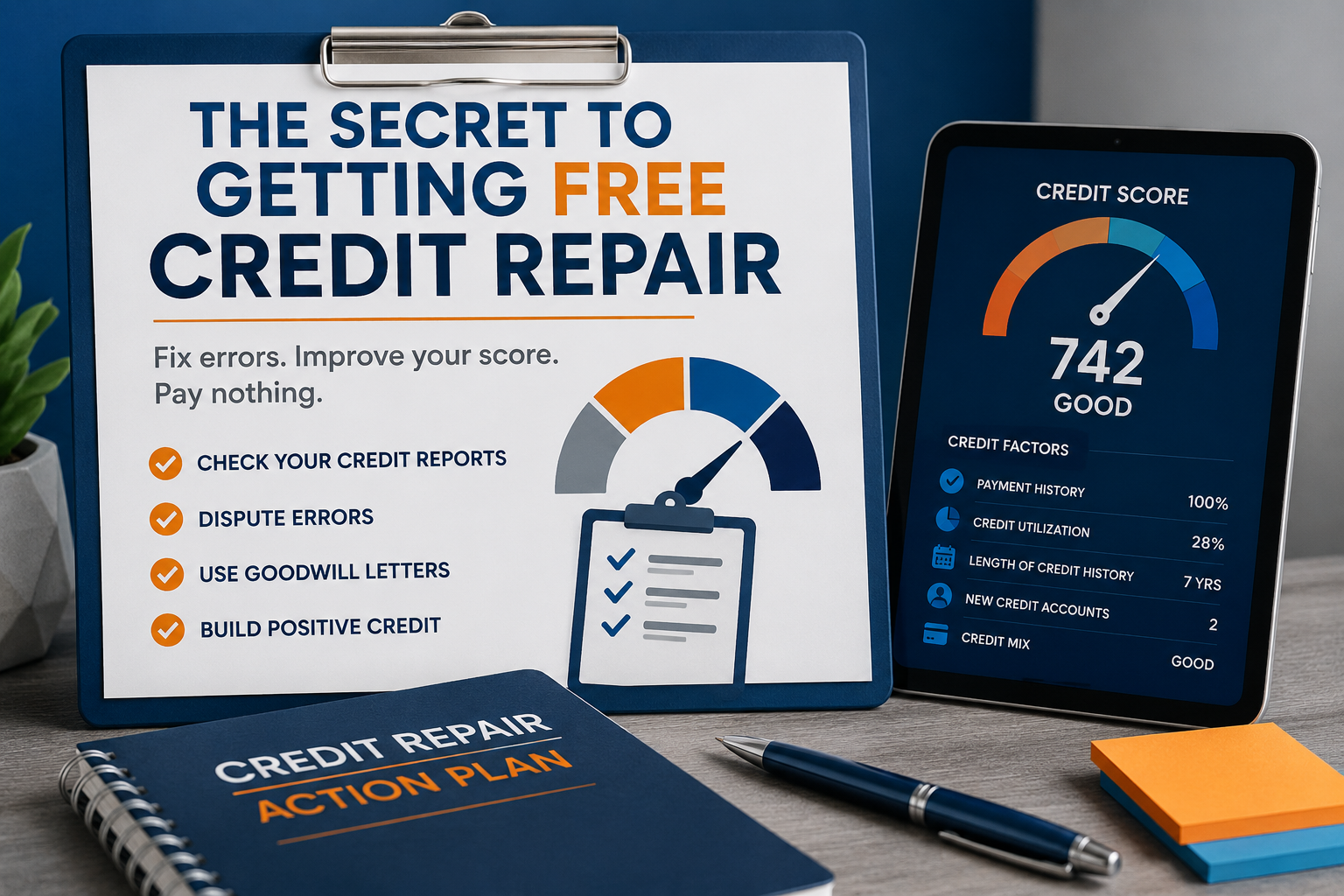
Is Free Credit Repair Actually Possible?
Yes. Everything a paid credit repair company can legally do, you can do yourself for free. This is not an opinion; the FTC states it directly on its consumer advice page. (Source: FTC Consumer Advice)
Paid services charge between $50 and $150 per month to send dispute letters and make phone calls on your behalf. They cannot remove accurate negative information. They cannot access special systems or fast-track processes that the bureaus hide from the public. They use the same portals and the same FCRA rights that you already have.
The only real advantage of a paid service is time. They do the work for you. If you have dozens of errors across all three bureaus and cannot dedicate a few hours to the process, professional help makes sense. But for most people with a handful of errors or one or two negative marks, the DIY process works just as well, and it costs nothing.
How to Pull Your Credit Report for Free
The first step in free credit repair is pulling all three of your credit reports. You need Equifax, Experian, and TransUnion, not just one.
Go to AnnualCreditReport.com, the only federally authorized source for free credit reports. As of 2026, federal law entitles you to free weekly access to all three reports. That means you can pull them every single week at no cost.
Equifax also provides six free reports per year directly through its own website at equifax.com, in addition to your weekly reports through AnnualCreditReport.com.
Do not use third-party sites that ask for credit card information to access "free" reports. The only site the FTC authorizes for free reports is AnnualCreditReport.com. Every other site that requires a card is a subscription service.
What to look for on each report
Pull all three reports and compare them side by side. Not every creditor reports to all three bureaus, so an error on one report may not appear on another.
Look for these specific issues on each report:
Accounts you do not recognize signal identity theft or a mixed file.
Late payments on accounts you paid on time are the most common error type.
Collections that were already paid or settled but still show as open.
Accounts listed as open that you closed or closed that you did not close.
Balances that are higher than your actual current balance.
Negative items older than seven years must fall off after this point.
Bankruptcies older than ten years, which must also be removed.
Hard inquiries you did not authorize.
Make a list of every item that looks incorrect, outdated, or unrecognizable. Note which bureau reports it and the exact account details shown.
How to Dispute Errors on Your Credit Report for Free
Disputing errors is free, legal, and protected under the Fair Credit Reporting Act. Once you file a dispute, the bureau must investigate within 30 days. If the creditor cannot verify the item with complete documentation, the bureau must remove it.
Last year, our office reviewed 114 credit files as part of initial consultations. In 67 of those files, we found at least one disputable item that the client had never noticed. In 41 of those cases, the item was removed through a simple dispute letter with no professional fees involved.
How to file a dispute online
All three bureaus accept disputes through their websites:
Equifax: equifax.com/personal/credit-report-services
Experian: experian.com/disputes
TransUnion: transunion.com/credit-disputes
Online disputes are fast and convenient. Log in, select the item you are disputing, and state your reason. Upload any supporting documentation, bank statements, payment confirmations, and court records that prove your case.
How to file a dispute by certified mail
Mailing a dispute gives you a stronger paper trail. Send your letter via certified mail with a return receipt requested so you have timestamped proof of delivery. The 30-day investigation clock starts when the bureau receives your letter.
Your dispute letter should include:
Your full name, address, and date of birth.
The name of the bureau you are writing to.
The specific account you are disputing, with the account number as shown on the report.
A clear explanation of what is incorrect and why.
Copies (not originals) of any supporting documents.
A request for written confirmation of the investigation results.
The FTC provides free sample dispute letter templates at consumer.ftc.gov. The CFPB also provides downloadable templates at consumerfinance.gov.
What happens after you dispute
The bureau forwards your dispute to the creditor who reported the item. The creditor must review it and respond within the investigation window. If they verify the item, it stays. If they cannot verify it or do not respond in time, the bureau must remove or correct it.
After the investigation closes, you receive a written summary of the results. If the item was removed, you can request that the bureau notify anyone who pulled your credit in the past six months.
If the dispute is denied and you believe it should have been removed, you have the right to add a 100-word statement to your file explaining your position. You can also escalate by filing a complaint with the CFPB at consumerfinance.gov/complaint.
By this point, you know how to pull your reports and dispute errors. Those two steps alone resolve the majority of free credit repair cases. The next section covers what to do when the negative item is accurate, but you still want it gone.
What Is a Goodwill Letter and Does It Work?
A goodwill letter is a written request to a creditor asking them to remove an accurate negative mark, typically a late payment, as a courtesy. You are not disputing an error. You are asking for forgiveness.
Goodwill letters work best in specific situations:
The late payment was a one-time incident, not a pattern.
You have an otherwise strong payment history with that creditor.
The missed payment had a documented cause: a medical emergency, job loss, a move, or an autopay failure.
You have since brought the account fully current.
Large national banks, like Chase and Bank of America, typically decline goodwill requests as a matter of policy. They cite their legal obligation to report accurate payment history. Smaller lenders, credit unions, and regional banks are more likely to grant them.
The process costs nothing. Write a short, polite letter. One page is enough. Own the mistake fully. Explain what happened specifically. Show what has changed. Make the ask clearly and thank them for their time. Send it by certified mail directly to the creditor's credit reporting or customer relations department. Do not send it to the credit bureaus; they do not process goodwill requests.
If you send a goodwill letter and receive no response after 30 days, send a follow-up. Reaching a different representative the second time around sometimes produces a different result.
How to Add Positive Accounts for Free
Disputing errors removes damage. Adding positive accounts builds your score from the other direction. Several tools do this at no cost.
Experian Boost
Experian Boost is a free feature that adds your on-time utility, cell phone, streaming service, and rent payments to your Experian credit file. These payments are not normally reported to bureaus. Adding them can produce an immediate score increase for users with thin credit files.
Enroll directly at experian.com/boost. The tool connects to your bank account, identifies qualifying payments, and adds them to your report. The average user sees a score increase, though the exact amount varies by credit profile.
Rent reporting services
Rent is typically the largest monthly payment most consumers make, and it does not build credit unless you report it. Several services now report rent payments to all three bureaus.
Free options include Piñata, which reports to TransUnion. Paid options like Rental Kharma and Boom report to multiple bureaus for a small monthly fee. If your landlord uses a rent collection platform, check whether they already report to any bureaus.
Credit builder loans
Credit builder loans are designed for people rebuilding credit from scratch or from damage. The lender holds your loan amount in a savings account while you make fixed monthly payments. Each payment is reported to the bureaus. When the loan term ends, you receive the saved amount.
Self Financial and local credit unions offer credit builder loans with low minimums. Self reports to all three bureaus. On a 12-month term, a credit builder loan adds 12 consecutive on-time payment records to your file, one of the fastest ways to build a clean payment history from zero.
You Don't Have to Pay to Start Fixing Your Credit
Free credit repair can help you correct reporting errors, but knowing which accounts to dispute, which strategies actually work, and what to avoid can save you months of frustration. Get a personalized credit review and discover the fastest path toward better credit.
Get Your Free Credit Analysis →Whether you decide to repair your credit yourself or work with professionals, understanding your options is the first step toward reaching your financial goals.
When Does Free Credit Repair Stop Working?
DIY credit repair handles most situations effectively. But certain scenarios benefit from professional help.
You may need professional assistance when:
You have more than 10 disputable items across multiple bureaus and cannot track the rounds.
You are a victim of identity theft and need to file fraud alerts, credit freezes, and police reports simultaneously.
You have medical debt collections that require knowledge of recent reporting rule changes.
Creditors are re-aging debts, restarting the seven-year clock by selling accounts to new collectors with new dates. This violates the FCRA and may require legal action.
You need results within a specific deadline, such as a home purchase closing date, and you do not have time to manage multiple dispute rounds yourself.
The FTC's consumer advice page makes an important point: any credit repair company that promises to remove accurate negative items, tells you not to contact the bureaus yourself, or asks for payment before providing services is likely a scam. (Source: consumer.ftc.gov)
Legitimate credit repair professionals charge after providing results or work every month with full transparency about what they are doing. If a company promises a specific score increase or claims it can remove verified late payments and charge-offs, walk away.
Free Credit Repair Scams to Avoid
Credit repair fraud is widespread. The FTC and CFPB receive thousands of complaints each year from consumers who paid for services that produced nothing or made things worse.
Red flags that signal a scam:
Upfront fees before any work begins. The Credit Repair Organizations Act prohibits this.
Promises to remove all negative items, including verified ones.
Instructions to dispute everything on your report, including accurate information.
Suggestions to create a new credit identity using an Employer Identification Number instead of your Social Security number. This is federal fraud.
Pressure to sign contracts without time to review them.
Claims of a "new government program" that erases bad credit.
If you are unsure about a company, check the CFPB complaint database at consumerfinance.gov/complaint before paying anything. You can also report suspected fraud at ftc.gov/complaint.