
Voluntary repossession is the decision to return a financed vehicle to your lender when you can no longer afford the loan, but handing back the keys does not automatically erase the remaining debt or protect your credit. If the lender sells the vehicle for less than your outstanding balance and allowable costs, you may still owe the difference, known as a deficiency balance.
The financial impact matters because auto debt affects millions of U.S. households. CFPB research reported that outstanding auto loan balances exceeded $1.64 trillion through the third quarter of 2024, across more than 100 million active auto-finance accounts. The FTC also warns that even when a vehicle is voluntarily surrendered, borrowers may remain responsible for a deficiency after the lender sells it.
At ASAP Credit Repair, we have spent more than 15 years helping consumers understand negative credit information and identify inaccurate reporting that may be affecting their credit profiles. We know that after a voluntary surrender, people are often concerned about more than losing the vehicle. They want to know what happens to the loan, how the account will appear on their credit reports, and whether they will still owe money.
This guide explains how voluntary repossession works. We'll talk about deficiency balances, credit-report consequences, alternatives to surrender, what to check after the vehicle is sold, and practical steps for rebuilding your credit afterward.
Why Voluntary Repossession Still Costs Money
Note that voluntary repossession does not cancel your auto loan.
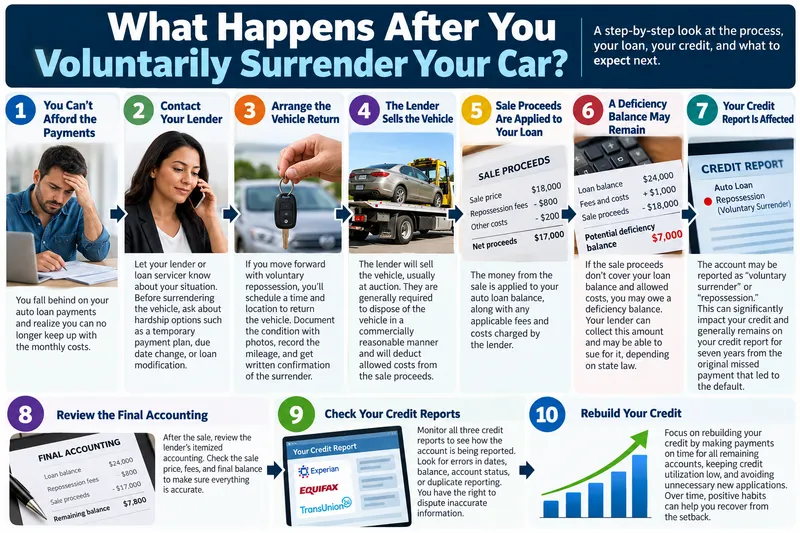
When you surrender the vehicle, the lender typically sells it and applies the sale proceeds toward what you owe. If the sale does not generate enough money to cover your remaining loan balance and applicable costs, you may be responsible for the difference, called a deficiency balance.
For example, if you owe $24,000 and the vehicle produces $18,000 in net sale proceeds, you could still have thousands of dollars left to pay. Costs associated with repossession, storage, preparing the vehicle for sale, and the sale itself may also affect the final amount, subject to your contract and applicable state law.
This is why returning a car should not be treated as simply handing back the keys and walking away from the debt. Before voluntarily surrendering a vehicle, ask your lender for your current payoff amount, review the vehicle's market value, and find out how any remaining balance will be calculated.
Voluntary Repossession: What It Is and How It Affects Your Credit
How Does Voluntary Repossession Work?
Surrendering the car does not close out the loan. The lender still records the account as delinquent leading into the surrender, reports the repossession to the three credit bureaus, and calculates what you still owe after the sale. Most lenders will ask you to sign a voluntary surrender or vehicle release form, and some will schedule a pickup at your home instead of a drop-off if that is easier logistically.
Before you sign anything, ask the lender in writing when and where the vehicle will be sold. Under the FTC's rules on vehicle repossession, in most states you are entitled to notice of the sale and the sale must be conducted in a commercially reasonable manner, meaning the lender cannot dump the car for far below market value and pass the shortfall on to you unchallenged.
Behind on Your Car Payment and Worried About Your Credit?
Get a free, no-obligation review of your credit report before repossession damage sets in — or start correcting it if it already has.
Get My Free Credit Analysis Now →5 Alternatives to Voluntary Repo
- Request a hardship deferment. Many lenders allow you to push one or two payments to the back of the loan if you call before you are seriously delinquent.
- Refinance the loan. A credit union or another lender may offer a lower rate or longer term that brings the payment within reach, especially if your credit was strong when you first financed.
- Sell the car privately. A private sale typically nets more than a wholesale auction, which reduces or eliminates the deficiency balance you would otherwise owe.
- Negotiate a repayment plan. Some servicers will spread missed payments across future months rather than accelerate the loan, particularly if you have a documented temporary hardship.
- Ask about a voluntary trade-in. If you have any equity or a co-signer who can help, trading the vehicle in at a dealership avoids a repossession being reported at all.
Does Voluntary Repossession Affect Your Credit?
The credit bureaus do not have a separate, softer code for "voluntary" surrender. What actually shows up on the report is a series of missed payments leading up to the surrender, followed by a status like "repossession" or "voluntary surrender," and often a separate deficiency balance if one remains unpaid. Both the original account and, in many cases, a placed-for-collection tradeline for the deficiency can appear, which is part of why repossessions are so damaging: they frequently generate two negative marks instead of one.
Voluntary vs. Involuntary Repossession: What's Actually Different
| Factor | Voluntary Surrender | Involuntary Repossession |
|---|---|---|
| Credit score impact | Similar, typically 100–150 points | Similar, typically 100–150 points |
| Deficiency balance | Still owed if sale proceeds fall short | Still owed if sale proceeds fall short |
| Repossession fees | Sometimes reduced or waived | Full towing and storage fees usually charged |
| Timing and dignity | You choose the date; can remove belongings calmly | Vehicle can be taken without warning, sometimes at work or home |
| Credit report language | May show "voluntary surrender" | Shows "repossession" |
The credit-scoring models generally do not give meaningful extra credit for surrendering voluntarily. Some lenders will waive certain repossession fees as a goodwill gesture for cooperating, and you avoid the disruption of a tow truck arriving unannounced, but the scoring models built by FICO and VantageScore treat both events as a serious derogatory mark tied to non-payment.
Other Ways Voluntary Repo Affects Your Finances
You May Still Owe Money to Your Lender
According to a 2025 CFPB report examining auto loan repossessions, 94% of the roughly 905,000 vehicle disposals studied ended with the borrower still owing a deficiency balance, and the average deficiency balance has climbed toward the $10,000 to $11,000 range in recent years. That means for the overwhelming majority of borrowers, surrendering the car does not end the financial obligation; it converts a car payment into an unsecured debt, often at a similar or larger dollar amount.
It Could Affect Your Ability to Get a Loan in the Future
Auto lending in particular is highly automated, and many underwriting systems flag any repossession within the past 24 to 48 months as an automatic decline or a referral to subprime lending desks. With more than $1.64 trillion in outstanding auto loan balances across over 100 million active accounts as of late 2024, lenders have enormous amounts of historical repayment data to model risk against, and a repossession is one of the strongest negative signals in that data.
Without a Plan
Vehicle is repossessed with no notice, fees stack up, deficiency balance goes to collections unnoticed, and the borrower discovers the damage only when applying for a new loan.
With a Plan
Borrower contacts the lender early, negotiates surrender terms and fee waivers where possible, documents the sale price and deficiency calculation, and disputes any inaccurate reporting once the account posts to the credit file.
How Long Does a Voluntary Repossession Stay on Your Credit Report?
This distinction trips up a lot of borrowers. If you missed your first payment in September 2026, surrendered the vehicle in December 2026, and the deficiency balance was charged off in March 2027, the 7-year clock still runs from September 2026 and the account should fall off by September 2033, not later. Per Experian's own guidance on deficiency balance reporting, the reporting period is tied to the original delinquency date, so a lender or collector re-aging the account to extend that window would be inaccurate reporting you can challenge.
Reviewing Your Credit Report for Repossession Accuracy
In practice, repossession files are prone to several specific, checkable errors:
- The deficiency balance still shows as owed after it was paid, settled, or discharged in bankruptcy.
- The original loan and the deficiency collection account both appear as separate negative marks for the same debt, sometimes called double reporting.
- The date of first delinquency is listed later than it actually occurred, extending the 7-year reporting window.
- The account is reported with an incorrect balance that does not match the actual deficiency calculation from the sale.
- The repossession is reported on an account where you were an authorized user rather than the primary obligor.
Under 15 U.S.C. § 1681i, you have the right to dispute any of these inaccuracies directly with the credit bureaus, and under § 1681s-2(b), the furnisher (your former lender or its collection agency) is required to actually investigate the dispute rather than rubber-stamp it. The CFPB has an open enforcement action against Experian, filed in January 2025, alleging the bureau ran sham investigations and failed to properly process consumer disputes, which is part of why documenting your own dispute paper trail matters.
Not Sure If Your Repo Is Reporting Correctly?
We'll pull your full credit report and flag any inaccurate dates, balances, or duplicate tradelines tied to your repossession, free of charge.
Claim My Free Credit Analysis Now →Pre-Surrender and Post-Surrender Checklist
Before You Surrender the Vehicle
- Get the payoff amount and deficiency estimate in writing from the lender.
- Ask whether any repossession or towing fees will be waived for voluntary cooperation.
- Remove all personal belongings and take dated photos of the vehicle's condition.
- Confirm in writing when and where the vehicle will be sold.
- Ask about GAP insurance if you have it; it may cover part or all of the deficiency.
After the Vehicle Is Sold
- Request an itemized statement showing the sale price and final deficiency calculation.
- Pull your credit reports from all three bureaus 30 to 45 days after the surrender to confirm accurate reporting.
- Set up a written plan or settlement agreement for the deficiency balance rather than letting it sit in default.
- Get any settlement or payment agreement confirmed in writing before sending money.
- Re-check your credit reports again 60 to 90 days later to confirm the deficiency status updates correctly.
Rebuilding Your Credit After a Voluntary Repossession
Most lenders will not consider you for a prime-rate auto loan again until the deficiency is resolved and you have 12 to 24 months of clean payment history afterward. Subprime and buy-here-pay-here dealers may approve financing sooner, but typically at APRs well above prime rates, so it is usually worth the wait if your transportation situation allows it.
Frequently Asked Questions
Does voluntary repossession hurt your credit less than a regular repossession?
No. Both voluntary surrender and involuntary repossession are reported to the credit bureaus as a repossession, and the scoring damage is nearly identical, typically 100 to 150 points for someone who was current before the loan went delinquent. The only real difference is you avoid a tow truck showing up unannounced and you can remove your belongings and negotiate the sale timeline in advance.
Will I still owe money after I voluntarily surrender my car?
In most cases, yes. The lender sells the vehicle at auction, usually for well below what you owe, then bills you for the deficiency balance. CFPB research found 94% of studied disposals ended with a remaining deficiency balance owed by the borrower.
How long does a voluntary repossession stay on your credit report?
Up to 7 years from the date of the first missed payment that led to the repossession, not from the date you surrendered the vehicle or the date the deficiency balance was charged off.
Can I get a car loan after a voluntary repossession?
Yes, though usually not immediately and rarely at a favorable rate. Subprime and buy-here-pay-here lenders often approve financing within months, but at high APRs. Prime lenders typically want 12 to 24 months of rebuilt payment history and a resolved deficiency balance first.
Should I let my car be voluntarily repossessed instead of paying it?
Voluntary surrender should generally be a last resort after you have explored deferment, loan modification, refinancing, private sale, or lender hardship programs. Surrendering stops the expense of a car you cannot afford, but it does not erase the debt and still causes significant credit damage.
What is the difference between voluntary repossession and involuntary repossession?
Voluntary repossession means you contact the lender and return the vehicle yourself. Involuntary repossession means the lender takes the vehicle without your cooperation, sometimes without warning. Both are reported as a repossession and both can lead to a deficiency balance.
Can a voluntary repossession be removed from my credit report?
An accurate repossession generally cannot simply be deleted on request, since furnishers are not required to remove accurate, verifiable information. What can be challenged is inaccurate reporting tied to the repossession, such as a wrong balance, incorrect delinquency date, duplicate tradelines, or a deficiency balance reported after it was paid.
Does the lender have to notify me before selling my repossessed car?
In most states, yes. Lenders are generally required to send a pre-sale notice disclosing how and when the vehicle will be sold, and the sale must be conducted in a commercially reasonable manner. Exact requirements vary by state.
Get Ahead of the Damage From a Repossession
Whether your repossession already happened or you're trying to avoid one, we'll show you exactly what's on your credit report and what's actually fixable.
Start My Free Credit Analysis Now →Related Reads
Sources: FTC – Vehicle Repossession, CFPB – What Happens if My Car Is Repossessed, CFPB – Repossession in Auto Finance (Jan. 2025), Experian – Deficiency Balance Reporting.