

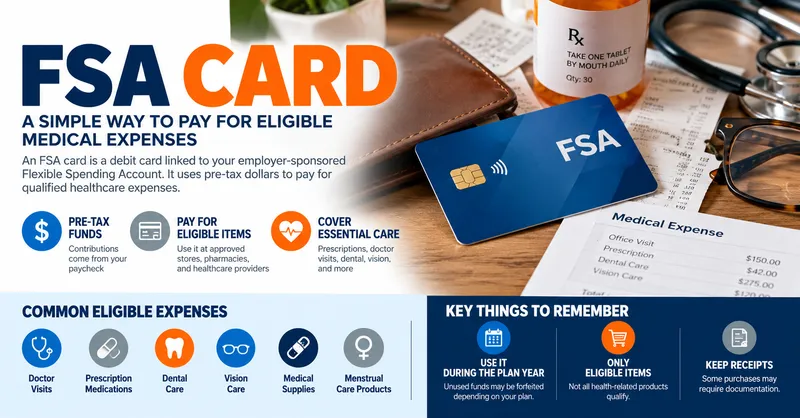
An FSA card lets you pay for medical expenses with pretax money straight from a paycheck. The funds come from a flexible spending account an employer sets up, not from a loan or a credit line. For 2026, the IRS caps employee contributions to a health FSA at $3,400, money that skips income tax, Social Security tax, and Medicare tax on the way out of a paycheck. A worker in the 22 percent tax bracket who sets aside $2,000 for the year keeps roughly $440 that would otherwise go to taxes.
Picture a $35 prescription copay or a $120 dental filling. Swipe the FSA card and the charge comes straight out of pretax funds already set aside, not a bank account. In nearly 20 years reviewing credit files, I've found a clear difference between spending pretax medical dollars and spending money that isn't there yet. An FSA purchase draws down an account already funded through payroll; a medical bill charged to a credit card creates a debt that carries interest until it's paid off.
This guide covers how the card works, what it covers, where it works, and whether using one touches a credit score.
What Is an FSA Card?
An FSA card is the payment card linked to a flexible spending account, a pretax benefit an employer sets up for medical costs. The account holds the money; the card spends it at checkout, the way a debit card draws from checking.
A Flexible Spending Arrangement, or FSA, is a benefit account funded through pretax payroll deductions. The card tied to it works like a debit card at checkout, but draws only from the FSA balance, never a bank account.
A few features separate it from other cards in a wallet:
- ✓ A credit card lends money and charges interest on unpaid balances.
- ✓ A debit card spends money from a personal checking account.
- ✓ An HSA card spends pretax money that stays with the employee for life.
- ✓ A health insurance card identifies coverage; it doesn't hold or spend money.
- ✓ An FSA card spends pretax employer-plan money that doesn't automatically carry forward.
How Does an FSA Card Work?
An employee chooses an annual election during open enrollment, and the employer deducts that amount from each paycheck before taxes. Most health FSA plans load the full election onto the card at the start of the plan year.
During open enrollment, an employee picks an amount to set aside for the year, up to the IRS limit. The employer divides that amount across each paycheck and deducts it before calculating income tax. Most health FSA plans front-load the full election onto the card at the start of the plan year, so a worker who elects $2,000 has that full amount available in January, before payroll has collected all of it.
Example: Maria elects $2,000 for the year, paid biweekly, 26 times a year. Her employer deducts about $76.92 per paycheck. In March, she swipes her FSA card for a $140 orthodontic payment. The charge comes straight out of the $2,000 balance, leaving $1,860 for the rest of the year.
What Does an FSA Card Pay For?
An FSA card pays for IRS-qualified medical expenses: doctor copays, prescriptions, dental and vision care, many over-the-counter medicines, medical supplies, and menstrual products, following IRS Publication 502.
| Category | Examples |
|---|---|
| Doctor visits & copays | Office copays, specialist visits, urgent care |
| Prescription medications | Prescribed drugs, insulin |
| Over-the-counter medicine | Pain relievers, allergy medicine, antacids, no prescription needed since the 2020 CARES Act |
| Dental care | Cleanings, fillings, braces, extractions |
| Vision care | Eye exams, glasses, contact lenses, contact solution |
| Medical supplies | Bandages, blood pressure monitors, first aid kits |
| Menstrual care products | Tampons, pads, menstrual cups, eligible since the 2020 CARES Act |
What Doesn't an FSA Card Cover?
An FSA card doesn't cover general wellness purchases, cosmetic treatments without a medical diagnosis, or insurance premiums. The IRS requires a qualifying medical purpose, not just a health-related label.
- ✗ Gym memberships and health club dues
- ✗ Vitamins and supplements bought for general health, not a diagnosed condition
- ✗ Cosmetic procedures without a medical purpose, such as teeth whitening or elective liposuction
- ✗ Health insurance premiums
- ✗ Nonprescription sunglasses bought for style rather than vision correction
Where Does an FSA Card Work?
FSA cards work at pharmacies, doctor's offices, hospitals, dental and vision providers, and retailers using an IRS-approved inventory system that flags eligible items automatically. Store acceptance doesn't make every item eligible.
Pharmacies, medical offices, hospitals, dentists, and optometrists accept FSA cards as standard practice. Many large retailers and online stores also accept them, using an Inventory Information Approval System that flags eligible items at checkout, sometimes splitting one receipt between two payment methods.
How Much Money Goes Into an FSA?
For 2026, the IRS caps employee salary-reduction contributions to a health FSA at $3,400, confirmed in Revenue Procedure 2025-32. An employer contribution, where the plan offers one, sits on top of that cap.
| 2026 FSA Rule | Amount or Limit |
|---|---|
| Employee salary-reduction limit | $3,400 |
| Maximum carryover into 2027 | $680 |
| Grace period and carryover together | Not allowed in the same plan (IRS Notice 2013-71) |
What Happens to Unused FSA Money?
A health FSA is generally a use-it-or-lose-it benefit. A plan offers either a grace period of up to two and a half extra months or a carryover of up to $680 into 2027, never both.
Unused money is forfeited at year's end unless the employer builds in one exception: a grace period, adding two and a half months to spend last year's balance, or a carryover, rolling up to $680 into the next plan year with no deadline. Under IRS Notice 2013-71, a plan offers one option, never both.
Why Was My FSA Card Declined?
Common causes: an expired card, an insufficient balance, a merchant without an eligible inventory system, mixed eligible and ineligible items in one purchase, or a plan requiring a receipt before the charge clears.
- Check the balance in the FSA portal or app before resubmitting the charge.
- Confirm the card hasn't expired or reached the plan year's end date.
- Ask whether the merchant's checkout system flags eligible items automatically.
- Split the purchase: eligible items on the FSA card, everything else on a different card.
- Submit a receipt directly to the plan administrator if checkout doesn't verify eligibility.
FSA Card vs. HSA Card: What's the Difference?
An FSA stays with the employer and generally doesn't roll over past a grace period or carryover limit. An HSA belongs to the employee for life and rolls over with no deadline.
| Feature | FSA | HSA |
|---|---|---|
| Ownership | Employer-sponsored, tied to the job | Employee-owned, portable for life |
| Eligibility requirement | Offered through the employer's plan | Requires enrollment in a high-deductible health plan |
| 2026 contribution limit | $3,400 (employee) | $4,400 self-only / $8,750 family |
| Unused funds | Use-it-or-lose-it, unless a grace period or carryover applies | Rolls over every year, no deadline |
| After leaving a job | Funds generally stay with the employer's plan | Account and funds move with the employee |
Does an FSA Card Affect Your Credit?
No. An FSA card spends pretax funds already set aside, the same way a prepaid card spends a loaded balance. It doesn't open a credit account, create a revolving balance, or get reported to the credit bureaus.
The Consumer Financial Protection Bureau draws a clear line between card types. A prepaid card, which an FSA card resembles, spends a balance loaded ahead of time. A credit card borrows money and charges interest on what's carried past the due date. Only the credit card builds a credit history.
How to Use Your FSA Card Without Losing Money
- ✓ Plan predictable expenses, like contacts and dental cleanings, before electing an annual amount.
- ✓ Keep every receipt; a card swipe doesn't always count as documentation.
- ✓ Check the balance and plan-year deadline every quarter, not just December.
- ✓ Spend leftover funds on glasses or OTC medicine before the plan year ends.
An FSA card and a credit card both pay a $300 dental bill, but the money works differently. The FSA card spends money already pulled from a paycheck before taxes. A credit card borrows $300 that must be repaid, plus interest if the balance carries past the due date.
An FSA card spends pretax dollars already set aside through payroll, within IRS rules on limits, eligible expenses, and deadlines. It never borrows money or gets reported to the credit bureaus. The real risk is an unrelated medical bill left unpaid after the funds run out.
Is an FSA card a credit card?
No. An FSA card spends pretax money from a flexible spending account. A credit card borrows money and charges interest on unpaid balances. The FSA card never creates debt.
Does an FSA Card Allow Cash Withdrawals?
No. FSA cards don't support ATM withdrawals or cash back. IRS rules restrict the card to qualified medical expenses at checkout.
Does My FSA Card Work at Walmart or Amazon?
Yes, at stores and online checkouts using an IRS-approved inventory system to flag eligible items. Walmart and Amazon both support this, though items still have to meet IRS Publication 502 rules.
Does an FSA Card Cover Groceries?
No. General groceries aren't a qualified medical expense. An FSA card covers items tied to medical care, such as prescribed medicine, not routine food purchases.
Does an FSA Card Cover Dental Treatment?
Yes. Cleanings, fillings, braces, and extractions generally qualify under IRS Publication 502 guidelines for medical and dental care.
Does an FSA Card Cover a Spouse or Dependent?
Yes. FSA funds cover qualified medical expenses for the account holder, a spouse, and any tax dependent, even if that person isn't on the same health insurance plan.
Does FSA Money Expire?
Yes, in most plans. Health FSAs are use-it-or-lose-it benefits. A plan offers either a grace period of up to two and a half extra months or a carryover of up to $680 into 2027, never both.
What Happens to an FSA Card After Leaving a Job?
The card and remaining balance generally stay with the employer's plan. Some plans offer limited COBRA continuation, but the rules depend on the specific employer.
Why Does My FSA Card Require Receipts?
IRS rules require proof that a purchase was a qualified medical expense, even after payment clears. Some purchases verify automatically at checkout; others need a receipt submitted afterward.
Does an FSA Card Affect My Credit?
No. Spending from an FSA doesn't open a credit account or get reported to the credit bureaus. A separate unpaid medical bill that goes to collections is what affects a credit report, not the FSA card itself.
Does Your Credit Report Show an Unpaid Medical Bill?
A medical bill left unresolved or billed in error still ends up in collections. A free 3-bureau audit shows exactly what Equifax, Experian, and TransUnion report before you pay anything.
Get My Free 3-Bureau Audit → Secure · 2 minutes-
Medicredit Contacted You? Check the Hospital Bill First How to verify a hospital collection against the original bill before paying anything.
-
Credit Report Still Wrong After a Lender Admits an Error? What to do when a corrected account still reports wrong after the lender admits the mistake.
-
Authorized User Debt: Fix Credit Report Errors How an account opened by someone else still shows up as personal debt, and how to dispute it.
- IRS Revenue Procedure 2025-32 — 2026 FSA limits
- IRS Publication 969 — FSA/HSA rules
- IRS Publication 502 — Medical expenses
- CFPB — Card type differences
- FSAFEDS — Eligible purchases