
If you found SYNCB on your credit report, you're probably asking the same question thousands of consumers ask every month:
"What is SYNCB and why is it affecting my credit?"
SYNCB is typically associated with Synchrony Bank, one of the largest issuers of retail credit cards in the United States. Many consumers do not recognize the Synchrony name because the account is often connected to a store-branded credit card rather than a traditional bank card.
At ASAP Credit Repair, we regularly review credit reports where consumers mistake a SYNCB account for identity theft because they recognize the store but not the bank behind it.
Understanding which account is being reported is the first step in determining whether the information is accurate.
What Is SYNCB on My Credit Report?
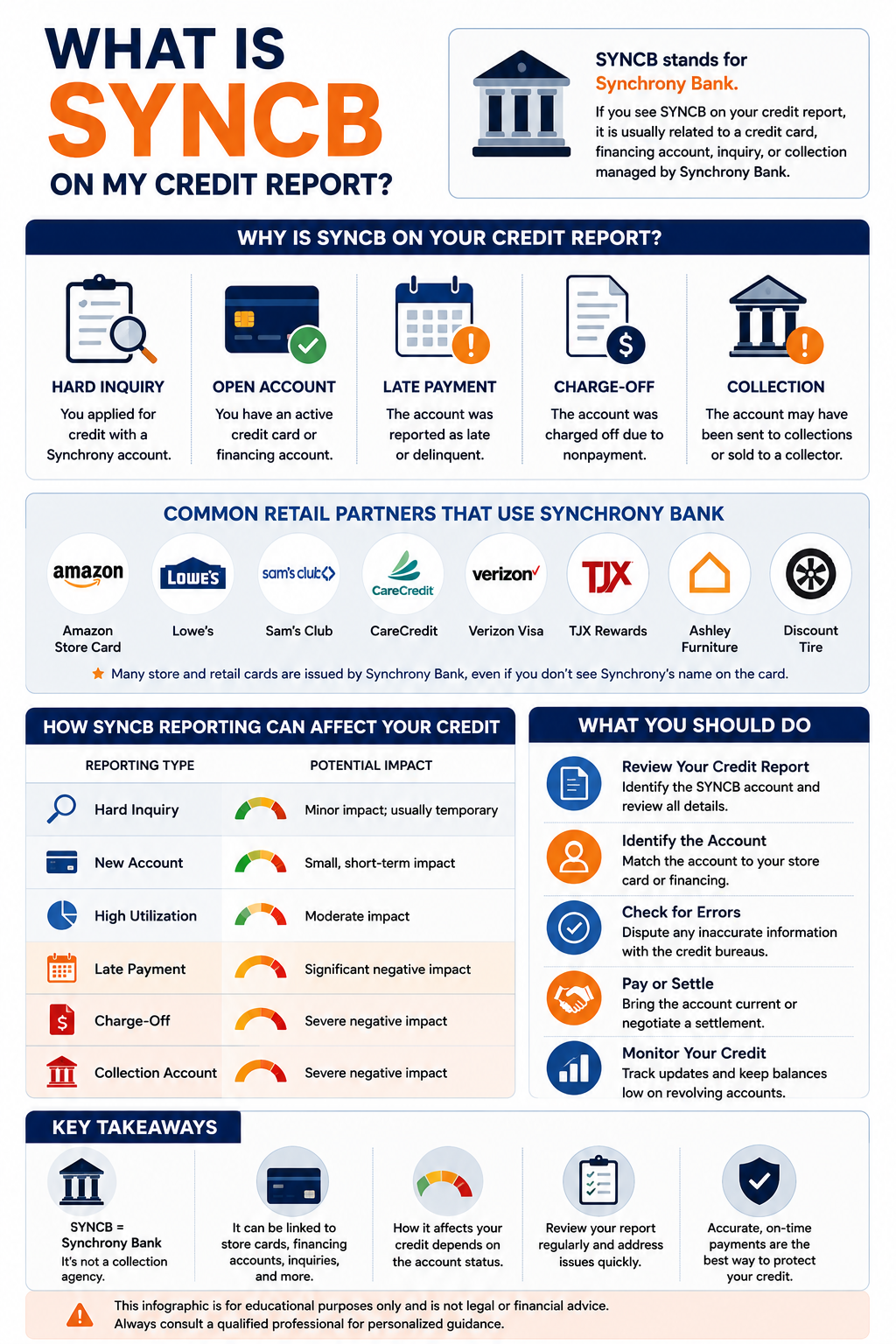
SYNCB stands for Synchrony Bank. If SYNCB appears on your credit report, it usually indicates a Synchrony-issued credit card, financing account, inquiry, late payment, charge-off, or collection-related account associated with one of its retail partners.
What Does SYNCB Mean on a Credit Report?
SYNCB is the credit report abbreviation for Synchrony Bank, one of the largest consumer finance companies in the United States. Synchrony Bank does not issue cards under its own brand at checkout. Instead, it issues cards under the names of retail partners. When those accounts appear on your Equifax, Experian, or TransUnion report, they show up as SYNCB followed by a partial store name or account identifier.
Synchrony Bank was spun off from GE Capital in 2014 and is now headquartered in Stamford, Connecticut. The company specializes in consumer retail credit and healthcare financing. Under the Fair Credit Reporting Act, Synchrony Bank reports account data to the three major credit bureaus each month. That data appears as SYNCB on the tradeline rather than the store name you remember.
The abbreviation format varies depending on the bureau and the account type. You may see SYNCB/AMAZON, SYNCB/LOWES, SYNCB/CARECR, SYNCB/SAMS, or simply SYNCB with an account number. All of these refer to accounts issued by Synchrony Bank on behalf of that retailer or service.
At ASAP Credit Repair USA, we see SYNCB entries on credit reports every week. Most are legitimate accounts the client opened and forgot about. The ones worth disputing are the ones where the balance is wrong, the delinquency date does not match the client's records, or the account shows as open when the client never applied for a Synchrony product.
Which Store Cards and Accounts Show Up as SYNCB?
Any credit card or financing account issued by Synchrony Bank will appear as SYNCB on your credit report. Synchrony issues cards for hundreds of retailers and healthcare providers. The most common ones that people search after seeing SYNCB on their report are listed below.
| What You See on Report | Actual Account | Category |
|---|---|---|
| SYNCB/AMAZON | Amazon Store Card or Amazon Prime Visa (store version) | Retail |
| SYNCB/WALMART | Walmart Credit Card or Walmart Mastercard | Retail |
| SYNCB/LOWES | Lowe's Advantage Credit Card | Home Improvement |
| SYNCB/SAMS | Sam's Club Mastercard or Sam's Club Credit Card | Retail |
| SYNCB/CARECR or SYNCB/CARE | CareCredit (healthcare financing) | Healthcare |
| SYNCB/PAYPAL | PayPal Credit (formerly Bill Me Later) | Payments |
| SYNCB/ASHLEY | Ashley Advantage Financing | Furniture |
| SYNCB/TJX | TJX Rewards Credit Card (TJ Maxx, Marshalls, HomeGoods) | Retail |
| SYNCB/GAP | Gap Good Rewards Mastercard or Gap Visa | Retail |
| SYNCB/OLD NAVY or SYNCB/ON | Old Navy Credit Card | Retail |
| SYNCB/ROOMS | Rooms To Go Credit Card | Furniture |
| SYNCB/HH GREGG or SYNCB/HHGREGG | HH Gregg financing (now closed accounts still reporting) | Electronics |
| SYNCB/PPCRDT or SYNCB/PP | PayPal Credit revolving line | Payments |
| SYNCB/BANANA REP | Banana Republic Credit Card | Retail |
| SYNCB/SWEETWATER | Sweetwater Sound financing | Music and Electronics |
Healthcare is a category many people overlook. Care Credit is one of the most widely used healthcare financing products in the country. Dental work, vision care, veterinary bills, and elective procedures are frequently financed through Care Credit, which reports as SYNCB/CARECR on all three bureaus. Many patients do not realize they signed a Synchrony Bank credit agreement at the provider's front desk.
Why Did SYNCB Appear on My Credit Report Now?
SYNCB appears on your credit report for one of three reasons. You opened a new Synchrony account and it posted for the first time. An existing account had a status change such as a missed payment, a charge-off, or a balance update. Or Synchrony Bank ran a hard inquiry when you applied for credit at a partner retailer. Each of these creates a different entry type on the report.
- You opened a store card or financing account.
- The account posts within 30 to 60 days of opening.
- It shows credit limit, balance, payment history, and status.
- An account in good standing helps your score.
- A missed payment or charge-off hurts your score.
- Stays on report for 7 years from date of first delinquency if negative.
- Stays on report for 10 years if it was a positive closed account.
- You applied for a Synchrony card or financing.
- The inquiry posts within days of the application.
- It shows only the inquiry date and lender name.
- Each hard inquiry lowers score by 5 to 10 points.
- If you were approved, an account tradeline posts separately.
- Hard inquiries stay on report for 2 years.
- Hard inquiries stop affecting score after 12 months.
A common scenario we see at ASAP Credit Repair USA is a client who applied for a Care Credit account at a dental office two years ago, used it once to pay a bill, and then forgot about it completely. The account posts on their credit report with a low balance and a missed payment from six months ago when the minimum due went to an old email address. That SYNCB entry is now hurting the score without the client realizing an active account even exists.
Is SYNCB on My Credit Report a Sign of Identity Theft?
Not usually, but it can be. The first step is to identify the specific account before concluding it is fraud. Most SYNCB entries are legitimate accounts the person applied for and forgot. If after calling Synchrony Bank you confirm you never opened the account and never authorized anyone to apply on your behalf, that is a clear identity theft signal and you should act immediately.
The Federal Trade Commission reported 1.1 million identity theft complaints in 2023, with credit card fraud being the most common type. Synchrony Bank's large retail network makes it a frequent target for synthetic identity fraud because new accounts can be opened online without requiring a physical card at a specific location.
If SYNCB on your report is fraudulent, the Fair Credit Reporting Act gives you the right to dispute the account and have it removed if Synchrony Bank cannot verify that you authorized it. You also have the right to place a fraud alert or security freeze with all three bureaus, which prevents any new Synchrony account from being opened in your name without additional verification.
Call 1-866-396-8254 and ask them to pull every account associated with your Social Security number. Ask for the account open date, the original credit limit, and the first purchase date. Compare that information against your own purchase history and records. This call takes about five minutes and tells you whether the account is legitimate before you spend time on a dispute.
Do this first | Takes 5 minutes | Determines everything elseGo to AnnualCreditReport.com and pull Equifax, Experian, and TransUnion. Search each report for SYNCB entries. Note the account type, balance, credit limit, payment history, and date of first delinquency for each one. If the balance Synchrony reported does not match what you actually owe, that discrepancy is disputable under the Fair Credit Reporting Act regardless of whether the account is legitimate.
Free at AnnualCreditReport.com | Check all 3 bureausGo to IdentityTheft.gov and file an identity theft report. Download the FTC Identity Theft Report document. Then contact each bureau individually to place a security freeze. A freeze prevents any lender including Synchrony from opening a new account in your name without you lifting the freeze first. You can freeze and unfreeze credit at Equifax, Experian, and TransUnion for free under the Economic Growth Act of 2018.
Free | Required before disputing fraud accountsSend a written dispute to Equifax, Experian, and TransUnion. Include your FTC Identity Theft Report, your full name, address, date of birth, and the SYNCB account number listed on the report. Under the Fair Credit Reporting Act, the bureau has 30 days to investigate. If Synchrony Bank cannot verify you authorized the account, the bureau must remove or correct the entry. Send disputes by certified mail with return receipt so you have documented proof of the submission date.
FCRA Section 611 dispute right | 30 day investigation windowHow Does SYNCB Affect Your Credit Score?
A SYNCB account in good standing with on-time payments and a low balance relative to the credit limit helps your credit score. A SYNCB account with missed payments, a high utilization rate, or a charge-off status hurts it. The impact depends on whether the account is positive or negative, not simply on Synchrony being the issuer.
| SYNCB Account Status | Credit Score Impact | What to Do |
|---|---|---|
| Open, on-time payments, low balance | Positive | Keep making on-time payments. Keep balance below 30% of the credit limit. |
| Open, high balance relative to limit (above 30% utilization) | Negative but fixable | Pay the balance down. Utilization drops instantly when balance drops. Score improves within one billing cycle. |
| 30 to 90 days past due | 50 to 80 point drop | Pay the past due amount now. A late payment stays on the report for 7 years but its score impact weakens over time as the account ages positively after you catch up. |
| Charge-off (account written off by Synchrony) | 100+ point drop possible | Contact ASAP Credit Repair USA to audit the entry for inaccuracies before paying. Paying a charge-off does not remove it. Deletion requires a dispute based on an error or a pay-for-delete agreement. |
| Hard inquiry only, no account opened | 5 to 10 point drop | No action needed. Hard inquiries stop affecting the score after 12 months and fall off the report completely after 24 months. |
| Closed account, paid in full, no negatives | Neutral to positive | Positive closed accounts stay on the report for up to 10 years and continue to contribute to credit history length. |
Credit utilization is the single biggest short-term lever for SYNCB accounts that are current but carrying a high balance. FICO and VantageScore both weight the ratio of balance to credit limit heavily in the score calculation. A Synchrony account with a $500 balance on a $600 limit is reporting 83% utilization, which damages the score significantly. Paying that balance to below $180 drops utilization to 30% and the score improves within one billing cycle.
Is Your SYNCB Entry Reporting Accurate Data?
Synchrony Bank accounts frequently show inaccurate balances, wrong delinquency dates, and duplicate entries after charge-offs. A free 3-bureau audit across Equifax, Experian, and TransUnion shows exactly what every SYNCB account is reporting and whether any entry contains errors that are disputable under the Fair Credit Reporting Act.
Get My Free 3-Bureau Audit → Secure · 2 minutes · No credit card requiredHow to Dispute a SYNCB Entry on Your Credit Report
You can dispute a SYNCB entry if it contains inaccurate information. An inaccuracy can be a wrong balance, a wrong date of first delinquency, a wrong account status, a duplicate entry, or an account you never opened. Accurate negative information cannot be removed through a dispute, but errors are disputable under the Fair Credit Reporting Act regardless of the underlying debt status.
Common errors on Synchrony Bank entries we find at ASAP Credit Repair USA include a charge-off balance that includes fees Synchrony added after the account was closed, a date of first delinquency that was reset when the account was sold to a debt buyer, and duplicate entries where both Synchrony and a collection agency are both reporting the same debt simultaneously.
A duplicate entry is a direct violation of Fair Credit Reporting Act accuracy standards. When Synchrony Bank sells a charged-off account to a debt buyer, the original Synchrony tradeline should show as charged-off and closed with a zero balance. The debt buyer then posts a separate collection tradeline. If Synchrony is still showing an open balance on the same account the debt buyer is collecting, both entries are reporting simultaneously and that is disputable.
What is SYNCB/Amazon on my credit report?
SYNCB/AMAZON refers to the Amazon Store Card issued by Synchrony Bank. If you applied for the Amazon Store Card through Amazon's website or the Amazon app, Synchrony Bank is the actual lender and the account appears on your credit report as SYNCB/AMAZON. The Amazon Visa card, which is a Visa network card, is issued by Chase Bank and appears differently on the report. SYNCB/AMAZON is specifically the store card usable only at Amazon.
Can I get SYNCB removed from my credit report?
You can get a SYNCB entry removed if it contains inaccurate information or if the account is fraudulent. Accurate information reported within the 7-year window for negative accounts or the 10-year window for positive closed accounts cannot be removed simply by requesting it. The standard dispute process under the Fair Credit Reporting Act Section 611 applies. Send a written dispute to Equifax, Experian, and TransUnion with supporting documentation showing the inaccuracy.
Why does SYNCB show a hard inquiry on my report?
A SYNCB hard inquiry means you applied for credit at a retailer that uses Synchrony Bank as its issuer. This happens when you apply for a store card at checkout, when you apply online for Care Credit or PayPal Credit, or when a retailer submits a financing application on your behalf. Hard inquiries stay on the report for two years. They stop affecting your credit score after 12 months. If you see a SYNCB hard inquiry you do not recognize, that is a potential fraud signal worth investigating.
Does paying off a SYNCB charge-off remove it from my credit report?
Paying off a charge-off does not automatically remove it from your credit report. The account status changes from unpaid charge-off to paid charge-off, which is slightly better but still negative. The entry stays on the report for 7 years from the original date of first delinquency regardless of payment. If you want removal, negotiate a pay-for-delete agreement before paying, confirm the agreement in writing, and then make payment only after receiving written confirmation that Synchrony Bank will request deletion.
Is Synchrony Bank a real bank?
Yes. Synchrony Bank is a federally chartered bank headquartered in Stamford, Connecticut. It operates under the supervision of the Office of the Comptroller of the Currency and the Consumer Financial Protection Bureau. Synchrony Financial, the parent company, is publicly traded on the New York Stock Exchange under the ticker SYF. Synchrony is one of the largest issuers of private label credit cards in the United States.
What is SYNCB/CARECR on my credit report?
SYNCB/CARECR refers to a Care Credit healthcare financing account issued by Synchrony Bank. Care Credit is used at dental offices, vision centers, veterinary clinics, and medical providers for out-of-pocket expenses not covered by insurance. If you used Care Credit to pay a medical or veterinary bill, SYNCB/CARECR is that account appearing under Synchrony Bank's name. The account is subject to the same credit reporting rules as any other Synchrony product.
SYNCB Charge-Off or Negative Entry Hurting Your Score?
Synchrony Bank entries with wrong balances, duplicate reporting, and incorrect delinquency dates are among the most common errors we find on consumer credit reports. A free 3-bureau audit shows every SYNCB entry across Equifax, Experian, and TransUnion and identifies any inaccuracy that is disputable under the Fair Credit Reporting Act. 20+ years in business. 3,000+ five-star reviews. 100% money-back guarantee on inaccurate item removal.
Get My Free Credit Blueprint → Secure · No hard inquiry · No credit card required-
JPMCB Card on My Credit Report: What It Means JPMCB is JPMorgan Chase Bank. It appears on your report when you have a Chase-issued card such as the Amazon Visa, Southwest card, or Marriott Bonvoy card. This covers how to identify which Chase account it is, what to do if you do not recognize it, and how to dispute it if it contains errors.
-
Does Paying Off Collections Improve Your Credit Score? Paying a Synchrony charge-off does not remove it. This covers when payment helps your score, when pay-for-delete is the better strategy, and what mortgage lenders specifically require before approving a borrower who has a Synchrony collection account on their report.
-
Unknown Collection Agency on Your Credit Report? Here Is What to Do When a Synchrony charge-off is sold to a debt buyer, a second collection entry appears on your report. This covers how to identify the debt buyer, how to request debt validation under the Fair Debt Collection Practices Act, and how to dispute a duplicate entry where both Synchrony and the collection agency are reporting the same account.