
What is the rarest credit score? If you mean the hardest score to reach at the top of the standard credit-score range, 850 is the number most people are looking for. It is the maximum possible score for base FICO Scores and modern VantageScore models. But calling 850 the single "rarest" exact score requires some context because scoring companies do not publish a current frequency table for every individual score from 300 through 850.
What we do know is that a perfect 850 FICO Score is uncommon. FICO reported that about 1.7% of scorable U.S. consumers had an 850 in April 2023. That works out to fewer than 2 out of every 100 consumers who could receive a FICO Score.
Getting there also looks different from simply having "good credit." Base FICO Scores run from 300 to 850, with scores of 800 and above falling into FICO's Exceptional range. People who reach 850 tend to have long credit histories, very low revolving balances and strong payment records.
At ASAP Credit Repair, nearly 20 years of credit repair experience has also shown us why chasing a perfect number can distract from the bigger issue. Your credit reports and the information used to calculate your scores matter more than hitting one exact number.
This guide explains how rare an 850 credit score really is. Let's discuss what separates 850 from other high scores. Lastly, whether a 900 score is possible and whether you actually need perfect credit.
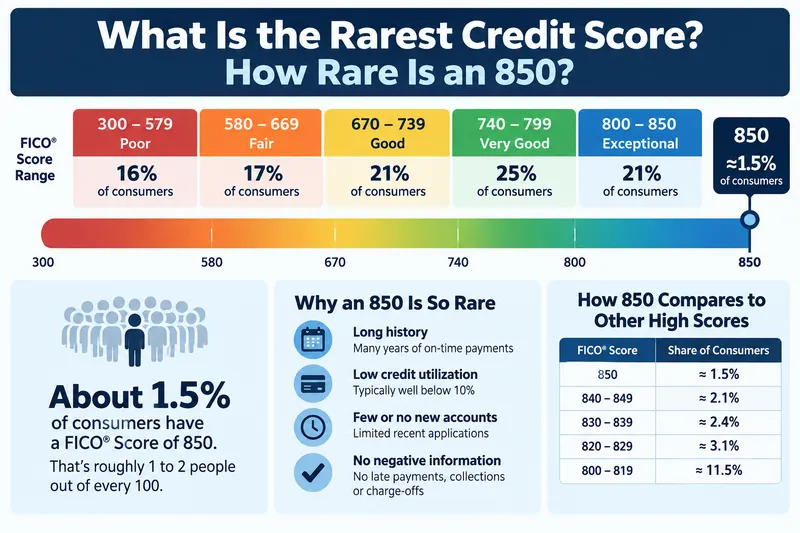
What Is the Rarest Credit Score? How Rare Is an 850?
An 850 credit score is the least common score at the top of the standard credit-score range. It is the maximum base FICO Score, and 1.71% of U.S. consumers held an 850 FICO Score as of June 2026. FICO does not publish a frequency count for every exact score between 300 and 850, so 850 is a rare perfect score — not a confirmed single rarest score in the range.
What Is the Rarest Credit Score?
An 850 is the highest possible base FICO Score and the highest VantageScore. 1.71% of U.S. consumers held an 850 FICO Score as of June 2026, according to Experian data. Public FICO data does not establish a frequency count for every individual score between 300 and 850, so the precise term is a rare perfect score, not a confirmed single rarest score.
That distinction matters. Plenty of competing pages declare 850 "the rarest score" without support. The accurate statement is narrower and more useful: 850 sits at the ceiling of the range, and the ceiling is uncommon.
How Rare Is an 850 Credit Score?
1.71% of U.S. consumers had an 850 FICO Score as of June 2026, up from 1.67% a year earlier. That is fewer than 2 out of every 100 scorable consumers in the country.
FICO's own 2023 data put the figure at approximately 1.7% of eligible consumers, with Hawaii leading all states at 2.62%. The percentage has stayed consistently small across measurement periods — perfect credit is rare, and it has stayed rare.
Is 850 a Perfect Credit Score?
Yes, for base scores. FICO Score 8, the most widely used version, runs from 300 to 850, with 850 as the ceiling.
VantageScore 4.0 uses the same 300-to-850 scale. Scores from 781 to 850 fall into VantageScore's Superprime tier — the top classification in its four-tier system.
FICO vs. VantageScore at 850
| Model | Typical Range | Highest Score |
|---|---|---|
| Base FICO Score (FICO Score 8) | 300–850 | 850 |
| VantageScore 4.0 | 300–850 | 850 |
| FICO Auto Score / FICO Bankcard Score | 250–900 | 900 |
850 is the ceiling on the two models consumers see most often. 900 exists only on industry-specific models built for auto lenders and credit card issuers.
Can You Have a 900 Credit Score?
Not on a base FICO Score or VantageScore. Both max out at 850.
Industry-specific FICO Scores — the FICO Auto Score and FICO Bankcard Score — run on a 250-to-900 scale, and 900 is their ceiling. These scores are built for specific lending decisions and differ from the score you see on a typical credit monitoring app or credit card statement.
Is an 850 Credit Score Hard to Get?
Yes. Here is why.
Long Credit History
Consumers with an 850 FICO Score carry decades-old credit accounts. FICO data on perfect scorers shows an average oldest account age of roughly thirty years.
Very Low Credit Utilization
Consumers with 850 FICO Scores use an average of 4% of their available revolving credit, compared to a 29% national average. Low utilization is one of the sharpest differences between an 850 profile and a typical credit file.
Strong Payment History
No late payments appear on an 850 credit file. Payment history carries the largest weight in the FICO formula, and a single missed payment removes 850 from reach until it ages off the report.
Limited New Credit Activity
New inquiries and newly opened accounts lower the average age of a credit file and introduce short-term risk signals into the score. This does not permanently block an 850, but frequent new credit activity works against it.
What Does an 850 Credit Profile Look Like?
| Factor | Typical 850 Profile |
|---|---|
| Score | 850 |
| Revolving utilization | Around 4%, versus a 29% national average |
| Open credit cards | Average of 5.6, versus 3.9 nationally |
| Oldest account | Decades old |
| Payment record | No late payments |
| Recent applications | Limited |
These figures describe the typical profile, not a requirement. Scoring formulas are proprietary, and individual credit files differ.
Want to See What's Actually on Your Credit Report?
Chasing a number means nothing if the information behind it is wrong. See exactly what's reporting on your credit, free, before deciding what to fix.
Get My Free Credit Analysis Now →Is 800 a Rare Credit Score?
800 and above sits in FICO's Exceptional range and covers a meaningfully larger share of consumers than 850 alone. The distinction is this: 800 is a range covering a band of scores; 850 is one exact score sitting at the top edge of that range. Reaching Exceptional is not the same achievement as reaching the ceiling.
Is 850 Better Than 800?
An 850 represents lower modeled credit risk than an 800 inside the scoring formula itself. That does not translate directly into better loan terms. Lenders set their own underwriting criteria and score thresholds, and most prime interest rates become available well before a score reaches 850. An 850 does not guarantee a better rate or approval than an 800 at every lender.
Do You Need an 850 Credit Score?
No. A perfect score is not a requirement for borrowing.
Lenders set their own underwriting standards, and your credit score is one factor among several in a lending decision. Income, existing debt, loan type, and lender-specific requirements affect approval independent of where your score sits inside the Exceptional range.
Perfect credit score ≠ guaranteed approval. A high score improves your position. It does not remove every other underwriting factor a lender considers.
Why Your Credit Score Won't Stay at 850
An 850 is a snapshot, not a permanent status. Several ordinary events move a score off the ceiling:
- Reported card balances change from one billing cycle to the next.
- New inquiries appear after a credit application.
- Accounts age, and the average account age shifts with every new line opened.
- New accounts lower the average age of the overall credit file.
- Information can differ between the three credit bureaus.
- Different scoring models calculate the same credit data differently.
FICO states that scores change as the information in a consumer's credit reports changes. An 850 today reflects today's data, not a fixed outcome.
Why You Have More Than One Credit Score
You have three credit reports — one at each major bureau — and those reports do not always hold identical data. Lenders also pull different FICO Score versions depending on the type of credit being evaluated.
Three credit reports, holding different data, run through different scoring models and versions, produce multiple scores for the same person. A lender often pulls a different FICO version than the score you see on your own monitoring app.
This is why your score can look different across a credit card app, a free monitoring service, and a mortgage lender's pull — without any single number being wrong.
What Matters More Than Having the Rarest Credit Score?
An 850 is impressive. The number itself is a result, not the underlying asset. The credit reports behind that number deserve the attention.
Nearly 20 years of credit repair work at ASAP Credit Repair has shown us that consumers often chase a handful of extra score points when the more useful question is whether their credit information is accurate. Review the accounts, balances, payment statuses, and other details appearing on your credit reports. If something is inaccurate or does not belong to you, find the source and use the correct dispute process.
A perfect score is not the goal for everyone. An accurate credit file and consistent credit habits give you something more useful to work with over time than a single number at the top of the range.
Frequently Asked Questions
What is the rarest credit score?
An 850 is the highest possible base FICO Score and VantageScore, and it is the least common score at the top of the range. As of June 2026, 1.71% of U.S. consumers held an 850 FICO Score. FICO does not publish a frequency count for every exact score between 300 and 850, so 850 is accurately described as a rare perfect score rather than a confirmed single rarest score.
How rare is an 850 credit score?
1.71% of U.S. consumers had an 850 FICO Score as of June 2026, up from 1.67% a year earlier. That means fewer than 2 out of every 100 scorable consumers reach the top of the range.
What percentage of people have an 850 credit score?
1.71% of U.S. consumers had an 850 FICO Score as of June 2026, according to Experian data.
Is an 850 credit score possible?
Yes. An 850 is the maximum base FICO Score and VantageScore, and over a million U.S. consumers hold one at any given time, based on current percentages.
Has anyone ever gotten an 850 credit score?
Yes. 1.71% of U.S. consumers currently hold an 850 FICO Score. These consumers typically carry very low revolving utilization, decades-old credit accounts, and no late payments on record.
Can you get a 900 credit score?
Not on a base FICO Score or VantageScore, which both max out at 850. Industry-specific models such as the FICO Auto Score and FICO Bankcard Score run on a 250-to-900 scale, where 900 is the ceiling.
Is an 800 credit score rare?
800 and above falls into FICO's Exceptional range and covers a meaningfully larger share of consumers than 850 alone. 800 is a range; 850 is one exact score sitting at the ceiling of that range.
Is 850 better than 800?
An 850 represents lower modeled credit risk than an 800 within the scoring formula. Lenders set their own underwriting criteria and score thresholds, so 850 does not guarantee a better rate or approval than 800 at every lender.
What is the highest possible credit score?
850 is the highest base FICO Score and VantageScore. 900 is the highest score on certain industry-specific FICO models, including the FICO Auto Score and FICO Bankcard Score.
What is the lowest possible credit score?
300 is the lowest base FICO Score and VantageScore. Some industry-specific FICO models start at 250.
How long does it take to get an 850 credit score?
FICO data on 850 scorers shows an average oldest account age of roughly three decades. Reaching 850 typically requires years of on-time payments, low revolving utilization, and a long credit history, not a fixed timeline.
Can your credit score drop after reaching 850?
Yes. Reported balances change, new inquiries appear, accounts age, and new accounts lower the average account age. An 850 is not a permanent status; it reflects the information in your credit reports at a specific point in time.
Do you need an 850 credit score to get the best interest rate?
No. Lenders set their own underwriting standards, and most top-tier rates become available once a score reaches the high 700s or low 800s. Credit score is one factor in a lending decision, not the only one.
Why are my FICO Scores different?
You have three credit reports, each held by a different bureau, and those reports hold different data. Lenders also pull different FICO Score versions. Different data plus different models produces different scores for the same person.