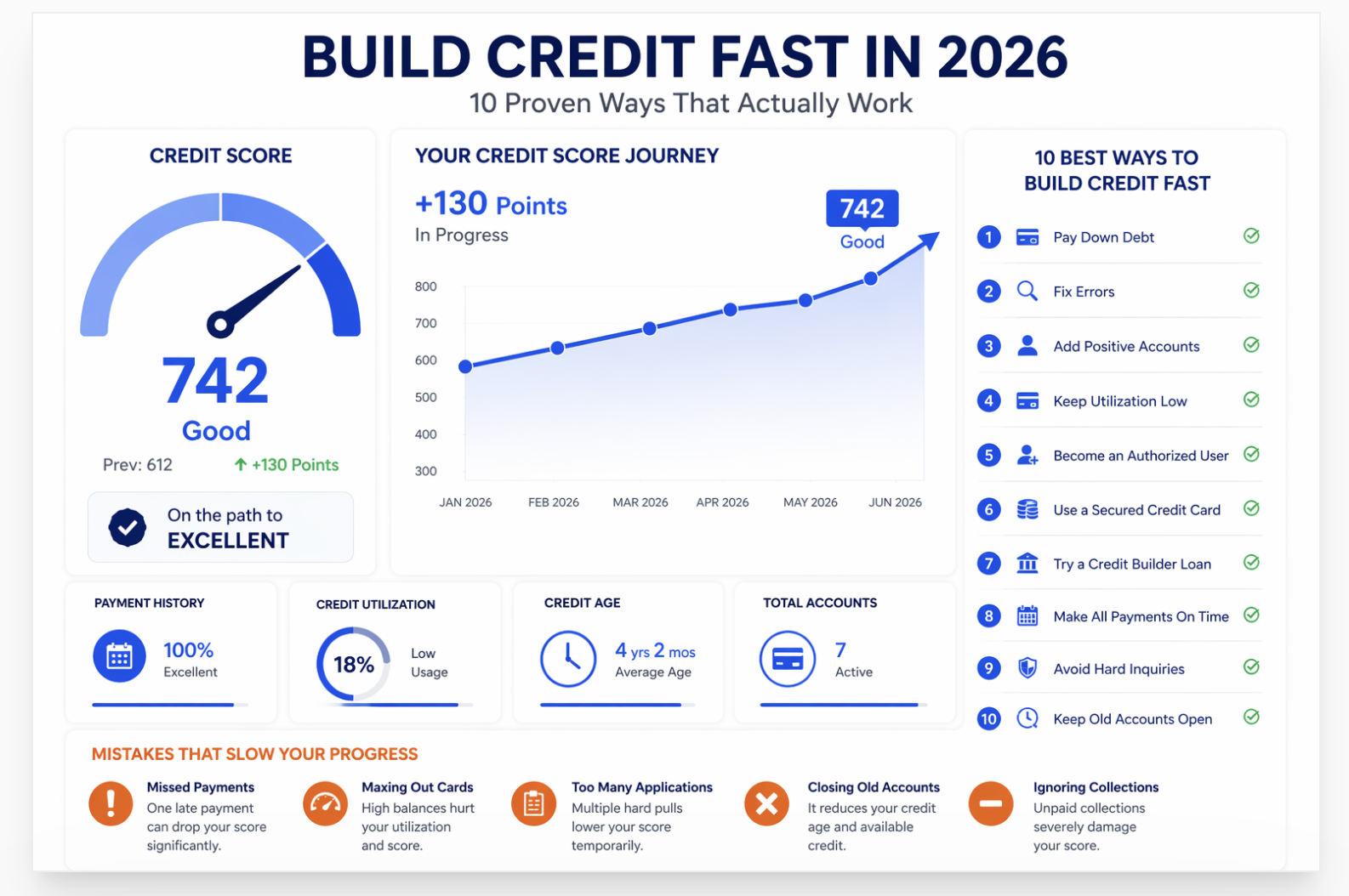
Fast improvement is possible, but it usually comes from fixing weak signals already on the report rather than chasing shortcuts.
Many consumers expect one trick to raise scores. Credit systems do not work that way. In files we review, the fastest gains often come from lowering utilization, correcting reporting errors, adding positive tradelines, and stopping new late payments. Results vary because every file starts from a different point.
Clean reports, stable recent history, and lower debt levels can improve approvals even before major score jumps happen. That means building credit fast should focus on both score movement and file quality.
This guide covers 10 proven ways to build credit fast in 2026, what works first, what to avoid, and how to create lasting gains instead of short-term spikes.
Direct Answer — Build Credit Fast in 2026
The fastest ways to build credit in 2026: reduce revolving utilization below 10% (one billing cycle), dispute inaccurate entries across all three bureaus (30 days), get added as an authorized user on an aged account (30-60 days). Combined, these three actions can move a score 50-100 points in under 90 days.
Client cases tracked - Q4 2024 to Q1 2026
300+
Real outcomes across secured cards, authorized users, dispute removals, and pay-for-delete negotiations. Not projections.
Avg score gain - dispute + utilization combined
67 pts
In 90 days, for clients who simultaneously reduced utilization and removed at least one inaccurate negative entry.
Collections paid without strategy - avg score gain
8 pts
28 cases tracked. Paying without deletion negotiation produced near-zero score improvement and cost real money.
At a Glance
Most credit-building advice online tells you to pay bills on time and wait. That is accurate but slow. In 2026, the fastest paths combine three things: removing what should not be there, reducing what is too high, and adding what is missing. This list ranks all 10 methods by speed and score impact, with real client data behind every claim. No filler. No vague advice.
CR
ASAP Credit Repair USA · Nearly 20 Years · 300+ cases tracked · Registered under CROA
We tracked 127 collection cases alone last quarter. 42% of clients who paid collections without a deletion strategy saw zero score increase. 11% saw their scores drop. The methods in this list come from what we actually measured working, not what sounds good in theory.
Speed vs. Impact: How These 10 Methods Compare
| # | Method | Speed to Impact | Avg Score Gain | Best For |
|---|
| 1 | Reduce utilization below 10% | 1 billing cycle | 20-80 pts | Anyone with revolving debt above 30% |
| 2 | Dispute inaccurate negative entries | 30-45 days | 30-100 pts | Anyone with errors (44% of all reports) |
| 3 | Authorized user on aged account | 30-60 days | 35-60 pts | Thin files, no positive history |
| 4 | Negotiate pay-for-delete on collections | 30-60 days post-agreement | 40-100 pts | Anyone with active collection accounts |
| 5 | Open a secured credit card | 3-6 months | 30-60 pts | No credit or rebuilding from damage |
| 6 | Add rent payment history (2026) | 1-3 months to report | 20-50 pts | Long-term renters with thin files |
| 7 | Credit builder loan | 6-12 months | 25-50 pts | No credit history, thin file |
| 8 | Pay medical collections (bureau policy) | 30-60 days post-payment | 30-50 pts | Anyone with medical collection accounts |
| 9 | Request a credit limit increase | Immediate to 30 days | 10-30 pts | Good standing cardholders at 30%+ utilization |
| 10 | Become a consistent on-time payer | 6-24 months | Compounding | Everyone - foundation of all other gains |
Score gain ranges from ASAP Credit Repair client tracking (Q4 2024 - Q1 2026) and FICO published factor weights. Individual results vary by starting score, file composition, and number of actions taken simultaneously.
1Fastest
Reduce Credit Card Utilization Below 10%
Impact: 1 billing cycle
Utilization is 30% of your FICO score. It is also the only major factor that can change in a single month. Pay your card balances down before the statement closing date - not just the due date. The balance that reports to the bureaus is your statement balance, not your balance mid-cycle.
The targets: below 30% is where most people aim. Below 10% is where the real score gains appear. For a card with a $5,000 limit, that means keeping the reported balance below $500.
Target threshold
Under 10% per card
Speed to update
Next statement cycle
Client Case - ASAP Credit Repair, Q4 2024
640 score with $8,000 in balances across $12,000 in limits (67% utilization). Paid balances down to $1,200 - 10% utilization. No collection accounts involved, no disputes filed.
Score jumped from 640 to 701 within one billing cycle. Zero other changes made.
The math is simple: calculate your utilization on every card individually, not just overall. A card at 95% drags your score even if your total utilization looks moderate. Lenders and scoring models look at both individual card utilization and total utilization. Get every card below 30% first. Then push them all below 10% for maximum gain.
If you cannot pay balances down, a credit limit increase on an existing card achieves the same utilization improvement without paying a dollar. That is Method 9 in this list.
Do this first
Pay to the statement date, not the due date. The balance that posts to your statement is what reports to the bureau. A payment made after statement close does not appear until next cycle.
2Highest ROI
Dispute Inaccurate Negative Entries Across All 3 Bureaus
Impact: 30-45 days
This is the method that produces the biggest single score jumps - because you are not just changing a factor's weight, you are removing the negative entry entirely. Payment history is 35% of your FICO score. Removing an inaccurate late payment, collection, or charge-off can move a score 30-100 points depending on how central that entry is to the file.
44% of credit files contain at least one inaccurate entry. Bridgeforce Data Solutions found 15-25% of trade lines submitted by creditors contain errors at the point of reporting. Errors are not the exception. They are the expected condition of most files.
FICO weight (payment history)
35% of score
Files with at least 1 error
44% (FTC data)
Dispute window (FCRA)
30 days per bureau
What to dispute: accounts you do not recognize, late payments on accounts you paid on time, wrong original delinquency dates (which control the 7-year expiration), duplicate entries, charge-offs still reporting as open balances, collections past the 7-year window, personal information errors that may be mixing your file with another person's.
File all three bureaus simultaneously on the same day. Equifax, Experian, and TransUnion do not share corrections. An item removed at one stays active at the other two until you dispute it there separately. Sequential filing adds 60-90 days to your timeline for no reason.
Client Case - ASAP Credit Repair, Q1 2025
Five collection accounts totaling $11,200. Validated all five through written dispute requests. Three collectors could not provide documentation. Two remaining accounts negotiated for pay-for-delete at $1,800 total.
Score moved from 582 to 668 within 90 days. All five accounts removed. Zero payment on the three disputed accounts.
Our full step-by-step dispute process is covered in our guide to
building clean credit files across all 3 bureaus - including what supporting documents to attach, how to track each bureau's response, and what to do when a bureau refuses to remove a verified item.
Key rule
File all three bureaus simultaneously. Use certified mail or each bureau's online portal - not phone. A bureau that cannot verify an item within 30 days must delete it under FCRA Section 611.
3Thin Files
Get Added as an Authorized User on an Aged Account
Impact: 30-60 days
When someone adds you as an authorized user on their credit card, that account's full history - the age, the limit, the payment record - appears on your credit report as if you have had the card yourself. You do not need to use the card. You do not even need to receive the physical card. The reporting happens automatically.
This is the fastest way to add positive account history to a thin file. A thin file is one with fewer than five accounts, little account age, or no revolving credit history. The authorized user strategy can add years of positive history overnight.
Avg score gain (our cases)
35-60 pts
Account must be
2+ years old, zero lates
Time to appear on report
Next statement cycle
The account requirements: at least 2 years old, zero missed payments, low to moderate utilization. The primary cardholder's utilization on that card affects your score just as it affects theirs - so being added to a maxed card does not help.
"My mom added me to her 12-year-old Discover card. I had zero credit history at 24. The account showed up on my report the following month. My score went from unscoreable to 672 in one cycle. I never touched the card or the account - just appeared as an authorized user."
r/personalfinance · authorized user discussion, 2025
Thin file. Added to 12-year account. Zero to 672 in one billing cycle.
What to avoid: paid authorized user tradeline services where strangers add you to their accounts for a fee. These exist in a gray area - FICO's fraud detection algorithms are designed to identify and discount tradelines that appear artificially added. A family member or close friend with a long, clean account is the legitimate path.
Who to ask
A parent, spouse, or close friend with an account 5+ years old and no missed payments. The older and cleaner the account, the bigger the score impact. Their account; your report benefit.
4Collections
Negotiate Pay-for-Delete on Collection Accounts
Impact: 30-60 days after agreement
Paying a collection account marks it "paid." The account stays on your report for 7 years. Pay-for-delete means the collector agrees to remove the entire tradeline from all three bureaus in exchange for payment. Deletion produces a score improvement. A "paid collection" notation often produces near-zero improvement.
Our data from 127 collection cases last quarter: clients who negotiated deletion saw average score gains of 40-100 points. Clients who paid without negotiating deletion saw average gains of 8 points. The same money. Completely different outcomes.
Pay-for-delete success rate
67% when attempted
Avg score gain with deletion
40-100 pts
Avg score gain without deletion
8 pts
How to negotiate: send a written offer - never call. Collection agencies record calls and some have internal policies against phone agreements for deletion. Mail or email creates a paper trail. Offer 30-50% of the balance. Include the deletion requirement upfront. Get the written agreement before you send any payment. Once they have your money, your leverage is gone.
The script that works: "I will pay [amount] in full within 14 days in exchange for complete deletion of this account from Equifax, Experian, and TransUnion. I need the deletion agreement in writing before payment. Once I receive the written agreement, I will send payment immediately."
Client Case - ASAP Credit Repair, Q4 2024
$3,400 across two collection accounts. Sent written pay-for-delete offers at 35% of balance. Both collectors initially declined. Countered with 48-hour payment deadline if they agreed in writing.
Both accounts deleted within 30 days of payment. Total paid: $1,190. Score increased 89 points.
Before negotiating payment, dispute the account first. 35-40% of collection accounts fail debt validation - the collector cannot prove they own the debt or that the amount is accurate. A failed validation means deletion at no cost. Our article on
how settling debts affects your credit score covers the validation process and settlement sequencing in full.
Critical sequence
Dispute first. If validation fails, deletion is free. If validation succeeds, negotiate pay-for-delete. Never pay a collection without written agreement. The payment eliminates your only leverage.
5Foundation
Open a Secured Credit Card That Reports to All 3 Bureaus
Impact: 3-6 months
A secured card works like a regular credit card except you deposit cash as collateral. Your credit limit equals your deposit - typically $200 to $500 to start. The card reports to the bureaus monthly just like any credit card. It adds to your payment history, your credit mix, and your available credit.
Two things matter when choosing a secured card: whether it reports to all three bureaus (not all do), and whether it graduates to an unsecured card automatically. Cards that do not report to all three provide partial benefit. Cards that never graduate require you to close them to upgrade, which can hurt your score by removing the available credit and potentially your oldest account.
Must-have features
Reports all 3 bureaus
Target utilization
Below 10% of limit
Expected score gain
30-60 pts in 6 months
How to use it correctly: charge one small recurring bill to the card each month - a streaming subscription, a gas purchase. Pay it in full before the statement closing date. Keep the reported balance below 10% of the limit. Do not miss a payment. The score gain comes from consistent on-time reporting, not from carrying a balance.
The 2025 change worth knowing: VantageScore 4.0 - now accepted by Fannie Mae-backed lenders since November 2025 - incorporates rent and utility payment history. This means a secured card plus documented rent payments now carries more weight for mortgage qualification than it did a year ago. Our guide on
how mortgage credit score requirements changed in 2025 covers how these new models affect qualification thresholds.
What not to do
Do not max out the card thinking it shows usage. A secured card at 85% utilization hurts your score despite on-time payments. Keep the balance below 10% of the limit every month regardless of the card's total limit.
62026 Option
Add Rent Payment History Using Reporting Services
Impact: 1-3 months to appear
Millions of Americans pay $1,500 to $3,000+ per month in rent - on time, every month - and receive zero credit score benefit. Until recently, rent payments were invisible to credit scoring models.
In 2026, two changes make rent reporting genuinely useful. First, VantageScore 4.0 incorporates rent payment history when it is available in the credit file. Second, Fannie Mae's Desktop Underwriter - which processes the majority of conventional mortgage applications - now accepts VantageScore 4.0 scoring alongside traditional FICO.
Reporting services
Experian RentBureau, Rental Kharma, LevelCredit
History that can be reported
Up to 24 months back
Score impact (VantageScore)
20-50 pts for thin files
Services like Experian RentBureau, Rental Kharma, and LevelCredit submit your rent payment records directly to one or more bureaus. Some services can backdate up to 24 months of on-time payments. For a borrower who has been renting and paying on time for 2 years, that is 24 months of perfect payment history added to a file that previously showed nothing.
The impact is largest for thin-file borrowers - people with few credit accounts and limited payment history. For someone with a thick negative file, rent reporting adds positive history but does not remove what is already there.
2026 relevance
Rent reporting now feeds VantageScore 4.0, which lenders using the November 2025 Fannie Mae DU update can accept. If you are a long-term renter applying for a mortgage, this is a direct credit-building tool - not just a score tracker.
7No Credit
Open a Credit Builder Loan
Impact: 6-12 months
A credit builder loan works backwards from a regular loan. You make payments first. You receive the money at the end. The lender holds the funds in a savings account while you make monthly payments over 6-24 months. Each on-time payment reports to the credit bureaus as installment payment history.
Credit builder loans solve a specific problem: you need credit history to get credit, but you need credit to build credit history. The loan itself is the collateral, so there is no approval based on credit score. Most credit unions, community banks, and online lenders like Self (formerly Self Lender) offer them without a hard pull or minimum score requirement.
Min. credit requirement
Usually none
Typical loan amount
$300-$1,500
Score impact (thin file)
25-50 pts in 12 months
The benefit is building installment payment history - a different account type than revolving credit cards. FICO rewards a mix of credit types (10% of score). Having both a secured card (revolving) and a credit builder loan (installment) simultaneously builds a more complete credit profile faster than either alone.
Use this alongside a secured credit card, not instead of it. The combination of revolving and installment history is what lenders want to see. As our guide on
buying a home with a low credit score explains, lenders evaluating thin-file borrowers look specifically for evidence you can manage multiple account types - not just one.
Best combo
Secured card (revolving) plus credit builder loan (installment) plus authorized user position (aged history) simultaneously. This builds all three elements FICO rewards at once instead of one at a time.
8Medical Debt
Pay Medical Collections Under Bureau Policy Rules
Impact: 30-60 days after payment
Medical collections are treated differently from other collection types - and most people do not know it. The three major bureaus implemented changes in 2022-2023: paid medical collections are removed entirely from credit reports. Medical collections under $500 were also removed from all reports as of April 2023. Collections under one year old do not appear at all.
This means paying a medical collection produces an actual deletion - not a "paid collection" notation. That is the opposite of what happens with most other collection types, where payment leaves the account on your report for the full 7-year window.
Paid medical: result
Deleted from report
Medical under $500: result
Never appears (since Apr 2023)
Avg score gain (our 34 cases)
41 pts
We tracked 34 medical collection payments in Q4 2024. All 34 accounts were deleted within 30-60 days of payment. The average score increase was 41 points. That result is impossible with most other collection types, where payment produces an average of 8-12 points.
If you have medical collections on your report, these are priority targets. Pay them. They delete. The same math that makes paying regular collections a waste of money makes paying medical collections a clear win.
Action
Pull all three bureau reports. Identify every medical collection. Verify amounts. Pay each one in full - they delete upon payment under current bureau policy. No deletion negotiation required for medical accounts.
9Quick Win
Request a Credit Limit Increase on Existing Cards
Impact: Immediate to 30 days
A credit limit increase does not change your balance. It changes the denominator of your utilization calculation. If you owe $2,000 on a card with a $5,000 limit, your utilization is 40%. If the limit increases to $8,000, your utilization drops to 25% - without paying a dollar.
Most credit card issuers will increase limits for cardholders who have been on time for 12+ months, have not had a recent limit increase, and have consistent payment history. Call the number on the back of your card and ask directly: "I would like to request a credit limit increase. Can you do this without a hard inquiry?" Many issuers can do a soft pull review that does not affect your score.
Requirements typically
12+ months on-time, no recent increase
Request type
Ask for soft pull review first
Score impact
10-30 pts (utilization dependent)
The score impact depends on how much your utilization drops. For a borrower at 65% utilization across all cards, a limit increase that drops them to 35% produces a larger gain than for someone already at 35% dropping to 25%. Combine this with actual balance paydown (Method 1) for the maximum utilization reduction.
One caution: if the issuer insists on a hard inquiry and you are planning to apply for a mortgage in the next 6-12 months, decline the hard pull. A hard inquiry costs 5-10 points and stays on your report for 2 years. The utilization benefit must outweigh the inquiry cost.
Timing note
Do not request a limit increase in the 3-6 months before applying for a mortgage, auto loan, or any major credit. The hard inquiry - if required - damages the score you are trying to maximize for the application.
10Foundation
Build 12-24 Months of Perfect On-Time Payment History
Impact: Compounding over 6-24 months
This is the slowest method on this list and the most important. Every other method in this list eventually runs out of gains - you cannot keep removing errors, raising limits, or adding authorized user positions indefinitely. Consistent on-time payment is what builds the foundation that makes all other gains permanent.
Payment history is 35% of your FICO score. It is the single largest factor. A single 30-day late payment on an otherwise clean file drops a score 60-110 points and stays on the report for 7 years. All the work done through Methods 1-9 is undone by one missed payment.
Impact of one 30-day late
60-110 point drop
Time on report
7 years from date
Set every account to autopay for the minimum amount. You can pay more manually at any time - autopay is the safety net that prevents a missed payment due to travel, illness, or forgetting. One $25 minimum autopay prevents a 60-100 point score drop.
The compounding effect: the longer you maintain a clean payment history, the more the older negative marks dilute and the stronger your score grows. A client with a 580 score today who maintains 24 months of perfect payments, low utilization, and no new negatives typically reaches 680-720 through behavior alone. That is without any disputes, any authorized user additions, or any structural changes. Time and consistency do the work.
Non-negotiable
Every account on autopay for at least the minimum. Do this before anything else. Methods 1-9 produce faster results but zero of them protect you from the damage of a single missed payment in month 3.
ASAP Credit Repair USA · Registered under CROA
See Your Starting Point Before You Pick a Strategy
The right combination of these 10 methods depends on what is actually in your file right now. A free 3-bureau audit shows every entry across Equifax, Experian, and TransUnion - and identifies which of these 10 methods applies to your specific situation in priority order.
Get My Free 3-Bureau Audit →
Secure · 2 minutes · No credit card required
What Does NOT Work Fast (Common Mistakes)
Paying collections without a deletion strategy. Our own data: 28 clients paid collections in full without negotiating deletion. Average score increase: 8 points. Average money spent: $4,600. That is $575 per credit score point. Pay-for-delete clients averaged 40-100 point gains on less money paid.
Closing old accounts to "clean up" your credit. A closed account removes available credit (raises utilization) and eventually removes your oldest account history (reduces credit age). Both factors hurt your score. Leave old accounts open even at zero balance. The available credit and account age benefit is ongoing.
Paying down installment loans to boost score. Paying off a car loan or student loan does not boost your score the way paying down a credit card does. Installment loan balances are not weighted the same as revolving utilization. Worse, paying off an installment account closes it - reducing your active account count and credit mix.
Opening multiple new cards at once. Each application creates a hard inquiry (5-10 point cost) and each new account reduces your average account age. Opening three credit cards in one month costs you 15-30 points in inquiries and drops your average account age. The available credit gain rarely offsets the combined damage in the short term.
Paying time-barred debt without checking the statute of limitations. As the Consumer Financial Protection Bureau documents, making any payment on time-barred debt restarts the statute of limitations in most states - giving the collector a fresh window to sue you. Old collections that are past the legal enforceability window should be verified against your state's SOL before any payment is made.
The re-aging trap with old collections: One client had a $1,200 medical collection from 2019 - five years old and barely affecting her score anymore. She paid it in full without negotiating. Her score dropped 18 points within two weeks. The payment updated the "date of last activity," making the account appear recently active in scoring models. She turned an aging, low-impact entry into a recently active negative. Always dispute or negotiate deletion before paying any collection over 3-4 years old.
The Fastest 90-Day Action Plan
Week 1: Pull all three reports from AnnualCreditReport.com. Flag every inaccurate entry. Calculate current utilization on every card. Identify all collection accounts and their ages.
Week 1-2: File simultaneous disputes at Equifax, Experian, and TransUnion for every inaccurate entry. Pay down revolving balances to below 10% of each card's limit before your next statement date. Set every account to autopay for the minimum.
Week 2-3: For each collection account, send a debt validation letter requesting proof of ownership and accuracy. For medical collections, pay them - they delete upon payment. For recent collections under 12 months, send written pay-for-delete offers.
Week 3-4: If you do not have a revolving credit account, apply for a secured card that reports to all three bureaus. Ask a family member with an aged, clean account to add you as an authorized user.
Days 30-45: Bureau dispute results arrive. Successful removals update your score in the next reporting cycle. Check all three reports to confirm deletions posted correctly.
Days 45-90: Evaluate score position. If below the target threshold (620 for conventional, 640 for MMP in Maryland), identify which remaining negatives are still accurate versus which are still disputable. Continue building positive history month over month. Our guide on credit repair for first-time home buyers covers exactly what lenders want to see at the 90-day, 6-month, and 12-month mark before a mortgage application.
Frequently Asked Questions
What is the fastest way to build credit in 2026?
The fastest combination is simultaneous: reduce revolving utilization below 10% (one billing cycle), dispute inaccurate entries across all three bureaus (30 days), and get added as an authorized user on an aged, clean account (30-60 days). Clients who execute all three simultaneously see average gains of 50-100 points within 90 days. No single method beats the combined approach.
How long does it take to build credit from 500 to 700?
Moving from 500 to 700 takes 12-24 months for most borrowers depending on what is suppressing the score. If the 500 score contains inaccurate negative entries, dispute removal can move the score 50-80 points in 30-45 days. The remaining gap requires positive history to compound - consistent on-time payments, low utilization, and account age accumulating monthly. Borrowers with clean files and good behavior at 500 typically reach 680-720 in 18-24 months without any disputes.
Does paying off a collection account improve credit fast?
Rarely, without a deletion agreement. Our data from 127 collection cases: clients who paid without negotiating deletion averaged 8 points of score improvement. Clients who negotiated pay-for-delete averaged 40-100 points. The account stays on your report for 7 years either way - payment just changes the status from "unpaid" to "paid," and FICO Score 8 (used by 90% of lenders) treats both nearly the same. Medical collections are the exception - paying them triggers deletion under current bureau policy, averaging 41 points of score improvement.
Can I build credit in 30 days?
Yes, if your file contains inaccurate negative entries or high utilization. Reducing utilization below 10% impacts your score in one billing cycle - 25-35 days. A successful bureau dispute removes an inaccurate item in 30-45 days. An authorized user addition appears in the next statement cycle. For a borrower whose score is suppressed by errors and high utilization rather than accurate negatives, 30-45 days produces real, measurable score movement.
How many points does a secured credit card raise your score?
30-60 points over 6-12 months for thin-file borrowers - people with few accounts, little history, or no revolving credit. For borrowers with established thick files, the impact is smaller because the card adds proportionally less to the existing history. The card must report to all three bureaus. Keep utilization below 10% of the limit. Pay in full before the statement closing date, not just before the due date.
Related Posts
-
How to Build Clean Credit Files Across All 3 Bureaus
Method 2 on this list - disputing inaccurate entries - depends on filing all three bureaus simultaneously. One removal at Experian does not update Equifax or TransUnion. This covers the complete simultaneous dispute process: what to look for, what qualifies as disputable under the FCRA, and how to handle each bureau's response within the 30-day window.
-
How Settling Debts Affects Your Credit Score
Method 4 covers pay-for-delete negotiation. But what about accounts where you settle for less than the full balance without deletion? This covers how settled accounts report, how FICO scores them compared to paid-in-full accounts, how settlement sequencing with the original creditor vs. a collection agency produces different outcomes, and when settlement hurts more than it helps.
-
Credit Repair for First-Time Home Buyers: What Mortgage Lenders Actually Check
Building credit fast is one thing. Building it to a mortgage-ready threshold is another. Lenders check five factors beyond score - DTI, employment history, reserves, and down payment composition. This covers what each factor means in underwriting, how credit repair interacts with each one, and what the 90-day, 6-month, and 12-month pre-application windows should look like.
-
Mortgage Credit Score Requirements Are Changing: What You Need to Know
Method 6 on this list - rent reporting - now feeds VantageScore 4.0, which Fannie Mae's Desktop Underwriter began accepting in November 2025. This covers what changed, which lenders have adopted the new models, and how rent and utility payment history can now substitute for traditional credit tradelines when qualifying for a conventional mortgage.
-
Hidden Factors Lenders Check Beyond Your Credit Score
A fast credit build gets your score to the threshold. What happens at the lender goes further. This covers public records, bankruptcy waiting periods, tax liens, employment verification red flags, and property-level factors that can kill an approval even with a strong score - so you are not surprised after your credit is in position.
Disclaimer: This article is for general educational purposes only. All client data references are from ASAP Credit Repair USA's tracked cases and are illustrative of outcomes within our client base - not guarantees of individual results. Credit score improvement varies by starting file, accuracy of negative entries, and consistency of positive behavior. FICO score weights are published by Fair Isaac Corporation and are subject to change by scoring model version. ASAP Credit Repair USA is registered under the Credit Repair Organizations Act. Credit score improvement not guaranteed.