
15 U.S.C. is often cited online as proof that consumers can avoid down payments, challenge finance charges, erase late payments, or force negative information off a credit report, but those claims can badly misread what the law says.
Title 15 of the United States Code covers commerce and trade, and the specific section number determines which consumer right, lending rule, or credit-reporting requirement may apply.
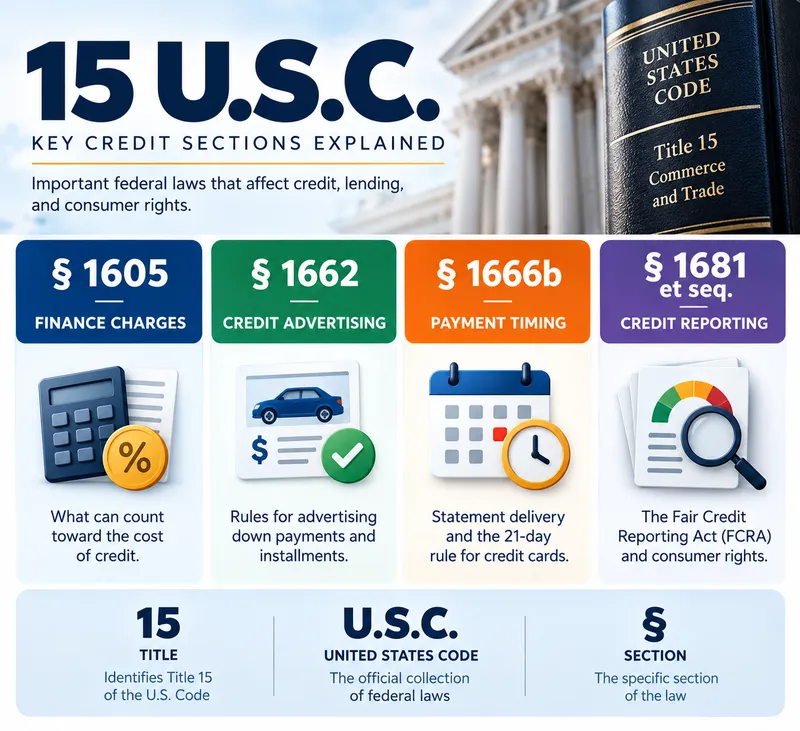
For example, 15 U.S.C. § 1605 defines finance charges. § 1662 regulates certain advertising claims about down payments and installment amounts. § 1666b includes the 21-day timing rule for certain credit card statements and payments.
The Fair Credit Reporting Act (FCRA) is also codified in Title 15, beginning at § 1681. None of these provisions creates a blanket rule making down payments illegal or automatically requiring negative credit information to be deleted.
At ASAP Credit Repair, nearly 20 years of experience helping consumers navigate credit-report issues has shown us how easily a legitimate federal law can be misunderstood when one sentence or section number is taken out of context.
This article breaks down the Title 15 sections consumers frequently encounter. We'll expand what each covers, corrects common online misconceptions, and shows which provisions are most relevant to credit reports and consumer rights.
15 U.S.C. Explained: Federal Credit Laws and Consumer Rights
What Does 15 U.S.C. Mean?
15 U.S.C. means Title 15 of the United States Code. U.S.C. stands for United States Code. The number after the section sign tells you the exact section of federal law being talked about.
What Does Title 15 of the U.S. Code Cover?
Title 15 contains laws that cover many areas of commerce, not just consumer credit. It includes:
- Trademarks
- Consumer credit
- Credit reporting
- Trade and commerce regulation
This is the main reason "15 U.S.C." shows up in so many unrelated search results. The title is huge, and the section number is what actually tells you what law you are looking at.
Not Sure Which Law Actually Applies to Your Credit Report?
Get a free review of what's on your credit report first, so you know which protections actually apply before you act on something you read online.
Get My Free Credit Analysis Now →Why Is 15 U.S.C. Important for Credit and Credit Reports?
Several major federal consumer credit laws live inside Title 15. Two matter most for your credit report.
Truth in Lending Act
The Truth in Lending Act, or TILA, sits inside the Consumer Credit Protection chapter of Title 15. It covers how lenders must disclose costs like finance charges and annual percentage rates.
Fair Credit Reporting Act
The Fair Credit Reporting Act, or FCRA, is written into Title 15 starting at Section 1681. The FTC describes Section 1681 as the FCRA's findings and purpose section, covering the role of consumer reporting agencies and the need for fairness, confidentiality, accuracy, and proper use of consumer information.
What Does 15 U.S.C. Section 1605 Say About Finance Charges?
The statute gives examples like interest, service or carrying charges, certain loan fees, certain credit report fees, and borrower-paid mortgage broker fees.
What can count as a finance charge?
| May be included | Examples |
|---|---|
| Interest | Cost of borrowing |
| Service or carrying charges | Certain creditor charges |
| Loan fees | Certain fees connected with credit |
| Finder's fees | When applicable |
| Certain insurance charges | Depending on conditions |
| Mortgage broker fees | Certain borrower-paid fees |
Not every fee connected with a loan automatically counts as a finance charge. Some fees, like certain title insurance or appraisal costs, are excluded when they are properly itemized and disclosed.
Does 15 U.S.C. Section 1605 Make Down Payments Illegal?
The actual statutory text is about how a finance charge is determined, not a rule against requiring a down payment. If you saw a claim online that Section 1605 bans down payments, that claim is not accurate. The confusion usually comes from a different section entirely, Section 1662, which is next.
What Does 15 U.S.C. Section 1662 Mean?
The law says a credit advertisement cannot claim a specific installment amount can be arranged unless the creditor usually and customarily arranges payments in that amount. In the same way, an ad cannot say a specific down payment is required unless the creditor usually and customarily arranges down payments in that amount.
Does 15 U.S.C. Section 1662(b) Mean No Down Payment Is Required?
Picture an ad that says "Only $500 down!" Section 1662 is about whether that creditor actually, usually, and customarily arranges that exact down payment amount for real customers. It does not mean "federal law says you never need a down payment." Anyone telling you otherwise is misreading the statute.
What Does 15 U.S.C. Section 1666b Cover?
Under current law, a creditor generally cannot treat a credit card payment as late unless it has reasonable procedures in place to make sure the periodic statement is mailed or delivered to you at least 21 days before the payment due date.
The 21-day credit card rule explained
Section 1666b also covers grace periods, the time you can pay off a balance without an extra finance charge. The statement showing what you owe generally must be delivered at least 21 days before the date payment is due to avoid that charge.
What Does 15 U.S.C. Section 1681 Mean?
Section 1681 alone is not the whole FCRA. The FCRA continues through many more sections covering credit report disclosures, disputes, identity theft, and the duties credit bureaus and furnishers owe consumers. The core ideas in Section 1681 are:
- Accuracy
- Fairness
- Privacy
- Proper use of consumer information
If you want to see how those rights actually work when something on your report is wrong, our guide on disputing errors with a 609 letter walks through the process step by step.
Does 15 U.S.C. Give You the Right to Remove Negative Credit Information?
You need the specific legal basis that actually fits your situation. Potential disputes may involve questions about:
- Account ownership
- Balances
- Payment history
- Account status
- Dates
- Duplicate reporting
- Identity theft
That is a much safer and more accurate position than online claims that sending a company "this federal code" makes debt disappear. Our guide on deletions vs. updates on your credit report explains the real difference between a full removal and a corrected entry. If you are working with, or considering, a credit repair company, a separate federal law inside Title 15 called CROA, the Credit Repair Organizations Act, controls what that company can legally promise and charge you, which is different from the FCRA rights covered here.
Common 15 U.S.C. Claims You Should Be Careful With
| Online claim | What the law actually addresses |
|---|---|
| "15 U.S.C. makes down payments illegal" | No general prohibition exists |
| "Section 1605 says you don't need a down payment" | Section 1605 defines finance charges, not down payments |
| "Section 1662 eliminates down payments" | It regulates advertising claims about down payments |
| "Section 1666b erases late payments" | It covers statement timing, not payment history removal |
| "Section 1681 deletes negative credit" | Section 1681 states the FCRA's purpose; other FCRA sections govern specific rights |
15 U.S.C. Section 1114 and Section 1125: Why Do These Appear in Search Results?
These sections concern trademark law, not consumer credit, and it helps to know that if you saw them mixed in with credit search results.
15 U.S.C. Section 1114
Covers infringement involving registered trademarks and uses that are likely to cause confusion, mistake, or deception.
15 U.S.C. Section 1125(a)
Covers false designations of origin and misleading claims about who makes or sponsors a product, including uses likely to cause confusion about affiliation or approval.
How to Read a 15 U.S.C. Citation Correctly
One more small detail that helps: a single section sign, §, means one section. Two section signs, §§, mean more than one section is being cited at once.
Where Should You Check the Actual Text of 15 U.S.C.?
For a legal topic like this, the source matters. The U.S. House Office of the Law Revision Counsel publishes the official, current text of the United States Code and should be your primary source when the exact wording matters. Government agencies like the CFPB and FTC then explain how these consumer financial provisions work in practice.
Blog posts, including this one, can explain federal law in plain language. But when the exact statutory wording matters for your situation, check the current U.S. Code and any applicable regulations directly, or talk to a qualified attorney.
Frequently Asked Questions
What does 15 U.S.C. mean?
15 U.S.C. means Title 15 of the United States Code. U.S.C. stands for United States Code, and the number that follows the section symbol identifies the specific section of federal law being cited.
Is 15 U.S.C. a federal law?
Yes, but it is not one single law. Title 15 is called Commerce and Trade and holds many different federal statutes. The section number after 15 U.S.C. tells you which specific law is being referenced.
What does 15 U.S.C. Section 1605 cover?
Section 1605 defines the finance charge used in consumer credit transactions, including interest, service or carrying charges, certain loan fees, credit report fees, and borrower-paid mortgage broker fees.
Does 15 U.S.C. Section 1605 make down payments illegal?
No. Section 1605 does not make down payments illegal. It defines how finance charges are calculated in a consumer credit transaction.
What does 15 U.S.C. Section 1662 mean?
Section 1662 regulates how down payments and installment amounts can be advertised in consumer credit offers. It stops a creditor from advertising terms it does not actually, usually, and customarily offer.
Does 15 U.S.C. Section 1662 mean no down payment?
No. Section 1662 does not prohibit down payments. It only regulates what a creditor is allowed to say about them in advertising.
What does 15 U.S.C. Section 1666b cover?
Section 1666b covers the timing of credit card billing statements. A creditor generally cannot treat a payment as late unless the statement was delivered at least 21 days before the due date.
What is the 21-day rule under 15 U.S.C. Section 1666b?
The 21-day rule requires a credit card statement to be delivered at least 21 days before your payment is due, or the creditor generally cannot treat your payment as late.
What is 15 U.S.C. Section 1681?
Section 1681 is the opening findings and purpose section of the Fair Credit Reporting Act, explaining why the law requires fairness, accuracy, and privacy from consumer reporting agencies.
Is 15 U.S.C. Section 1681 the Fair Credit Reporting Act?
Section 1681 is the starting point of the FCRA, but the full law continues through many more sections covering disclosures, disputes, identity theft, and bureau duties.
Can Title 15 remove negative information from your credit report?
Simply citing 15 U.S.C. does not automatically require deletion of accurate negative information. Only inaccurate, incomplete, or unverifiable information can legally be disputed and removed.
What is 15 U.S.C. Section 1114?
Section 1114 is a trademark law covering infringement of registered trademarks, not a credit law.
What does 15 U.S.C. Section 1125(a) mean?
Section 1125(a) is a trademark and unfair competition law covering false designations of origin and misleading claims about who makes or sponsors a product. It has no connection to credit reports.
Federal Credit Laws Give You Rights, but the Details Matter
Seeing a statute online does not automatically mean it applies to your credit problem. Start by reviewing your accounts for the balance, payment history, dates, status, and ownership details you believe may be wrong.
Claim My Free Credit Analysis Now →Related Reads
Sources: U.S. Code – 15 U.S.C. § 1605, U.S. Code – 15 U.S.C. § 1662, U.S. Code – 15 U.S.C. § 1666b, U.S. Code – 15 U.S.C. § 1681.