

How to go from a 500 to a 700 credit score fast comes up almost every time someone starts credit repair after collections, charge-offs, or missed payments.
A 500 score usually means multiple negative accounts reporting at the same time. According to the Consumer Financial Protection Bureau, payment history and credit utilization carry the most weight, which is why most score movement starts there.
In actual client files, the pattern is consistent. People try to add new accounts first or make random payments without a plan. The score moves a little, then stalls. The accounts causing the damage are still reporting. The people who break past the mid-600s handle it differently. They deal with collections, bring utilization down before statements close, and control what gets reported each month.
Going from 500 to 700 is not one move. It is a sequence. If you fix the reporting issues first and build positive data at the same time, the score starts to respond. If you do it out of order, progress slows down or reverses.
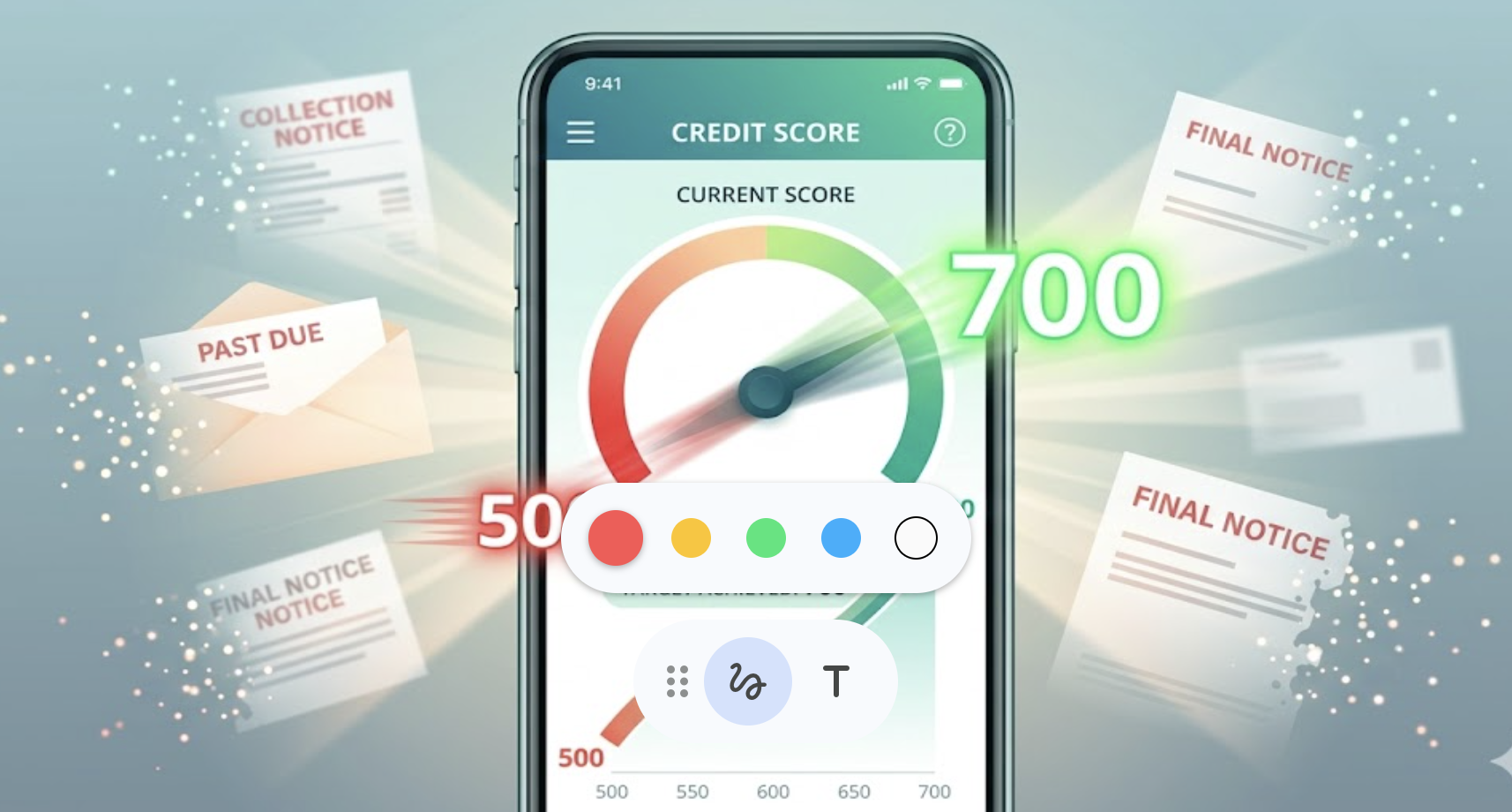
Credit Score Improvement · How to Raise Credit Score from 500 to 700 · Credit Rebuilding · Credit Repair Strategy · FICO Score Growth
Updated April 2026 · Sources: FICO Score Credit Insights Report Fall 2025, Experian credit education, myFICO scoring blog, The Street / Fidelity credit guide, CNBC personal finance, WalletHub credit data, myFICO Forums rebuilding threads
A 500 credit score puts you in the "poor" range. You pay more for car loans and insurance. Renting an apartment gets harder. Getting a mortgage is almost impossible. But this score is not permanent. It moves based on what you do each month.
The national average FICO score was 715 in early 2025, according to FICO's Credit Insights Report. That means the gap between where you are at 500 and the national average is just 215 points. This guide shows you the fastest path to close that gap.
How Long Does It Take to Go From 500 to 700?
There is no single timeline that fits everyone. What matters is what is holding your score down right now. The table below shows the three main phases most people go through.
The first phase moves the fastest because it targets things you can change right now. Credit utilization recalculates every billing cycle. An error removed this month is gone for good. The later phases are slower because you are asking time to do the work.
That member's result was possible because their main problem was high balances, not a long history of missed payments. When the main drag on your score is something you can fix fast, like utilization, the gains can come quickly. When the main drag is old late payments or judgments, it takes longer.
To understand exactly what is pulling your score down right now, the first step is pulling your TransUnion, Equifax, and Experian reports. Each bureau can show different information. Our guide to what your TransUnion credit score means breaks down how TransUnion calculates its score, what the ranges mean, and why your three scores may differ by 20 to 40 points.
What Is the Fastest Way to Raise Your Credit Score?
Here is what the research shows about each move and how fast it works:
The chart shows two things. First, removing an error and cutting utilization are nearly tied for the biggest gains. Second, the remaining moves add 20 to 55 points each. None of them work in isolation. Going from 500 to 700 requires several of them working together.
As Fidelity's credit guide, reported by The Street, notes: "People with the best FICO scores tend to keep their average utilization below 6%, with fewer than three accounts carrying balances at any time." Getting below 6% is the target. Below 10% is the realistic near-term goal for someone rebuilding from 500.
How Do I Get My Credit Score Up 100 Points Fast?
The math is straightforward. Payment history is 35% of your FICO score. Credit utilization is 30%. That is 65% of your score in just two categories. If you are losing points in both areas, fixing both gives you the most movement in the shortest time.
Here is how to approach each one:
Utilization: Get each individual card below 10%, not just your overall utilization. FICO penalizes high utilization on individual cards, not just in aggregate. A card at 85% utilization hurts even if your overall number looks acceptable. Pay the highest-utilization card first. Pay before the statement closing date, not the due date, because the balance that reports is the statement balance, not the balance on your due date.
Errors: According to a CNBC consumer finance report, a single incorrect entry marked as 30 days late can drop a credit score by as much as 100 points. If you have one entry like that on your report and it is wrong, getting it removed can add that same 100 points back. Bureaus have 30 days to investigate a dispute. If they cannot verify the entry, it must come off.
That advice from the myFICO community matches how FICO's algorithm works. Each utilization threshold matters separately. Crossing from above 70% to below 70% on a single card produces a score jump. Crossing from above 50% to below 50% produces another. Below 30%, another. Below 10% is the final target for maximum points. Each threshold crossed is a separate scoring improvement.
Can I Raise My Credit Score 200 Points Fast?
The reason a 200-point gain takes time even when you do everything right is that FICO rewards consistency. Payment history is not just about whether you paid. It is about how long you have been paying on time. A clean payment record that starts today needs months to accumulate weight. You cannot manufacture six months of clean history in 30 days.
That said, if your score is being held down by something that can be fixed quickly, like high balances on credit cards or an error on your report, the jump can be faster than you expect. One myFICO member described going from 537 to 707 in four months by paying down balances aggressively. That is 170 points in one-third of a year.
If you are unsure why your score dropped to 500 in the first place, that is the first thing to understand. A score does not start at 500 by accident. Our guide on the most common reasons for a credit score drop breaks down the specific triggers that pull scores into the 400s and 500s, and which ones recover fast versus which ones take time to overcome.
Step-by-Step Plan to Go From 500 to 700
- Pull all three credit reports from AnnualCreditReport.com. Do this before anything else. You need to know exactly what is on your report before you know what to fix. Look for accounts you do not recognize, balances that are wrong, payments marked late when you paid on time, and collection accounts. Write down every negative entry and note whether it looks accurate.
- Pay every credit card below 10% of its limit before the statement closing date. This is the single fastest move. If you can only do one thing this month, this is it. Pay before the statement closes, not the due date. The closing date is when the balance gets reported to the bureaus. A card paid to zero by the closing date reports a zero balance, which helps utilization the most.
- Dispute every inaccurate entry with each bureau separately. File disputes at Experian.com, TransUnion.com, and Equifax.com. An error on one bureau's report does not automatically mean it is on all three. Check each one. For each error, state what is wrong, attach any proof you have, and file the dispute. Bureaus have 30 days to respond. If they cannot verify the entry, it must be removed.
- Contact collection agencies about pay-for-delete agreements. If you have open collection accounts, reach out to the collector and offer to pay in exchange for a full deletion of the account from your credit report. Get the agreement in writing first. Under FICO Score 9, paid collections are ignored. But a deleted collection has zero impact under any scoring model. Deletion is the better outcome.
- Set autopay on every single account. One 30-day late payment can drop a rebuilding score by 60 to 110 points. That is months of progress wiped in one missed payment. Set autopay for at least the minimum on every account. Then pay the full balance separately when you can. Autopay keeps your payment history clean while you focus on the other steps.
- Ask someone with good credit to add you as an authorized user. When someone adds you to their credit card account as an authorized user, their account history shows on your report. You get the benefit of their on-time payments and their low utilization. You do not need to use the card. You just need to be listed on the account. Choose someone with a card that is at least two years old, low utilization, and a clean payment record.
What Builds Credit the Fastest?
Secured credit cards are a useful tool when you do not have enough open accounts. A secured card requires a deposit, usually $200 to $500, that becomes your credit limit. Use the card for one small purchase each month, like a recurring subscription, and pay it off in full before the statement closes. The card reports to the bureaus every month and adds a positive payment record. After 6 to 12 months, many secured cards upgrade to unsecured accounts and return your deposit.
Becoming an authorized user works faster than a secured card for most people. The account shows on your report immediately after the primary cardholder adds you, and there is no hard inquiry. The catch is that you need someone willing to add you who also has good credit habits. If the primary holder carries high balances or misses payments, those negatives show on your report too.
Credit-builder loans, offered by many credit unions and online lenders, work differently. You make monthly payments into a savings account, and the lender reports those payments to the bureaus. At the end of the term, you receive the money. The benefit is a clean installment loan on your record. The drawback is that it does not help your credit utilization ratio the way a credit card does.
Understanding where your score sits on each bureau is important at this stage. All three bureaus use the same FICO model but can produce different scores because creditors do not always report to all three. Our breakdown of what credit score ranges actually mean covers the FICO thresholds that matter most for getting approved for loans and housing, so you know which milestone to target next after you clear 600 and again when you pass 660.
The AZEO method is the most precise utilization strategy used by the myFICO community. It means paying all your credit cards to zero balance except one, which you let report a small balance under 10% of its limit. This approach tells the FICO model you use credit but pay almost all of it off. FICO rewards that pattern with the highest possible points in the utilization category.
Does Paying Off Collections Help Your Credit Score?
Here is the key decision when you have an open collection account. If the collection agency agrees to delete the account in exchange for payment, take that deal. If they only agree to update it as "paid in full," that is still worth doing because it keeps the account from going to judgment. But if you are paying just to pay without any deletion agreement, check which scoring model your target lender uses first.
As WalletHub's credit scoring data confirms: "Newer credit scoring models, such as VantageScore 3.0 and 4.0 and FICO Score 9 and 10, ignore collection accounts with a $0 balance. Therefore, paying collection accounts could boost your score over 100 points." The problem is that many mortgage lenders still use FICO 2, 4, and 5, older models that do not ignore paid collections. Know which model matters for the loan you are trying to get.
Know Exactly What Is Holding Your Score at 500
A free 3-bureau audit shows every entry across your Experian, TransUnion, and Equifax reports. It identifies which items are disputable, which collections qualify for pay-for-delete, and where your utilization stands. This is the starting point for any rebuild plan.
Get My Free Credit Audit → Secure · 2 minutes · No credit card requiredFrequently Asked Questions
How long does it take to go from 500 to 700 credit score?
Most people take 12 to 24 months. The speed depends on what is pulling your score down. If the main issue is high credit card balances, you can see 40 to 80 points of gain in the first billing cycle after paying balances down. If the main issue is multiple late payments or collections, those take longer because they age slowly. A realistic plan is to target 50 to 80 points of gain in the first 90 days and then build steadily over the following year.
What is the fastest way to raise your credit score?
The fastest single action is paying credit card balances below 10% of each card's limit. Utilization makes up 30% of your FICO score and recalculates every billing cycle. A card paid from 80% to 8% utilization can add 40 to 80 points in 30 days. Disputing an inaccurate entry on your credit report is the second fastest move and can add 50 to 100 points if the entry gets removed.
Can I raise my credit score 200 points fast?
A 200-point gain from 500 to 700 is possible in 12 to 24 months. Faster results are possible if your score is being held down mainly by high utilization and errors, since both can be fixed quickly. A member of the myFICO community documented going from 537 to 707 in four months by paying down balances aggressively. But that person had few missed payments. The more serious your negative history, the longer the timeline.
What builds credit the fastest?
Lowering credit card utilization is the fastest credit-building action because it updates every billing cycle. After that, disputing and removing errors from your report produces the next fastest gain. Adding a secured credit card and being added as an authorized user on a well-managed account are also fast ways to add positive payment history to a thin or damaged file.
Does paying off collections help your credit score?
It depends on the scoring model. Under FICO 9 and VantageScore 4.0, paid collections have no impact on your score. Under FICO 8, the most widely used model, a paid collection still shows as a negative but does less damage than an unpaid one. The best outcome is negotiating a full deletion of the account in exchange for payment. A deleted collection has no impact under any scoring model.
How do I get my credit score up 100 points fast?
To gain 100 points quickly: pay every credit card below 10% of its limit before the statement closing date, dispute any inaccurate entries on your credit report, and bring any past-due accounts current. These three actions target the two largest FICO factors, payment history (35%) and utilization (30%), and can produce 80 to 150 points of gain in 60 to 90 days if the conditions are right.
-
Voluntary Surrender vs Repossession: Which Is Less Damaging? If a repossession or voluntary surrender is part of what pushed your score to 500, this covers exactly how each affects your credit, how long each stays on your report, and the fastest path to recovery after either event.
-
Can You Sell Your House While in Pre-Foreclosure? For homeowners also facing mortgage stress alongside credit rebuilding, this covers the window you have to sell before a foreclosure auction, protect your equity, and avoid the full credit damage of a completed foreclosure.
-
Bank Account Frozen But I Never Got Served: Is That Legal? Unpaid collection accounts can lead to court judgments and a frozen bank account. This explains what to do within the 10-day window to protect your funds and how to challenge a default judgment entered without proper notice.
Reaching 500 to 700 Credit Score is Possible
A 200-point increase is possible, but it does not happen all at once. Early gains usually come from lowering utilization and correcting reporting issues. Bigger jumps come later as negative accounts stop affecting the score and positive history builds.
What matters is order and consistency. Remove or resolve what is hurting the score. Keep balances low before they report. Do not add new problems while trying to fix old ones.
Most people who stay in the 500s are not stuck. They are repeating the wrong steps. When the sequence is right, the score moves.