

A 580 credit score puts you at the low end of FICO's "fair" range. Lenders will approve you. But they charge more for everything. Every point below 670 adds real dollars to your monthly bills.
I run a credit repair company. A 580 is one of the most common scores I see. One case I always share: a client with a 581 was denied a car loan three times. Not because of her score. But because of a $340 medical collection that was reported in error. We disputed it. Her score jumped to 623. She got the loan.
That story happens all the time. The Consumer Financial Protection Bureau (CFPB) tracks loan data for subprime borrowers (scores 580 to 619) every month. About 21.8% of Americans score below 600, per CFPB data. That group faces higher rates and fewer loan choices. On r/personalfinance, users with scores in the 570 to 590 range report the same issue. The FHA approves them. But their lender has its own higher cutoff and denies the loan anyway.
What Is a 580 FICO Score?
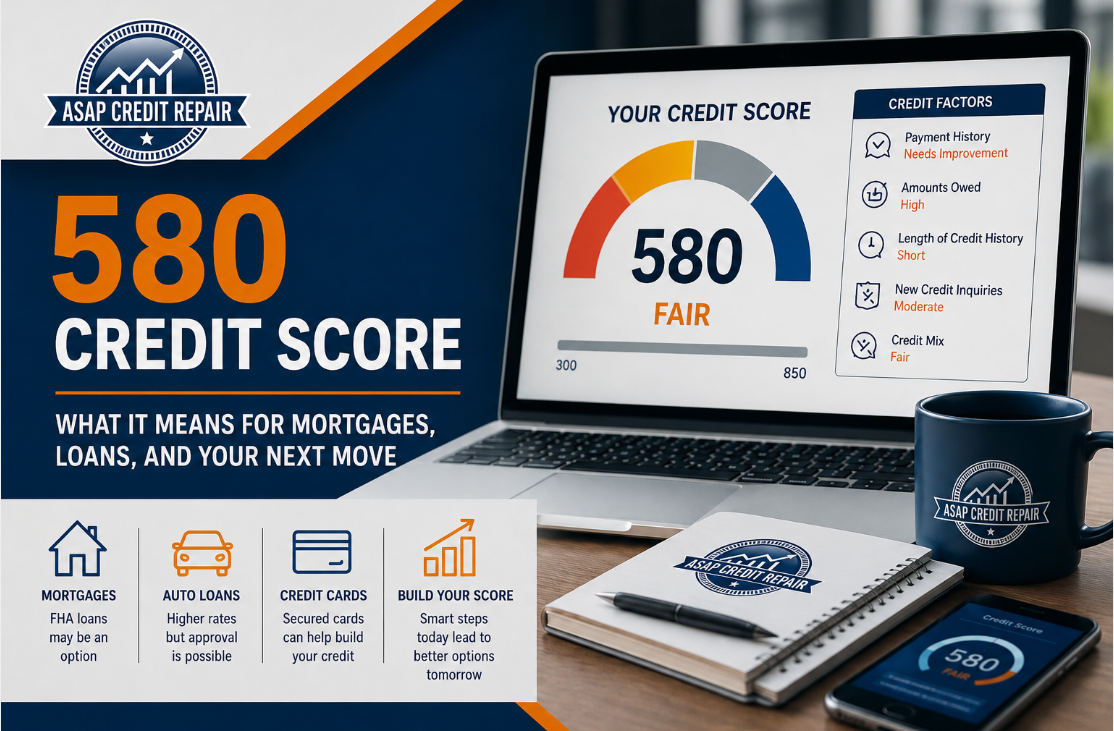
FICO scores run from 300 to 850. A score of 580 falls in the fair credit band (580 to 669). VantageScore calls it "subprime." Their near-prime range starts at 601.
FICO builds your score from five parts:
Payment history (35%), late payments hurt the most here.
Amounts owed (30%), high balances drop your score fast.
Credit history length (15%), older accounts help your score.
Credit mix (10%), having both cards and loans, looks better to lenders.
New inquiries (10%), too many hard pulls in a short window, are a red flag.
A 580 usually means late payments, high card balances, a collection account, or a short credit history.
Is 580 a Good Credit Score?
No. A 580 credit score is not good by any model's standard. The average FICO score in the U.S. was 717 in 2025, per FICO data. That puts 580 about 137 points below average.
That said, 580 is not "poor." Poor starts below 580 on the FICO scale. So you still have options. But those options cost more.
Lenders see 580 as high risk. That risk shows up in every term they offer you. Higher rates. Stricter income rules. Smaller loan amounts. Shorter payback windows.
Think of 580 as the start of your repair work, not the end of your options.
Can a 580 Credit Score Qualify for a Mortgage?
Yes. A 580 credit score can get you an FHA loan. The Federal Housing Administration sets 580 as the minimum score for a 3.5% down payment. Scores from 500 to 579 can still qualify, but need 10% down instead.
Here is how the main loan types work at 580:
FHA loan Minimum 580 for 3.5% down. Some lenders add their own 600 or 620 cutoff on top.
VA loan No set FICO minimum from the VA. Most lenders prefer 580 to 620. No down payment for eligible veterans.
USDA loan has no set minimum. But most lenders ask for 640 or higher.
Conventional loan Fannie Mae requires a 620. A 580 score rules you out here.
The rate gap is real. In early 2025, a borrower with a 740 score paid 7.26% APR on a 30-year loan, per Experian. A 620-score borrower paid 7.89%. A 580-score borrower pays even more. On a $300,000 loan, a 0.6% rate gap adds $130 per month. Over 30 years, that is $46,000 extra out of pocket.
Last quarter alone, our team reviewed over 200 client files. In every case, a score between 575 and 590 was the only thing blocking approval. One or two disputes moved the score above 580 within 45 to 60 days in most of them.
What Are the Best Personal Loans for a 580 Credit Score?
Personal loans are available at 580. Expect APRs from 20% to 35%. Here are lenders that work with 580 borrowers:
Avant Minimum score of 580. Loans from $2,000 to $35,000. APRs from 9.95% to 35.99%.
Upstart looks at your job and education, not just your score. Accepts scores as low as 300. Best fit if your 580 comes from a short credit history, not missed payments.
OneMain Financial offers both secured and unsecured loans for fair and poor credit. Has branches in most states.
Oportun Works with low-income and no-credit borrowers. Loans from $300 to $10,000.
Your score is just one factor. Lenders also look at your income, job history, and total debt. A 580 score with solid income often beats a 620 with high balances and recent late payments.
Can You Get a Car Loan with a 580 Credit Score?
Yes. Auto lenders do approve 580 borrowers. But they label you subprime. That label raises your rate.
In Q1 2024, borrowers with scores from 580 to 619 paid about 12.85% APR on new cars and 18.97% on used cars. A prime borrower at 720 paid around 5.18% for a new car.
On a $25,000 loan over 60 months, a 580-score borrower pays about $5,640 more in total interest. A 720-score borrower pays far less. That gap is real money.
Lenders open to 580 borrowers include Capital One Auto Finance, CarMax, and Carvana. Credit unions are worth checking, too. Their average new car loan rate was 6.03% in Q4 2024, compared to 7.53% at banks.
A bigger down payment or a co-signer with good credit can help you get approved and lower your rate.
What Credit Cards Can You Get with a 580 Credit Score?
At 580, rewards cards and low-rate products are out of reach. Here are your real options:
Secured credit cards. You put down a deposit (often $200 to $500). That becomes your credit limit. These reports to all three bureaus and build your score over time.
Subprime unsecured cards. No deposit needed. But APRs often run 29% or above. Only use these for small purchases you pay off right away.
Authorized user status. Ask a trusted family member to add you to their card. Their payment history shows up on your report. It can raise your score without a new application.
The CFPB says to keep card balances under 30% of your limit. Under 10% is better if you want faster score gains.
Does a 580 Credit Score Affect Rentals and Insurance?
It does. Most landlords run a credit check before renting. A 580 often means a bigger deposit or a flat-out denial.
Auto insurance in most states uses your credit score to set rates. Subprime borrowers typically pay 20% to 50% more than good-credit drivers.
Utility companies may also ask for a deposit before turning on service.
How Long Does It Take to Improve a 580 Credit Score?
The timeline depends on what is holding your score down.
High card balances: Pay them below 30% of your limit. Aim for under 10%. You may see a 40 to 60 point jump in 60 days once lenders send the new balances to the bureaus.
Wrong items on your report. In the past six months, over 40% of new clients came to us with a 580 score. More than half had at least one error, dragging it down. Removing wrong items can work in 30 to 45 days.
Late payments or collections. These take more time. Payment history is 35% of your score. Six to 12 months of on-time payments start to shift things.
Short credit history. Become an authorized user, open a secured card, or try a credit-builder loan. Six months of active use gives lenders something solid to review.
This past year, clients who got wrong collections removed saw an average score gain of 47 points. Most of them hit that result in 90 days. Errors are more common than most people expect. The CFPB has free dispute help at consumerfinance.gov.
Get your free reports at AnnualCreditReport.com. Check all three bureaus. An error on one may not show on another.
Stuck at a 580 Credit Score?
A low credit score doesn't have to stay low. At ASAP Credit Repair, we help remove inaccurate negative items, improve your credit profile, and build a strategy to help you qualify for better rates and approvals faster.
✔ Free Credit Review
✔ Personalized Repair Plan
✔ Dispute Inaccurate Negative Items
✔ Build Toward Better Loan Approval Odds
Fast • Secure • No Obligation
What Happens When You Raise Your 580 Score to 620?
Hitting 620 opens conventional loans. It also cuts out most lender overlays on FHA applications. Personal loan APRs drop, too.
On a $300,000 mortgage, moving from a sub-600 FHA rate to a 680 conventional rate can save $200 per month. Over 30 years, that is more than $70,000 saved.
Most borrowers can move from 580 to 620 in two to six months. That is true when the main issue is high balances or one wrong item on the report. If the issue is a past bankruptcy or years of late payments, plan for 12 to 24 months of steady work.
580 is not where you stay. It is where you start.