

Balance Transfer vs Debt Consolidation: Which Saves More Money? How much debt do you have, and how fast can you pay it off? Balance transfers work best for smaller credit card balances you can clear within 12 to 21 months. Debt consolidation loans fit better when your debt is larger, mixed, or needs a longer repayment window.
Running a credit repair company, I see this decision come up every week. One case that stuck with me: a client came in with $22,000 across five credit cards, all above 20% APR. She had applied for a balance transfer card, got approved for only $6,000, and still owed $16,000 at high interest. She thought she had solved her debt problem. She had not. That gap between what she could transfer and what she still owed cost her thousands more in interest.
Real data backs up how common this situation is. According to TransUnion, the average outstanding personal loan balance hit a record $11,676 in Q2 2025, with the most common reason for taking one out being debt consolidation or refinancing. Meanwhile, the average credit card interest rate sits at 21% APR as of early 2026, per the Federal Reserve, one of the highest levels in decades (Federal Reserve Consumer Credit Data).
Understanding both options clearly is the first step to choosing the right one.
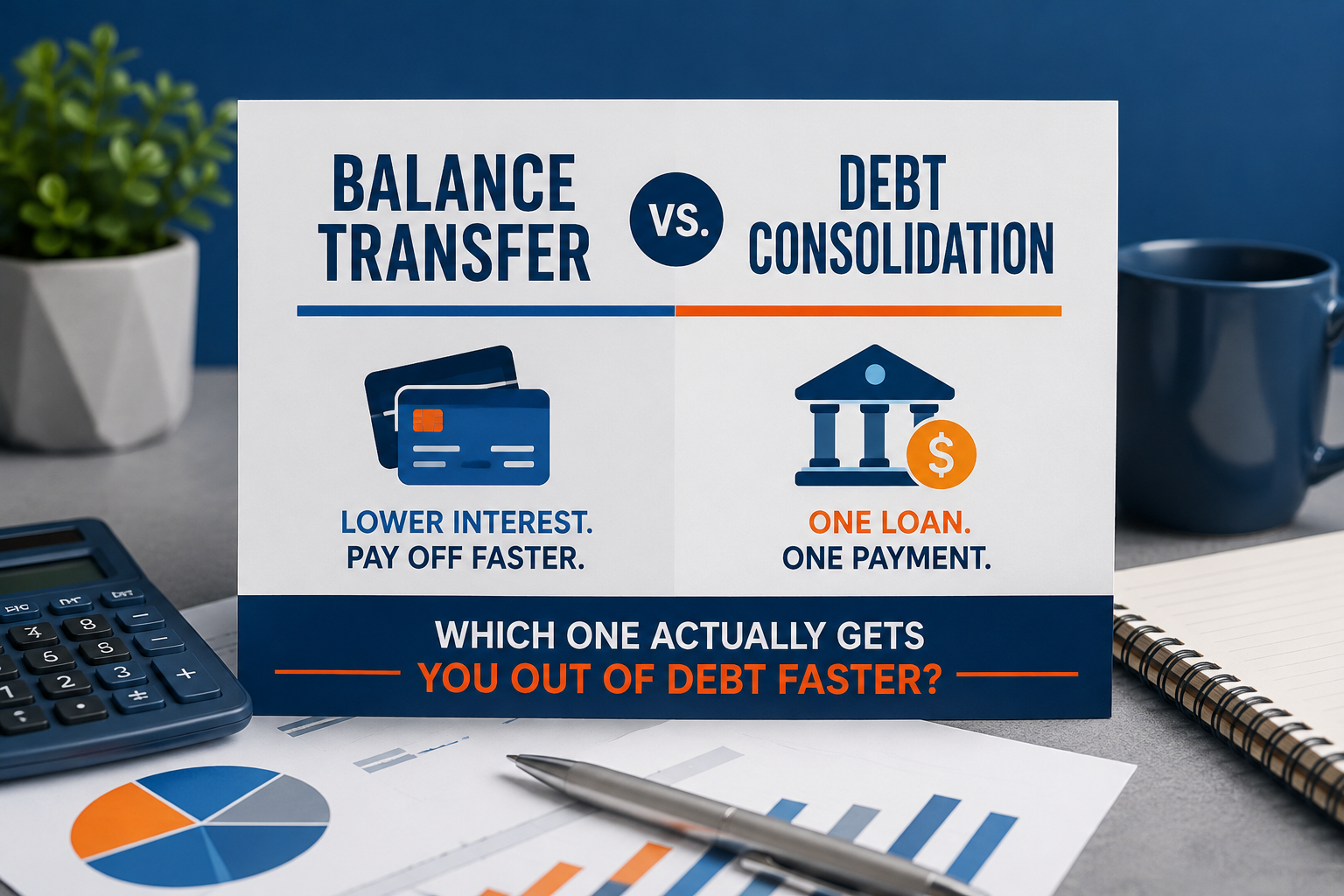
What Is the Difference Between a Balance Transfer and Debt Consolidation?
A balance transfer moves your existing credit card balances to a new card that offers a low or 0% introductory APR. That promotional rate typically lasts 12 to 21 months. During that window, every dollar you pay goes directly toward the principal, not interest.
Debt consolidation works differently. You take out a new loan, usually a personal loan, and use it to pay off multiple existing debts. You then make one fixed monthly payment on the loan, typically at a lower interest rate than your credit cards.
Both tools reduce what you pay in interest. But the structure, cost, and ideal use case are different for each.
How a Balance Transfer Works
A balance transfer card charges a fee of 3% to 5% of each transferred amount. On a $10,000 transfer at 4%, that fee adds $400 to your balance upfront. After the promotional period ends, the regular APR kicks in — often between 17% and 28%.
The entire strategy depends on paying off the balance before that promotional window closes. If you do not, you start paying full interest on whatever remains.
How a Debt Consolidation Loan Works
A debt consolidation loan gives you a fixed interest rate and a set repayment term, usually one to seven years. The average APR on a 24-month personal loan was 11.40% in 2025, according to Federal Reserve data, compared to 21.52% for the average credit card. Some lenders charge an origination fee of 1% to 9.99%, which gets added to the loan total.
The loan covers more than just credit cards. Auto loans, medical bills, and other unsecured debts can all qualify.
Which Option Is Cheaper: Balance Transfer or Debt Consolidation?
The cheaper option depends on your balance size and how long you need to repay.
For a $10,000 credit card balance at 23% APR, you would pay about $2,300 in interest over one year if you kept it on your card. A balance transfer with a 5% fee costs $500 upfront. If you clear the balance during a 12-month 0% period, you save $1,800 even after the fee.
For a $20,000 balance across multiple debts, a 3-year personal loan at 11.40% APR costs roughly $3,300 in total interest. Keeping the same $20,000 on credit cards at 21% costs nearly $13,000 in interest over the same period.
The balance transfer wins for smaller, fast-payoff situations. The consolidation loan wins for larger balances or longer timelines.
In our office, last year alone we reviewed over 180 client debt profiles where the wrong tool added $4,000 to $8,000 in unnecessary interest costs simply because the client chose based on name recognition rather than their actual numbers.
How Do I Know If I Qualify for a Balance Transfer Card?
Balance transfer cards generally require good to excellent credit, a FICO score of 670 or higher. Cards with the longest 0% periods, such as 18 to 21 months, typically require scores of 700 or above.
Card issuers also set a credit limit that controls how much you can transfer. That limit often falls short of your total debt. If you carry $18,000 in credit card debt and get approved for a $7,000 limit, you still have $11,000 sitting at your original high rate.
One more restriction: you cannot transfer balances between cards from the same issuer. A Chase card cannot receive a Chase balance. Always check the issuer rules before applying.
What Credit Score Do You Need for a Debt Consolidation Loan?
Debt consolidation loans are available across a wider credit range. Borrowers with fair credit (580 to 669) can qualify, though they will receive higher APRs. Credit unions often offer the most competitive rates for borrowers in the mid-600s range.
Borrowers with scores above 720 typically qualify for APRs between 6% and 14%. Borrowers with scores below 620 may see rates above 25%, which can make consolidation less effective than expected.
What Are the Risks of a Balance Transfer?
The biggest risk is not paying off the transferred balance before the promotional period ends. If $5,000 remains when the 0% window closes, the remaining balance immediately starts accruing interest at the card's regular rate, sometimes 25% or higher.
Three other risks to know:
The transfer fee adds to your balance. A 5% fee on $15,000 means you start with $15,750 owed. Your monthly payment must account for this from day one.
New purchases may not get the 0% rate. Many balance transfer cards apply the intro rate only to transferred balances, not new spending. Carrying both at once makes it harder to pay down the debt.
Missing a payment can cancel the promo rate. Some card issuers will revoke the 0% APR if you miss even one payment during the promotional period.
When Does a Debt Consolidation Loan Make More Sense?
A debt consolidation loan makes more sense in four specific situations.
Your total debt exceeds $15,000 to $20,000, and you cannot realistically pay it off within 21 months.
Your debt is a mix of credit cards, medical bills, and personal loans, not just credit cards.
Your credit score does not meet the threshold for the best balance transfer offers.
You want a fixed monthly payment and a guaranteed payoff date, rather than a flexible card payment.
According to Forbes Advisor data cited by CNBC, nearly half (47%) of debt consolidators borrow between $10,000 and $20,000, and 32% borrow over $20,000. These amounts exceed what most balance transfer cards will approve in credit limits.
A fixed-rate consolidation loan also removes the risk of interest rate changes. Your rate does not rise after a promotional period, and your monthly payment stays the same from start to finish.
Does a Balance Transfer or Debt Consolidation Hurt Your Credit?
Both options affect your credit score, but the impact is temporary and manageable.
How a Balance Transfer Affects Your Credit
Applying for a new credit card triggers a hard inquiry, which typically drops your score by 5 to 10 points. Opening a new account also lowers your average account age. On the other hand, a new card increases your total available credit, which can lower your credit utilization ratio, a positive for your score.
How a Debt Consolidation Loan Affects Your Credit
A consolidation loan also creates a hard inquiry. Paying off multiple credit card accounts with the loan proceeds can reduce your utilization rate significantly, which is a positive signal to credit bureaus. Over time, on-time loan payments build a stronger payment history, which is the most important factor in your FICO score at 35%.
Both options tend to help your credit in the medium to long term when managed correctly. The short-term dip from the hard inquiry recovers within a few months.
Can I Use Both a Balance Transfer and a Debt Consolidation Loan Together?
Yes, and for some borrowers, combining both makes sense. One approach: use a balance transfer card for your highest-interest credit card debt that you can pay off quickly, and take out a consolidation loan for the remaining larger balance.
This split strategy works when your debt is high enough that no single tool covers all of it at a favorable rate. The key is to calculate the total cost of each option, including fees, rates, and timelines, before combining them.
Unsure Whether a Balance Transfer or Debt Consolidation Is Right for You?
The wrong choice can cost thousands in unnecessary interest. Get a personalized credit analysis and discover the fastest path to becoming debt-free while protecting your credit score.
Get Your Free Credit AnalysisNo obligation. Learn which debt payoff strategy could save you the most money.
What Happens If I cannot Pay Off a Balance Transfer in Time?
If you cannot clear the transferred balance before the promotional period ends, two paths exist. First, apply for another balance transfer card and move the remaining balance again. This only works if your credit score still qualifies and a new issuer approves another transfer. Second, pivot to a debt consolidation loan for the remaining amount. A loan locks in a fixed rate and a clear payoff date, stopping the uncertainty of running out a promotional clock.
Which One Should You Choose?
Choose a balance transfer if:
Your debt is primarily credit card debt under $15,000.
Your credit score is 670 or higher.
You can make payments large enough to clear the balance within the promotional window.
You will not add new charges to the card.
Choose a debt consolidation loan if:
Your total debt exceeds $15,000 or includes non-credit-card debt.
You want a fixed monthly payment and a guaranteed end date.
You need more time than a promotional period allows.
Your credit score limits your balance transfer options.
Both tools reduce the interest you pay. Neither eliminates debt on its own; consistent monthly payments do that. The tool only changes the cost and structure of those payments.
One final point worth repeating: the average credit card APR is 21% right now. Every month you stay on a high-rate card without a plan costs money that could go toward your principal. Pick the option that fits your numbers, not just the name that sounds most familiar.