
The best credit cards for bad credit are secured cards that report to all three credit bureaus, charge no annual fee, and offer a clear path to an unsecured upgrade. The right card does not just give you access to credit. It gives you a tool to raise your score fast.
Running a credit repair company means we see the full picture. One of the most unforgettable cases we handled came from a client with a 498 score who had been declined three times. She opened a $200 secured card, kept her balance below 10%, and paid it in full each month. Eleven months later, her score crossed 640, and she qualified for an unsecured card with no deposit required.
Real people in r/CreditCards on Reddit share similar stories. One user reported starting with a poor credit score and opening the Capital One Platinum Secured card. Eight months later, they received an automatic credit limit increase, and their score jumped 67 points. (Source: Bankrate, citing r/CreditCards) The pattern repeats: the right card plus consistent habits produces measurable results within a year.
The data backs it up. According to the New York Federal Reserve, total U.S. consumer debt hit nearly $8 trillion in Q3 2024. All 50 states saw average credit scores fall in 2024. Credit card delinquency rates reached levels not seen since 2011. Millions of Americans need a realistic path back to good credit. This guide shows you exactly which cards work and how to use them.
What Credit Score Is Considered Bad?
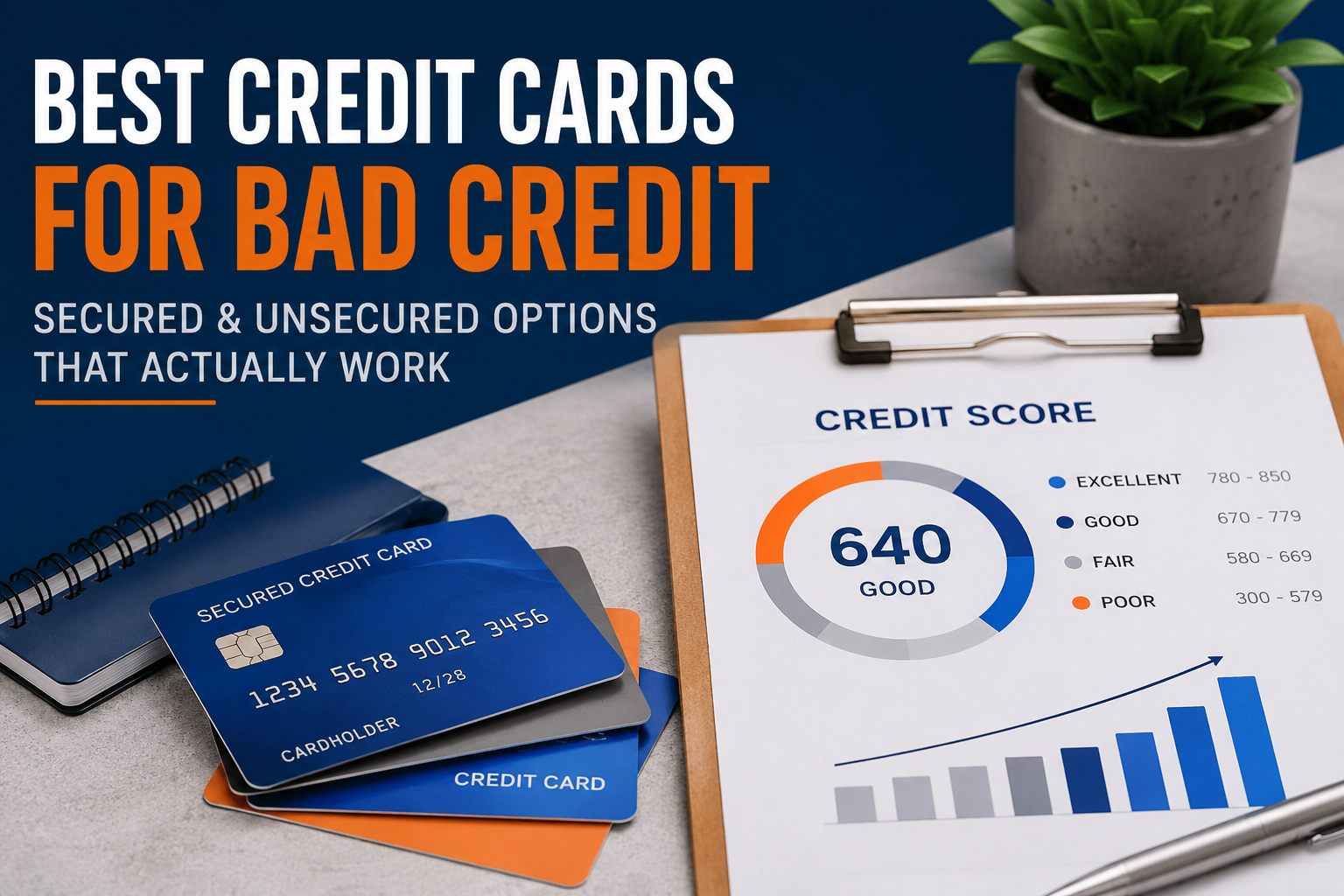
A bad credit score falls below 580 on the FICO scale. Lenders consider scores between 580 and 669 as "fair" credit, which still limits your options. Here is the full range:
800 to 850: Exceptional
740 to 799: Very good
670 to 739: Good
580 to 669: Fair
300 to 579: Poor
Most credit card issuers require a score of at least 580 to qualify for any card. Below 580, secured cards and no-credit-check options become your primary tools. The good news is that you do not need a perfect score to start rebuilding. You just need the right card and the right habits.
What Is the Difference Between Secured and Unsecured Credit Cards for Bad Credit?
A secured credit card requires a cash deposit. That deposit becomes your credit limit. A $200 deposit gives you a $200 limit. The issuer holds the deposit as collateral. Because of that, approval is almost guaranteed regardless of your score.
An unsecured credit card requires no deposit. The issuer extends credit based on your income, score, and credit history. Unsecured cards for bad credit are harder to get and often carry higher fees.
Bankrate's 2024 data found that people with bad credit are 46% more likely to get approved for a secured card than for an unsecured bad-credit card. If your score is below 580, start with secured. If your score is between 580 and 640, you may qualify for both types.
The key difference in outcome: both types report to credit bureaus the same way. A secured card used responsibly builds your score just as fast as an unsecured card. The deposit is refundable when you close or upgrade the account.
Best Credit Cards for Bad Credit in 2026
Discover it Secured Credit Card: Best Overall
The Discover it Secured card earns 2% cashback at gas stations and restaurants on up to $1,000 in combined purchases each quarter, then 1% on everything else. Discover also matches all the cashback you earn in your first year. There is no annual fee and no foreign transaction fee.
The minimum deposit is $200. Discover reviews your account starting at seven months to see if you qualify for an upgrade to an unsecured card. That is one of the fastest upgrade timelines among major issuers.
This card is the best overall pick because it gives you rewards while you rebuild. Most bad-credit cards offer nothing back. Discover offers a path to rewards and an unsecured upgrade in under a year.
Capital One Platinum Secured: Best for Low Starting Deposit
The Capital One Platinum Secured card starts with a $200 credit limit. Capital One may approve you with a deposit as low as $49, $99, or $200, depending on your creditworthiness. The annual fee is $0.
Capital One automatically reviews your account for a credit limit increase after six months of on-time payments. No additional deposit is required for that increase. Many users report jumping from $200 to $500 to $1,000 within a year without putting in more cash.
This card suits buyers who cannot tie up $200 immediately. A $49 entry point makes it the most accessible secured card from a major issuer.
OpenSky Plus Secured Visa: Best for No Credit Check
OpenSky does not check your credit history when you apply. Approval is based entirely on your ability to fund the deposit. The minimum deposit starts at $300. The annual fee is $0 on the Plus version.
OpenSky reports to all three major credit bureaus monthly. That monthly reporting is what drives your score up over time. This card works well for anyone with a score below 500, a recent bankruptcy, or no credit file at all.
The downside is that OpenSky does not offer an unsecured upgrade path. You will need to open a different card once your score improves.
By now, you know the secured card landscape: Discover is the strongest overall, Capital One is the easiest to enter, and OpenSky removes every barrier. The next two options are for buyers who want to skip the deposit entirely.
Credit One Bank Platinum Visa: Best Unsecured Card for Bad Credit
The Credit One Bank Platinum Visa is one of the few unsecured cards available to buyers with scores as low as 550. It offers a $300 initial spending limit with no deposit required.
The annual fee ranges from $75 the first year to up to $99 after that. That fee comes out of your credit limit, so your usable credit starts lower. The APR is high, typically around 29.99%. Pay the balance in full every month to avoid interest charges that offset any benefit.
This card fits buyers who cannot fund a deposit but need a credit line. Use it for small, recurring purchases and pay it off immediately.
Self Visa Secured Credit Card: Best for No Credit History
The Self Visa requires a minimum $100 deposit, making it one of the lowest-entry secured cards available. There is no credit check. Self reports to all three bureaus each month.
The unique feature of the Self Visa is the Credit Builder Account option. You open a savings account and make fixed monthly payments. Those payments fund your security deposit over time while also reporting to the bureaus. This creates two credit lines instead of one.
The annual fee is $0 for the first year, then $25. The APR is 28.24%. Like all secured cards, pay your balance in full each month.
Can You Get a Credit Card With a 500 Credit Score?
Yes. Several cards accept scores at or below 500. The OpenSky Plus Secured Visa and the Self Visa do not check credit at all. The Discover it Secured and Capital One Platinum Secured accept scores in the low 500s.
The key is to apply for cards that match your score range. Applying for a premium card with a 500 score triggers a hard inquiry and results in a denial. That hard inquiry still drops your score by 3 to 5 points. According to FICO, hard inquiries affect your score for up to 12 months and stay on your report for 2 years.
Only apply for cards where your score meets or exceeds the recommended range. Use prequalification tools first. Most major issuers offer soft-pull prequalification checks that do not affect your score at all.
Will Getting a Credit Card for Bad Credit Hurt My Score?
Applying for a card causes a small, temporary dip. One hard inquiry typically drops your score by about 5 points. That dip usually reverses within a few months. FICO does not count new credit inquiries after 12 months.
The bigger risk is applying for multiple cards at once. Each application triggers a new hard pull. Three applications in 30 days can drop your score by 15 points or more. Space out applications by at least 90 days.
Once you have the card, responsible use raises your score. Payment history is 35% of your FICO score. Credit utilization is 30%. A secured card kept below 10% utilization and paid in full each month attacks both of those factors directly.
Last quarter, our office saw 38 new clients come in with scores below 550. Of those, 29 had opened multiple cards in a short window and triggered five or more hard inquiries. That single habit was responsible for 20 to 40 points of unnecessary score damage.
How Long Does It Take to Rebuild Credit With a Secured Card?
Most users see a meaningful score increase within 6 to 12 months of consistent on-time payments. Here is a realistic timeline:
Months 1 to 2: Score may dip slightly due to new account and hard inquiry.
Month 3 to 4: Score starts to recover as on-time payments post.
Month 6: Most issuers review for credit limit increases or unsecured upgrades.
Month 12: Many users reach the "fair" range (580 to 669) from a starting point in the 500s.
Speed depends on what else is on your report. Active collections and late payments slow progress. If your report has errors, dispute them at AnnualCreditReport.com first. Removing an incorrect collection can raise your score by 20 to 50 points faster than any card habit alone.
What to Look for in a Credit Card for Bad Credit
Not all bad-credit cards are worth your time. Watch for these before you apply:
Reports to All Three Bureaus
This is non-negotiable. A card that only reports to one bureau builds credit at one-third the speed. Every card on this list reports to Experian, Equifax, and TransUnion.
No or Low Annual Fee
Annual fees eat into your available credit and cost you money you do not need to spend. Discover, Capital One Platinum Secured, and OpenSky Plus all charge $0. Credit One Bank charges up to $99. Factor that into your decision.
Upgrade Path to Unsecured
The goal is to get your deposit back. Cards that offer automatic or requested upgrades to unsecured accounts return your money and give you a higher limit. Discover and Capital One both offer upgrade pathways. OpenSky does not.
Prequalification Without a Hard Pull
Always use the issuer's prequalification tool before applying. It shows your approval odds without touching your score. This is especially important when you have a fragile score in the low 500s.
Low Utilization Target
Keep your balance below 30% of your credit limit at all times. Below 10% is better. On a $200 limit, that means keeping your balance under $20 at statement time. Pay the full balance before the statement date for maximum score impact.
A bad credit score is not permanent. The right secured card, used consistently, produces a measurable score increase within 6 to 12 months. Start with the Discover it Secured if you can fund $200 and want rewards. Choose Capital One Platinum Secured if you need the lowest entry deposit. Pick OpenSky Plus if your score is below 500 or you have a recent bankruptcy. Pay in full each month, keep utilization below 10%, and let the bureaus do the rest.