

Can Claude AI help me repair my credit? Yes, but Claude cannot repair your credit for you. Anthropic's AI assistant can review information you provide, explain credit report entries, calculate credit utilization, and draft dispute letters. It cannot order Experian, Equifax, or TransUnion to remove an account. The difference matters: Claude prepares the information, but you still have to verify it and take action.
Consider a borrower with a $3,000 credit card balance and a $6,000 limit. That's 50% credit utilization. Ask Claude how to reach 30%, and it calculates a $1,200 payment target. Paying $300 a month would take four months, excluding interest and new purchases. Claude handles the calculation. The borrower has to make the payments, and the card issuer must report the updated balance before it appears on the credit report.
Disputing credit report errors is another practical use, but the law sets the rules, not Claude. Under the Fair Credit Reporting Act (15 U.S.C. § 1681i), credit bureaus generally have 30 days to investigate a dispute, with a possible 15-day extension in certain circumstances. Claude can organize account details and draft a letter explaining why an entry is inaccurate. It cannot prove the error, conduct the bureau's investigation, or guarantee deletion. The Consumer Financial Protection Bureau (CFPB) also confirms that consumers can dispute credit report errors for free.
The bigger question is whether Claude's convenience justifies sharing your financial information. Anthropic's consumer privacy settings determine how eligible conversations are handled for model improvement, while separate retention and safety rules still apply.
This guide looks at Claude's actual role in credit repair, tests its usefulness through a fictional dispute-letter example, and explains the privacy controls worth checking. You'll also find six credit repair prompts, a seven-step dispute process, and the deadlines that apply after you submit a dispute.
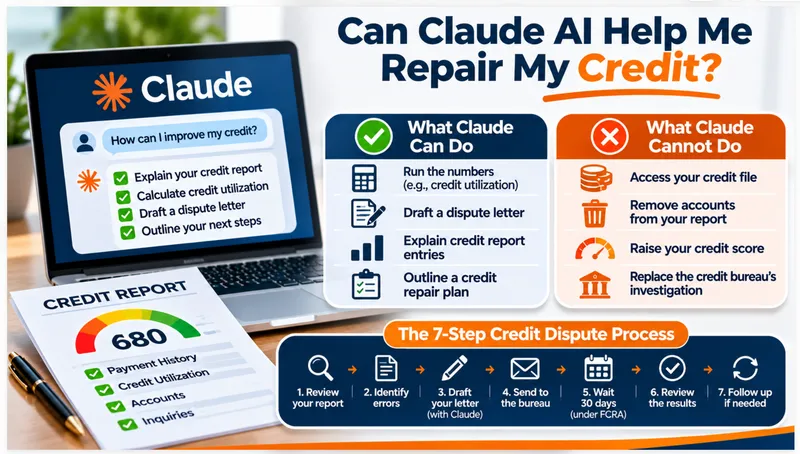
Can Claude AI Help Me Repair My Credit?
Claude AI helps with the paperwork of credit repair, but it does not repair your credit. It cannot see your credit file, file a dispute, or remove an accurate negative item.
What Claude does well is writing and planning. It drafts dispute letters, explains report terms, and builds payoff schedules in minutes.
Disputing errors on your credit report is free. The CFPB states it is your legal right under the Fair Credit Reporting Act, and a good AI draft saves you time using it. It does not replace the work.
Here is what this guide covers:
- What Claude AI does well for credit repair
- What it does not do
- What Anthropic says about your data
- A sample letter Claude wrote from a fictional account
- What happens after you send a dispute, day by day
- Six copyable prompts, including a debt validation letter
- How long negative items stay, and what Claude remembers
- When a credit repair company is the better choice
- Can Claude AI help you repair your credit?
- What Claude AI does well
- A sample letter Claude wrote
- What Claude AI does not do
- Is it safe to share your credit report with Claude?
- Does Claude remember your credit details?
- How to use Claude for credit repair: 7 steps
- What happens after you send a dispute
- Six prompts for credit repair
- How long negative items stay
- If a debt collector is involved
- Five mistakes to avoid
- Claude AI vs. a credit repair company
- How long results take
- FAQ
- Claude drafts. You act. Only corrected or improved reported data moves a credit score.
- Redact before you paste. Anthropic's own help page lists SSNs, card numbers, and bank details as data to be careful with.
- Accurate negatives stay. The CFPB states that most negative information remains for seven years.
- Check every fact. Verify each law and account detail against your reports and the CFPB.
- The clock is 30 days. Federal law gives a bureau 30 days to reinvestigate, or 45 if you send new information during that window.
- One error, one letter. Specific, documented disputes work. Generic AI letters get screened out.
Can Claude AI Help You Repair Your Credit?
Claude AI helps with credit repair tasks but does not repair credit itself. It drafts dispute letters, explains report terms, and plans debt payoff. You pull the reports, find the errors, send the disputes, and follow up. Only corrected data or better payment habits change your score.
Credit repair means getting inaccurate or unverifiable items corrected on your reports. The CFPB states that you do this by contacting both the credit reporting company and the company that supplied the information.
Claude speeds up the writing in that process. It has no connection to Equifax, Experian, or TransUnion.
Credit Repair Rules to Know Before You Prompt
| Question | Answer | Source |
|---|---|---|
| Cost to dispute an error | Free | CFPB |
| Bureau reinvestigation window | 30 days, extended up to 15 days if you send new information | 15 U.S.C. 1681i |
| Written results after the investigation ends | Within 5 business days | 15 U.S.C. 1681i |
| Most negative items stay | 7 years | CFPB |
| Bankruptcies stay | Up to 10 years | CFPB |
| Consumer statement length | Up to 100 words | 15 U.S.C. 1681i |
| Cancel a credit repair contract | 3 business days, no charge | CFPB |
What Claude AI Does Well for Credit Repair
Claude handles four credit repair tasks well: drafting dispute letters, explaining report terms, building payoff plans, and logging follow-ups. All four are writing or planning work. Each one still needs your facts and your review.
Claude AI dispute letters
Give Claude the account, the error, and the correction you want. It returns a short, plain letter.
The CFPB states that a dispute should explain the inaccuracy and include copies of supporting documents. Add those yourself.
Plain-language report explanations
Paste one redacted tradeline and ask what it means. Terms like "charge-off" and "date of first delinquency" read clearly after one pass.
Payoff plans
Say you owe $3,000 on a card with a $6,000 limit. That is 50% utilization.
A 30% target equals $1,800, so you pay down $1,200. At $300 a month, that takes four months. Ask Claude to show its arithmetic and check the numbers.
Follow-up logs
Ask Claude for a simple table with columns for date sent, recipient, tracking number, and response due date. The CFPB states that furnishers generally have 30 days to respond.
A Sample Letter Claude Wrote From a Fictional Account
Given a specific, documented error, Claude writes a usable 150-word dispute letter in seconds. The draft still needs your real details, your proof, and a fact check. The example below uses a fictional account.
A cardholder paid the Sample Bank Visa on March 3, two days before the March 5 due date. The credit report shows a 30-day late payment for March 2026. The bank statement shows the payment posted March 3.
That is a provable error. It has a date, an amount, and a document.
[Your Name]
[Your Address]
[Date]
[Credit Bureau Name]
[Dispute Department Address]
Re: Dispute of inaccurate payment history, Sample Bank Visa ending 0000
I am disputing an inaccurate entry on my credit report under the Fair Credit Reporting Act. The Sample Bank Visa ending 0000 shows a 30-day late payment for March 2026.
That entry is wrong. My payment posted on March 3, 2026, two days before the March 5 due date. A copy of my March statement showing the posting date is enclosed.
Please investigate, correct the payment history to show the account as paid on time for March 2026, and send me written results of your investigation.
Sincerely,
[Your Name]
The draft is short, names the account, states the error, and points to proof. Those four traits separate a letter that gets investigated from a letter that gets screened out.
What You Change Before Sending
- ✓Replace every placeholder. Use the full account number only on the paper copy you mail.
- ✓Match the dates to your documents. The posting date must match the statement you enclose.
- ✓Confirm the dispute address. Copy it from the bureau's website, not from the draft.
- ✓Cut anything you did not ask for. Delete invented case law, threats, and legal claims.
Red Flags in an AI-Written Dispute Letter
| Red Flag | Why It Hurts | Fix |
|---|---|---|
| No specific error named | The bureau cannot investigate "this account is wrong" | State the exact field and the correct value |
| Cites court cases | AI tools produce citations that do not exist | Delete every case you did not verify |
| Demands deletion of an accurate item | The CFPB states accurate negatives generally stay | Dispute only what you prove is wrong |
| Runs past one page | Reviewers skim for the error | Keep it under 200 words |
| Includes your full SSN or account number | Extra exposure with no benefit | Use the last four digits |
What Claude AI Does Not Do
Claude does not pull your credit reports, decide whether an item is wrong, send disputes, or remove accurate negatives. It also gets facts wrong at times. Treat every output as a draft you verify against your reports and the CFPB.
| Credit Repair Task | Claude AI | Who Does It |
|---|---|---|
| Pull your credit reports | No access | You, at AnnualCreditReport.com |
| Decide whether an item is wrong | Needs your records | You, comparing the report to statements |
| Send the dispute | Cannot send | You, to the bureau and the furnisher |
| Investigate the dispute | Not involved | The bureau and the furnisher |
| Remove accurate negatives | Cannot | No one, per the CFPB |
| Guarantee a score increase | Cannot | No one, per the CFPB |
No tool changes this: the CFPB states that you generally cannot have accurate negative information removed from your report, and most of it stays for seven years.
Is It Safe to Share Your Credit Report With Claude?
Share a redacted excerpt, never the full report. Anthropic uses consumer chats for model improvement only when you allow it, when safety systems flag the chat, or when you opt in to a program. Anthropic's help page lists SSNs, card numbers, and bank details among data to be careful with.
Anthropic's privacy page says chats and coding sessions on Free, Pro, and Max plans are used for model improvement in three cases. You allow it in the Model Improvement setting, safety systems flag the chat, or you opt in to a program such as the Trusted Tester Program.
Incognito chats are not used to improve Claude, even when Model Improvement is on.
| Setting | What Anthropic States |
|---|---|
| Model Improvement on | Chats are used to improve Claude. Anthropic announced a five-year retention period for this case |
| Model Improvement off | Anthropic announced that the existing 30-day retention period continues |
| Incognito chat | Not used to improve Claude |
| Flagged by safety systems | Still used for trust and safety work |
| Work, API, and Education plans | Excluded from the consumer terms change |
Anthropic's support page recommends being thoughtful about sharing financial information such as SSNs, credit card numbers, and bank account details. It also lists passwords and private login credentials.
Does Claude Remember Your Credit Details?
Claude remembers everyday context such as your role and projects when memory is on, and memory is on by default for Free, Pro, Max, and Ultra plans. You can pause it, reset it, delete single memories, or use an Incognito chat that is not saved to memory.
Anthropic's help page states that Claude remembers "the everyday context that helps it work with you." Sensitive topics like health or politics are not saved by default.
Financial details you paste into a chat sit in your chat history. Delete the chat when the task ends.
| Control | What It Does | Where |
|---|---|---|
| Pause memory | Keeps existing memory but stops using and creating it | Settings, Your Claude |
| Reset memory | Permanently deletes all memories, including project memories | Settings, Your Claude |
| Edit or delete one memory | Lists everything under Topics, where you edit or delete | Settings, Your Claude |
| Turn memory off for one chat | Click "+" and turn off Memory before your first message | New chat |
| Incognito chat | Not saved to memory or chat history | Ghost icon |
How Long Does Anthropic Keep Deleted Chats?
Deleted chats leave your history right away. Anthropic states they are deleted from back-end storage within 30 days.
If you allow chats to be used for training, Anthropic states they may be kept de-identified for up to five years. Incognito chats are not used to improve Claude, even when model improvement is on.
How to Use Claude for Credit Repair: 7 Steps
Pull your reports, find a provable error, redact your details, ask Claude for a short letter, correct every fact, attach proof, and send two disputes. The process takes about an hour for one error and puts every decision in your hands.
Here's how to do it:
- Pull your reports. Get all three at AnnualCreditReport.com.
- Find a provable error. Compare each account to your statements. Look for a wrong balance, a late payment you made on time, or an account you never opened.
- Check your privacy setting. Open Claude's privacy settings and decide whether Model Improvement stays on. Use an Incognito chat for financial prompts.
- Redact and prompt. Replace your name, address, and account numbers with placeholders, then paste the prompt below.
- Correct every fact. Add your real details offline. Delete any law or case citation you did not verify.
- Attach proof. Include copies of statements and receipts, never originals.
- Send two disputes. Mail one to the bureau and one to the furnisher by certified mail with a return receipt.
Write a short, plain-English letter disputing an error on my credit report under the Fair Credit Reporting Act. Address it to [Credit Bureau Name].
The error: the [Creditor Name] account ending [XXXX] shows a [wrong balance / late payment / account I do not recognize] reported as [what the report shows]. The correct information is [what is true]. I have attached [statement / receipt / confirmation].
Ask the bureau to investigate, correct or delete the inaccurate item, and send me the results in writing. Do not cite case law or statutes I did not mention. Keep it under 200 words.
What Happens After You Send a Dispute?
The bureau has 30 days to reinvestigate, or up to 45 if you send relevant new information during that window. It must send written results within 5 business days of finishing. Inaccurate, incomplete, or unverifiable items must be deleted or modified.
Here is the sequence under 15 U.S.C. 1681i, the dispute section of the Fair Credit Reporting Act:
| Stage | What the Law Says | What You Do |
|---|---|---|
| Day 0: bureau receives your dispute | The 30-day reinvestigation clock starts | Log the delivery date from your receipt |
| Days 1 to 30: reinvestigation | The bureau contacts the furnisher and reviews your documents | Send new proof if you find it |
| New information sent in the window | The period extends by not more than 15 days | Mail new proof early, not on day 29 |
| Results | Written notice within 5 business days of completion | Compare the notice to your original dispute |
| Item inaccurate or unverifiable | The bureau must delete or modify it | Pull a fresh report to confirm |
| Item deleted, then reinserted | The furnisher must certify it is complete and accurate, and the bureau must notify you within 5 business days | Keep every notice |
| Dispute called frivolous or irrelevant | The bureau must notify you within 5 business days of that decision | Resubmit with specifics and proof |
What Do You Do If the Bureau Verifies the Item?
Send a second dispute with new proof, and dispute directly with the furnisher. A repeat of the same letter gets the same result.
If the dispute stays unresolved, you can file a statement of up to 100 words. Later reports must note that you dispute the item.
You can also file a complaint with the CFPB at consumerfinance.gov/complaint.
What If the Account Is Not Yours?
An account you never opened may signal identity theft. The FTC runs IdentityTheft.gov, where you report it and get a recovery plan.
Use a dispute letter for wrong data. Use an identity theft report for fraud.
Six Prompts for Credit Repair With Claude
Six prompts cover most credit repair writing: a dispute letter, a furnisher letter, a debt validation request, a goodwill request, a second-round letter, and a follow-up log. Each prompt names the task, the facts, the length, and what to leave out.
You already have the bureau dispute prompt in the steps above. Here are the other five.
Furnisher Dispute Prompt
Write a short letter to [Creditor Name], the company reporting my account ending [XXXX] to the credit bureaus. State that the account shows [wrong information] and the correct information is [what is true]. Ask them to correct their reporting to all three bureaus and send me written confirmation. Enclose [document]. Keep it under 150 words. Do not cite case law.
Debt Validation Prompt
Write a short letter to a debt collector, [Collector Name], disputing a debt and asking for verification. I received their first contact on [date]. Ask them to send the name of the original creditor, the amount, and proof the debt is mine. Ask them to stop collection until they send verification. Keep it under 150 words and do not cite case law.
Goodwill Request Prompt
Write a polite goodwill letter to [Creditor Name] asking them to remove one accurate late payment from [Month Year] on my account ending [XXXX]. Explain that the cause was [short, true reason], that I have paid on time for [number] months since, and that the account is current. Do not claim the late payment was an error. Keep it under 150 words.
Second-Round Letter Prompt
My first dispute to [Bureau Name] about [account and error] came back verified on [date]. Write a new letter that states the error again in one sentence, lists these new documents: [list], and asks the bureau to reinvestigate. Do not repeat my first letter word for word. Keep it under 175 words.
Follow-Up Log Prompt
Build a table to track my credit disputes with these columns: account, error, recipient, date mailed, tracking number, date delivered, 30-day deadline, 45-day deadline, result, next step. Add three blank rows. Then explain in two sentences how to fill in the deadline columns.
How Long Do Negative Items Stay on Your Credit Report?
Most negative information stays on your credit report for seven years. Bankruptcies stay up to ten years, per the CFPB. Positive information can stay longer. Claude cannot shorten these periods, and neither can a credit repair company.
| Item | How Long It Stays |
|---|---|
| Most negative information | Seven years |
| Bankruptcies | Up to ten years |
| Positive information | Can be reported longer |
Ask Claude to build a calendar of your negative items once you have the dates from your report. Use the date of first delinquency printed on each tradeline, and verify every date against the report itself.
An item still on the report after its time is up is an error you can dispute. Our guide to late payments on your credit report explains how those dates work.
What If a Debt Collector Is Involved?
Dispute the debt in writing within 30 days of the collector's first contact. The CFPB states that the collector must then stop all collection activity until it sends verification. Claude can draft the letter, but you mail it and keep proof of delivery.
The CFPB states that you can dispute a debt at any time. The 30-day timing matters because it controls the pause in collection.
Collection can restart after the collector sends verification that answers your dispute.
Use the debt validation prompt above, then send the letter by certified mail with a return receipt. Read the CFPB's page on what happens after you dispute a debt before you mail it.
Five Mistakes to Avoid With AI Credit Repair
Avoid five mistakes: pasting your full report, disputing accurate items, trusting an unverified citation, skipping the furnisher, and paying anyone upfront. Each one wastes time or puts your data or money at risk.
- ✗Pasting the full report. Share one redacted tradeline instead.
- ✗Disputing accurate items. Dispute only what you show is wrong.
- ✗Trusting a citation you did not check. Verify statutes at the CFPB or the U.S. Code.
- ✗Skipping the furnisher. The CFPB states that you contact both the bureau and the company that supplied the information.
- ✗Paying upfront for "AI credit repair." The CFPB states that credit repair companies cannot request or receive payment until they complete the promised services.
Claude AI vs. a Credit Repair Company: Which Fits?
Use Claude and your own time for one or two clear errors on one report. Hire a credit repair company for many disputes across three bureaus and several furnishers. Neither route guarantees a score increase or removes accurate information.
| Situation | Better Fit |
|---|---|
| One wrong balance on one report | You, with a Claude draft |
| Several errors across all three bureaus | A credit repair company, or a long DIY process |
| Accurate late payments from years ago | Neither removes them. Build new on-time history |
| You lack time to track follow-ups | A credit repair company |
| Someone promises a specific score jump | Walk away |
How Long Does Claude-Assisted Credit Repair Take?
Expect about 30 days for a dispute response. The CFPB states that furnishers generally have 30 days from receipt to investigate. A score change follows the corrected data, not the letter, and a second round adds another month.
The letter takes minutes. The investigation takes weeks.
Federal law sets 30 days for the bureau, extended by up to 15 days when you send new information. Plan for 45 days if you add proof mid-dispute.
A payoff plan shows up one billing cycle at a time, because each issuer reports balances on its own schedule. Our guide to credit score mistakes lists the habits that undo progress.
Think of Claude as a fast writing assistant, not a credit expert. You stay responsible for every fact in the letter.
Not Sure What to Dispute?
An AI tool writes the letter, but it cannot read your credit file. Start with the report itself. ASAP Credit Repair USA helps you review your three-bureau reports for inaccurate balances, payment statuses, and unfamiliar accounts, so you know what deserves a dispute.
Review Your Credit Report → Credit report corrections do not guarantee a score increase or the removal of accurate information.Frequently Asked Questions About Claude AI and Credit Repair
Is Claude AI able to repair my credit?
No. Claude drafts letters and plans, but it does not change your credit report. Your score improves when wrong data gets corrected or when your payment and balance habits change. Use Claude to save time on the writing, then send the dispute and follow up yourself within 30 days.
Does Claude AI write credit dispute letters?
Yes. Claude writes a clear first draft when you describe the error and the correction. Rewrite the facts yourself, attach proof, and delete any law or case it cites that you did not verify. Mail one letter to the bureau and one to the furnisher, with copies of everything.
Is it safe to upload my credit report to Claude?
Not the full report. A credit report holds your SSN, birth date, addresses, and every account, per the CFPB. Anthropic's help page lists SSNs, card numbers, and bank details as data to be careful with. Redact first, use an Incognito chat, and paste only one tradeline.
Does Claude AI train on my credit report?
Only under specific conditions. Anthropic states that consumer chats are used for model improvement when you allow it in settings, when safety systems flag the chat, or when you opt in to a program. Incognito chats are not used to improve Claude. Check the current setting before you paste anything.
Does Claude AI have access to my credit score?
No. Claude has no access to your credit file unless you type details in. Check your score through your bank, card issuer, or myFICO, and pull your full reports free at AnnualCreditReport.com. Then give Claude only the redacted facts it needs for each task.
Is Claude AI better than a credit repair company?
For one clear error, Claude plus your time works. For many errors across three bureaus, a company saves time on tracking. The CFPB states that disputing errors is free, that companies cannot collect payment before finishing services, and that no company guarantees results or a specific score.
What prompts work for credit repair with Claude?
Ask for tasks, not verdicts. Request a dispute letter draft, a payoff schedule from rounded balances, a plain-English definition of a report term, or a follow-up log. Avoid asking whether an item is legally removable. Check each answer against your reports and the CFPB.
How long does a dispute written with Claude take?
Plan on about 30 days after the bureau and the furnisher receive it. The CFPB states that furnishers generally have 30 days to investigate and respond. Send both disputes by certified mail, keep copies of everything, and note the dates you mailed them.
How long do negative items stay on my credit report?
Most negative information stays for seven years, and bankruptcies stay up to ten years, per the CFPB. Claude cannot shorten those periods. Use the date of first delinquency on each tradeline to find the end date, and dispute any item that stays past it.
Does Claude AI remember my credit details between chats?
Memory is on by default for Free, Pro, Max, and Ultra plans and stores everyday context. Pause or reset it in Settings, delete single memories under Topics, or use an Incognito chat. Delete the chat when your task ends. Deleted chats leave Anthropic's back end within 30 days.
What do I do if the bureau says my dispute is verified?
Send a second dispute with new documents and dispute directly with the furnisher. You can add a consumer statement of up to 100 words, and later reports must note the dispute. If the item stays wrong, file a complaint at consumerfinance.gov/complaint.
Does a debt collector have to stop after I dispute the debt?
Yes, if you dispute in writing, generally within 30 days of the collector's first contact. The CFPB states that the collector must stop all collection activity until it sends verification. Collection can restart after the collector verifies the debt, so keep proof of delivery.
Do other AI tools have the same limits as Claude?
Yes. No chatbot sees your credit file, files a dispute, or removes an accurate negative. The differences are in privacy settings, memory, and retention. Read each tool's data policy before you paste financial details, and redact your SSN and account numbers in every tool.
- DIY Credit Repair: Fix Your Credit Like a ProA step-by-step guide to disputing on your own.
- Dispute Credit Report Errors GuideHow to dispute a wrong balance or status.
- How to Do a Credit Report Clean UpSix steps to review and dispute your reports.
- Late Payments on Your Credit ReportHow long they stay and how to handle them.
- How to File a TransUnion DisputeBureau-specific dispute steps.
- Consumer Financial Protection Bureau — How do I dispute an error on my credit report?
- Consumer Financial Protection Bureau — Is it possible to remove accurate negative information from my credit report?
- Consumer Financial Protection Bureau — How can I tell a credit repair scam from a reputable credit counselor?
- Consumer Financial Protection Bureau — What is a credit report?
- Anthropic Privacy Center — Is my data used for model training?
- Anthropic — Updates to Consumer Terms and Privacy Policy
- Anthropic Help Center — Inputting sensitive data into chats with Claude
- U.S. Code via govinfo.gov — 15 U.S.C. 1681i, Procedure in case of disputed accuracy
- Consumer Financial Protection Bureau — How long does information stay on my credit report?
- Consumer Financial Protection Bureau — Can a debt collector still collect a debt after I have disputed it?
- Anthropic Help Center — Use Claude's chat search and memory
- Anthropic Privacy Center — How long do you store my data?
- Federal Trade Commission — IdentityTheft.gov
- AnnualCreditReport.com — Free credit reports