

Can debt collectors see my savings account, check how much money I have, or take my savings without warning? These questions come up repeatedly in online debt forums, especially when someone receives a collection letter, faces a lawsuit, or worries that a collector knows where they bank.
The concern is understandable.
You could have $3,000 saved for rent, emergencies, or medical bills while an old credit card debt sits in collections. Then a collector calls, mentions your bank, or threatens legal action. Does that mean they have access to your account?
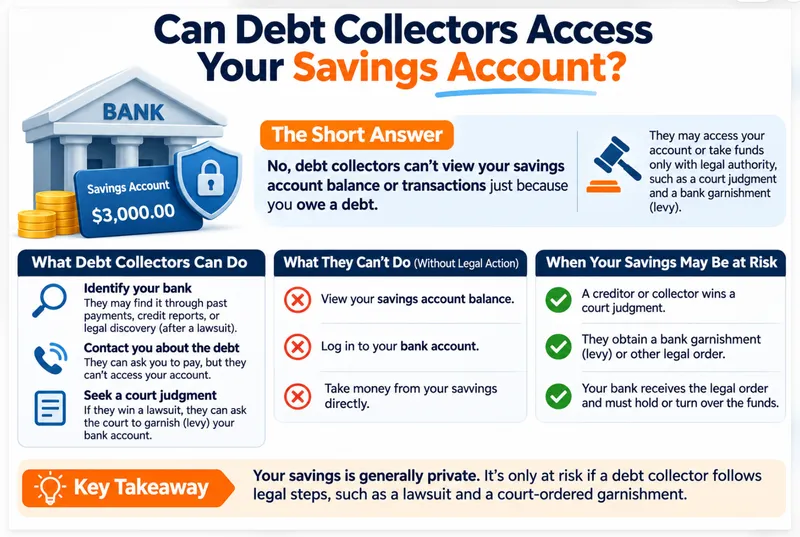
Debt collectors generally cannot view your savings account balance or transaction history simply because you owe a debt. However, creditors and collectors with the appropriate legal authority may obtain financial information or pursue a bank account levy or garnishment. The rules depend on state law, the type of debt, and whether the collector has obtained a court judgment.
The distinction matters because knowing where you bank, seeing your balance, and legally freezing money in your account are three different things.
This guide explains what debt collectors can find out about your savings, when a bank must respond to legal demands, which funds receive protection, and what to do if your account is at risk.
Can Debt Collectors See My Savings Account?
No. Debt collectors cannot see your savings account balance or transactions on their own. Your credit report does not list bank balances, and your bank does not report deposits to collectors. A collector reaches your savings only after winning a court judgment and getting a court-ordered bank levy, with a few narrow exceptions covered below.
In twenty years of reviewing client files, the fear behind this question is almost always bigger than the legal reality. Collectors work the phone and the mail. They do not have a window into your bank. What they have is the debt, your contact information, and, once a court rules for them, a set of legal tools that start to look at your accounts.
What Debt Collectors Actually See About You
Your Credit Report Shows Debts, Not Deposits
A credit report covers financial information tied to debt. Experian states that savings and checking account balances, investments, and records of purchase transactions do not appear on it. A collector with a legal reason to pull your report sees your accounts, balances owed, and payment history. It never sees how much money sits in your savings.
Your Bank Does Not Report to Collectors
Banks do not hand account details to a collector over the phone. Federal law also restricts who a collector is allowed to talk to. Under 15 U.S.C. § 1692c(b), a debt collector may not communicate with anyone other than the consumer about a debt, except with your consent, with a court's permission, to carry out a postjudgment remedy, or as allowed under § 1692b.
Section 1692b covers location calls. A collector contacting a third party to find you must identify itself, must not say you owe a debt, and is limited to one contact unless the person asks for more. A collector that calls your bank and announces your debt is breaking the law.
How Debt Collectors Get to Your Savings Account
Step One: A Court Judgment
Most creditors garnish wages or benefits only after a court issues a judgment saying you owe the debt, according to the Consumer Financial Protection Bureau. A collector has to file a lawsuit, serve you, and win. Ignoring the summons usually ends in a default judgment against you, which gives the collector the same enforcement tools as winning at trial.
Step Two: Finding the Account
A judgment creditor does not know your bank by default. After judgment, creditors use court tools to find assets, such as requiring a debtor to answer questions about accounts or serving subpoenas on banks. The FDCPA allows a collector to contact third parties when it is reasonably necessary to carry out a postjudgment judicial remedy. The procedures vary by state.
Step Three: A Bank Levy
With a judgment and the bank's name, the creditor asks the court for a levy. The order directs the bank to freeze funds in your account and turn them over, up to the judgment amount. Notice rules, exemptions, and timing differ from state to state.
Which Savings Funds Are Protected From Debt Collectors
Federal Benefits Get Automatic Protection
The CFPB states that a bank must review your account and protect two months' worth of direct-deposited benefits. Covered benefits include Social Security, Supplemental Security Income, veterans' benefits, Railroad Retirement, Civil Service Retirement, and FERS payments.
Under the federal garnishment rule at 31 CFR 212.2, the bank looks back two months from the date of the account review. The protected amount is the lesser of the benefit payments deposited during that window or your account balance at the time of review.
Exceptions to Federal Benefit Protection
Some claims go around the protection. Federal agencies such as the IRS or the Department of Education take up to 15 percent of Social Security or SSDI benefits. States generally garnish wages or bank funds for child support without a court order.
State Exemptions Add More Protection
States set their own exemptions for bank funds. The CFPB notes that a minimum amount is shielded from levies in some situations even without federal benefits. Check your state's exemption rules before assuming your savings is exposed, and file any required exemption claim by the deadline in the levy notice.
When Your Own Bank Takes Money From Your Savings
A debt collector is not the only party with access to your account. A bank usually has a right of offset. If you fall behind on a loan you owe that same bank, such as a car loan, the bank takes money from your deposit account to cover it, sometimes without telling you first.
Federal law restricts this in some cases. For example, it does not allow a bank to use your deposit account to pay off your consumer credit card account. If you owe money to the bank that holds your savings, keep the savings somewhere else until the debt is resolved.
What Debt Collectors Cannot Do About Your Bank Account
- Look up your savings balance through your credit report.
- Tell your bank, your employer, or your neighbors that you owe a debt.
- Take money from your account without a court judgment, other than the exceptions above.
- Keep collecting a debt you dispute in writing within 30 days of the first notice, until the collector mails you verification.
What to Do If a Collector Threatens Your Bank Account
Do Not Give Out Bank Account Information
Never hand over your routing and account numbers to a collector over the phone until you have verified the debt and the company. A collector holding your account number gets payment access you did not agree to. Pay by a method you control, and keep a record of every payment.
Request Debt Validation in Writing
Send a written dispute within 30 days of the collector's first notice. Under 15 U.S.C. § 1692g, the collector must stop collecting the disputed debt until it mails you verification of the debt or a copy of a judgment. Use certified mail and keep copies.
Respond to Any Lawsuit
A summons has a response deadline, and the deadline varies by state. Missing it hands the collector a default judgment and opens the door to a bank levy. If you are served, respond on time and talk to a consumer attorney or a local legal aid office.
Report Violations
If a collector contacts your bank about your debt, threatens to take your savings without a judgment, or lies about its authority, file a complaint with the CFPB and the FTC. Keep call logs, letters, and voicemails as evidence.
How Credit Repair Fits In
A collection account on your credit report and a threat to your bank account are two separate problems. Credit repair addresses the first. If a collector reports the wrong balance, a duplicate account, an account that is not yours, or a debt that was already paid, that entry is a reporting error you dispute with the credit bureaus and the furnisher. See how this works in our guide on filing a bureau dispute and our post on a recalled collection still on your report. For the full picture, read what a credit repair service does.
Credit repair does not stop a lawsuit, erase a valid debt, or shield your bank account. It corrects inaccurate information. ASAP Credit Repair USA does not promise deletions or score increases.
Collection accounts on your report? Claim My Free Credit Analysis Now and find out which entries are accurate and which are errors worth disputing.
Frequently Asked Questions
Can a debt collector see how much money I have in the bank?
No. Credit reports do not include bank balances, and a collector has no direct access to your accounts. After a court judgment, a creditor uses legal tools such as debtor examinations and bank subpoenas to find out what you hold.
Can a debt collector freeze my savings account?
Not without a court judgment in most cases. The exceptions are federal agencies such as the IRS, child support enforcement, and your own bank exercising a right of offset on a debt you owe it.
Can a debt collector take my Social Security from savings?
Social Security deposited directly into your account is protected. The bank must review the account and protect two months' worth of benefits. The IRS and the Department of Education are exceptions, and they take up to 15 percent.
Can a debt collector call my bank?
Only to find your location, and only without revealing that you owe a debt. After a judgment, a collector contacts your bank through legal process to carry out a levy.
Should I close my savings account to avoid collectors?
No. Closing an account does not erase the debt, and a creditor with a judgment finds your next account. Moving money to dodge a judgment creates its own legal risk. Talk to a consumer attorney before moving funds.
Is my joint savings account at risk?
It depends on your state. Some states let a creditor of one owner reach a joint account, and others protect the other owner's share. Check your state's rules or ask a consumer attorney.
Does a collection account mean a lawsuit is coming?
Not always. Many collectors never sue. A collection account is a credit reporting issue first, and a lawsuit is a separate step. If you are served, respond by the deadline on the summons.
Sources
- Consumer Financial Protection Bureau: Can a debt collector take or garnish my wages or benefits?
- 31 CFR 212.2: Garnishment of accounts containing federal benefit payments
- 15 U.S.C. § 1692c: Communication in connection with debt collection
- 15 U.S.C. § 1692b: Acquisition of location information
- 15 U.S.C. § 1692g: Validation of debts
- Experian: What is not included in your credit report
- HelpWithMyBank.gov: Right of offset
- Federal Trade Commission: Debt Collection FAQs