
Can You Terminate a Mortgage Early?. Most lenders allow you to pay off your home loan before the scheduled end date, through extra payments, a lump-sum payoff, refinancing, or selling the home. Whether early termination costs you money depends entirely on what type of mortgage you have and what your loan documents say about prepayment.
Running a credit repair company, I see this question come up far more than most people expect. One of the most unforgettable accounts I've handled involved a client who sold her home, paid off her mortgage, and then received a $4,800 prepayment penalty bill from her lender weeks later. She had no idea it was in her contract. That kind of surprise is avoidable.
According to a 2024 analysis of Home Mortgage Disclosure Act (HMDA) data by Homebuyer.com, only 0.248% of mortgages originated in 2024 included a prepayment penalty. That number is low, but the cost to those borrowers can run into thousands of dollars. Knowing whether your loan is in that group matters.
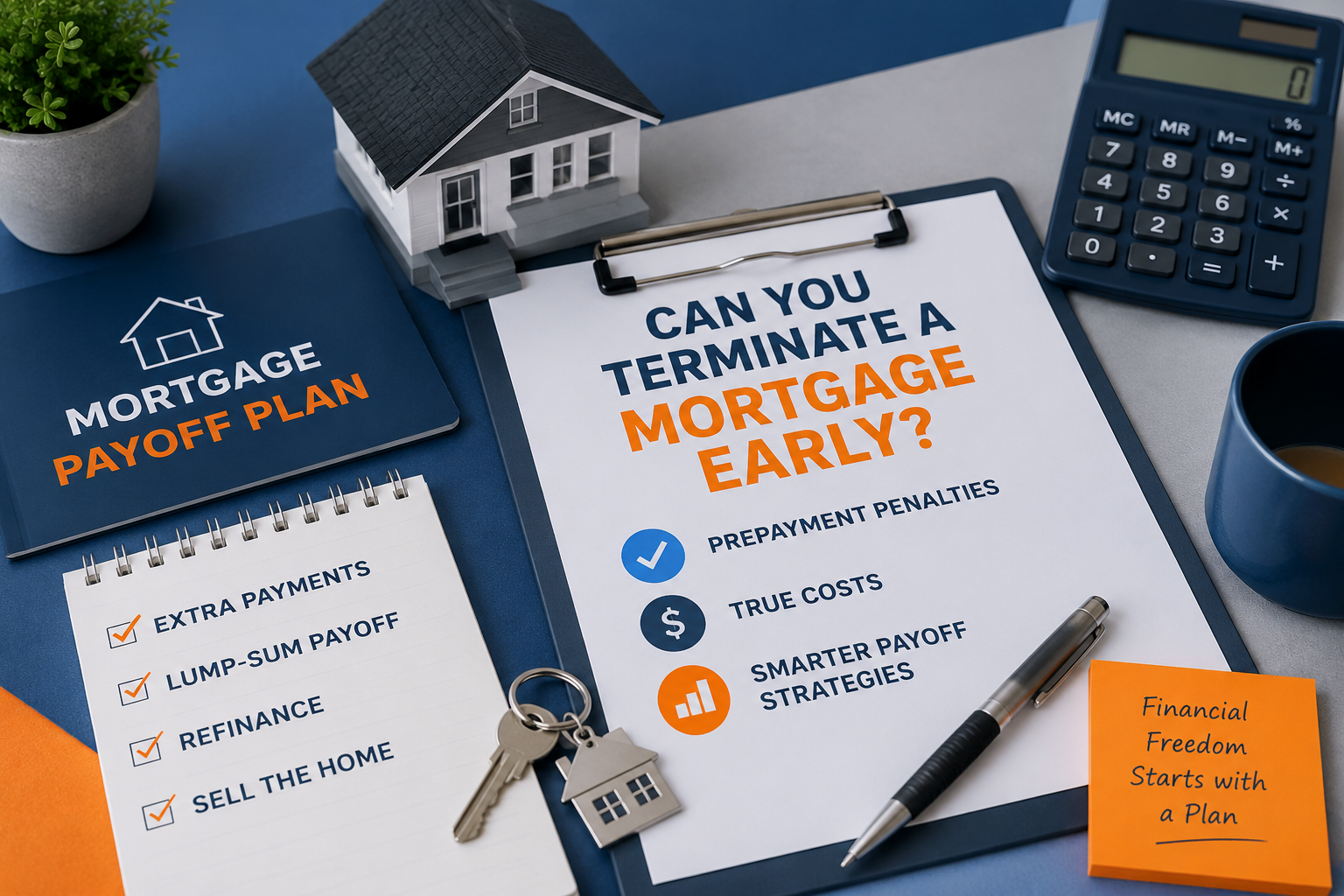
Can You Terminate a Mortgage Early?
Early mortgage termination means ending your loan obligation before the agreed-upon payoff date. Homeowners do this in four main ways:
Making extra principal payments over time to shorten the loan term.
Paying the remaining balance in one lump sum.
Refinancing into a new loan, which closes the original one.
Selling the home and using the proceeds to pay off the balance.
All four methods are legal. None of them requires your lender's approval. What they may trigger, depending on your contract, is a prepayment penalty fee.
According to the Consumer Financial Protection Bureau (CFPB), whether a penalty applies depends on your loan type and the specific terms in your mortgage agreement. The CFPB notes that the penalty disclosure must appear in your loan documents. Look for it in the Note itself or an attachment labeled "Addendum to the Note."
What Is a Prepayment Penalty on a Mortgage?
A prepayment penalty is a fee your lender charges when you pay off your mortgage ahead of schedule. Lenders charge this fee because they earn revenue from the interest your payments generate over the loan's life. When you exit early, they lose that income.
Prepayment penalties most often apply in three situations:
You sell your home within a few years of taking out the loan.
You refinance your mortgage before the penalty period ends.
You make a large lump-sum payment that exceeds what your contract allows.
Note that simply making an extra monthly payment toward the principal does not typically trigger a prepayment penalty. The fee usually activates when you pay off a large portion or all of the remaining balance at once.
What Are Soft vs. Hard Prepayment Penalties?
Not all prepayment penalties work the same way. Two types exist, and the difference matters depending on your situation.
A soft prepayment penalty only applies if you refinance your loan early. It does not apply if you sell your home. Homeowners who plan to sell but not refinance can often avoid this type of penalty.
A hard prepayment penalty applies whether you sell, refinance, or pay off the balance early. This version offers fewer escape routes and carries a higher financial risk for borrowers who need to exit the loan.
Your loan documents will specify which type applies. If you cannot find the clause, ask your mortgage servicer to point to the exact section before you take any action.
What Loans Have Prepayment Penalties?
Most common mortgage types today do not carry prepayment penalties. Federal law, specifically the Dodd-Frank Act, which took effect in 2014, prohibits prepayment penalties on FHA, VA, and USDA loans entirely. These are government-backed loans, and borrowers who hold them can pay off early without any penalty fees.
Conventional loans follow different rules. Under the Dodd-Frank Act, lenders can only charge a prepayment penalty during the first three years of a conventional mortgage. After year three, the penalty cannot apply, regardless of what your original contract said.
The law also caps the penalty amount:
During years one and two, the penalty cannot exceed 2% of the outstanding loan balance.
During year three, the penalty cannot exceed 1% of the outstanding balance.
Portfolio loans and non-standard loans carry the most risk. These are loans lenders hold on their own books rather than selling to investors. They operate outside some of the standard protections and are more likely to include prepayment penalty clauses.
According to Nolo, many states go further than federal law and restrict or prohibit prepayment penalties entirely on residential mortgage loans. Your state's rules may offer added protection beyond the federal cap.
So if you hold an FHA, VA, or USDA loan, you have no penalty risk. If you hold a conventional loan taken out after 2014, any penalty only applies in the first three years and is capped by law.
At this point, you know which loan types carry penalties and how federal law limits them. The next question is what early payoff actually costs you, and what it does to your credit.
How Much Does It Cost to Pay Off a Mortgage Early?
The cost of early termination depends on whether your loan has a prepayment penalty, how far into the loan you are, and the remaining balance.
If your loan carries a prepayment penalty and you are still within the penalty window, fees typically range from 1% to 5% of the remaining loan balance, according to Homebuyer.com's analysis of HMDA data. On a $300,000 remaining balance, that is $3,000 to $15,000.
Here is what a penalty can look like at the federal cap:
Remaining balance of $250,000 in year one or two: penalty up to $5,000.
Remaining balance of $250,000 in year three: penalty up to $2,500.
Beyond penalties, early payoff also carries an opportunity cost. U.S. Census Bureau data shows that 89% of mortgages currently held in the U.S. are 30-year fixed loans. Many of those were locked in at low interest rates between 2020 and 2022. For borrowers in that group, the money used to pay off a 3% mortgage early might earn significantly more in an investment account. That gap is a real cost, even if it does not show up on a bill.
Does Paying Off a Mortgage Early Hurt Your Credit Score?
Paying off a mortgage early does not damage your credit score in a significant way. However, it can cause a temporary dip for two reasons.
First, closing a long-standing account reduces the average age of your credit history. Credit age is a factor in your score. Second, eliminating a mortgage removes a major installment loan from your credit mix. A mix of credit types, including installment loans and revolving accounts, supports a stronger score.
Rocket Mortgage notes that the long-term benefits of an early payoff usually outweigh the short-term credit impact. For most borrowers, the score effect is minor compared to the financial picture.
The Pros and Cons of Paying Off a Mortgage Early
Early mortgage termination is not the right move for every borrower. The decision depends on your interest rate, your other financial obligations, and your goals.
Reasons to Pay Off Early
You eliminate your largest monthly expense, which frees up cash flow immediately.
You own your home outright, which removes foreclosure risk.
You save on total interest paid over the life of the loan. On a $300,000 mortgage at 6%, paying it off 10 years early can save over $100,000 in interest.
Entering retirement debt-free reduces financial pressure on a fixed income.
Reasons to Hold Off
Tying up capital in your home reduces liquidity. Your home is not a quick source of cash in an emergency.
Mortgage interest may still be tax-deductible on your return. Paying off the loan removes that deduction.
If your mortgage rate is low, the same money invested in an index fund may generate higher returns.
A Reddit Bogleheads forum discussion featured a 31-year-old who paid off a 3.375% mortgage in just six years. The community response was split. Some praised the security. Others pointed out that the S&P 500 historically returns around 9.8% annually, which significantly outpaces a 3.375% interest rate. That debate captures the real tension in this decision.
How to Pay Off a Mortgage Early Without Penalties
Homeowners who want to accelerate payoff without triggering a penalty have several options. These strategies work with the loan structure rather than against it.
Make one extra payment per year. Apply the entire amount to the principal. On a 30-year loan, this alone can cut several years off the repayment timeline.
Switch to biweekly payments. Instead of 12 monthly payments, you make 26 half-payments per year. That equals 13 full payments annually, shaving months or years off the loan.
Apply windfalls to principal. Bonuses, tax refunds, and inheritances can make a significant dent in your balance without triggering a penalty clause.
Recast your mortgage. With a recast, you put a lump sum toward the principal, and the lender recalculates your monthly payment over the remaining term. The interest rate stays the same, and it typically costs a small flat fee, often around $250, rather than full refinancing costs.
Refinance into a shorter term. A 15-year mortgage builds equity faster and carries a lower interest rate than a 30-year loan. Refinancing resets the loan, so any previous prepayment penalty window also resets. Check the new contract carefully.
In our office, last year we reviewed over 30 mortgage cases where clients wanted to pay down faster. In nearly every case, the biweekly payment switch or one extra annual payment got them to their payoff goal without any penalty exposure.
Thinking About Paying Off Your Mortgage Early?
Before you make a lump-sum payment, refinance, or pay off your loan, make sure your credit profile is working in your favor. A stronger credit score can unlock better refinancing options and save thousands in interest.
Get Your Free Credit AnalysisDiscover what may be holding your score back and learn practical steps to improve your mortgage and financing opportunities.
How to Check If Your Mortgage Has a Prepayment Penalty
Before taking any action, confirm whether your current loan includes a prepayment clause.
Pull out your original closing disclosure. Page one lists key loan terms, including any prepayment penalty.
Look at your mortgage note. Search for any section labeled "right to prepay" or "prepayment."
Check any document titled "Addendum to the Note," as the CFPB confirms penalties are sometimes disclosed only there.
Call your mortgage servicer directly and ask. Request the answer in writing.
If you find a penalty clause, ask your servicer whether they will waive it. Some lenders agree, especially for long-standing borrowers with strong payment histories. Get any waiver agreement in writing before proceeding.
Nearly 40% of U.S. homeowners are currently mortgage-free, the highest share in 13 years, according to U.S. Census Bureau American Community Survey data. Millions of borrowers have successfully navigated early payoff. Knowing your contract terms is the first step in joining them without an unexpected bill.