

Credit card reconsideration gives you a way to request another review of a denied application before submitting a new one. The strongest reason to call is specific: you have corrected information, supporting documents or details the issuer did not consider.
Credit rejection remains common despite an improving picture. The New York Fed’s June 2026 survey put the rejection rate across credit types at 16.1%, down from 23.1% a year earlier, a seven-percentage-point decline. Those figures measure credit rejections broadly, not the success of reconsideration requests.
A second review gives an issuer an opportunity to assess additional information. It does not erase accurate late payments, reduce outstanding debt or guarantee an exception to approval requirements.
Calling alone does not affect your credit score. Before authorizing further review, however, ask whether the issuer requires another hard inquiry rather than assuming it will reuse the original report.
At ASAP Credit Repair USA, our report reviews focus on account details and supporting records. That work helps identify reporting errors; the issuer retains control over approval.
Our existing guides explain why credit card applications are denied.
This article focuses on what comes next: preparing for reconsideration, presenting your case and deciding what needs to change before applying again.
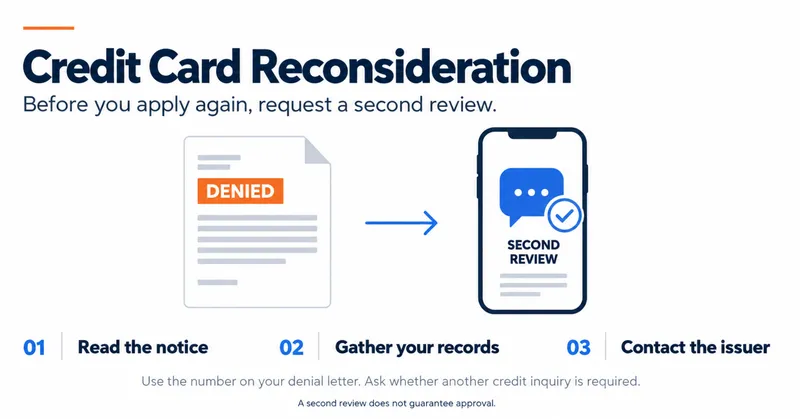
Credit Card Reconsideration: What to Do Before Applying Again
Credit card reconsideration is a request that the issuer review a denied application a second time, usually by phone. It works on a narrow set of problems and fails on the rest.
A reconsideration call does not trigger another hard credit check, according to Forbes Advisor. That makes it the lowest-cost move you have after a denial.
The call wins when the denial came from a fixable problem: a typo, an identity check, a frozen credit report, or credit limits spread across too many of your cards. It loses when the denial came from weak credit, heavy debt, or a hard issuer rule such as Chase's 5/24.
This article covers what to do before and during the call, what real cardholders posted on public forums, and what to change before you apply again. Our existing posts explain why issuers deny applications, so this one covers the second review itself.
At ASAP Credit Repair USA, we review credit reports for inaccurate, unverifiable, or incomplete entries. No one controls an issuer's decision, and none of the sources we reviewed publishes a reconsideration success rate.
What Is Credit Card Reconsideration, and Does It Hurt Your Score?
Credit card reconsideration asks the issuer to re-review a denied application, and an analyst reads your file again by hand. The call does not trigger another hard inquiry, so it does not lower your score. It does not guarantee approval.
Forbes Advisor (last audited March 27, 2026) calls reconsideration "not a guaranteed pathway to approval." NerdWallet (updated November 6, 2025) describes the process as a manual review of your credit report by an analyst.
A new application is a different event. It starts a new hard inquiry, which takes roughly 5 to 10 points off a score on average, according to myFICO.
| Factor | Reconsideration Call | New Application |
|---|---|---|
| Hard inquiry | None added | One added |
| Who decides | An analyst reviewing the file by hand | The issuer's automated system first |
| Best timing | Right after the denial, inside about 30 days | After the reason for the denial has changed |
| Fits when | The denial came from a typo, an ID check, a freeze, or spread-out limits | The denial came from score, debt, or a hard issuer rule |
| Cost to your score | None | Roughly 5 to 10 points on average |
myFICO adds that a hard inquiry stays on your report for up to two years, and the FICO score counts only the last 12 months of them.
Not Sure What the Issuer Saw on Your Report?
Start with your credit reports. A review shows which entries are accurate, which are wrong, and which ones the analyst reads on the call.
Claim My Free Credit Analysis Now → Secure · 2 minutes · No credit card requiredWhen Does Credit Card Reconsideration Work?
Reconsideration works when the denial came from a fixable file problem: a typo, an identity verification gap, a frozen credit report, or credit lines the issuer would approve if you moved a limit. It fails against weak credit, high debt, and fixed issuer rules.
Thrifty Traveler reports that hard-coded rules such as 5/24 generally cannot be overridden. AwardWallet says issuers typically do not budge on 5/24 or 2/3/4.
Check the denial reason against that list before you dial. A call for a rule-based denial costs you time and gains nothing.
What Should You Do Before You Call for Reconsideration?
Read the denial reason, pull the credit report named in the notice, fix any error, and call within about 30 days. Have a specific reason you want this card ready, and know which existing card you would move a limit from.
- Read the adverse action notice. NerdWallet says it arrives immediately or by mail within 10 days. It names the credit reporting agency the issuer used.
- Request the specific reasons. The CFPB's Regulation B sample notice says to ask within 60 days of the letter. The lender provides the reasons within 30 days after you ask.
- Pull the named report. Free reports from all three bureaus are available at AnnualCreditReport.com.
- Fix what is wrong. Lift a freeze. Correct a typo. Dispute an inaccurate entry with the bureau and the furnisher.
- Call inside the window. AwardWallet gives about 30 days to review without another hard pull. Doctor of Credit warns that waiting longer than a month means a new application and a new hard inquiry.
- Use the number on your letter. Published phone numbers for Chase, Capital One, and Wells Fargo differ from source to source. The number on your denial letter or the issuer's site is the correct one.
Forbes says to call right after the denial or wait up to 60 days for the letter. The call is the faster path.
What to Have Ready
- ✓Your application details: full name, card, application date, and how you received the denial
- ✓Your income and housing cost as you listed them, so you confirm them without hesitation
- ✓A specific reason for this card: the benefit you will use and the existing card it replaces
- ✓Answers about recent accounts and inquiries on your report
- ✓A limit you would move from an existing card with the same issuer
What Do You Say on a Credit Card Reconsideration Call?
Open with your name, the card, and the application date, and expect identity verification questions first. Ask what held up the application, answer with facts from your report, and offer a fix such as moving a credit limit.
- Lead the call. Million Mile Secrets advises you to state why you called before the agent asks. Say the card, the date, and that you want a manual review.
- Ask what the issue was. The answer tells you whether you hold a fixable problem or a rule.
- Explain why you want this card. Name the specific benefit. A vague answer gives the analyst nothing to approve.
- Use your existing relationship. Mention how long you have held the issuer's other cards and that you pay them on time.
- Offer a trade. Doctor of Credit advises flexibility on the line. AwardWallet's author won a Chase approval by lowering limits on existing cards.
- Keep your accounts open. Doctor of Credit says not to close same-issuer accounts first.
What Do Real Cardholders Report on Forums After a Reconsideration Call?
Public forum threads show approvals after short calls to an issuer's reconsideration line. Every case is self-reported, and success posts get written more often than failures. Read the threads below as individual reports, not as a success rate.
The two threads below are public myFICO forum posts we read directly. The posters are anonymous or use handles, and neither page shows a verifiable date.
Replies in the Amex thread add two lessons. One user, vish1, advised spacing out future applications and grouping any planned ones together.
Tons_of_Debt reported the same success with reconsideration. Another poster, denied for Blue Cash after holding a Zinc card for about six months, had a manager re-review the application.
The Barclays thread shows the other side. One reply came from a user recently denied twice, by Sallie Mae and Hawaiian Airlines.
Reconsideration is one tool, and it does not rescue every file.
Published writers report the same split. Million Mile Secrets' Jason Stauffer won a Chase reconsideration after preparing answers about his recent accounts.
An application of his denied for not using his existing cards passed six months later, after regular use. He also writes that not every call works.
What Does the Data Say About Credit Denials and Second Reviews?
The New York Fed's Survey of Consumer Expectations put the rejection rate for credit applicants at 16.1% in June, down from 23.1% in June 2025. No source we reviewed publishes the share of reconsideration calls that end in approval.
The same survey reports that the application rate rose to its highest level since October 2021. More people apply, and a smaller share hear no.
The New York Fed does not report a credit-card-only figure on that page. A denial rate of 16.1% still means roughly 1 in 6 applicants hears no, which is why a plan for the second review matters.
What Should You Do If Reconsideration Fails?
Change the reason for the denial before you apply again. Dispute errors, pay down balances, and wait out any issuer rule. Apply to one card at a time, because each new application adds a hard inquiry that counts against your score for 12 months.
- ✓Dispute inaccurate entries. A bureau has 30 days to reinvestigate, or 45 days if you send relevant new information, under FCRA Section 611 (15 U.S.C. 1681i).
- ✓Lower revolving balances. FICO weights amounts owed at 30% of the score, according to myFICO.
- ✓Wait out issuer rules. A 5/24 or 2/3/4 denial changes only with time.
- ✓Group planned applications. The Amex thread's advice to space out and cluster applications matches how issuers read recent activity.
- ✓Use the card you want. Stauffer's unused-cards denial reversed after six months of regular use.
Our guides on disputing credit report errors and why disputes fail cover the correction step in detail. If your report is accurate and you still got denied, read why a correct report still gets denied.
When Does Professional Credit Repair Make Sense After a Card Denial?
Credit repair makes sense when the report holds entries you believe are wrong and your own disputes returned unchanged results. A review checks ownership, balances, dates, payment history, and dispute outcomes.
Credit repair corrects inaccurate reporting. It does not replace repayment, and it guarantees no issuer decision or score increase.
Not Sure What's Hurting Your Credit?
A credit report review shows what the issuer saw, which entries are wrong, and what to fix before your next application.
Review My Credit Report → Secure · 2 minutes · No credit card requiredFrequently Asked Questions About Credit Card Reconsideration
What is credit card reconsideration?
Credit card reconsideration is a request that an issuer review a denied application again, usually by phone. An analyst reads your file by hand instead of relying on the automated decision. The request costs you no new hard inquiry, and approval is not guaranteed.
Does a reconsideration call hurt your credit score?
No. Forbes Advisor reports that a reconsideration call does not trigger another hard credit check. A new application does add a hard inquiry, which takes roughly 5 to 10 points off a score on average, according to myFICO. The call avoids that cost.
How long do you have to ask for reconsideration?
Call as soon as you learn of the denial. AwardWallet puts the review window at about 30 days without another hard pull, and Doctor of Credit warns that waiting longer than a month needs a new application. Forbes says to call right after the denial.
What is the reconsideration phone number?
Use the number on your denial letter or the issuer's website. Published numbers for Chase, Capital One, and Wells Fargo differ from one source to the next, so no single list is reliable. The number printed on your own letter routes you to the correct department.
Does reconsideration work for a low credit score?
Rarely. Forbes lists weak credit, high debt, recent charge-offs, and too many applications among the reasons that seldom succeed. The call fits fixable file problems such as typos, identity checks, and freezes. For a low score, repair the report and apply later.
What should you say on the call?
State your name, the card, and the application date. Ask what held up the application, then answer with facts from your report. Explain why you want this card, mention your history with the issuer, and offer a fix such as moving a credit limit. Stay polite.
Does reconsideration override Chase 5/24?
Generally no. Thrifty Traveler reports that hard-coded rules such as 5/24 generally cannot be overridden, and AwardWallet says issuers typically do not budge on them. Chase denies applicants who opened five or more cards across issuers in 24 months. Wait until the count drops and apply again.
Do you have a right to the specific reasons for a denial?
Yes. The CFPB's Regulation B sample notice says to request the specific reasons within 60 days of the letter. The lender provides them within 30 days after you ask. Those reasons tell you whether a reconsideration call fits or whether to fix something first.
Should you dispute errors before you reapply?
Yes, when an entry is wrong. A bureau must reinvestigate in 30 days, or 45 days if you send relevant new information in that window, under FCRA Section 611. File the dispute with the bureau and the furnisher so the next issuer pulls a corrected report.
Does credit repair guarantee a card approval?
No. Credit repair corrects inaccurate reporting and guarantees no issuer decision or score increase. The Credit Repair Organizations Act bars a provider from charging before the service is fully performed. Issuers decide on score, debt, income, and their own rules together.
Reconsideration is a one-time window, so use it with a plan. Read the reason, fix the file, call inside 30 days, and offer the issuer a reason to say yes.
-
Top Reasons Your Credit Card Application Was Denied Even With Good Credit The causes behind a denial, matched to what you review.
-
Chase Credit Card Denied? 5 Steps to Get Approved Next Time Chase's 5/24 rule and how to plan the next application.
-
Why Was My Credit Limit Increase Denied? Why They Say No How to start with the reason listed in a denial notice.
-
How to File a TransUnion Dispute & Fix Credit Report Errors The dispute steps to follow once you spot an inaccurate entry.
- Forbes Advisor — Credit Card Reconsideration: Everything You Need To Know (audited March 27, 2026)
- NerdWallet — Declined For a Credit Card? Call the Reconsideration Line (updated November 6, 2025)
- AwardWallet — Credit card reconsideration call (July 17, 2026)
- Thrifty Traveler — Credit card reconsideration guide
- Million Mile Secrets — 5 tips for making your credit card reconsideration telephone call a success
- Doctor of Credit — Tips For Reconsideration Phone Calls
- myFICO Forums — AMEX Blue Cash approved after recon
- myFICO Forums — Barclay APPROVED
- Federal Reserve Bank of New York — SCE Credit Access Survey
- Consumer Financial Protection Bureau — Regulation B, Appendix C, sample notification forms
- 15 U.S.C. § 1681i — Fair Credit Reporting Act, procedure in case of disputed accuracy
- myFICO — How hard inquiries work
- myFICO — What is in your credit score
- AnnualCreditReport.com — Free credit reports