

Credit mix is the collection of different credit account types on your report, and it makes up 10% of your FICO score. It covers revolving accounts like credit cards, installment loans like auto or student loans, and mortgage accounts. FICO uses it to measure one thing: can you handle more than one kind of debt at the same time?
Running a credit repair company, this topic comes up constantly. One of the most unforgettable accounts I handled was a client with a 620 score and zero debt. She paid everything on time, but every single account was a credit card. No installment loans, no mortgage. Her credit mix was flat, and it was costing her. The fix took less than 90 days.
The CFPB confirms that having a mix of different types of credit, from student loans to credit cards to mortgages, is one of the key behaviors that helps your score grow over time (source: consumerfinance.gov). And myFICO confirms credit mix sits at 10% of your total FICO calculation (source: myfico.com).
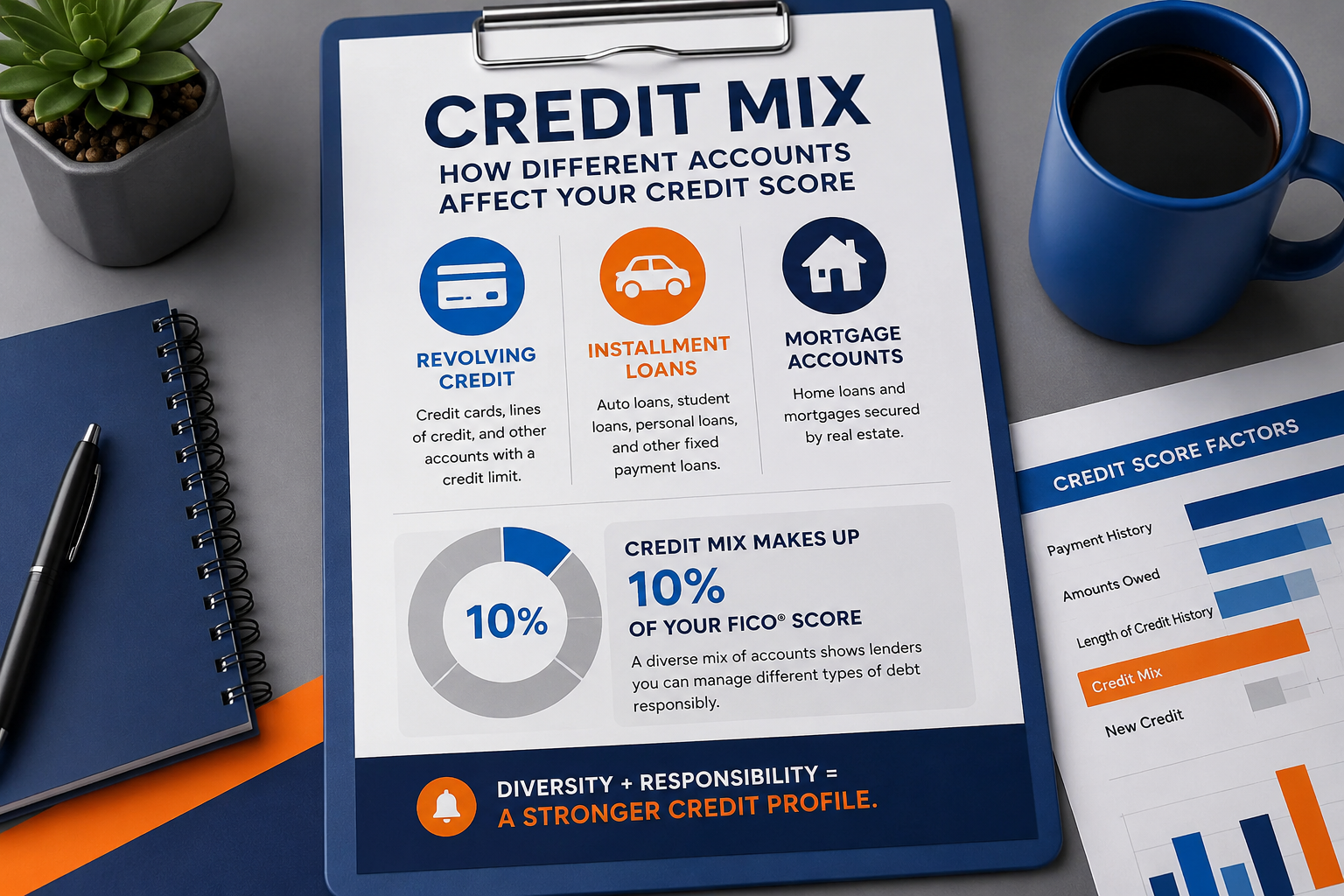
What Is Credit Mix?
Credit mix refers to the variety of credit account types in your credit report. FICO looks at whether you have a combination of revolving accounts, installment loans, and other credit types, not just one kind.
There are two main categories:
Revolving credit — accounts with a borrowing limit you can use and repay repeatedly. Examples include credit cards, home equity lines of credit (HELOCs), and personal lines of credit.
Installment credit — accounts where you borrow a fixed amount and repay it in set monthly payments. Examples include auto loans, student loans, personal loans, and mortgages.
A credit profile with only credit cards signals to lenders that you have no experience managing a loan with fixed payments. A profile with only an auto loan shows the opposite gap. FICO rewards profiles that demonstrate both.
What Does FICO Actually Look at in Your Credit Mix?
FICO does not just count how many accounts you have. It looks at the types of accounts and your payment behavior across all of them.
According to myFICO, the model considers credit cards, retail accounts, installment loans, finance company accounts, and mortgage loans when calculating your mix (source: myfico.com). You do not need one of every type. But a credit file with only one category will score lower than a file with two or more categories managed well.
Payment history still dominates at 35%. But here is what most people miss: FICO does not just note that you have a mix, it also checks how you pay that mix. A diverse set of accounts with late payments does not earn you points. Good payment history across multiple credit types does.
How Does Credit Mix Affect Your Credit Score?
Credit mix accounts for 10% of your FICO score. That translates to roughly 85 points on a 300-850 scale if your profile is otherwise average. For VantageScore 3.0, credit mix is part of "depth of credit," which carries 20-21% of the score weight, making it even more significant under that model.
Last quarter alone, we saw over 40 clients come in with scores stuck between 640 and 670 despite clean payment histories. In most cases, the common thread was a thin credit mix, usually two or three credit cards with no installment loan on file. Adding one credit-builder loan moved scores by 15-25 points within 60 days in several of those cases.
The impact varies by credit profile. For someone with a long history and a strong payment record, the credit mix has a smaller marginal effect. For someone building credit or rebuilding after a derogatory mark, it carries more weight.
One critical point: credit mix does not operate in isolation. If you carry high credit card balances (hurting utilization, which is 30% of your score) or have a short history (15%), a better mix will not fully offset those gaps.
What Is a Good Credit Mix?
A good credit mix includes at least one revolving account and one installment account, both with positive payment history.
There is no magic formula. Experian states that the ideal credit mix has both revolving and installment credit; it does not require five account types (source: experian.com). The goal is diversity, not volume.
For most consumers, a practical target looks like this:
One or two credit cards (revolving)
One active installment loan, auto, student, personal, or mortgage
That combination signals to lenders that you can manage flexible, open-ended credit and structured, fixed-payment debt at the same time.
If you are earlier in your credit journey, even a credit-builder loan paired with a secured credit card meets the threshold. You do not need a mortgage or a car loan to earn points for credit mix.
What Is NOT Included in Your Credit Mix?
Not every payment you make shows up in your credit mix. Two common types are excluded:
Payday loans — most payday lenders do not report to the three major bureaus. On-time payments do not help you. But if you default and the debt gets sent to collections, it will appear on your report as a negative mark.
Title loans — same situation. The lender holds your vehicle title as collateral, but repayment typically does not get reported to Equifax, Experian, or TransUnion.
Rent and utility payments also do not factor into your credit mix. Under newer scoring models like FICO Score 9 and 10, rent reporting can affect your payment history category, but it does not add a new account type to your mix.
This is worth knowing before you take on any short-term debt, expecting it to help your score. The CFPB notes that not all lenders report to credit bureaus, and consumers should verify reporting behavior before borrowing (source: consumerfinance.gov).
How to Build a Better Credit Mix Without Damaging Your Score
Many people search "how to improve credit mix" and land on advice to open several new accounts fast. That strategy backfires. Every new application triggers a hard inquiry, which temporarily lowers your score. Multiple applications in a short window also signal financial stress to lenders.
The right approach is gradual and intentional:
Audit your current mix first. Pull your free report at AnnualCreditReport.com. Check what account types appear. Identify the gap: are you heavy on revolving and light on installment, or the reverse?
Add one missing account type at a time. If you have only credit cards, consider a credit-builder loan through a credit union. These loans are low-risk, designed for exactly this purpose, and report to all three bureaus.
Consider a secured credit card if you lack revolving credit. You deposit a set amount as collateral. Use it for small monthly purchases and pay in full each month. This builds both payment history and revolving account history.
Become an authorized user. If you lack a credit history, a family member with a strong credit card account can add you. The account history and account type show up on your report.
Do not open new accounts if you are preparing to apply for a major loan. New accounts lower your average account age and generate hard inquiries. Both hurt your score in the short term. Time for new credit openings at least six months before a mortgage or auto loan application.
Last year, our team tracked 60 clients who added a single installment account to a credit card-only profile. Within six months, 72% saw score increases ranging from 10 to 30 points with no other changes to their report. The data holds: targeted diversification works.
Should You Open New Accounts Just to Improve Credit Mix?
No. myFICO is direct on this point: do not apply for credit you do not need simply to diversify your mix (source: myfico.com). Taking on unnecessary debt creates real financial risk for a 10% scoring factor.
The exceptions are situations where you were going to borrow anyway, an auto loan you need, a personal loan to consolidate high-interest card debt, or a credit-builder product specifically designed for credit building. In those cases, the new account serves a financial purpose and improves your mix.
This is the most common mistake we see. Clients open store credit cards or finance small purchases through buy-now-pay-later services, thinking it will help. Some of those accounts do not even report to bureaus. Others add hard inquiries with no scoring benefit.
Does Closing an Account Affect Your Credit Mix?
Closing an account can affect your credit mix, but the impact depends on what you close.
If you close the only credit card in your profile, you remove the sole revolving account. That weakens your mix. If you close one of three credit cards, the remaining two still show revolving credit activity, and the impact is minimal.
Closing an account also reduces your total available credit limit, which raises your credit utilization ratio. Since utilization is 30% of your FICO score, the consequence is usually more damaging than the mix impact.
Before closing any account, check what type it is and whether it is the only one of that type on your report.
Not Sure If Your Credit Mix Is Helping or Hurting You?
Your credit mix may only be 10% of your FICO score, but the wrong account setup can still keep your score stuck. Get your credit report reviewed and see which areas may be holding you back.
Get Your Free Credit Report ReviewSee what’s affecting your score before opening new accounts.
How to Check Your Current Credit Mix
Pull your free credit report at AnnualCreditReport.com. Federal law entitles you to one free report per bureau per year from Equifax, Experian, and TransUnion.
Your report lists every open and closed account. Look for the account type field, which will indicate whether each account is revolving, installment, or mortgage. Count how many of each type you have open and active. That is your current credit mix.
If your file shows only one account type, that is the gap to address. Start with a low-risk, low-cost product like a secured card or a credit-builder loan. Build from there deliberately, one account at a time.