

Credit repair takes anywhere from 30 days to several years, depending on what is on your report and whether the negative items are accurate or not.
That is the direct answer. But the range is wide enough to be misleading, and most people who come to us have no idea which end of that range applies to their situation.
I run the largest credit repair company in Texas, ASAP Credit Repair. One of my most memorable cases last year was a man who had been sitting on a damaged score for two years, convinced it would take a decade to recover. He had a mix of outdated collection accounts, one identity theft entry, and a late payment marked incorrectly. Within 67 days of filing disputes, three items came off his report, and his score moved up 89 points. He had been waiting for time to do what proper disputes could do in weeks.
The data backs up the extent of this confusion. The CFPB received approximately 2.7 million credit and consumer reporting complaints in 2024, with the single most common issue being incorrect information on credit reports. Millions of people are carrying severe damage from errors they have the legal right to dispute today. The problem is that most do not know how fast that process can move, or what slows it down.
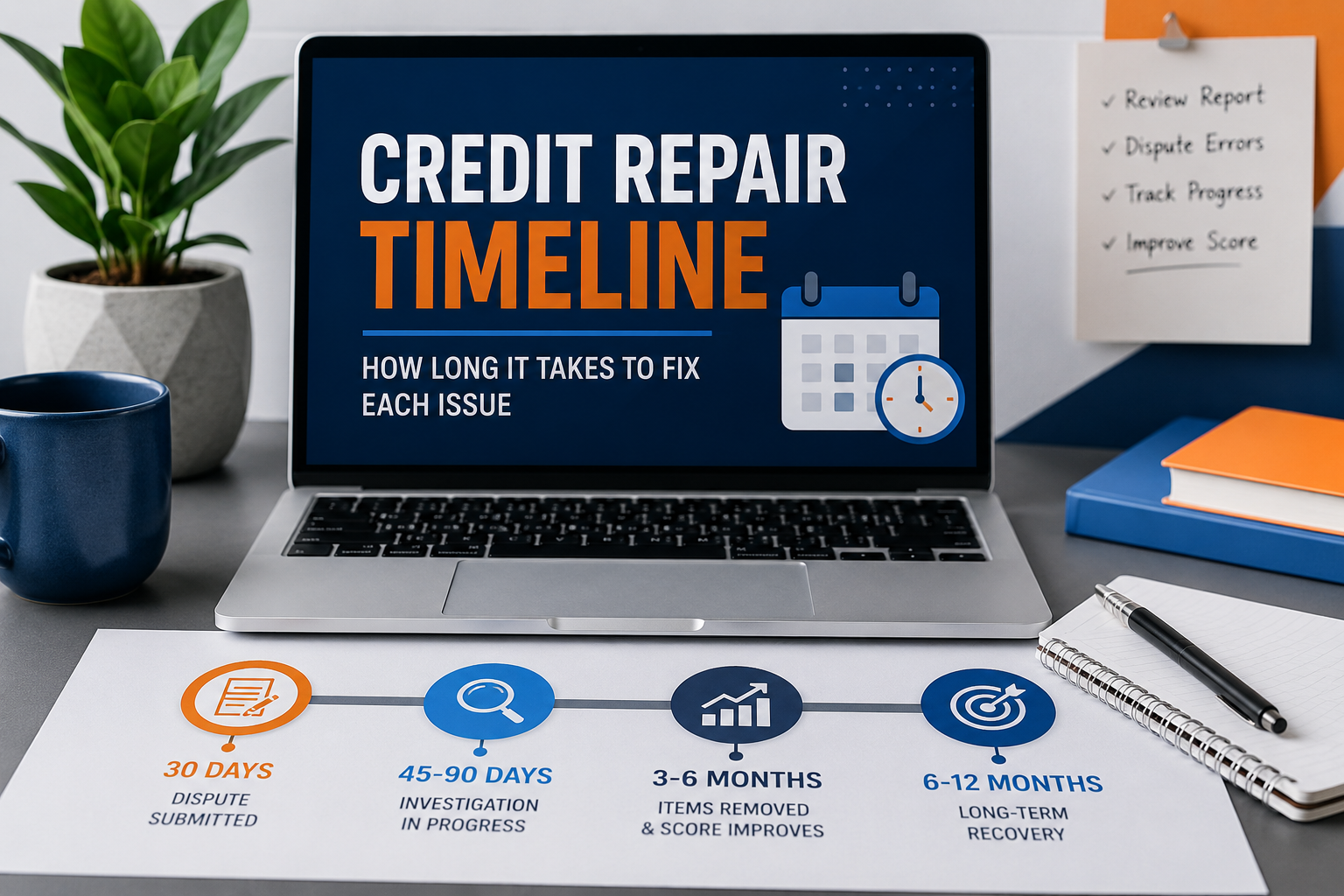
How Long Does Credit Repair Actually Take?
Credit repair services can take anywhere from 45 days to six months to resolve most credit issues. Depending on the depth of the credit issues, some cases may take up to a year.
That range exists because credit repair is not one single process. It is a series of disputes, responses, follow-ups, and sometimes escalations. The timeline shifts based on three things: what type of negative item is on your report, whether the item is accurate or inaccurate, and how quickly the bureaus and data furnishers respond.
The 30-Day Dispute Clock
The starting point for any timeline is the legal investigation window. When you dispute an error on your credit report, a credit reporting company generally must investigate the dispute within 30 days of receiving it. They have five business days after completing an investigation to notify you of the results.
That 30-day window is set by the Fair Credit Reporting Act. It is a legal mandate, not a courtesy. Credit reporting agencies must complete dispute investigations within 30 days, a rule unchanged since the FCRA's core framework, with extensions only possible if you agree.
One exception: if you submit additional documentation during the investigation, the credit bureaus automatically get a 15-day extension, increasing the allowable investigation time to 45 days from 30.
This means the fastest outcome for a single dispute is roughly 35 to 45 days from submission to result. For most clients with multiple items across all three bureaus, the full process runs longer because disputes are staggered and some require re-filing.
Credit Repair Timeline by Issue Type
Not all negative items move at the same speed. The type of item on your report is the single biggest factor in how long credit repair takes.
Late Payments: 30 to 90 Days for Inaccurate Entries
Late payments respond fastest when they are inaccurate. If a payment was marked late in error, a dispute filed with documentation can result in removal within the standard 30 to 45-day window.
Accurate late payments work differently. Late payments remain on a credit report for up to seven years from the original delinquency date. The late payment remains on your report even if you pay the past-due balance.
However, the impact of a late payment weakens over time. A 30-day late mark from five years ago carries far less weight than one from last month. For accurate late payments, goodwill deletion requests to the original creditor can sometimes remove them early, but success is not guaranteed.
In our experience, inaccurate late payments are among the fastest items to dispute and win. Most resolve within one dispute round.
Collections Accounts: 30 to 180 Days
Collection accounts fall into two categories: those with errors and those that are accurate.
Inaccurate collection accounts, such as debts that do not belong to you, accounts with wrong amounts, or entries from collectors without a permissible purpose, can be disputed and removed within 30 to 90 days.
Accurate collection accounts stay on your report for seven years from the original delinquency date, per FCRA rules. If you pay a collection account before the seven years is up, it can remain on your credit report, but the account may have less of an impact on your credit score.
Last year, we handled over 40 cases where clients had paid collection accounts still showing as unpaid on their reports. Every one of those was disputable and correctable. Resolved status should match what the creditor recorded.
Charge-Offs: 60 to 180 Days
Charge-offs are among the more complex items to dispute. A charge-off means the original creditor wrote the debt off as a loss. The account can still be collected, but the reporting rules are specific.
A charge-off can appear on your report for up to seven years and 180 days from the last delinquency.
Charge-offs with inaccurate amounts, wrong dates of first delinquency, or duplicate reporting from both the original creditor and a collection agency are all disputable. Those disputes typically resolve within one or two rounds, or 60 to 180 days total.
Accurate charge-offs that are correctly reported require time and positive account-building to recover from, rather than formal disputes.
Foreclosures: 1 to 2 Years for Score Recovery
Foreclosures carry one of the longest timelines in credit repair. A foreclosure stays on your credit report for seven years from the point when you first missed a mortgage payment.
If the foreclosure entry contains errors, such as the wrong delinquency date or incorrect account details, those are disputable and can reduce the damage sooner. But an accurate foreclosure stays on the report for the full seven years.
Score recovery after a foreclosure is possible within one to two years of consistent on-time payments, even with the entry still present. The impact of the foreclosure on your score decreases over time as positive history accumulates.
Bankruptcy: The Longest Timeline
Bankruptcy carries the longest mandatory reporting period of any credit issue. Bankruptcies can stay on your report for up to ten years. Chapter 13 typically falls off after seven years. Chapter 7 lasts for the full ten.
Accurate bankruptcy entries cannot be removed early through disputes. What credit repair can do is ensure no additional inaccurate items are being reported in connection with the bankruptcy, and that accounts included in the filing are not still showing as open or delinquent.
Clients with bankruptcy on their reports can still see meaningful score gains within 12 to 24 months through secured credit products and on-time payment history.
What Slows Credit Repair Down
Understanding what delays the timeline helps you avoid the most common traps.
Filing Disputes Without Documentation
A dispute submitted without supporting evidence is easier for the bureau to reject as "verified." When you file with proof, such as payment receipts, account statements, or correspondence from the original creditor, the furnisher must actually investigate. Disputes without documentation often extend timelines by triggering re-disputes.
Disputing Accurate Items
Disputing items you know are accurate wastes dispute cycles and can result in the bureau flagging subsequent disputes as frivolous. Repeat disputes on the same credit issue can pause the FCRA's 30-day investigation clock if they are seen as duplicative, freeing bureaus from reinvestigating without new information. Accurate items require a different strategy: time, positive history, and goodwill outreach.
Not Filing With All Three Bureaus
Each bureau maintains its own file. A dispute with Equifax does not automatically update Experian or TransUnion. Clients who file with only one bureau can wait months before realizing the same error still sits on the other two reports. Every disputable item should be challenged across all three bureaus simultaneously.
Waiting Too Long After Spotting an Error
Credit reporting inaccuracies do not self-correct. The CFPB data show credit complaint volume rising year over year, indicating more errors are entering the system, not fewer. By the first five months of 2024, the average month had over 145,000 credit reporting complaints, nearly 18 times the 2017 rate. Errors do not age off on their own before the seven-year mark. The only way to remove them before their scheduled drop-off is to dispute them.
What Speeds Credit Repair Up
Some actions directly shorten the timeline and increase dispute success rates.
Pulling All Three Reports Before Filing
Reviewing all three reports before filing any disputes lets you map every inaccuracy across every bureau. This prevents wasted rounds and missed items. Free weekly reports are available at AnnualCreditReport.com.
Staying Organized With Dispute Records
Keeping copies of every dispute letter, every response, and every certified mail receipt gives you legal standing if a bureau misses its deadline. If the bureau does not respond or fails to fix a clear error, you may have legal options. Strong records turn a missed deadline into a leverage point.
Combining Disputes With Positive Credit Behaviors
Dispute success removes negative items. Positive credit behavior rebuilds the score from the other direction. Both work simultaneously. Clients who open a secured credit card with under 10% utilization while disputes are pending move their scores faster than those who only dispute. When you reduce balances below 30% of your total credit limit, your score may start improving within one to three months.
Working With a Professional
Experienced credit repair professionals know how to escalate disputes when bureaus reject valid challenges, how to craft dispute letters that trigger proper furnisher investigations, and how to sequence disputes for maximum impact. In the last quarter alone, we onboarded 58 new clients who had already attempted self-filing and hit roadblocks. The most common issue was that they filed disputes without identifying the correct disputable claim under the FCRA, which led to "verified" responses with no removal.
How Long Until You See Real Score Changes?
Timeline and score movement are two different things. Disputes can resolve in 30 to 45 days, but score changes depend on when the bureaus update their files and when lenders report new data.
Most clients see the first score movement within 45 to 90 days of a successful dispute, once the removed item stops factoring into the score calculation. Significant improvements, such as 50 to 100-point gains, typically appear within three to six months when multiple items are disputed across all three bureaus.
Complex files with accurate derogatory items mixed in with inaccurate ones take longer. Realistic expectations for those cases run six to twelve months. Bankruptcy and foreclosure cases with no disputable errors require the longest timelines, with meaningful recovery measured in years rather than months, driven by positive account history rather than dispute outcomes.
The key distinction is this: credit repair resolves inaccuracies on a legal timeline. Credit recovery rebuilds the score over time. Both happen in parallel for most clients, and knowing which stage you are in prevents frustration and keeps the strategy on track.
Ready to Fix Your Credit Timeline?
Find Out What’s Really Holding Your Score Back
Credit repair does not have to feel confusing. Get your credit report reviewed and learn which negative items may be inaccurate, outdated, or disputable.
Start Your Free Credit ReviewNo pressure. Just a clear look at your next best step.
Is Credit Repair Right for Your Timeline?
Credit repair is the right tool when your score is low because of inaccurate, outdated, or unverifiable negative items. In those cases, the timeline is measured in weeks to months, and the results are legally enforceable.
Credit repair is not a shortcut for accurate negative information. No company can legally remove current, accurate negative entries, and any company that claims otherwise is violating federal law.
The fastest path forward starts with pulling your reports, identifying what is actually disputable, and filing with documentation. For most consumers, the surprise is not how long credit repair takes. It is how fast things can move when the right items are being disputed the right way.