

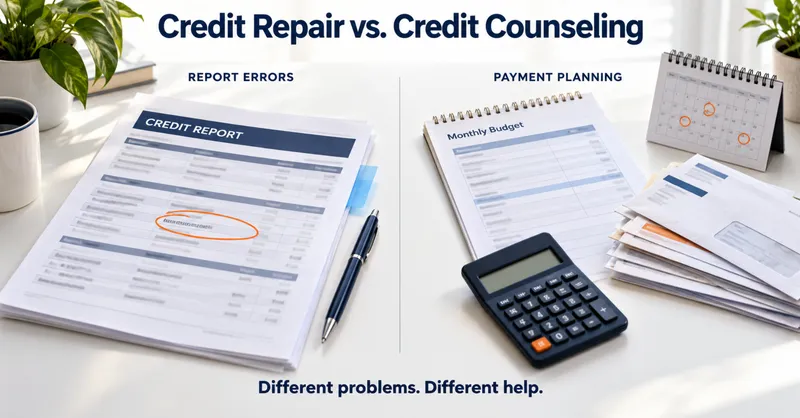
Credit repair vs credit counseling is a choice between two different services: help correcting your credit reports and help managing your debt. Choosing the wrong one means paying for a service that leaves your main financial problem unresolved.
Credit repair focuses on inaccurate information, such as a payment incorrectly marked late or an account that belongs to someone else. Credit counseling examines your income, expenses and debts to help establish a workable repayment strategy.
The distinction matters because a low credit score does not tell you which service you need. An error-filled report and an accurate report showing missed payments require different responses, even when the scores look similar.
Cost is another consideration. You have the right to dispute credit-report errors yourself for free, while credit counseling is often free or low cost; a debt management plan generally carries separate fees.
Before hiring either provider, identify what needs to change. If the information is wrong, focus on correcting it. If the debt is accurate but unaffordable, focus on repayment options.
For some consumers, both steps are necessary. Here’s how credit repair and credit counseling compare, what you’re paying for and how to decide which approach fits your situation.
Credit Repair vs. Credit Counseling: Which Help Do You Actually Need?
Credit repair vs credit counseling is the question people ask after a bad stretch: several collection accounts, missed payments, and a credit score that dropped. They cannot tell whether the problem sits in the credit report or in the debt itself.
The two problems need different fixes. Credit repair addresses inaccurate reporting.
Credit counseling addresses budgeting, debt management, and repayment strategies.
Neither service erases a legitimate debt. Neither guarantees a higher credit score, and a provider who promises either one is breaking rules the Federal Trade Commission enforces.
The practical split is simple. If your report shows a late payment you never missed, you have a reporting problem.
If your report is accurate but your minimum payments are unaffordable, you have a repayment problem.
At ASAP Credit Repair USA, we review credit reports for inaccurate, incomplete, and unverifiable information every day. We also know where credit repair stops, and that is where a counselor takes over.
This article covers what each service does, what each costs, how each affects credit scores, how debt management plans work, and a decision table that matches six common situations to a starting point.
Credit repair focuses on identifying and disputing inaccurate information on credit reports. Credit counseling helps consumers understand their finances, create budgets, and develop repayment plans. Choose credit repair for reporting errors. Choose credit counseling for debt payments you struggle to manage. Consumers dealing with both problems need separate solutions for each.
Credit Repair vs Credit Counseling: What's the Difference?
Credit repair corrects what a credit report says about you. Credit counseling changes how you pay what you owe. Credit repair disputes inaccurate, incomplete, or unverifiable entries under the Fair Credit Reporting Act. Credit counseling reviews your budget and debts and, where it fits, sets up a debt management plan.
| Comparison Factor | Credit Repair | Credit Counseling |
|---|---|---|
| Primary purpose | Correct inaccurate credit-report information | Build a budget and a repayment strategy |
| Main problem addressed | Reporting errors | Debt payments you struggle to manage |
| Services provided | Report review, dispute preparation, tracking investigation results | Budget assessment, debt review, financial education, plan evaluation |
| Credit-report disputes | Core service | Not a core service |
| Debt repayment assistance | None. Debts stay owed | Core service |
| Debt management plans | Not offered | Offered when the plan fits your situation |
| Typical costs | $0 if you dispute yourself. A paid provider cannot charge before the service is fully performed | Counseling is often free or low cost. A debt management plan adds setup and monthly fees |
| Effect on credit scores | Scores reflect corrected data. No increase is guaranteed | On-time payments and lower balances support scores. No increase is guaranteed |
| Expected timeline | A bureau investigates a dispute in 30 days, or 45 days if you send new information | A plan often takes 48 months or more, per the FTC |
| Best suited for | Reports with wrong, duplicate, or unverifiable entries | Accurate reports with payments you cannot afford |
A clean credit report does not make a payment affordable. An affordable payment plan does not correct a wrong late payment.
Not Sure Which Problem You Have?
Start with your credit reports. A review shows whether the damage comes from reporting errors or from debt you still owe.
Claim My Free Credit Analysis Now → Secure · 2 minutes · No credit card requiredWhat Is Credit Repair and How Does It Work?
Credit repair is the process of disputing inaccurate, incomplete, or unverifiable information on your credit reports. It rests on your dispute rights under the Fair Credit Reporting Act (FCRA), which require the credit reporting agency and the information furnisher to investigate.
When you file a dispute, the credit reporting agency has 30 days to reinvestigate or delete the item. The period extends to 45 days when you send relevant new information during the first 30.
Companies that sell credit repair services fall under the Credit Repair Organizations Act (CROA). The law defines a credit repair organization as a person who offers paid services to improve a consumer's credit record, credit history, or credit rating.
What Problems Does Credit Repair Address?
- ✓Late payments reported when you paid on time
- ✓Accounts that belong to someone else
- ✓Duplicate or misattributed debts
- ✓Incorrect balances
- ✓Wrong account statuses, such as open on a closed account
- ✓Incorrect delinquency dates
- ✓Mixed credit files that blend your data with another person's
- ✓Accounts opened through identity theft
- Identify the error. Pull your reports at AnnualCreditReport.com and mark the entry that does not match your records.
- Gather evidence. Collect the bank statement, the lender's payment confirmation, or any letter that proves the correct status.
- Submit the dispute. Send it to each bureau that shows the error and to the furnisher, with copies of your documents.
- Review the result. The bureau reports whether it corrected, deleted, or verified the entry. A verified result sends you back to your evidence.
What Credit Repair Does Not Do
Accurate negative information stays reportable for the period the law sets. The FTC puts it at seven years for most items and ten years for bankruptcy.
Credit repair does not cancel a debt. It does not create a repayment agreement, and it does not guarantee loan approval.
What Is Credit Counseling and How Does It Work?
Credit counseling is financial guidance that helps you understand your income, expenses, debts, and repayment options. A counselor reviews your whole financial picture, then recommends a budget, a repayment strategy, or a debt management plan.
The Consumer Financial Protection Bureau (CFPB) states that credit counseling organizations are usually nonprofit. The FTC adds a warning: nonprofit status does not guarantee that services are free, affordable, or legitimate.
What Services Do Credit Counselors Provide?
- ✓Budget assessments that compare your income with your fixed and variable expenses
- ✓Debt reviews that list every balance, interest rate, and minimum payment
- ✓Repayment planning that matches payments to your actual cash flow
- ✓Financial education through workshops and written materials
- ✓Creditor communication when a plan requires creditor agreement
- ✓Debt management plan evaluations that show whether a plan fits your situation
What Is a Debt Management Plan?
A debt management plan (DMP) consolidates your payments, not your debts. You make one monthly payment to the counseling organization, and the organization pays each participating creditor.
According to the CFPB, a DMP typically lowers monthly payments, interest charges, and fees. The concessions depend on each creditor's agreement, so the FTC advises you to confirm them with every creditor.
Confirm that each creditor accepted the plan before you send any payment. Expect a plan to take 48 months or more, and expect to stop using new credit while you are enrolled.
Money Management International (MMI) states that creditors almost always close the credit card accounts included in a plan. MMI also lists a setup fee and a monthly fee for plans, and the amounts differ by state.
Credit Repair vs Credit Counseling: Which Service Helps Your Credit Score?
Neither service guarantees a specific credit score increase. Credit repair changes the data that scoring models read. Credit counseling supports the payment behavior that scoring models reward.
FICO weighs payment history at 35% and amounts owed at 30%, according to myFICO. Those two categories explain how each service touches your score.
A lender reports a 60-day late payment you made on time. The bureau deletes it after the dispute. The scoring model now reads a clean payment history for that account.
A borrower builds a budget and pays every card on time. Balances fall month by month, so revolving utilization drops and new late payments stop.
A DMP carries a tradeoff. MMI states that closed accounts shorten average account age and lower a score a little at the start.
MMI also states that a DMP notation on a report is not a factor in any credit scoring model. Lenders still read the full file during underwriting, so account status and repayment history matter to them.
How Much Does Credit Repair Cost Compared With Credit Counseling?
Disputing errors yourself costs nothing. Credit counseling sessions are often free or low cost, while a debt management plan adds setup and monthly fees. Paid credit repair fees vary by provider, and federal law bars the provider from charging before the service is fully performed.
| Service | What the Sources Show |
|---|---|
| Self-directed credit-report disputes | $0. The FTC states that disputing mistakes costs nothing |
| Professional credit repair | Set by each provider. No national average exists in a federal source. CROA bars payment before the service is fully performed |
| Counseling sessions | MMI offers free personal credit and budget counseling, per its disclosures page (reviewed October 2026) |
| DMP setup fee | MMI charges a setup fee that varies by state. Michigan law caps the initial fee at $50 |
| Ongoing DMP fee | MMI charges a monthly fee that varies by state. Michigan law caps ongoing fees at 15% of the debt paid through the plan |
Section 1679b(b) of CROA bars a credit repair organization from charging or receiving money before the service is fully performed. The FTC adds that a credit repair contract must be in writing and carry a three-day right to cancel.
The FTC applies a different timing rule to debt management plans. Under the Telemarketing Sales Rule, a company that promises a DMP cannot collect a fee until you enter the plan and make at least one payment through it.
Fee rules differ by service and by state. Ask for the price in writing before you agree to anything.
Do You Need Credit Repair or Credit Counseling?
The underlying problem decides the service, not your credit score. Wrong information on your report points to credit repair. Payments you cannot afford point to credit counseling. Many consumers have both problems and need both actions.
| Your Situation | Recommended Starting Point |
|---|---|
| 1. Your credit report shows a late payment you never missed | Credit-report review and dispute |
| 2. Your credit report is accurate, but minimum payments are unaffordable | Credit counseling and a repayment assessment |
| 3. Your credit cards are near their limits | Budgeting, repayment planning, and evaluating the effect of lower revolving balances |
| 4. A collection account belongs to someone else | Credit-report dispute and identity verification |
| 5. You have accurate late payments and several overdue debts | Credit counseling for repayment assistance. Review reports separately for inaccuracies |
| 6. You have both inaccurate reporting and unaffordable debt | Address both problems through separate, coordinated actions |
Match the service to the cause. The score only tells you that something is wrong.
What Happens If You Need Both Credit Repair and Credit Counseling?
You run two separate actions. Credit counseling fixes the payment problem. A credit-report dispute fixes the reporting problem. Neither action replaces the other.
Consider a hypothetical borrower with $12,000 in credit card debt and minimum payments that strain the monthly budget. The same borrower finds a collection account on the report that belongs to someone else.
A counselor reviews the budget and the $12,000 in card debt, then evaluates whether a debt management plan fits.
The borrower disputes the collection account with the bureaus and the furnisher, with identity documents as evidence.
Correcting the collection does not eliminate the card debt. Repaying the card debt does not correct the collection error.
Each action targets one problem, and each problem keeps its own deadline.
Credit Repair vs Credit Counseling vs Debt Settlement
Settlement carries separate risks: missed payments, collection activity, fees, litigation exposure, and possible tax consequences. Our article on credit repair vs settling debt covers that comparison in full.
How Do You Choose a Legitimate Credit Repair or Credit Counseling Service?
Verify eight items before you pay anyone: clear service descriptions, a written agreement, fee disclosures, no score guarantees, no promises to erase accurate information, consumer rights disclosures, verifiable credentials, and clear cancellation terms.
- Clear service descriptions. The provider states exactly what it will do and what it will not do.
- Written agreements. Every term sits in a contract you read before you sign.
- Transparent fee disclosures. You get a specific price quote in writing, including setup and monthly fees.
- No guaranteed score increases. No provider controls how scoring models or bureaus respond.
- No promises to erase accurate information. The FTC warns against any organization that claims it removes accurate negative information.
- Consumer rights disclosures. A credit repair contract explains your legal rights under federal law.
- Verifiable provider credentials. Ask whether the organization is licensed in your state and how it trains or certifies its counselors.
- Clear cancellation terms. A credit repair contract carries a three-day right to cancel without charge.
Nonprofits with 501(c)(3) status fall outside CROA's definition of a credit repair organization. For a counselor, the FTC's fee, licensing, and written-agreement questions carry the weight.
When Does Professional Credit Repair Make Sense?
A review starts with five items: account ownership, balances, dates, payment history, and prior dispute results. A mismatch in any one of them is the reason to file, and the pattern across the bureaus shows what to send.
Not Sure What's Hurting Your Credit?
Start by reviewing your credit reports. ASAP Credit Repair USA helps consumers identify inaccurate account information and understand the appropriate steps for addressing reporting errors.
Review My Credit Report → Secure · 2 minutes · No credit card requiredFrequently Asked Questions About Credit Repair vs Credit Counseling
What is the main difference between credit repair and credit counseling?
Credit repair disputes inaccurate information on your credit reports. Credit counseling reviews your budget and debts and builds a repayment strategy. One works on the record, and the other works on your cash flow. Neither service erases a legitimate debt, and neither guarantees a higher score.
Is credit counseling better than credit repair?
Neither is better in general. Credit counseling fits an accurate report paired with payments you cannot afford. Credit repair fits a report with wrong, duplicate, or unverifiable entries. Check your reports first, because the cause of the problem, not the service name, decides which help works.
Does credit counseling hurt your credit score?
A counseling session does not. A debt management plan closes most enrolled credit card accounts, according to MMI, and that lowers a score a little at the start. On-time plan payments and falling balances support the score afterward, though no result is guaranteed for any borrower.
Does credit repair remove debt?
No. Credit repair corrects reporting, not what you owe. Deleting an inaccurate collection entry removes the entry from your report, not the underlying obligation. A legitimate debt remains owed and stays reportable for the period the law allows, so plan the repayment separately.
Is nonprofit credit counseling free?
Counseling sessions are often free or low cost, and MMI lists free personal credit and budget counseling. A debt management plan carries setup and monthly fees. The FTC states that nonprofit status does not guarantee free or affordable services, so get every fee in writing first.
How much does credit repair cost?
Disputing errors yourself costs nothing. Paid providers set their own prices, and no federal source publishes a national average. Under the Credit Repair Organizations Act, a provider cannot charge or receive money before the service is fully performed. Get the price in a written contract.
Will a debt management plan appear on my credit report?
The accounts in the plan report the plan's status. MMI states that a DMP notation is not a factor in any credit scoring model. Closed accounts and the payment record still show on the report, and lenders read both during underwriting, so the whole file counts.
Should I use credit counseling if my credit report has errors?
Use counseling only if you also struggle with payments. Counseling does not dispute reporting errors, so errors stay on the report until someone files. Dispute the errors with the bureaus and the furnisher on their own track, and pursue a repayment plan separately if the debt is unaffordable.
Is credit counseling the same as debt settlement?
No. Credit counseling builds budgets and structured repayment plans. Debt settlement negotiates to resolve a debt for less than the amount owed. Settlement carries separate risks: missed payments, collections, fees, litigation exposure, and possible tax consequences. A debt management plan carries none of those risks by design.
How long does credit repair take?
A credit reporting agency must reinvestigate a dispute within 30 days, or 45 days if you send relevant new information in that window. Complex files with several accounts and multiple bureaus take longer, since each dispute runs on its own clock and each furnisher responds separately.
Do credit counselors negotiate with creditors?
Counselors on a debt management plan work with creditors to arrange lower interest rates, lower fees, or lower payments. The FTC states that concessions are not guaranteed. Confirm each concession with the creditor, and confirm acceptance of the plan before you send a payment to the agency.
Do I need both credit repair and credit counseling?
You need both when your report has inaccuracies and your debt is unaffordable. The two services solve separate problems. Dispute the errors with the bureaus, and work with a counselor on the repayment plan at the same time, since neither action replaces the other.
-
Why Credit Repair Is Better Than Settling Debt How credit repair and debt settlement differ on score damage, taxes, and lawsuit risk.
-
What Is Credit Repair Service and How Can It Help You How the dispute process works and how to choose between DIY credit repair and professional help.
-
How to File a TransUnion Dispute & Fix Credit Report Errors The dispute steps to follow once you spot an inaccurate entry.
-
Credit Report Correct but Denied? 7 Reasons Why What lenders weigh beyond the accuracy of your report.
- Consumer Financial Protection Bureau — What is a debt management plan?
- Consumer Financial Protection Bureau — What is credit counseling?
- Federal Trade Commission — Credit Repair: How to Help Yourself
- Federal Trade Commission — Choosing a Credit Counselor
- U.S. Department of Justice — Credit counseling agencies approved under 11 U.S.C. § 111
- 15 U.S.C. § 1679b — Credit Repair Organizations Act, prohibited practices
- 15 U.S.C. § 1679a — Credit Repair Organizations Act, definitions
- 15 U.S.C. § 1681i — Fair Credit Reporting Act, procedure in case of disputed accuracy
- Money Management International — Licenses and disclosures
- Money Management International — Credit impact of a debt management plan
- myFICO — What is in your credit score
- AnnualCreditReport.com — Free credit reports