

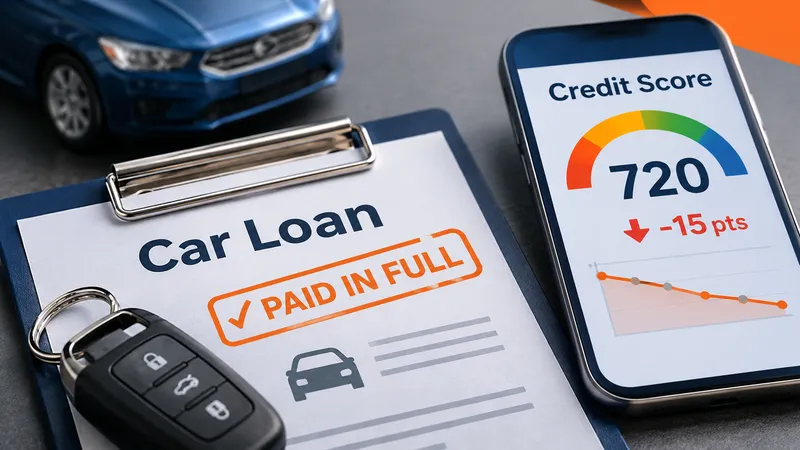
A credit score drop after paying off a car loan can catch you off guard, especially when you have spent years making payments on time. You finally pay off your vehicle, eliminate a monthly bill, and expect your credit score to improve. Instead, your score drops. The reason often comes down to how credit scoring models evaluate installment loans. According to FICO, credit mix accounts for 10% of your credit score, while length of credit history accounts for 15%. When you pay off your only active installment loan, your credit profile changes. You may lose certain scoring benefits even though you have successfully paid your debt. However, the size of the change depends on your overall credit history, remaining accounts, and the scoring model used.
At ASAP Credit Repair USA, nearly 20 years of experience reviewing consumer credit reports have shown why borrowers need to examine their accounts after paying off a loan. A lower score does not automatically mean something went wrong, but inaccurate reporting can make matters worse. Your lender might report an incorrect remaining balance, an inaccurate late payment, or the wrong account status after closing your loan. Under the Fair Credit Reporting Act (FCRA), consumers have the right to dispute inaccurate credit information. This guide explains why paying off a car loan can lower your credit score, what affects the size of the drop, how long a paid-off loan remains on your credit report, and how to identify reporting errors that may require correction.
Why Does a Credit Score Drop When You Pay Off a Car Loan?
Paying off a car loan closes an active installment account. That closure reduces your credit mix if the auto loan was your only active installment account, and it can lower the average age of your open accounts depending on how long you had the loan. Neither effect means anything went wrong; both are built into how FICO and VantageScore calculate scores. The drop is a temporary structural adjustment, not a sign of damaged credit, and it typically reverses as remaining accounts age.
The score drop feels wrong because the intuition behind credit scoring says that debt is bad and paying it off is good. That intuition is mostly correct: carrying high balances on revolving accounts does serious scoring damage, and paying them down helps significantly. Installment loans work differently. The scoring benefit of an installment loan comes from having an open, active account with a positive payment history. Once the loan is paid off, the account closes, and those active-account benefits diminish.
Credit Mix The Most Common Cause
FICO 8 calculates credit mix as 10% of the total score. VantageScore 4.0 weighs it at a similar level. Credit mix measures whether a borrower has experience managing different types of credit, specifically revolving accounts like credit cards and installment accounts like auto loans, mortgages, and personal loans. Having both types in the active file demonstrates a broader credit history to lenders.
When an auto loan is paid off and closed, it no longer counts as an active installment account. If it was the borrower's only active installment account, the credit mix factor drops to revolving-only, which scores lower than a mixed file. The scoring models register this as a reduced profile, not as damage, but the effect appears as a point drop on the report.
Average Age of Accounts — A Secondary Factor
The length of credit history factor in FICO 15% of the total score includes the average age of all open accounts. When an account closes, it stops contributing to that average for open accounts. The closed account does remain on the credit report and continues to count toward the overall account history, but the average age of the open file can shift depending on what else is in it.
The effect is most pronounced when the auto loan was the oldest account on the file, when it had been open for several years, or when only a few other accounts remain open after payoff. A borrower with ten open accounts who closes one auto loan sees very little shift in average age. A borrower with two open accounts who closes the older one sees a more significant shift.
Installment Utilization — A Smaller Factor
Newer scoring models, including FICO 9 and FICO 10, track installment utilization, the ratio of remaining balances across all installment loans to their original amounts. A loan that is 90% paid off (a small remaining balance against a large original amount) signals financial progress and scores positively. When the loan closes at zero, that utilization ratio drops out of the calculation entirely. The scoring benefit of an almost-paid installment loan disappears when it becomes a fully-paid closed account. This is typically a minor factor compared to credit mix, but it contributes to the same directional drop.
How Much Does Paying Off a Car Loan Lower Your Credit Score?
For most borrowers, paying off a car loan drops the credit score between 5 and 20 points. The drop is larger, sometimes 20 to 40 points when the auto loan was the only installment account, when the file has fewer than five total accounts, or when the loan had been open for many years. A drop of more than 40 points after a payoff with no other changes to the credit file is a signal to check the report for a reporting error.
The size of the drop depends on the composition of the rest of the file. The scoring factors affected by payoff credit mix and average account age carry meaningful but limited weight in the overall calculation. For a borrower with a diverse, well-aged file, losing one installment account creates a small structural adjustment. For a borrower with a thinner file, the same event carries more weight.
| File Profile at Time of Payoff | Expected Score Drop | Why |
|---|---|---|
| 5+ open accounts, multiple installment loans still open | 5 to 10 points | Credit mix maintained by remaining installment accounts; average age minimally affected |
| Several open accounts, auto loan was only installment account | 10 to 20 points | Credit mix drops from mixed to revolving-only; installment utilization factor drops out |
| Few open accounts (2–3 total), auto loan was oldest or only installment | 20 to 40 points | Credit mix loss combined with meaningful average age shift; thin file amplifies both effects |
| Drop exceeds 40 points; no other changes to file | Investigate | Structural scoring math alone does not produce this. Check the credit report for a reporting error on the closed account. |
The drop is temporary. Scoring models continuously recalculate based on current account activity. As remaining accounts age and the closed auto loan's positive payment history continues to contribute to the file's overall history, the score stabilizes and typically recovers within two to six months, longer if the file is thin and no new positive accounts are added.
Does a Paid-Off Car Loan Stay on Your Credit Report?
Yes. A paid-off car loan with a positive payment history stays on your credit report for up to 10 years after the account closes. During that time, your on-time payment history continues to boost your score. The account status must show as "closed paid in full" or "paid as agreed." Any other closed status such as "charge-off," "settled," or "paid was delinquent" is a reporting error that requires a dispute.
The 10-year retention period for positive closed accounts is a consumer benefit, not a burden. That payment history is evidence of your track record. Lenders reviewing your credit file see years of on-time payments on a loan you carried from origination to payoff; that record works in your favor for future loan applications even after the account is no longer active.
The scoring contribution of a closed positive account diminishes over time. The account ages, the payment history becomes older, and its relative weight in the payment history factor decreases as newer active accounts accumulate. But the account never hurts the score during those 10 years; it simply contributes less as it ages.
When an auto loan is paid off, the account closes with a status of "paid in full," "paid as agreed," or "closed $0 balance." These are positive closed statuses. A "charge-off" is what happens when a lender writes off a delinquent loan as a loss. If your paid-off auto loan is showing "charge-off," "settled for less than full amount," or "paid derogatory" in the closed account status field, that is a serious reporting error. It means the lender is showing the wrong account outcome on your file. That error requires an immediate dispute under FCRA Section 623 with the lender and Section 611 with each bureau where it appears.
See How Your Paid-Off Car Loan Is Actually Reporting on All Three Bureaus
A free 3-bureau audit pulls your current Experian, TransUnion, and Equifax reports so you can see the exact status, balance, and payment history showing on your closed auto loan and identify any error that is amplifying the post-payoff score drop.
Claim My Free Credit Analysis Now → Secure · 2 minutes · No credit card requiredWhat Credit Report Errors Happen After Paying Off a Car Loan?
The most common errors after car loan payoff are: the balance not updating to zero; the account closing with a status of "charge-off" or "paid was delinquent" instead of "paid in full"; a late payment notation added in the final billing cycle even though the loan was paid on time; the account remaining listed as open; and a duplicate entry from a prior loan servicer. Each error is disputable under FCRA Section 623 with the lender and Section 611 with the bureau.
Auto loan payoff is a data-intensive event in a lender's reporting system. The account status changes, the balance updates to zero, the closed date is recorded, and the final payment history is locked. Any of those fields can be populated incorrectly during the account closing process, and the error persists on the credit report until the borrower disputes it.
Balance Not Updating to Zero
This is the most visible error. The loan is paid off, and the lender's internal system confirms the payoff, but the data sent to Experian, TransUnion, or Equifax still shows a remaining balance. The account looks like it still has money owed. This inflates the borrower's total reported debt load and can affect debt-to-income calculations for future lending. It amplifies the score drop beyond what the structural factors alone would produce.
Wrong Account Status at Closing
The account status field tells lenders and scoring models how the loan ended. "Paid in full," "paid as agreed," and "closed $0 balance" are the correct statuses for an auto loan that was paid off as contracted. Errors occur when this field populates with "charge-off," "settled," "paid collection," or any derogatory status. These errors can result from internal coding mistakes at the lender, from a loan that was previously delinquent and had the delinquency resolved before payoff (where the delinquency code is erroneously applied to the final closure), or from loan transfers where the new servicer applied the wrong closing code.
Erroneous Late Payment on the Final Cycle
Some borrowers who pay off their loan early before the scheduled final payment date find a 30-day late notation on their payment history for that final cycle. The lender's system expected a standard monthly payment; the loan was instead paid in full, and the system recorded the absence of a standard payment as a missed payment. This is an internal processing error. The payoff receipt and the account ledger both show the loan was paid in full. The late notation is the error.
Account Remaining Listed as Open
When a lender's system fails to send the account closure update to the bureaus, the account continues to appear as open, sometimes with a balance, sometimes at zero. An open account with a zero balance is not a scoring problem, but it can confuse lenders reviewing the file manually and may cause questions during mortgage underwriting. An open account with a residual balance is a more serious problem for debt-to-income calculations.
Duplicate Entries from Prior Servicers
Many auto loans are originated by one company and serviced by another, or transferred between servicers during the loan term. When both the originating lender and the servicing company report the same loan as separate entries on the credit report, the borrower has two entries for one loan. After payoff, one or both entries may close incorrectly. If the duplicate has been on the report for years, the duplicate entry's payment history also matters. A servicer that reported missed payments differently than the originating lender creates inconsistencies across the credit file.
How Do You Fix a Credit Score Drop After Paying Off Your Car?
If the drop came from structural scoring changes, credit mix reduction, or account age, the most effective fix is adding a new active installment account such as a credit builder loan, which restores the mix benefit without large debt. If the drop came from a reporting error, file a dispute with the lender under FCRA Section 623 and simultaneously with the bureau under FCRA Section 611. Pull your credit report within 30 days of payoff to catch any error while documentation is easy to obtain.
The fix depends on the cause. Structural drops from credit mix or account age are not errors; they are scoring math responding to a real change in the account profile. Reporting errors that amplify the drop are disputable. Knowing which one you are dealing with requires pulling the credit report and looking at the specific entries.
- ✓ Pull your credit report within 30 days of payoff. Go to AnnualCreditReport.com and pull Experian, TransUnion, and Equifax. Look at the auto loan entry and confirm: the balance shows zero, the account status shows "paid in full" or "paid as agreed," there are no new late payment notations in the payment history, and the account appears only once, not duplicated from a prior servicer.
- ✓ Verify the account status code is positive. The account status field is the most important thing to check. It must show "paid in full," "paid as agreed," "closed — $0 balance," or an equivalent positive designation. Any derogatory status code on a loan you paid off is a reporting error; record it and begin the dispute process immediately.
- ✓ Check for a late payment notation on the final billing cycle. Scroll through the payment history month by month. If there is a "30 days late" notation in the final one or two months of the loan's history and you know the loan was paid on time or paid off early, that notation is an error. Your payoff confirmation from the lender is the evidence for this dispute.
- ✓ File a dispute for any error — with the lender and the bureau simultaneously. Under FCRA Section 623, send a written dispute directly to the auto lender identifying the specific error and providing your payoff documentation. Send the same dispute to each bureau where the error appears under FCRA Section 611. Both the lender and the bureau have 30 days to investigate. The bureau must delete any item it cannot verify within that window under Section 611(a)(5)(A).
- ✓ If the drop is structural — not an error, consider a credit builder loan. A credit builder loan is a small installment loan specifically designed to restore credit mix without requiring a large borrowing amount. The loan amount is typically held in a savings account while you make monthly payments; at the end, the account is paid in full, and the payment history is reported. It restores the active installment account your profile lost when the auto loan closed, and the savings component means you end the loan with money rather than debt.
- ✗ Do not take out a new auto loan just to restore credit mix. A new car loan restores the installment account mix, but it also adds hard inquiry damage from the application, reduces average account age by adding a new account, and increases your total debt load. The scoring benefit of restored credit mix is worth about 10 points of FICO, not worth taking on a new car loan for scoring purposes alone.
- ✗ Do not wait months to check the credit report after payoff. Reporting errors that appear in the account closing process are easiest to dispute immediately after payoff; the documentation is fresh, the lender's records are current, and the payment confirmation is recent. Waiting six months to check creates a situation where the error has been sitting on the file, and you may need to work harder to obtain the supporting records.
A small score drop after paying off a car loan is normal scoring math; credit mix and average account age shift when an active installment account closes. That drop should be 5 to 20 points and should recover within a few months. A drop larger than that is a signal to pull the credit report and look for a reporting error: a wrong status code, a balance that did not update to zero, or a late payment notation that does not belong in the history. Those errors are disputable, the documentation is straightforward, and the fix is a formal dispute with the lender and the bureau under the FCRA.
Why does a credit score drop when you pay off a car loan?
Paying off a car loan closes an active installment account. That closure reduces your credit mix if the auto loan was your only active installment account, and it can lower the average age of your open accounts depending on how long you had the loan. Neither effect means anything went wrong; both are built into how FICO and VantageScore calculate scores. The drop is a temporary structural adjustment and typically reverses as remaining accounts age.
How much does paying off a car loan lower your credit score?
For most borrowers, paying off a car loan drops the credit score between 5 and 20 points. The drop is larger, sometimes 20 to 40 points when the auto loan was the only installment account on the file, when the file has fewer than five total accounts, or when the loan had been open for many years. A drop of more than 40 points after a payoff with no other changes to the credit file is a signal to check the report for a reporting error.
Does a paid-off car loan stay on your credit report?
Yes. A paid-off car loan with a positive payment history stays on your credit report for up to 10 years after the account closes. During that time, your on-time payment history continues to boost your score. The account status must show as "closed paid in full" or "paid as agreed." If the account shows any other closed status such as "charge-off," "settled for less than full balance," or "paid derogatory," that is a reporting error that requires a dispute.
What credit report errors happen after paying off a car loan?
The most common errors after car loan payoff are: the balance not updating to zero; the account closing with a status of "charge-off" or "paid was delinquent" instead of "paid in full"; a late payment notation added in the final billing cycle even though the loan was paid on time; the account remaining listed as open; and a duplicate entry from a prior loan servicer. Each error is disputable under FCRA Section 623 with the lender and Section 611 with the bureau.
How do you fix a credit score drop after paying off your car?
If the drop came from structural scoring changes, credit mix reduction, or account age, the most effective fix is adding a new active installment account such as a credit builder loan, which restores the mix benefit without large debt. If the drop came from a reporting error, file a dispute with the lender under FCRA Section 623 and simultaneously with the bureau under FCRA Section 611. Pull your credit report within 30 days of payoff to catch any error while documentation is easy to obtain.
Find Out Exactly Why Your Score Dropped and Whether an Error Is Making It Worse
A free 3-bureau audit reviews your Experian, TransUnion, and Equifax reports so you can see exactly how your closed auto loan is reporting the status, balance, payment history, and whether a reporting error is amplifying what should be a minor, temporary scoring adjustment.
Claim My Free Credit Analysis Now → Secure · 2 minutes · No credit card required-
Santander Auto Loan Repossession: What Happens to Your Credit? Covers the full credit reporting impact of a Santander repossession, the stacking late payment notations, the repossession status, the deficiency collection, and the most common re-aging errors.
-
Capital One Closed My Account Without Warning: Will It Hurt My Credit? Same category of question as an account closing event causing an unexpected score drop. Covers credit utilization spikes from closed revolving accounts and how to dispute inaccurate closing status codes.
-
Canceled GAP Insurance but Auto Loan Balance Is Still Wrong? Here's Why Covers how GAP cancellation refunds and total-loss payouts fail to reach the loan balance on the credit report, another auto loan reporting error that inflates the balance shown on a closed or transferred account.