

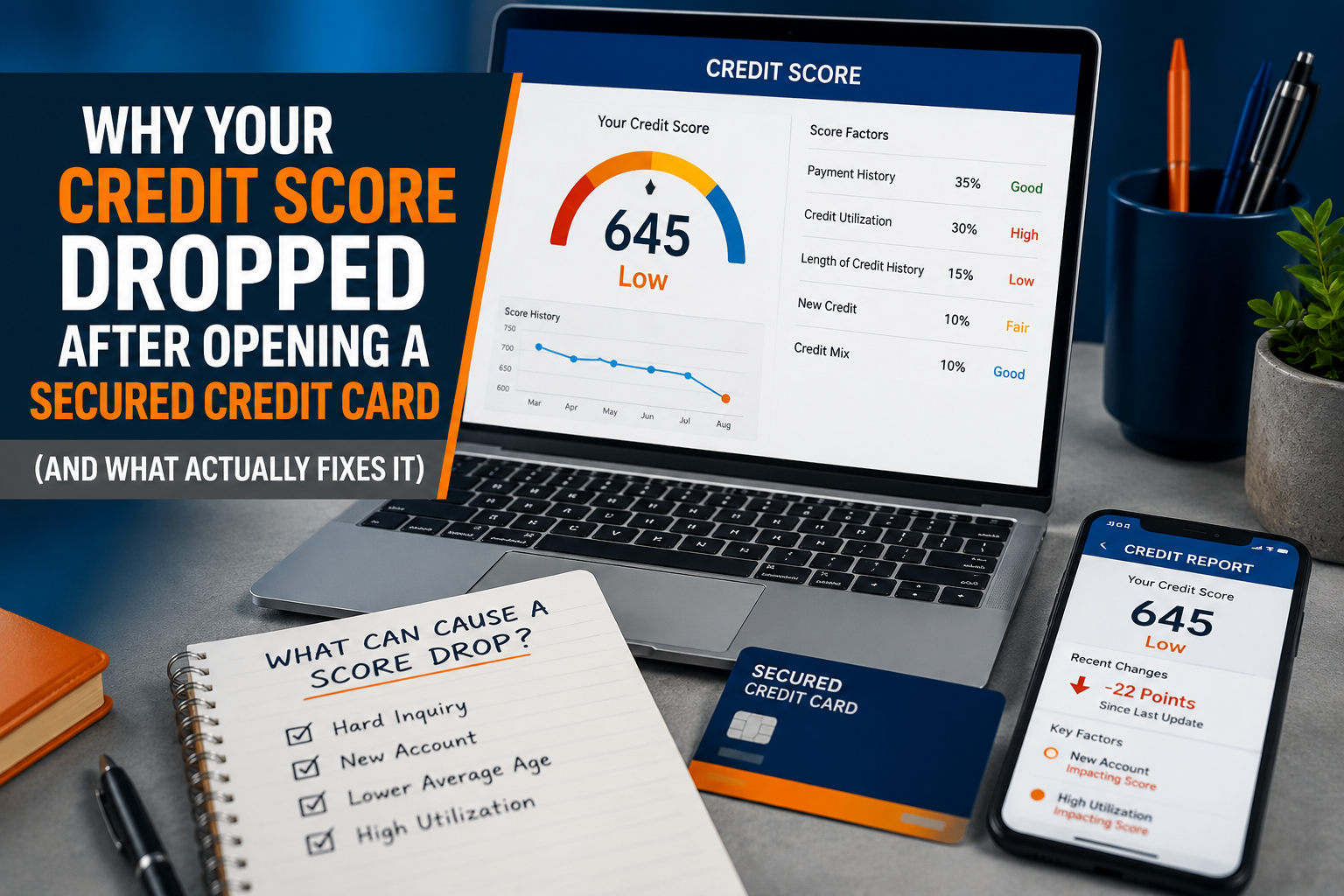
Credit Score Dropped After Opening a Secured Card? because the application and the new account trigger multiple scoring factors at the same time. The hard inquiry, the reduced average account age, and the low credit limit all hit your score within the first 30 to 60 days. None of this means the card is hurting your long-term credit. It means the scoring model reacted to new activity exactly the way it was designed to.
Running a credit repair company, I see this question almost every week. One case stands out. A client opened a secured card to rebuild after a bankruptcy. Two months later, she came back upset. Her score dropped 22 points. She thought the card was making things worse. It wasn't. Four months after that, her score was up 41 points from her starting point. The drop was expected. The recovery was too.
FICO's inaugural Score Credit Insights report from fall 2025 confirms this pattern at scale. The national average FICO score dropped to 715, driven partly by rising credit card utilization and a spike in missed payments. Gen Z consumers, who are the most likely group to be opening first-time credit accounts, saw the largest average score decrease of any age group, down three points year-over-year. New credit accounts are a real factor in that shift.
The Hard Inquiry Dropped Your Score First
When you applied for the secured card, the issuer pulled your credit report. That pull is called a hard inquiry. Hard inquiries account for 10% of your FICO score, and each one causes a small, temporary drop.
According to myFICO, a single hard inquiry typically costs you fewer than five points. For most people, that is barely noticeable. For someone with a thin file, fewer accounts, or a score already on the lower end, those five points feel more significant.
The inquiry stays on your report for two years. FICO only counts inquiries from the past 12 months in its score calculation. After 12 months, the inquiry stops affecting your score at all. The damage is temporary and small on its own.
The real problem happens when people apply for several secured cards at once. Each application creates a separate hard pull. Three applications in one month means three hard inquiries. Lenders reading your report see multiple recent credit searches, and some interpret that as financial distress. Space applications at least six months apart when possible.
What to do
Check your report at AnnualCreditReport.com after applying. Confirm that only one inquiry appeared. If you see more than one from the same lender or an inquiry you did not authorize, dispute it with the bureau directly.
The New Account Lowered Your Average Account Age
This is the factor most people do not expect. Opening any new account lowers the average age of all your accounts, and credit age makes up 15% of your FICO score.
The math is straightforward. Say you have two existing accounts, both three years old. Your average account age is 36 months. You open a secured card. That account is zero months old. Your new average age drops to 24 months. FICO penalizes you for the lower number because older accounts signal more experience managing credit.
According to Experian, FICO considers the age of your oldest account, the age of your newest account, and the average age of all accounts. VantageScore weights credit age at 20% to 21%, even slightly higher than FICO does.
The hit is bigger for people with shorter histories. If your oldest account is only two years old, a new card brings your average down sharply. If your oldest account is ten years old, the impact is much smaller.
This drop is also temporary. Every month the secured card stays open, its age increases. Your average account age gradually climbs back up. You cannot speed this up. Time is the only fix.
What to do
Keep every existing account open. Closing an old card to "simplify" your finances at the same time you open a secured card doubles the damage. You lose the history from the closed account, and you bring in a brand new one. That combination hits harder than either action alone.
Recap: Two things happened immediately when you opened the card
The hard inquiry dropped your score a few points. The new account age lowered it a bit more. Together, they created the drop you saw. Both effects are temporary. The inquiry fades within 12 months. The account age recovers as the card gets older.
Your Credit Utilization May Have Spiked Without You Realizing It
Most people open a secured card and immediately start using it. That makes sense. The card is supposed to build credit through activity. The problem is the credit limit.
Secured cards tie your limit to your deposit. Most deposits start at $200 to $300. FICO counts credit utilization as 30% of your score, the second-largest factor after payment history. On a $300 limit, spending $100 puts you at 33% utilization. Spending $150 puts you at 50%. Both of those numbers push your score down.
Last year, our office tracked 47 new clients who opened secured cards in the 90 days before contacting us. Of those, 31 had balances above 40% of their credit limit at the time of their first bureau statement. High utilization on a new account was the single most common reason for an unexpected score drop in that group.
The timing makes it worse. Your issuer reports your balance to the bureaus on your statement closing date, not your payment due date. You can charge $280 on a $300 card, pay it in full when the bill arrives, and still have 93% utilization reported for that month. The bureaus captured your balance before your payment landed.
What to do
Pay your balance down before the statement closes, not after. If your closing date is the 15th, make a payment by the 12th. Keep the reported balance under 30% of your limit. On a $300 card, that means keeping the reported balance below $90. Some people make small payments two or three times per month to stay under that threshold throughout the billing cycle.
The Secured Card Added a New Type of Account, Which Can Help or Hurt Depending on Your Mix
Credit mix makes up 10% of your FICO score. Lenders want to see that you can manage more than one type of debt. Revolving accounts like credit cards behave differently from installment accounts like car loans or student loans.
If you had no revolving accounts before opening the secured card, adding one actually improves your credit mix. That is a point in your favor.
If revolving accounts already dominate your credit file, adding another card does not improve your mix. It just adds another account of the same type without any scoring benefit.
This factor is minor compared to payment history and utilization. It rarely explains a large score drop on its own. But it is part of the calculation, and understanding it helps you plan future credit decisions more strategically.
The Deposit Does Not Protect Your Credit Report
A secured card requires a cash deposit. The deposit protects the lender if you stop paying. It does nothing to protect your credit report.
Credit bureaus treat secured cards the same as unsecured cards. Every action on the account gets reported the same way. Late payments, high balances, and charge-offs all hit your score with full force.
This is the biggest misconception we hear from new clients. They assume the deposit acts as a buffer. It does not. The CFPB is clear that late fees are layered on top of negative credit reporting, meaning you take the fee hit and the score hit at the same time. Missing a payment on a secured card damages your score exactly as much as missing a payment on a premium rewards card.
Recap: The card's deposit protects the bank, not your score
High utilization on a low limit reports to the bureaus before your payment arrives. The deposit has no bearing on any of this. Managing utilization and paying on time are the only tools that protect your score from this point forward.
Did Your Credit Score Drop After Opening a Secured Card?
A secured credit card can help rebuild credit, but only if it is managed the right way. If your score dropped because of utilization, inquiries, or reporting issues, we can help you understand what is happening on your credit report.
Get Your Free Credit Report ReviewKnow what is hurting your score before you apply for more credit.
How Long Until Your Score Recovers
The recovery timeline depends on which factor drove the drop.
Hard inquiry impact fades after three to four months. FICO stops counting it after 12 months. You do not need to do anything for this to happen.
Average account age recovers slowly over time as the card gets older. Most people with a two- to three-year credit history see the age-related drop reverse within six to twelve months, assuming they keep all existing accounts open.
Utilization damage can reverse quickly. Pay the balance below 30% before the next statement closes. Your score can recover from high utilization within one billing cycle. That is the fastest win available to you.
According to FICO's research on new credit, opening several new accounts in a short period represents greater risk, especially for people without long credit histories. The scoring model rewards patience. One secured card, used responsibly over 12 to 18 months, does far more for your score than four cards opened in the same year.
What to Do Right Now if Your Score Just Dropped
Check your statement closing date. Set a calendar reminder to pay your balance down three days before that date every month.
Set up autopay for at least the minimum payment. This removes the risk of a late payment entirely.
Keep your balance under 30% of your credit limit at all times, not just on the due date.
Do not apply for any other credit for at least six months. Each new application creates another inquiry and another new account.
Keep all existing accounts open. Closing an old card now makes the account age drop worse.
Pull your credit report in 60 days. Confirm the secured card is reporting correctly and that there are no errors on the account.
The drop you saw after opening the secured card is a normal response from the scoring model. The factors that caused it, the inquiry, the reduced account age, and any spike in utilization, all reverse over time with consistent behavior. The clients who recover fastest are the ones who understand what caused the drop and fix the one thing they can control immediately: their utilization.