
A secured credit card requires a cash deposit to open. An unsecured credit card does not. That is the core difference between the two, but it is far from the only one that matters when you are deciding which one to get.
Running a credit repair company means I see this question almost every week. Clients come in after a bankruptcy, a string of late payments, or simply no credit history at all, and they want to know how to start over. Secured cards come up in almost every one of those conversations. They are, in many cases, the first real step back toward financial stability.
A 2023 KeyBank Financial Mobility Survey found that 55% of Americans describe themselves as being in a difficult financial position, up from 37% the year before. For many of those people, a secured card is the most accessible entry point into the credit system (KeyBank press release via PRNewswire).
What Is a Secured Credit Card?
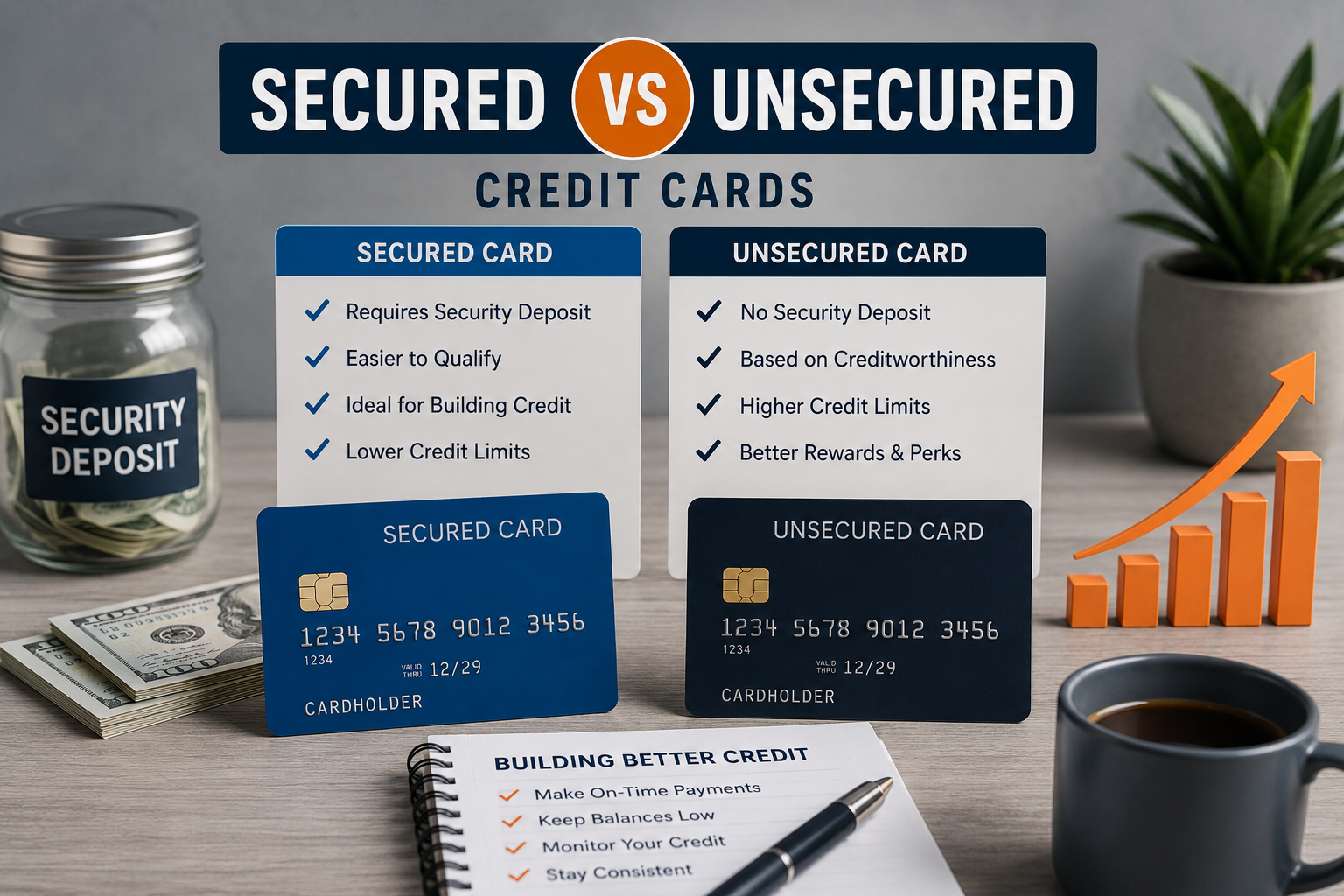
A secured credit card is a credit card backed by a refundable cash deposit. When you apply, you put down a deposit usually between $200 and $2,500, and that deposit becomes your credit limit. If you deposit $300, your credit line is $300.
The deposit protects the card issuer. If you stop making payments, the issuer keeps the deposit to cover what you owe. That reduced risk is exactly why secured cards are available to people with poor credit or no credit history at all.
Beyond the deposit, a secured card works like any other credit card. You swipe, you receive a monthly statement, and you pay. If you carry a balance, you pay interest. The issuer reports your payment activity to all three credit bureaus, TransUnion, Equifax, and Experian, just like an unsecured card would.
What Is an Unsecured Credit Card?
An unsecured credit card requires no deposit. The card issuer extends a line of credit based on your creditworthiness, your credit score, income, and payment history. Most credit cards on the market are unsecured.
Your credit limit on an unsecured card depends on your profile. A borrower with a 750 score might qualify for a $10,000 limit. A borrower with a 620 score might qualify for $500 or get denied altogether.
Unsecured cards also tend to offer better rewards, lower interest rates, and fewer fees. Cash back, travel points, purchase protection, and airport lounge access are all features commonly found on unsecured cards. These perks are rarely available on secured cards.
Secured vs Unsecured Credit Cards: Key Differences?
The deposit is the most obvious difference. But the gap between secured and unsecured cards goes further than that.
The Federal Trade Commission notes that secured credit cards generally carry higher annual percentage rates and higher annual fees than unsecured cards (FTC consumer guide). Some secured cards also charge fees you rarely see on unsecured cards, such as application fees, monthly maintenance fees, and even credit limit increase fees.
Here is a side-by-side breakdown of the key differences:
Deposit requirement: Secured cards require a refundable upfront deposit. Unsecured cards require none.
Credit limit: Secured card limits equal your deposit amount in most cases. Unsecured card limits are based on your credit profile.
Interest rates: Secured cards typically carry higher APRs. Unsecured cards offer lower rates for borrowers with good credit.
Fees: Secured cards often charge annual fees and sometimes monthly fees. Unsecured cards range from no-fee options to premium cards with high annual fees justified by rewards.
Rewards: Unsecured cards offer the most robust reward programs. Secured cards rarely offer any.
Credit building: Both types report to all three credit bureaus. Both build credit equally when used responsibly.
Both card types give you revolving credit. Both affect your credit utilization ratio. Both show up on your credit report. The reporting mechanism is identical; only the entry requirements differ.
Who Should Get a Secured Credit Card?
A secured credit card makes sense for three specific situations.
First, you have no credit history. Students, recent immigrants, and young adults who have never had a credit account need a starting point. A secured card gives them one without requiring a track record they have not yet had a chance to build.
Second, you have bad credit. A score below 580 makes it nearly impossible to qualify for a standard unsecured card. A secured card is one of the few options that remain accessible in that range.
Third, you are rebuilding after a major credit event. A bankruptcy, a foreclosure, or a period of delinquent accounts can push your score into territory where most unsecured cards are out of reach. A secured card lets you start generating a positive payment history again.
Last quarter, we worked with 31 clients who were coming off bankruptcies. Every single one of them started with a secured card as part of their recovery plan. The card itself is not the goal; it is the tool.
Do Secured Cards Build Credit the Same Way as Unsecured Cards?
Yes. Neither card type builds credit faster than the other. What builds credit is your behavior with the card, not the card itself.
Payment history makes up 35% of your FICO score. Credit utilization makes up 30%. A secured card reports to all three bureaus. An unsecured card does the same. The algorithm does not care whether you put down a deposit.
The one advantage secured cards can have for new users is behavioral. Because your credit limit equals your deposit, overspending is difficult. A $300 limit forces discipline in a way a $5,000 unsecured limit does not.
KeyBank's secured card graduation data makes this concrete. Among the 40,000-plus clients who completed their secured card program, those who began with no FICO score at all reached an average score of 721 by the time they graduated to an unsecured card. Clients who started with a low FICO score improved by an average of 63 to 81 points (KeyBank, September 2025).
That is not the card doing the work. That is consistent, on-time payment behavior, doing the work, and the secured card provided the structure to make it happen.
How Long Does It Take to Graduate From a Secured to an Unsecured Card?
Most issuers review accounts for upgrade eligibility between the 6- and 12-month mark. Discover and Capital One typically make graduation decisions between months 7 and 18, based on payment history and credit score improvement.
Issuers look for three things before graduating an account: consistent on-time payments, low credit utilization, and an overall improvement in your credit profile.
When your card graduates, your account history stays intact. The issuer converts the account from secured to unsecured, returns your deposit, and often increases your credit limit. Your account age does not reset. Your payment history transfers fully.
Not every issuer graduates automatically. Some require you to call and request an upgrade review. Check your card agreement to understand how your issuer handles this process.
What Should You Look for in a Secured Credit Card?
Not all secured cards are equal. Some are genuine credit-building tools. Others are fee traps that cost more than they help.
Before applying, check for these four things:
Reports to all three credit bureaus. A secured card that does not report to Experian, Equifax, and TransUnion does not build credit. Confirm this before applying for some prepaid debit cards that market themselves as credit-builders but report nothing.
Low or no annual fee. Secured cards with annual fees above $35 eat into the value of a low credit limit. A $75 annual fee on a $200 credit line is a poor trade.
No application fee or monthly maintenance fee. These fees are red flags. Standard secured cards from major banks and credit unions do not charge them.
A clear path to graduation. Look for issuers that review accounts for upgrade eligibility and have a track record of actually upgrading responsible users.
In our office, we reviewed 18 secured card agreements over the past six months when clients asked us to help them choose. Nine of them had monthly maintenance fees buried in the fine print. Those are the cards we advised clients to walk away from.
Ready to Move Beyond a Secured Credit Card?
Whether you're rebuilding after bankruptcy, recovering from late payments, or starting with no credit history, the right credit strategy can help you qualify for better cards, higher limits, and lower interest rates faster.
Get a personalized credit review and discover which negative items may be hurting your score, how to improve your credit utilization, and the steps needed to graduate from secured credit cards to better financing opportunities.
No obligation. Review your credit report and learn your best path toward stronger credit.
When Should You Switch From a Secured to an Unsecured Card?
You are ready to move when your credit score reaches the mid-600s, and you have at least 12 months of on-time payment history on your secured card. That combination puts you in range for most entry-level unsecured cards.
Before you apply for an unsecured card, check for a pre-qualification offer from your existing issuer. Pre-qualification uses a soft pull, which does not affect your credit score. A hard inquiry from a full application does.
If your issuer does not offer graduation, apply for a separate unsecured card and keep the secured card open. Closing the secured card eliminates the credit limit it contributes, which can raise your utilization ratio and temporarily lower your score.
Once you have an unsecured card with a reasonable limit, you can close the secured card and recover your deposit, but wait until your overall credit picture is strong enough that losing that limit does not push your utilization above 30%.
The goal was never to hold a secured card forever. It is a bridge. Use it intentionally, protect your payment history on it, and let it carry you to the next stage of your credit profile.