
Is a stable job enough to get good credit? No. A stable job helps, but it does not build credit on its own. FICO scores do not factor in your employment status at all. Your income does not appear on your credit report. Good credit comes from how you manage debt, not how much you earn.
Running a credit repair company, I hear this assumption every week. One of the most common accounts I deal with is a salaried professional with a clean income and zero debt experience. They come in frustrated. They earn well. They have kept the same job for five years. They still cannot get approved for a mortgage or a good credit card. The job did not build their credit. A stable job is not enough to get good credit on its own. The missing piece was always credit behavior, not the paycheck.
A 2024 survey by the Federal Reserve Bank of New York confirms this pattern. Rejection rates on credit cards, auto loans, and mortgage refinance applications all rose in 2024, reaching new highs since 2013 (source). Bankrate found that 48% of loan applicants faced at least one rejection in the past 12 months. Many of those applicants had steady jobs. The jobs were not enough.
Show Image
Is a Stable Job Enough to Get Good Credit: What FICO Actually Measures
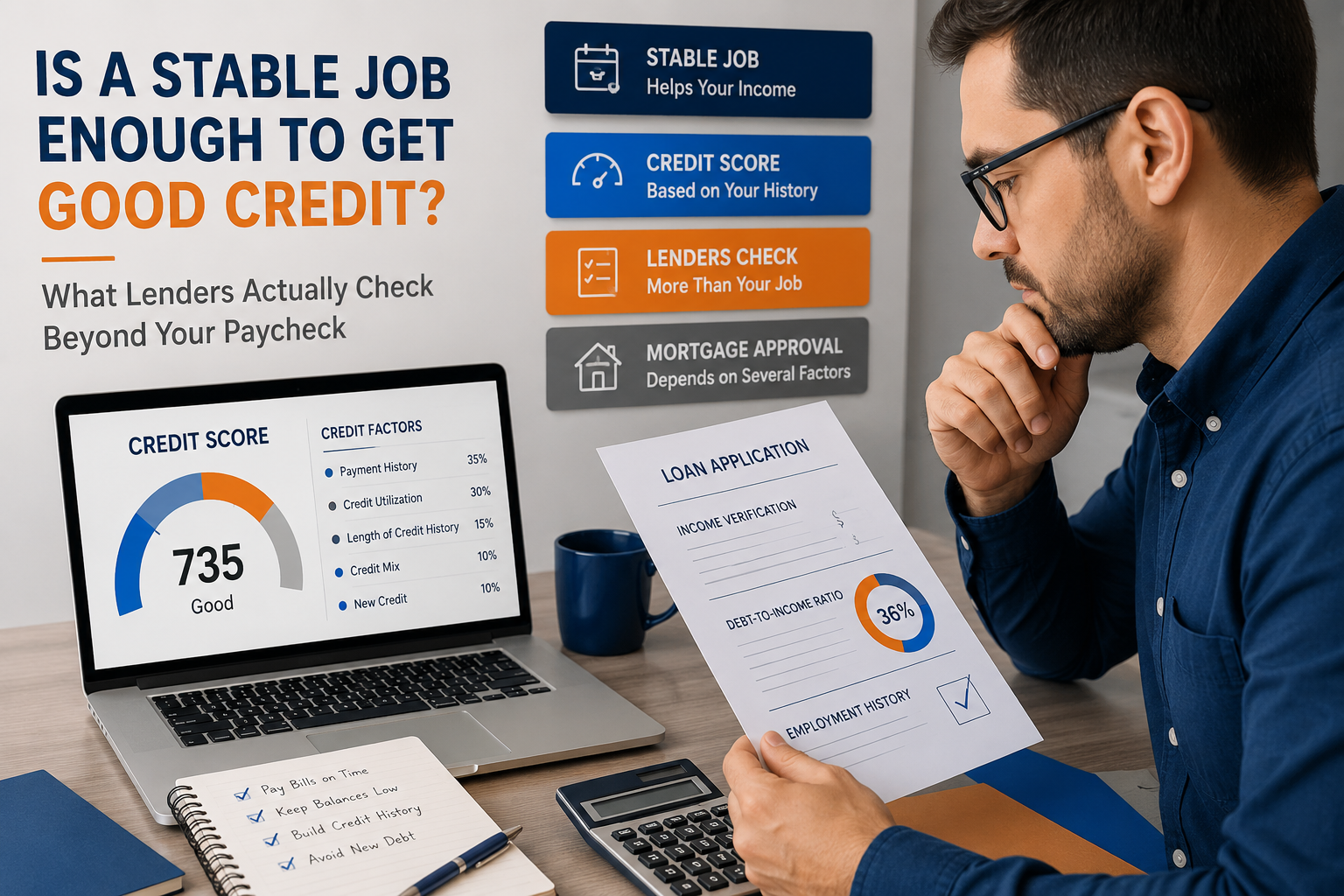
FICO scores are based on five factors. Employment status is not one of them. John Ulzheimer, a former FICO and Equifax specialist, told CNBC Select that income is not on your credit report. Because it is not there, it cannot factor into your credit score. No wealth metric is included.
Here are the five things FICO actually measures:
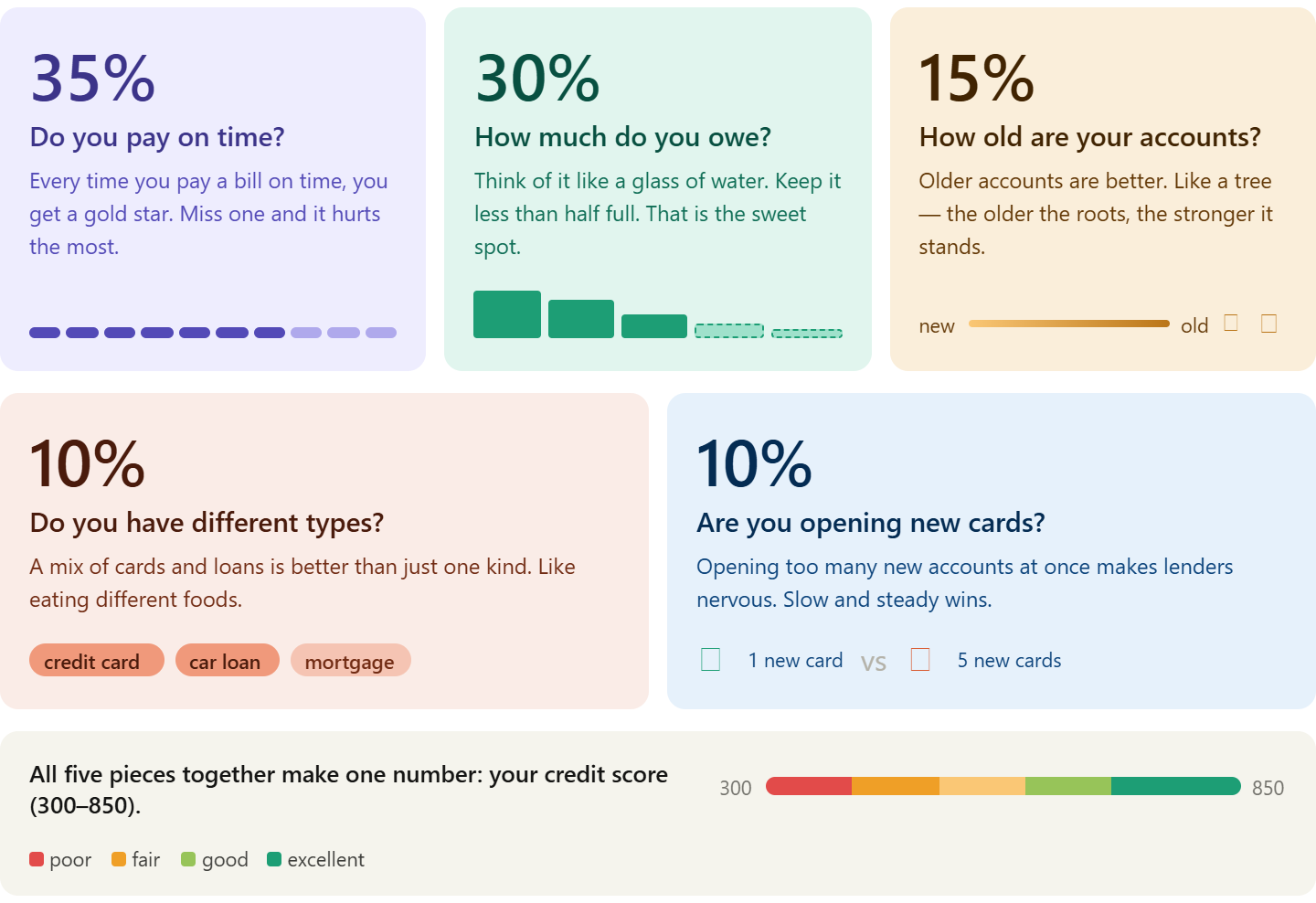
Your job does not appear anywhere on this list. A person earning $20,000 a year can outscore someone earning $200,000. Better credit behavior is the only reason.
Does Income Show on Your Credit Report?
Income does not appear on your credit report. None of the three major bureaus, Experian, TransUnion, and Equifax, collects or displays your salary, job title, or employment duration. None of that data appears in your credit file.
Your credit report does list your employer's name. But that information comes from credit applications you have filled out, not from your employer directly. The bureau stores it as an identifier only. It does not affect your score.
What your report does show is how you have managed every credit account you have opened. It shows balances, payment dates, late payments, collections, and credit applications. A stable job with no credit accounts creates a blank file. Lenders treat a blank file the same way they treat a bad one. Lenders have nothing to evaluate.
This is why a stable job alone is not enough to get good credit. You need credit accounts, and you need to manage them well.
What Lenders Actually Check Besides Your Credit Score
Here is where the picture changes. A good FICO score gets you in the door. But lenders run a second review before they approve a loan. That review is where your job matters, just not for your credit score.
Lenders look at five things during underwriting:
Credit score: your FICO or VantageScore number.
Debt-to-income ratio (DTI): total monthly debt payments divided by gross monthly income.
Employment history: Most conventional lenders want at least 2 years of consistent income, per SuperMoney's 2025 guide.
Income verification: pay stubs, W-2s, or tax returns to confirm your claimed income.
Cash reserves: enough liquid savings to cover payments in an emergency.
A stable job directly affects items 2, 3, and 4. That is real influence, just not on your credit score itself. Last year, our office handled over 30 mortgage cases where clients had strong FICO scores but DTI ratios above 45%. Every single one got a worse rate or a smaller loan than they expected. The job was stable. The debt load was the problem.
The DTI threshold most lenders use is 43%. Above that, approval chances drop fast. Your stable job only helps if the income it produces keeps your DTI in range.
Can You Have a Good Credit Score Without a Job?
Yes. Your credit score can stay strong even during unemployment. FICO does not factor in job loss, and your score will not drop simply because you stopped working.
The risk is indirect. Without income, it becomes harder to pay bills on time. A single 30-day late payment can lower a score by 80 to 100 points. That is where unemployment damages credit, through behavior, not status.
According to myFICO, if you can keep payments current during unemployment, your score stays unaffected. Unemployment benefits do not appear on credit reports. Neither does the fact that you are job searching.
This cuts both ways. A person with no job but clean payment habits can outperform someone with a high salary and a history of late payments. The score only tracks behavior. The behavior is what matters.
How a Stable Job Helps Mortgage Approval
For mortgage loans, employment stability matters a lot. Just not for your credit score. Employment stability matters for your underwriting file.
Experian notes that mortgage lenders check how long you have worked in your current job or field. They also review your debt-to-income ratio and your income trend. The most important rule: most conventional lenders require at least 2 years of steady income history.
Here is what that means in practice:
Two or more years at one employer: strong signal. Approvals move fast.
Two or more years in the same field, different employer: usually acceptable with documentation.
Recent job change to a higher-paying role: acceptable with an offer letter and first pay stub.
Frequent job changes across industries: red flag. Lenders may request more documentation or decline.
Self-employed less than 2 years: most lenders require 2 years of tax returns showing stable or rising income.
A stable job does not replace good credit. It runs alongside it. A borrower with a 620 FICO score and a stable 5-year job history will still pay more in interest than a borrower with a 750 score and one year on the job. The credit score sets the rate. The job history confirms the income that supports repayment.
Does Changing Jobs Hurt Your Credit Score?
A job change does not directly hurt your credit score. FICO does not track employment changes. Your score will not drop on the day you resign or start a new position.
The indirect risks are the same as unemployment: a gap between jobs may create cash flow pressure, which can lead to missed payments. That is what damages credit. The job change itself is invisible to the credit bureaus.
However, job changes do affect mortgage timing. If you change jobs while your mortgage application is in process, lenders often pause the application. They need to re-verify income with the new employer. Switching industries during an active application is the most disruptive scenario. Lenders want to see continuity in your earning capacity, not just continuity in paychecks.
Does Being Self-Employed Hurt Your Credit Score?
Self-employment does not hurt your credit score directly. FICO does not know or care whether you are salaried or self-employed.
But self-employment creates two real challenges:
The first is income verification. Lenders use your last 2 years of tax returns to calculate qualifying income. Many self-employed borrowers write off expenses aggressively, which lowers their taxable income. A lower taxable income means a lower qualifying income. Actual cash flow does not matter to the lender. Only the number on the return does. This shrinks the loan amount you qualify for.
The second is DTI. Because self-employed income looks lower on paper, the DTI calculation often comes out higher. A higher DTI pushes you toward loan limits or worse rates.
The credit score itself is not the issue. The income documentation is. In 2024, our team reviewed over 20 self-employed client files where FICO scores were above 700 and loan applications still came back with reduced approvals. In every case, the taxable income on the return was below the lender's required threshold, not the score.
Self-employed borrowers benefit from keeping personal and business credit separate, using business credit accounts to build a parallel profile, and working with a tax professional on how write-offs affect qualifying income.
Stable Job, But Still Struggling With Credit?
A steady paycheck helps, but good credit comes from payment history, low balances, and a clean credit report. If collections, late payments, or high utilization are holding you back, we can help you see what needs to be fixed.
Get Your Free Credit AnalysisASAP Credit Repair • Credit Help That Goes Beyond Your Paycheck
What Actually Builds Good Credit Alongside a Stable Job
A stable job creates the income that makes credit management possible. It does not build credit on its own. Here is what does:
Open at least one credit account. A secured credit card or credit-builder loan starts the clock on your credit history.
Pay every bill on time. Payment history is 35% of your score. One late payment erases months of progress.
Keep your credit use rate below 30%. Above 30% starts to lower your score. Below 10% is ideal.
Keep old accounts open. Account age makes up 15% of your score. Closing your first credit card shortens your history.
Add a mix of account types over time. A credit card plus an installment loan gives scoring models more data to work with.
A stable job funds all of the above. It gives you the income to pay on time and the cash flow to keep balances low. That is the real connection between job stability and good credit, not a direct one, but a behavioral one.
The Federal Reserve Bank of New York's 2024 data makes the stakes clear: rejection rates rose across every loan category last year. Stable employment was not enough to reverse that trend. Clean credit files were.
The Difference Between Job Stability and Credit Stability
Job stability and credit stability are two separate things. Both matter. Neither replaces the other.
Job stability tells lenders you can repay. Credit stability tells them you have repaid, consistently, over time. Lenders want both. A strong job with no credit history is a thin file. A long credit history with no stable income is a risk. The combination is what opens the best rates and the best products.
The fastest path to good credit with a stable job is to open one secured credit card, use it for a small recurring expense, and pay the full balance every month. Do that for 12 months. Then add an installment loan, a credit-builder product works well. In 24 months, most borrowers in this pattern reach the 700+ range, which opens the majority of competitive loan products.
Your job is the foundation. Your credit behavior is the structure built on top of it. One without the other leaves the approval process incomplete.