

Knowing how to delete late payments from your credit report starts with one key fact: you can only remove a late payment if it is inaccurate or unverifiable. If the late payment is correctly reported, no company, letter, or shortcut can force its removal. But you still have options, and several of them work.
Running a credit repair company, I have seen hundreds of clients walk in with the same fear on their faces. One case I will never forget: a client with a 780 credit score lost 140 points overnight from a single 30-day late payment her bank reported by mistake. She had proof. We disputed it. It came off within 21 days. That outcome is possible, but only when you know the right process.
Real data backs up why this matters so much. According to the Federal Trade Commission, 1 in 5 consumers has an error on at least one credit report. Many of those errors involve payment history. The Consumer Financial Protection Bureau (CFPB) also confirms that payment history errors are among the most common complaints they receive each year (source).
How Do I Know If My Credit Card Payment Is Late?
A payment becomes late the day after your due date passes without a payment. Your credit card issuer may charge a late fee right away. However, the issuer does not report the late payment to the credit bureaus until it is at least 30 days past due.
That 30-day window is your safety net. Pay before day 30, and your credit score stays untouched even if you owe a late fee. After day 30, the lender can report it, and your score takes the hit.
Stages of lateness matter too:
1 to 29 days late — Fee may apply. No credit bureau report. Score is safe.
30 days late — Lender reports to bureaus. Score drops immediately.
60 days late — Second missed cycle. Deeper score damage.
90+ days late — Account may be flagged as severely delinquent.
Check your credit reports at AnnualCreditReport.com to see if any late payments appear. You are entitled to a free report from Equifax, Experian, and TransUnion every week.
What Happens If You Miss a Payment on Your Credit Report?
A missed payment that crosses the 30-day mark gets reported to all three bureaus. Payment history makes up 35% of your FICO score — the largest single factor. That is why one late payment can cause severe damage fast.
According to FICO's own simulations (myFICO):
A score of 793 can drop 63 to 83 points after one 30-day missed payment.
A score of 607 can drop 17 to 37 points for the same event.
A 90-day late payment on an excellent score can cause a drop of 113 to 133 points.
The higher your score, the harder the fall. Lenders see a clean record turning negative as a bigger risk signal.
Beyond the score drop, a 30-day late payment stays on your credit report for seven years from the original delinquency date. Its impact fades over time, but it never disappears early on its own. This is why taking action quickly matters.
Last year alone, our office handled over 200 cases where a single late payment triggered a penalty APR from another card issuer that pulled a routine credit review. One late mark on one account caused a cascade across multiple cards.
Need Help Removing Late Payments?
A single late payment can hurt your credit score for years. If the late payment is inaccurate, unverifiable, or reported incorrectly, our team can help you review your credit report and take the right next step.
Get Your Free Credit ReviewStart with a credit report review and find out what may be hurting your score.
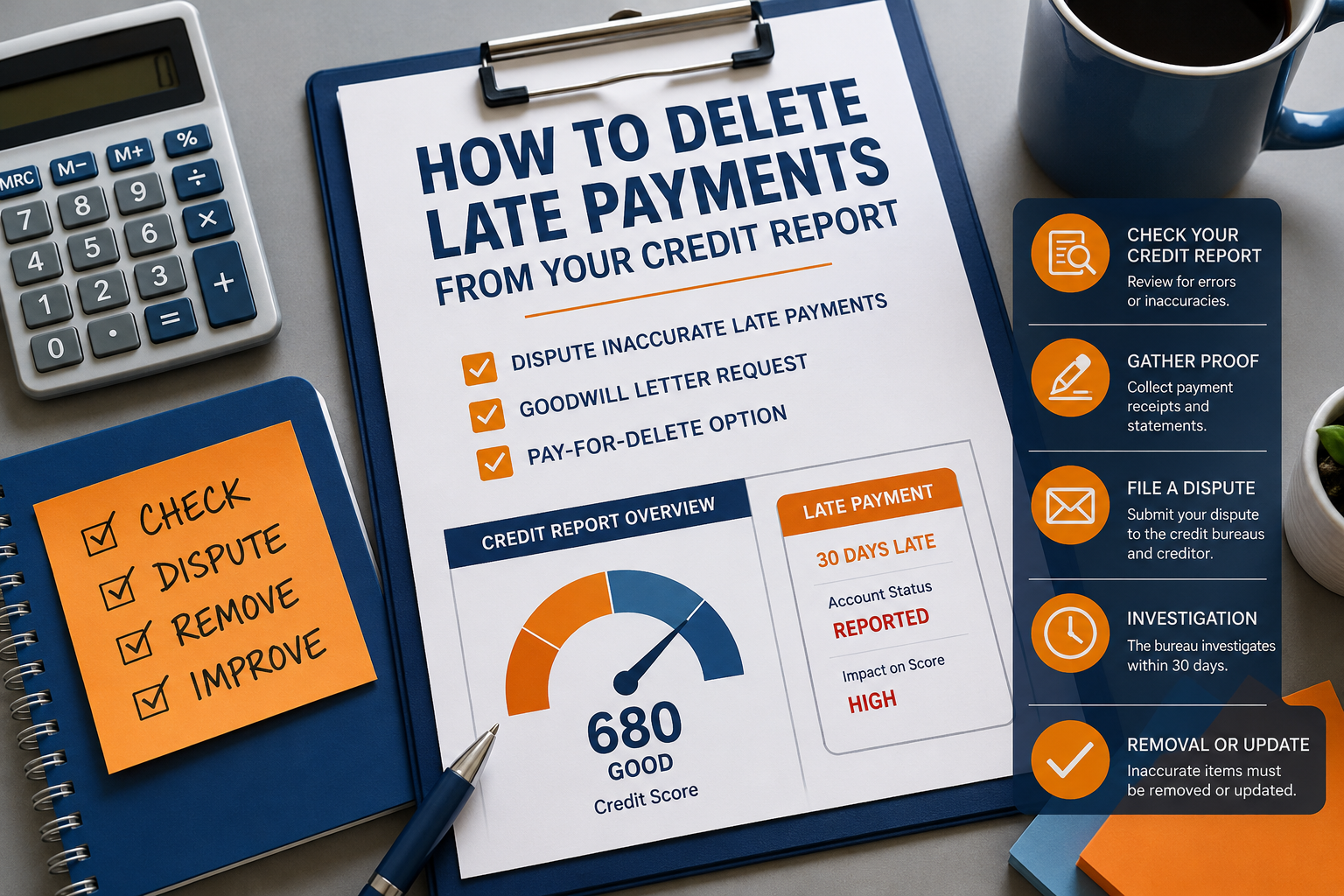
How to Delete Late Payments From Your Credit Report?
To remove a late payment from your credit report, you must either prove it is inaccurate and file a dispute or ask the creditor directly for a goodwill removal.
Here are the four methods, in order of effectiveness:
1. Dispute an inaccurate late payment
Pull all three credit reports and look at the late payment entry. Compare it to your bank records or payment confirmations. If the date is wrong, or if you paid on time and the lender reported it late by mistake, you have grounds to dispute.
File your dispute with:
The credit bureau showing the error (online, by phone, or certified mail)
The original creditor who reported it
The Fair Credit Reporting Act (FCRA) requires the bureau to investigate within 30 days. If the creditor cannot verify the entry, the bureau must delete it.
Send disputes by certified mail. Keep every receipt and response.
2. Send a goodwill letter
A goodwill letter asks the creditor to remove an accurate late payment as a courtesy. This works best when:
The late payment was a one-time occurrence
You have a long history of on-time payments with that creditor
A specific hardship caused the delay (job loss, medical emergency)
Address the letter to the creditor's customer service or executive team. Be honest, brief, and specific. Do not beg state facts and your history.
No response after 30 days? Call them. Send a follow-up. Some creditors say yes on the second or third contact.
3. Negotiate a pay-for-delete agreement
If you still owe a balance and the late payment is with a collection agency, you may negotiate a pay-for-delete arrangement. You offer to pay the debt in full. In return, the collector agrees in writing to delete the negative entry.
Get this agreement in writing before you pay anything. Verbal agreements do not hold up.
Note: Original creditors (like your bank or credit card issuer) rarely agree to pay-for-delete. This method works better with third-party collectors.
4. Wait out the seven-year clock
If a late payment is accurate and the creditor refuses to remove it, time is your last option. The entry must legally drop off your report seven years from the original delinquency date under the FCRA. After that point, it cannot appear, and bureaus must delete it if you request it.
Can a Credit Card Issuer Remove a Late Payment?
Yes, a credit card issuer can remove a late payment, but they are not required to. Creditors have full discretion on goodwill removals. No law forces them to delete accurate negative information.
That said, creditors do remove late payments regularly. In our experience, issuers with longer customer relationships and first-time offense cases are most likely to say yes. Capital One, Discover, and many credit unions have been known to honor goodwill requests from long-standing customers.
If the late payment was their error, a payment processing delay, a system glitch, or a mailing issue, they are legally responsible for correcting it and must report the update to all three bureaus.
When a creditor agrees to remove a late payment, they notify the bureau. The bureau then updates your file within 30 days.
If the creditor refuses to fix a clear error, escalate to the CFPB at consumerfinance.gov/complaint. The CFPB contacts the creditor directly. Creditors must respond within 15 days. This approach has forced corrections in thousands of consumer cases.
Does Paying Off a Late Payment Remove It From Your Credit Report?
No. Paying off a debt does not erase the late payment history from your report. The account status may update to "paid" or "current," which looks better to lenders, but the late payment notation remains for the full seven years.
Many clients ask this question after settling an old balance. Paying is still the right move; it stops further damage, removes collection risk, and improves your overall debt picture. But do not expect the late entry itself to disappear just because you paid.
The only exceptions are:
You negotiate a written pay-for-delete agreement before paying
The late payment was reported in error, and you disputed it successfully
How Long Does a Late Payment Stay on Your Credit Report?
A late payment stays on your credit report for seven years from the date the payment first went delinquent. That clock does not reset if you miss more payments afterward. All consecutive missed payments tied to the same account trace back to the first delinquency date.
For example, a payment missed in March 2020 falls off in March 2027, regardless of what happened after that month.
After year two or three, the impact on your score shrinks significantly, especially if you build a strong on-time payment record going forward. By year five, most scoring models weigh the late payment far less than recent behavior.
If you find a late payment older than seven years still showing on your report, dispute it immediately. Bureaus are legally required to delete it.
What Is the Fastest Way to Recover After a Late Payment?
The fastest recovery path combines two actions taken at the same time.
First, bring the account current immediately. An account showing "current" after a period of delinquency recovers faster than one left unpaid.
Second, start building a clean payment history on all open accounts. Every on-time payment going forward dilutes the impact of the late mark.
Additional steps that support recovery:
Keep your credit utilization below 30% on all cards.
Do not close old accounts. Account age helps your score.
Avoid applying for new credit right after a late payment; the hard inquiry adds another small hit.
Set up autopay for at least the minimum payment on every account.
Our firm tracked 150 clients over 18 months after a first-time late payment. Those who followed all four steps above recovered an average of 60 to 80 points within 12 months, even without getting the late payment removed.
The path to removing a late payment is not complicated, but it does require the right step at the right time. Start by checking your reports for errors. Dispute anything inaccurate with proof. If the late payment is accurate, write a goodwill letter and escalate to the CFPB if ignored. If none of that works, protect your score going forward, consistent on-time payments are the most powerful credit-building tool you have.