

How to avoid interest on credit card debt starts with understanding one simple rule: pay your full statement balance by the due date every month. Most cardholders do not realize how quickly credit card interest compounds. With APRs above 20%, even carrying a small balance can quietly cost hundreds over time. The good news is that avoiding interest is simple when you understand grace periods, payment timing, and smart payoff strategies.
I work in the credit repair industry, and the number one thing that holds our clients back is not bad debt. It is good debt gone wrong, a credit card used responsibly, then hit by one month of carrying a balance, which triggers interest, then late fees, then a cycle that takes years to unwind. One of the most common cases we see: a client who transferred a balance to a 0% promotional card, missed the payoff deadline by one month, and got charged interest retroactively on the full original balance. That is a brutal lesson to learn the hard way.
The good news: avoiding credit card interest entirely is possible. It requires understanding a few rules and building habits around them.
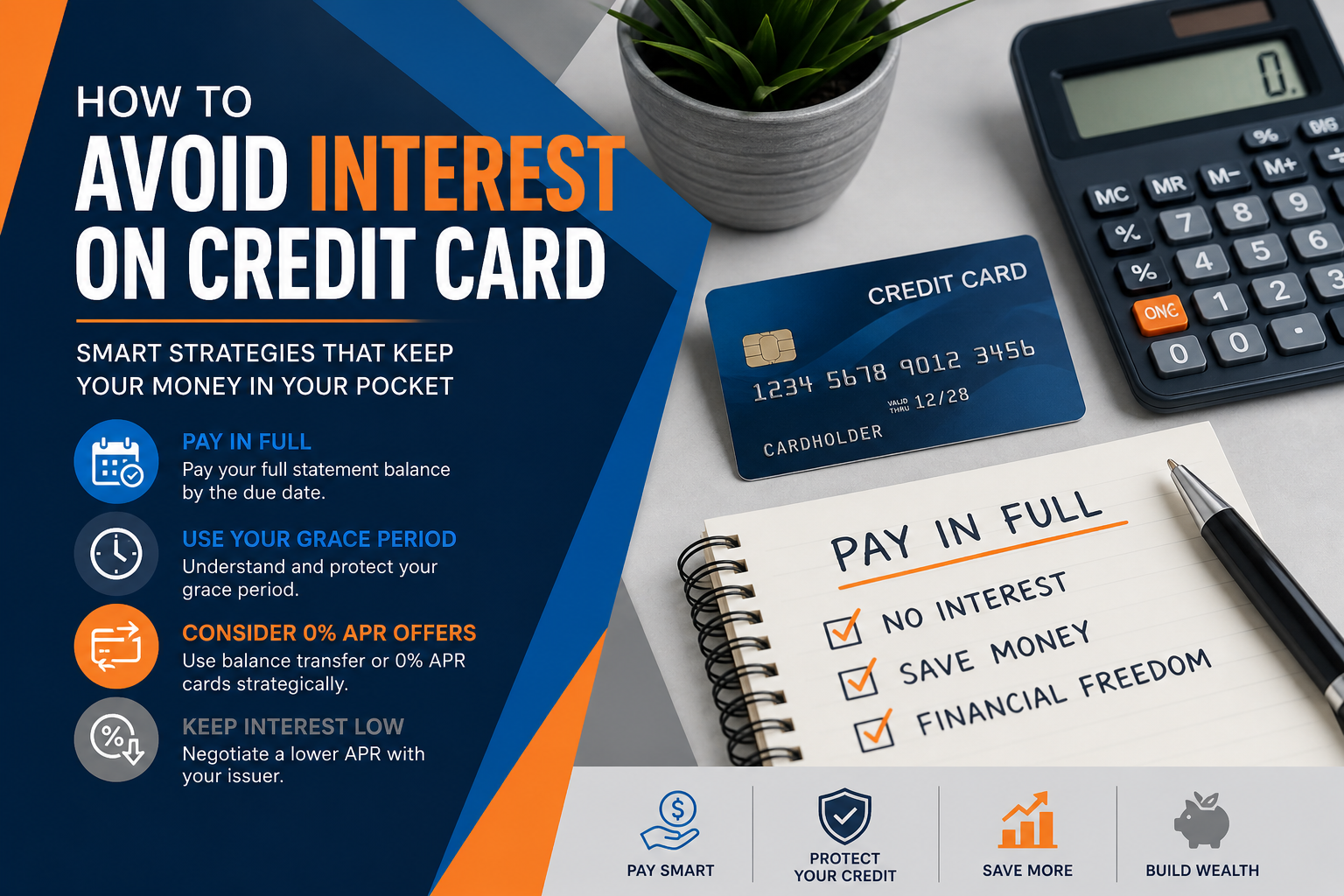
How to Avoid Interest on Credit Card Charges by Understanding How Interest Works
Credit card interest accrues daily. Your issuer takes your annual percentage rate (APR) and divides it by 365 to get your daily periodic rate. That rate applies to your average daily balance each day of the billing cycle. At the end of the month, those daily charges add up to a finance charge on your statement.
For example, a 22% APR produces a daily rate of about 0.060%. On a $1,000 balance, that is roughly $0.60 per day or about $18 per month. That number grows as the balance grows, because yesterday's interest becomes part of today's balance.
The key detail: interest only applies when you carry a balance past your due date. Pay in full by your due date every month, and you pay zero interest regardless of how high your APR is.
What Is a Credit Card Grace Period?
The grace period is the time between your statement closing date and your payment due date. Federal law requires this window to be at least 21 days for most credit cards.
During the grace period, new purchases do not accrue interest as long as you paid your previous balance in full. The moment you carry any balance from one month to the next, you lose your grace period. Interest then starts accruing on new purchases from the day you make them, not from the due date.
This is the most misunderstood part of credit card interest. Many cardholders think paying "most" of their balance protects them. It does not. Even $5 left unpaid eliminates your grace period and puts every new purchase into immediate interest accrual.
How to Use the Grace Period Strategically
Pay your full statement balance, not just the minimum, not "most of it" by the due date every month. That single habit eliminates interest charges.
Set up autopay for the full statement balance if your cash flow allows it. If not, set autopay for the minimum as a safety net, and manually pay the full amount a few days before the due date.
Does Paying in Full Every Month Avoid Interest?
Yes. Paying your full statement balance by the due date is the most direct way to avoid credit card interest. No partial payment, no minimum payment the full amount on your statement.
Cardholders who do this consistently pay a 22% APR card as if it had a 0% APR. The rate becomes irrelevant when you never carry a balance.
What About Minimum Payments?
Minimum payments are a trap. On a $3,000 balance at 22% APR, making only the minimum payment of around $60 per month means you will pay the balance off in over 20 years and spend more than $4,000 in interest alone. That is more than the original balance.
Pay the full balance. If you cannot, pay as much above the minimum as possible and stop adding new charges until the balance is cleared.
How Can I Stop Paying Interest on My Credit Card?
Stopping interest on an existing balance requires one of three approaches.
1. Pay Off the Balance in Full
The most direct method. If you have the cash, pay the full balance and then start paying in full each month going forward. Your grace period returns once your balance is zero and your next statement closes.
2. Transfer to a 0% Introductory APR Card
Balance transfer cards offer a promotional period, typically 12 to 21 months, during which no interest accrues on the transferred balance. This gives you time to pay down principal without interest growing on top of it.
Last quarter, we reviewed over 60 cases at our firm where clients used balance transfer cards to eliminate interest. The ones who succeeded all had one thing in common: they calculated the exact monthly payment needed to clear the balance before the promotional period ended, and they automated it.
Watch for these details before transferring:
Most balance transfer cards charge a fee of 3% to 5% of the transferred amount. On $5,000, that is $150 to $250 upfront.
Some cards use deferred interest instead of true 0% APR. Deferred interest charges interest retroactively on the original balance if you have not paid in full by the end of the period.
New purchases on the transfer card may not be covered by the 0% offer.
3. Negotiate a Lower Interest Rate With Your Issuer
Call your credit card company and ask for a rate reduction. This works more often than most people expect. Issuers would rather lower your rate slightly than see your account go delinquent.
Your chances improve if:
You have made on-time payments for at least 12 months
Your credit score has improved since you opened the account
You mention that you are considering a balance transfer to a competitor
Be direct: "I have been a customer for three years with no late payments. I want to request a lower interest rate." That is the entire script. Ask for a supervisor if the first representative says no.
Can I Get a 0% Interest Credit Card?
Yes. Many credit cards offer a 0% introductory APR on purchases, balance transfers, or both for a set promotional period. These cards typically require a credit score of 670 or higher to qualify.
Common offer lengths range from 12 to 21 months. During that window, no interest accrues on qualifying balances. After the period ends, the standard APR, often 17% to 29%, kicks in on any remaining balance.
Use a 0% APR purchase card for a large planned expense you know you can pay off within the promotional window. Do not treat it as free money. The standard rate at the end is just as expensive as any other card.
What Is Deferred Interest vs. Waived Interest?
True 0% APR means interest is waived if you carry a balance at the end of the promotional period; only the remaining balance accrues interest going forward.
Deferred interest means interest is charged retroactively on the original balance if you have not paid in full. Many store credit cards use deferred interest. Read the terms before transferring or making large purchases.
What Purchases Charge Interest Immediately?
Two categories bypass the grace period entirely and accrue interest from the transaction date.
Cash advances. ATM withdrawals, convenience checks, and some peer-to-peer payment transactions processed as cash advances start accruing interest immediately. The APR for cash advances is often 25% to 30% higher than the purchase APR. A cash advance fee of 3% to 6% also applies on top of that.
Deferred interest purchases. Promotional financing at retail stores often defers, not waives interest. If you do not pay the full promotional balance by the deadline, interest applies to the entire original amount from the purchase date.
Avoid both unless you fully understand the terms and have a clear payoff plan.
How to Avoid Interest When You Already Have a Balance
Carrying a balance does not mean you are stuck paying high interest forever. Here is a practical order of operations.
Step 1: Stop adding new charges to the card with the balance. Every new purchase compounds the problem.
Step 2: Pay more than the minimum every month. Even $50 extra per month cuts months off your payoff timeline and saves on interest.
Step 3: Apply for a balance transfer card if you qualify. Calculate the transfer fee vs. the interest you will save. On a $4,000 balance at 22% APR, a 3% transfer fee ($120) saves you roughly $880 in interest over 12 months. That math works.
Step 4: Call your issuer and ask for a rate reduction. Even lowering your APR from 24% to 18% saves meaningful money on a large balance.
Step 5: Consider a debt consolidation loan if your balance spans multiple cards. Credit union personal loan rates often start around 7% to 9%, a significant drop from a 22% credit card APR. The trade-off: you need a credit score above 680 to qualify for the best rates, and consolidation does not fix the spending habits that created the balance.
How Does Interest Affect My Credit Score?
Interest charges themselves do not appear on your credit report. But the effects do.
Carrying a high balance raises your credit utilization ratio, the percentage of your available credit you are using. Utilization accounts for 30% of your FICO score. A card with a $5,000 limit and a $4,000 balance has 80% utilization. That level suppresses your score significantly.
Paying down a balance reduces utilization and improves your score, often within one to two billing cycles. This is one of the fastest ways to raise a credit score: pay down revolving balances to below 10% of each card's limit.
Practical Rules to Never Pay Credit Card Interest Again
These four rules, followed consistently, result in zero interest charges on credit cards:
Pay your full statement balance by the due date every month, not the minimum, not most of it.
Never use a credit card for a cash advance. Use a personal loan or savings instead.
Read the terms of any 0% promotional offer. Know the end date and the rate that follows.
Keep your utilization low enough that you can always afford to pay the full balance.
Credit card interest is not inevitable. It is the default state for cardholders who do not actively manage their balances. The cardholders who pay zero interest each year use the same cards, earn the same rewards, and build the same credit history. They just treat the card as a payment tool, not a loan.
The FDIC states it plainly: when you pay your full balance by the due date each month, you will not be charged any interest on that balance. That is the rule. Everything else is a strategy to help you follow it.