

The disadvantages of paying in cash are real, and they go far beyond losing a few bills from your wallet. Cash blocks credit history growth, removes purchase cover, and locks you out of online shopping. Most people focus on budgeting benefits and miss the bigger picture. That blind spot can hurt them for years.
I own a credit repair company. One of the most unforgettable cases I handled came from a client in her late 30s. She had paid everything in cash her whole life, no credit cards, no loans, no debt. When she applied for a mortgage, lenders rejected her. Not because of bad credit, but because she had no credit at all. She had to build from scratch, like a teenager with her first job.
That story comes up again and again. In a popular r/personalfinance thread, users share how "doing the responsible thing" by avoiding credit left them locked out of apartments, car loans, and low insurance rates. One commenter put it plainly: "I thought paying cash made me smart. Turns out lenders just see a ghost." (Source: r/personalfinance)
The numbers back this up. The Federal Reserve's 2025 Diary of Consumer Payment Choice found that cash now makes up just 14% of all U.S. consumer payments, down from 26% in 2016. Credit cards lead at 35%. Cash is not dead, but the people most reliant on it often face the steepest costs.
The Main Disadvantages of Paying in Cash
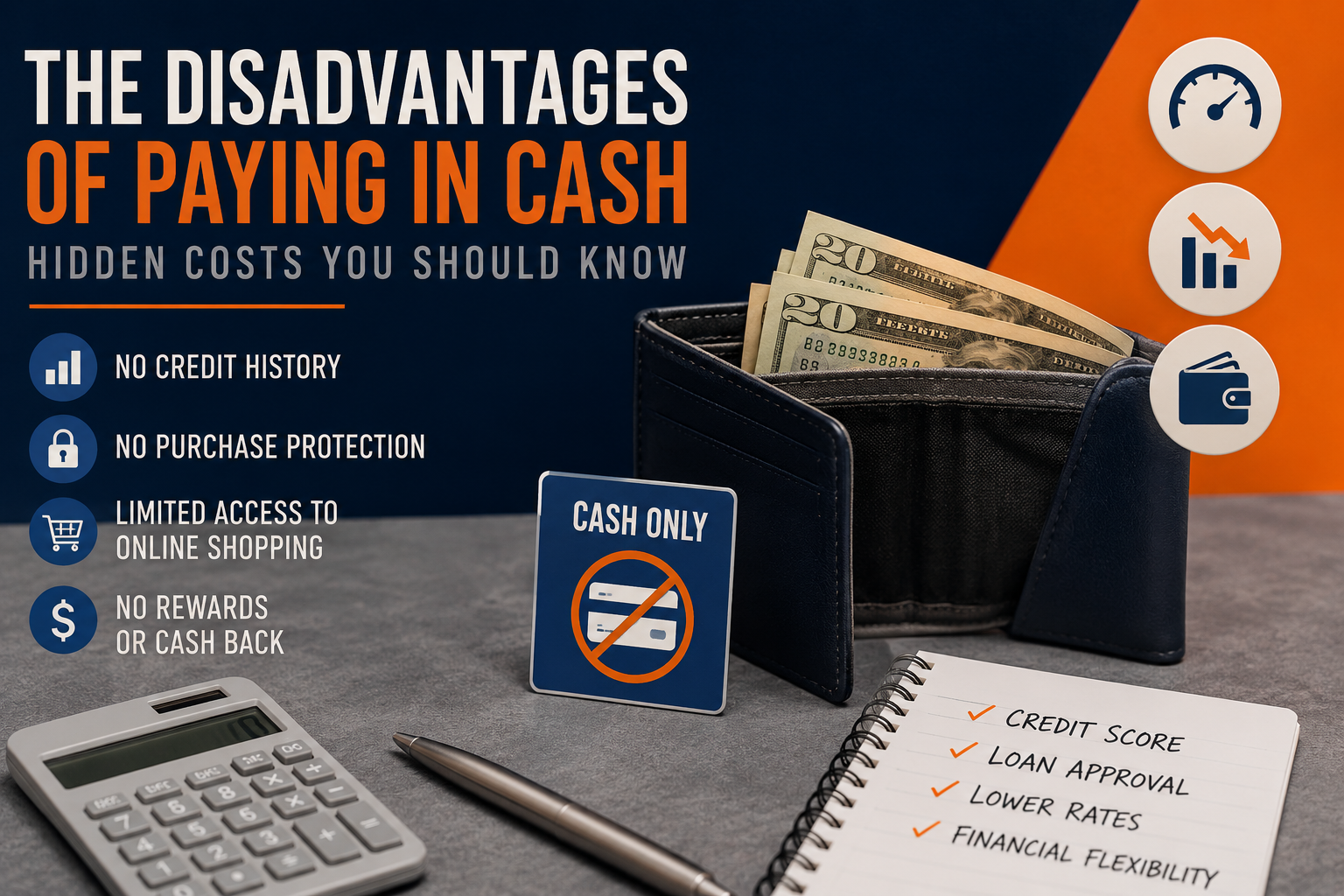
The disadvantages of paying in cash fall into three buckets: credit damage, theft risk, and lost perks. Here they are, ranked by long-term impact.
1. Cash builds zero credit history. Every cash purchase disappears from your credit file. Equifax, Experian, and TransUnion record nothing when you hand over a $20 bill. According to myFICO, your credit report needs at least one account open and active within the last six months to produce a score. Pay only in cash, and that file stays blank.
2. Lost or stolen cash is gone for good. A stolen credit card takes one phone call to freeze. You get your money back. Stolen cash gives you nothing. No dispute, no refund, no recovery.
3. Cash locks you out of online shopping. Remote and digital purchases made up 23% of all consumer payments in 2024, per the Federal Reserve. Cash users cannot access e-commerce, streaming services, or remote orders of any kind.
4. Cash earns no rewards. A credit card with 2% cash back on $1,000 per month creates about $240 per year in free money. Cash earns nothing. Over five years, that gap reaches $1,200 or more.
5. Cash offers no purchase cover. Credit cards come with chargeback rights and fraud cover built in. Pay cash for a broken product, and your only option is the store's goodwill.
6. Carrying cash creates a theft target. Large amounts of visible cash attract risk in ways a card in a wallet simply does not.
What Are the Disadvantages of Carrying Cash?
Carrying physical cash creates risks that digital payments avoid.
Cash is fragile. It burns, soaks, and tears. A wet wallet can destroy $200 in seconds. A card gets replaced for free in a few days.
Carrying cash also requires ATM visits. Out-of-network ATM withdrawals typically cost $3 to $5 per visit, charged twice, once by your bank and once by the ATM owner. Someone making four cash withdrawals per month loses up to $240 per year in fees alone, according to Bankrate.
Cash also leaves no spending record. Credit and debit card statements create a full history useful for taxes, budgets, and disputes. Cash receipts fade, get lost, and leave no digital backup.
At our credit repair firm, we worked with clients who paid cash for business costs for years. When the IRS asked for proof, they had none. The documentation gap cost some of them thousands in disallowed deductions.
So when you weigh the disadvantages of paying in cash, the cost is not only the loss of rewards. It is lost records, lost protection, and lost flexibility.
What Is the Problem With Cash Payments?
The core problem with cash payments is simple: they are invisible to the money system.
Credit scores power access to housing, loans, insurance, and even some jobs. Cash keeps your spending habits completely off the radar of credit bureaus. Paying for groceries with a $20 bill creates no record anywhere.
29% of Gen Z consumers reported having no credit score or not knowing if they have one, per a FICO survey. Cash-heavy habits among young adults drive this number. Without a score, these consumers face security deposits on utilities, higher insurance rates, and landlords who reject their applications outright.
The problem grows over time. Consumers with thin credit files pay higher interest rates on car loans and mortgages when they finally need one. A borrower with no credit history may face an interest rate 2 to 4 points higher than a borrower with strong credit on the same loan. Over a 30-year mortgage, that gap means tens of thousands of dollars in extra cost.
Cash also fails in crises. A broken car engine, a medical bill, or a sudden job loss needs fast access to funds. Without a credit line, cash-only consumers often turn to payday loans. The Consumer Financial Protection Bureau reports that payday loans carry APRs above 300%.
What Are the Pros and Cons of Using Cash?
Cash has real strengths. Knowing both sides helps you use each payment method where it works best.
Pros of paying in cash:
Cash stops debt from building up. You spend only what you have.
Cash works without internet, electricity, or card systems.
Cash protects your privacy. No merchant collects your card data.
Cash can earn discounts. Many small businesses reduce prices for cash buyers since they avoid card fees of 2 to 3%.
Cash creates a mental spending check. Handing over bills makes cost feel real in a way that tapping a card does not.
Cons of paying in cash (the disadvantages of paying in cash):
Cash builds no credit history.
Cash lost or stolen cannot be recovered.
Cash cannot be used for online purchases.
Cash earns no rewards, points, or cash back.
Cash provides no fraud cover or chargeback rights.
Cash requires ATM visits that often include fees.
Cash creates no automatic spending records.
The right move is not cash or cards. It is using cash, where it adds value to small purchases, budgeting envelopes, privacy-sensitive payments, and using credit, where it builds your profile.
Does Paying in Cash Hurt Your Credit Score?
Paying in cash does not directly lower your credit score. But it stops your score from growing. Over time, that creates the same result.
Your FICO score needs at least one active credit account reported within the last six months. Cash-only spenders who close all credit accounts lose what FICO calls "scorability." Their file goes stale. Lenders treat a stale file with the same caution as a bad one.
Adults 55 and older use cash for 22% of their payments, compared to 12% for those under 55, per the Federal Reserve's 2024 data. Older adults built credit history earlier in life, so the gap hurts them less. Young consumers who go cash-only from the start face the steepest costs.
Howard Dvorkin, founder of Consolidated Credit Counseling Services, said it plainly in an NBC News interview: "A lack of credit history is sometimes as bad as having a bad credit history." That is exactly what we see in credit repair work. Clients who avoided credit out of discipline arrive at major money milestones with no file a lender can use.
Building credit does not require carrying debt. Use a credit card for regular purchases. Pay the full balance each month. That habit, kept for six to twelve months, creates a usable FICO file at no interest cost.
Can You Get a Loan If You Only Pay in Cash?
Getting a loan with no credit history is hard, but not impossible.
Some lenders offer manual review, which looks at bank records, income, and payment history directly. FHA loans allow this process for borrowers with no credit score. But the process is slower and usually produces worse rates.
Credit-invisible borrowers, those with no credit file at all, number about 26 million Americans, per the Consumer Financial Protection Bureau. Many pay their bills on time every month. Lenders still cannot see that behavior because cash payments never reach the credit bureaus.
The simplest fix is a starter credit card used for small, regular purchases with the balance paid in full each month. Six months of on-time payments create a scorable file. That single step removes most of the disadvantages of paying in cash that block access to loans and housing.
Paying in Cash Could Be Costing You More Than You Think
No credit history can make it harder to qualify for mortgages, car loans, apartments, and lower interest rates. Find out what may be hurting your score and how to start building stronger credit today.
Get Your Free Credit AnalysisDiscover negative items, outdated collections, and hidden issues affecting your credit profile.
When Does Cash Actually Make Sense?
Cash works well in specific situations. Use it for small daily purchases where budget control matters. Use it at farmers markets, food trucks, or cash-discount shops. Use it when you want privacy on a transaction.
Use a credit card for everything else, then pay it off in full. That split strategy gives you the discipline of cash where it helps most, and the credit history you need for the long term.
If your credit file already has errors or old collection items, the disadvantages of paying in cash are compounded. The priority then is cleaning up the existing file before new habits can take effect. Disputing incorrect items and addressing outdated accounts can lift a score faster than any new payment habit alone.