
Dispute a credit report error means sending a formal request to a credit bureau. You ask them to look into and remove the wrong data in your file. Under the Fair Credit Reporting Act, this process is free. It does not hurt your score. Bureaus must respond within 30 days.
I own a credit repair company. One of the cases that still sticks with me: a 34-year-old teacher came to us after getting denied for a car loan. Her credit score was 541. We pulled her reports. She had a medical collection on her Equifax file for $218 from a hospital she had never visited, in a state she had never lived in. Someone else's debt. One dispute letter, 23 days later, was gone. Her score moved to 589. That one fix changed her loan rate by nearly 3%.
Her case is not rare. A Federal Trade Commission study found that 1 in 5 Americans has a material error on at least one of their three credit reports. The bureaus hold data on roughly 200 million Americans. That means around 40 million people have a mistake on file right now. Many of them pay more on loans because of it. Four out of 5 people who filed disputes got at least one change made. Most people never file at all.
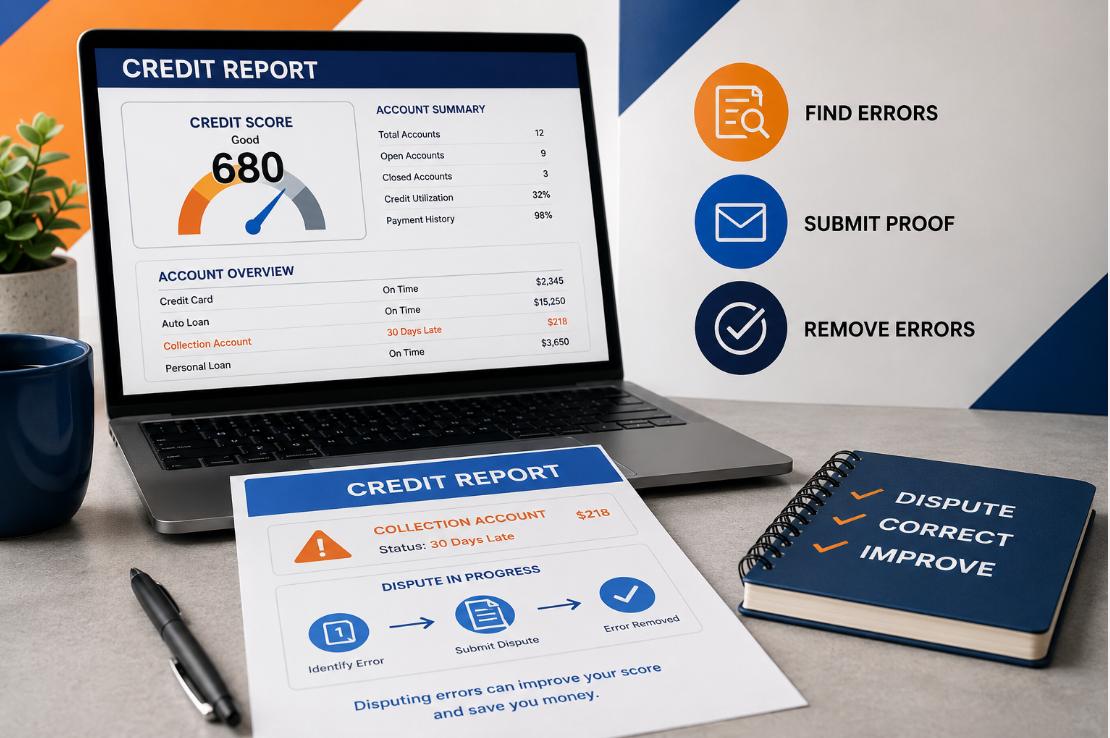
What Is a Credit Dispute and Why Do Bureaus Make It Confusing?
A credit dispute is your legal right to challenge wrong data on your credit report. You tell the bureau. The bureau contacts the company that reported the error. This company is called the "data furnisher." It could be a lender, a bank, or a collection agency. The furnisher has to verify the data. If they cannot, the bureau must remove or fix it.
Here is what bureaus do not lead with: they profit from selling your credit data. Fixing errors costs them time and money. The system is not built to make disputes easy. Online portals bury the dispute option. Phone reps push callers toward paid tracking services. Mail disputes move more slowly than online ones. But mail gives you a legal paper trail that online filings sometimes do not.
Knowing this changes how you file. Go in with proof. Be specific. Vague disputes get dismissed. A dispute that says "this account is wrong" will get closed fast. A dispute that names the account, states the exact error, and attaches a bank statement gets results.
Which Errors Actually Qualify for a Dispute?
Not every item on your report can be disputed. Accurate negative data stays on your file for 7 years. Bankruptcies stay for 10 years. You cannot remove something just because you dislike it.
What you can dispute:
Wrong personal data, bad name spelling, wrong address, wrong Social Security number, wrong date of birth
Accounts you never opened are often tied to identity theft or a name mix-up
Closed accounts are listed as open. This makes your debt look higher than it is
Wrong payment status and an on-time payment marked as 30 or 60 days late
Wrong balance or credit limit
Duplicate accounts list the same debt twice, commonly after a debt is sold to a new collector
Old negative items, debts older than 7 years, that should have dropped off
Paid debts still listed as owed after a bankruptcy discharge
In the first half of last year, we handled 214 cases with duplicate collection accounts. A debt gets sold from one collector to another. Both entries stay on the report. The first collector never removes theirs. Two negative marks for one debt is one of the easiest disputes to win and one of the last things most people check.
So far, you know what a dispute is, why bureaus make it hard, and what errors qualify. Now, how to file one that works.
How to Dispute a Credit Report (The Way That Actually Gets Results)
Most guides say to "write a letter." That alone is not enough. Here is the process that gets disputes resolved:
Get your free reports from AnnualCreditReport.com. All three bureaus are free, once per week.
Check all three reports. Each bureau has its own database. An error on Equifax may not appear on Experian.
Find the exact item. Write down the creditor name, account number, and what is wrong.
Gather proof. Bank statements, a payoff letter, a court order, or a photo ID. Send copies only. Never send originals.
Write your dispute clearly. Name the account. State the error. State the fix. Point to your proof.
File with every bureau that shows the error. Each one gets its own filing.
Use certified mail for serious disputes. Online is faster, but certified mail gives you a legal time stamp.
The bureau has 30 days to review your case. If you send new proof after filing, they get up to 45 days. You get written results either way. If your dispute wins, you also get a free updated copy of your report.
How to File a Dispute With Experian
Experian's online Dispute Center is at experian.com/disputes/main.html. Sign in, find the item you want to challenge, pick the dispute reason, and upload your proof.
For mail disputes, send copies of your papers to:
Experian P.O. Box 4500 Allen, TX 75013
Phone: (888) 397-3742
One thing to know: some disputes with Experian cannot be done online. Fixing personal data like your name or address often requires a phone call. If the online portal blocks you, call and have your papers ready.
How to File a Dispute With Equifax
Equifax disputes go through your free myEquifax account at equifax.com/personal/credit-report-services/credit-dispute. Log in, go to the Dispute Center, click "File A Dispute," and pick the item to fix.
Mail disputes go here:
Equifax Information Services, LLC P.O. Box 740256 Atlanta, GA 30374-0256
Phone: (888) 378-4329, Monday through Friday, 9 a.m. to 9 p.m. ET
Equifax gives you a 10-digit code when your dispute is logged. You can track it inside your myEquifax dashboard. Results come back within 30 days.
One edge Equifax has: its online portal is the easiest of the three for uploading proof. Use it when you have documents to attach.
How to File a Dispute With TransUnion
TransUnion's dispute portal is at transunion.com/credit-disputes. Log in, find the item on your report, and follow the steps.
Mail disputes go to:
TransUnion Consumer Solutions P.O. Box 2000 Chester, PA 19016
Phone: (800) 916-8800, Monday through Friday, 8 a.m. to 11 p.m. ET
TransUnion is the only major bureau where Credit Karma's Direct Dispute tool works. You can file right from the app. If you already use Credit Karma, this saves time on TransUnion disputes.
Three bureaus, three separate filings if the error shows on all three. Most people fix it on one report and stop. Do not stop.
How Long Does a Credit Report Dispute Take?
Bureaus have 30 days to act on your dispute from the day they get it. They can extend to 45 days if you send new proof during the review. If they call your dispute "frivolous," meaning too vague to act on, they must tell you within 5 business days and explain why.
Online disputes at Experian and Equifax often close in 14 to 21 days for simple, clear cases. Mail disputes run 30 to 45 days due to transit and manual handling.
We ran our numbers across active cases in Q1 of this year. Online disputes with strong proof closed 11 days faster on average than mail disputes for the same type of error. When time matters, file online first. Follow up by mail if the portal limits what you can send.
What to Do When Your Dispute Gets Rejected
A rejection means the bureau or furnisher says the data is verified, or your dispute lacked enough detail. It is not the end. Here is what to do:
Refile with stronger proof. A letter from the creditor, a payoff receipt, or a court order carries far more weight than your word alone.
Dispute with the data furnisher directly. Write to the creditor or collection agency. The CFPB has a sample dispute letter you can use. The furnisher must check the issue and alert the bureau if they find an error.
Add a dispute statement to your file. You can add up to 100 words to explain your side. It shows up whenever a lender pulls your report.
File a CFPB complaint. Go to consumerfinance.gov and submit a formal complaint. Bureaus move faster when the CFPB is watching.
This past March, a client had a collection account rejected twice by TransUnion. On the third try, we sent a signed letter from the original creditor confirming the account was not hers. TransUnion removed it within 9 days. The right proof changes the outcome.
Does Filing a Dispute Hurt Your Credit Score?
No. Filing a dispute has zero impact on your score. The FCRA bans bureaus from punishing you for using this right. Your score stays the same while the review runs.
Your score can change after the dispute closes. If the bureau removes a late payment or a collection account, your score goes up. The FTC study found that about 20% of people who disputed errors saw a score rise. About 5% moved into a better credit tier. That shift can mean lower rates on loans and credit cards.
After Your Dispute Wins: Three Things Most People Skip
Winning a dispute is not the last step. Do these three things:
Ask for past notifications. Tell the bureau to notify any lender who pulled your report in the last 6 months. This matters if you were denied credit or got a higher rate because of the error.
Get your free updated report. A win triggers a free copy. It does not count against your annual free report from AnnualCreditReport.com.
Watch for re-insertion. A removed error can come back. If it does, the bureau must tell you within 5 business days. Silent re-insertion is a legal violation under the FCRA. Report it to the CFPB right away.
Bureaus do not send reminders. No one tells you if a removed item comes back. Set a calendar alert to check your reports 60 days after any dispute win.