

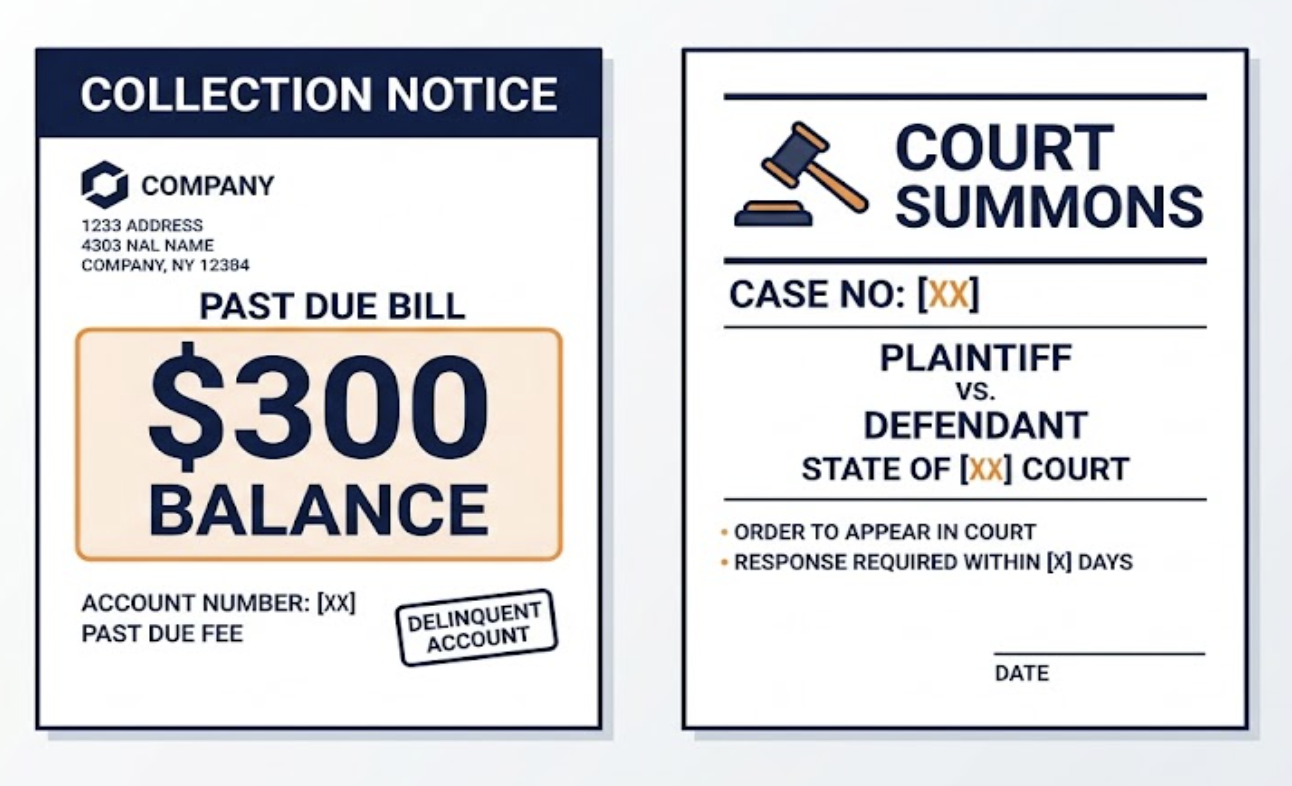
Can Conn’s collections take you to court for $300?
Yes. There is no minimum debt amount required for a creditor or collection agency to file a lawsuit. A balance of $300 can still lead to legal action if the creditor decides it is worth pursuing.
In practice, lawsuits for smaller balances depend on cost, volume, and collection strategy. Some creditors bundle accounts or use automated legal processes, which makes it financially viable to pursue lower balances. Others focus on larger debts. In accounts we see involving retail creditors like Conn’s, smaller balances can still move forward if the account has been charged off and placed with a collection firm.
The key point is not the amount. It is whether the creditor believes the debt can be collected through the court system. This article explains when small debts lead to lawsuits, what increases that risk, and what to do if you are served.
Conns Collections · Conn's HomePlus Debt · Jefferson Capital Systems · Debt Lawsuit Defense · Credit Report Impact · FDCPA Rights
Updated April 2026 · Sources: Retail Dive (Conn's bankruptcy reporting, July 2024), Fox Business (Conn's Chapter 11 filing), CFPB debt validation rights, FDCPA 15 U.S.C. § 1692g, Texas Justice of the Peace court debt collection documentation
- Conn's is gone. It filed for Chapter 11 bankruptcy in July 2024. All 553 stores closed. Jefferson Capital Systems now owns the Conn's loan portfolio.
- Jefferson Capital files lawsuits. They are one of the largest debt buyers in the U.S. They do pursue consumers in court, typically for larger balances.
- $300 is below the threshold most collectors pursue in court, but small claims and justice of the peace courts can make smaller amounts viable.
- The debt still hurts your credit even if they do not sue. An unpaid Conn's/Jefferson Capital collection stays on your report for 7 years.
- You have rights. You can request debt validation within 30 days of first contact. You can dispute errors on your credit report. You can check if the debt is past the statute of limitations in your state.
If you had a Conn's account, you are probably wondering who you are actually dealing with now and what they can do to you. This article answers both questions directly.
Who Is Collecting Conn's Debt Now?
Conn's was a home goods retailer that sold furniture, appliances, and electronics, primarily in Southern states. About 61% of its purchases were financed through Conn's own in-house credit program. That program created a large portfolio of consumer loans. When Conn's collapsed, Jefferson Capital stepped in and bought that entire portfolio.
Jefferson Capital is not a collection agency in the traditional sense. They are a debt buyer. They purchased the debt outright, meaning they own it and keep everything they collect. As reported by Retail Dive's coverage of the Conn's bankruptcy, Jefferson Capital's $360 million offer was the only bid for the Conn's consumer loan portfolio. No auction happened. Jefferson Capital got everything.
Can Conn's Collections (Jefferson Capital) Take You to Court for $300?
Here is the cost reality for a $300 lawsuit. Court filing fees in Texas justice of the peace courts run roughly $30 to $100. A process server to deliver the summons costs $50 to $100. If Jefferson Capital hires a local attorney on a flat fee, they may pay $150 to $300. Total cost to file a small claims case against you for $300: roughly $200 to $500. That means they would spend more than they might recover on a $300 debt, especially if you dispute it.
For debts above $1,000 to $2,000, the math flips. The filing cost is the same. The potential recovery is much higher. This is why collectors disproportionately sue for larger balances. But "disproportionate" is not the same as "never." And justice of the peace courts and small claims courts exist precisely to make small-dollar disputes affordable.
The chart reflects a practical truth that debt defense attorneys see every day: under $300, the economics of a lawsuit rarely make sense. But "rarely" is not "never." And even without a lawsuit, the unpaid balance continues to damage your credit. That damage is not hypothetical. It is real and ongoing every month the account sits unpaid.
This is the more common outcome for small Conn's balances. Not a lawsuit. A credit report entry that sits there for seven years and costs them approval after approval. The lawsuit risk is real for larger balances. The credit damage risk is real regardless of the balance size.
What Happens If You Don't Pay Conn's Collections?
The default judgment scenario is the one most people underestimate. If Jefferson Capital files a lawsuit and you do not respond by the deadline, they win automatically. No evidence required. No hearing where you explain your side. The court enters a default judgment for the full amount claimed. With that judgment, Jefferson Capital can then garnish your wages or place a levy on your bank account, depending on your state's laws.
That outcome happens because many people assume a lawsuit is a bluff. Conn's filed lawsuits in Texas justice of the peace courts, which are local courts that handle small claims and minor civil matters. Filing is fast and inexpensive. A default judgment from a justice of the peace court carries the same legal weight as one from any other civil court.
Understanding how a Conn's account on your credit report actually works, what it reports as, and how long it stays, helps you make a better decision about whether to dispute it or negotiate it off. Our breakdown of what to do when Conn's is hurting your credit score covers the specific reporting patterns we see in Conn's and Jefferson Capital accounts, including when the debt was re-aged incorrectly after the bankruptcy sale and how to dispute those errors.
What Is the Statute of Limitations on Conn's Debt?
| State | SOL on Written Contracts | SOL on Open Accounts | Key Notes |
|---|---|---|---|
| Texas | 4 years | 4 years | Conn's was based here. Most filings were in TX JP courts. |
| Florida | 5 years | 5 years | SOL reduced from 6 to 5 years effective July 2023. |
| Georgia | 6 years | 6 years | Conn's operated stores in multiple GA counties. |
| Louisiana | 3 years | 3 years | One of the shorter windows. Check date of last payment. |
| Virginia | 5 years | 5 years | Conn's operated stores in VA before bankruptcy. |
| North Carolina | 3 years | 3 years | Short SOL. Verify date of first delinquency precisely. |
Does Conn's Collections Still Report to Credit Bureaus?
Re-aging is one of the most common reporting errors in debt buyer accounts. When a debt is sold, the new owner must report the same original delinquency date as the original creditor. If Jefferson Capital is showing your Conn's account with a more recent date than when you actually stopped paying, they may be extending how long the account appears on your report. A Conn's account that went delinquent in 2020 should fall off your report by 2027. If Jefferson Capital lists 2022 as the date, they are adding two years to your credit damage.
We see this pattern specifically with Conn's accounts in our credit repair practice. The bankruptcy sale happened fast. The documentation transferred imperfectly. Some accounts came over with wrong dates, wrong balances, or wrong account statuses. All of these are disputable under the FCRA. An account you stopped paying in 2021 should not still be reporting a current balance of $2,000 if it was charged off years ago.
Knowing whether a payment arrangement with a collector like Jefferson Capital actually helps or hurts your credit is a question many people get wrong. Making a payment plan sounds responsible, but under certain scoring models it can update the date of activity on the account and extend how long it lingers. Our guide on how payment arrangements affect your credit report explains exactly when a payment plan helps your score, when it does not, and how to structure any agreement so that it does not accidentally make things worse.
What to Do If Conn's Collections (Jefferson Capital) Contacts You
- Request debt validation within 30 days of first contact. Under FDCPA Section 1692g, you have 30 days from the first written communication to request validation. Send your letter certified mail. Jefferson Capital must send you written proof of the debt - the amount, the original creditor, and confirmation of their right to collect. Until they provide that, all collection activity must stop.
- Check the statute of limitations in your state. Look up the SOL for written contracts or retail installment agreements in your state. Compare it to the date of your last Conn's payment. If the SOL has passed, the debt is time-barred. Jefferson Capital cannot win a lawsuit in that case. Do not make any payment until you know this number.
- Pull all three credit reports and check what is being reported. Go to AnnualCreditReport.com. Find every entry related to Conn's or Jefferson Capital. Note the date of first delinquency, the balance, and the account status. If anything is wrong, that is your basis for a dispute under the FCRA. Bureaus have 30 days to investigate.
- Respond to any court papers before the deadline. If you receive a summons, read it the day it arrives. The response deadline is typically 14 to 30 days from service. Missing that deadline results in a default judgment. A default judgment can lead to wage garnishment or a bank levy without any further court action. Even if you cannot afford an attorney, filing a basic answer denying the debt is better than not responding at all.
- Negotiate a settlement if the debt is valid and within the SOL. Jefferson Capital purchased the Conn's portfolio at a significant discount to face value. They have room to settle for less. Contact them in writing. Offer 40 to 60 cents on the dollar. Get any settlement offer in writing before you pay. Confirm the settlement ends all collection activity and they agree not to pursue the remaining balance.
One of the most common credit repair mistakes people make with collection accounts is paying without a deletion agreement, thinking that a paid collection is good for credit. Under FICO 8, the most widely used scoring model, a paid collection still counts against you. The only outcome that fully removes the damage is deletion. Our guide to the top credit repair mistakes to avoid covers this and other frequent errors people make when trying to handle collection accounts on their own, including what triggers re-aging and why bulk disputes can backfire.
What Are Your Rights Against Jefferson Capital Under the FDCPA?
One common Jefferson Capital complaint is contact about debts consumers do not recognize. This happens because their portfolio includes charged-off accounts that were transferred multiple times before being purchased. When they contact you about a Conn's account, the name on the account might look unfamiliar because it has been reported under different business names through the bankruptcy process.
As documented in Fox Business's reporting on the Conn's bankruptcy, Conn's had an estimated 25,000 to 50,000 creditors and $1.9 billion in debt. The consumer loan portfolio was a major piece of that. Many accounts involved customers who financed furniture, appliances, or electronics through the Conn's in-house program and fell behind during or after the pandemic. Jefferson Capital is now the entity pursuing all of those accounts.
If Jefferson Capital contacts you and the account is not yours, or the amount is wrong, you have specific FCRA and FDCPA rights to address that. As the FTC's consumer guide to disputing credit report errors explains, you can dispute any entry that is inaccurate, incomplete, or unverifiable at no cost. If the bureau cannot verify the item within 30 days, it must be removed.
Is a Conn's or Jefferson Capital Account Hurting Your Score Right Now?
A free 3-bureau audit shows exactly what Jefferson Capital is reporting on your Experian, TransUnion, and Equifax reports - including whether the date of first delinquency is correct, whether the balance matches the original account, and whether the account is disputable under the FCRA.
Get My Free Credit Audit → Secure · 2 minutes · No credit card requiredFrequently Asked Questions
Can Conn's collections take you to court for $300?
Technically yes, but it is unlikely for $300. There is no minimum debt amount under federal law for filing a lawsuit. However, for $300, the legal costs often exceed the potential recovery, which makes small lawsuits uncommon. Jefferson Capital, which now owns Conn's debt, does file lawsuits - primarily for larger balances. Small claims and justice of the peace courts make smaller-debt lawsuits more feasible, so it is not impossible, just less likely than with a $2,000 or $5,000 balance.
Who is collecting Conn's debt now?
Jefferson Capital Systems purchased Conn's consumer loan portfolio for $360 million after Conn's filed for Chapter 11 bankruptcy in July 2024. All Conn's stores closed by October 2024. Jefferson Capital, a major debt buyer headquartered in Minnesota and now publicly traded on Nasdaq, owns and collects these accounts. They report to credit bureaus and file lawsuits through local collection law firms.
What happens if you don't pay Conn's collections?
If you do not pay, four things can happen: the account keeps reporting as a negative on your credit report for seven years; Jefferson Capital can sue you if the debt is within your state's statute of limitations; if they win a judgment, they can garnish wages or freeze a bank account; and the balance can grow with interest and fees depending on your original contract terms. Ignoring a lawsuit summons results in a default judgment automatically, without any hearing on the merits of the debt.
Does Conn's report to credit bureaus?
Conn's HomePlus is gone, but Jefferson Capital, which now owns the debt, reports to all three credit bureaus: Experian, TransUnion, and Equifax. If you have an unpaid Conn's account, it likely now appears under Jefferson Capital's name on your credit report. The account should show the original date of first delinquency from your Conn's account, not the date Jefferson Capital acquired it. If the date has been changed, that may be re-aging, which is a violation of the FCRA and can be disputed.
How long does Conn's have to sue you for debt?
The statute of limitations depends on your state. Texas has a 4-year SOL on written contracts. Florida is 5 years. Louisiana and North Carolina are 3 years. Georgia and Virginia are 6 years. The clock typically starts from your date of last payment or date of first delinquency. If the SOL has expired, Jefferson Capital cannot win a lawsuit. However, they can still try to collect and still report the debt. Making a payment on a time-barred debt can restart the clock in some states.
-
How Many Points Can Credit Repair Increase in 60 Days? If a Conn's or Jefferson Capital collection is holding your score down, this covers the realistic point gains from credit repair, how dispute rounds work, and what to expect in the first 60 days of active repair work.
-
Does an Acima Lease Hurt Your Credit? If you used a lease-to-own program through Conn's or a similar retailer, this explains how these accounts report to bureaus, when they help versus hurt your score, and what happens when an account goes delinquent under a lease agreement.
-
Can Payday Loans Hurt Your Credit Score? If a Conn's debt is one of several collection accounts on your report, understanding which types of debt cause the most credit score damage and how each type of account gets reported helps you prioritize what to dispute or negotiate first.
About Conns Collections
Can a debt collector sue you for a small amount like $300?
Yes. There is no legal minimum. Creditors can sue for any unpaid balance if they choose to pursue it.
What is the lowest amount a debt collector will sue for?
There is no fixed threshold. Some collectors pursue debts under $500, especially if they handle high volumes or use standardized legal processes.
Is it worth it for a creditor to sue over $300?
It depends on their cost structure. Large creditors or collection firms may still pursue smaller debts if the process is efficient.
What happens if you ignore a small debt lawsuit?
The court can enter a default judgment. This allows the creditor to pursue collection methods permitted by law.
Takeaway
A $300 balance can lead to a lawsuit, even though many people assume small debts are ignored. Creditors are not limited by amount. They decide based on cost and likelihood of recovery.
If a lawsuit is filed, the amount matters less than your response. Ignoring the case can result in a judgment, while responding allows you to challenge or resolve the debt.
The safest approach is to treat any collection account as a potential legal matter, regardless of size.