

The number of credit cards you have matters far less than how you manage them. Some people carry one card for years and maintain excellent credit. Others open several cards and still improve their score because their utilization drops and payment history stays clean.
The confusion comes from timing. Opening multiple cards in a short period can temporarily lower scores because of hard inquiries, reduced average account age, and increased risk signals to lenders. But over time, well-managed cards can strengthen a credit profile instead of hurting it.
Across credit forums, many consumers panic after seeing a short-term score drop from new applications, then later realize their score recovered once balances stayed low and on-time payments continued. That pattern is extremely common.
Does Having Multiple Credit Cards Hurt Your Credit?
Having multiple credit cards does not automatically hurt your credit.
In many cases, multiple cards can actually help your score by increasing available credit and lowering utilization. Problems usually happen when new applications create too many hard inquiries, balances become too high, or payments are missed.
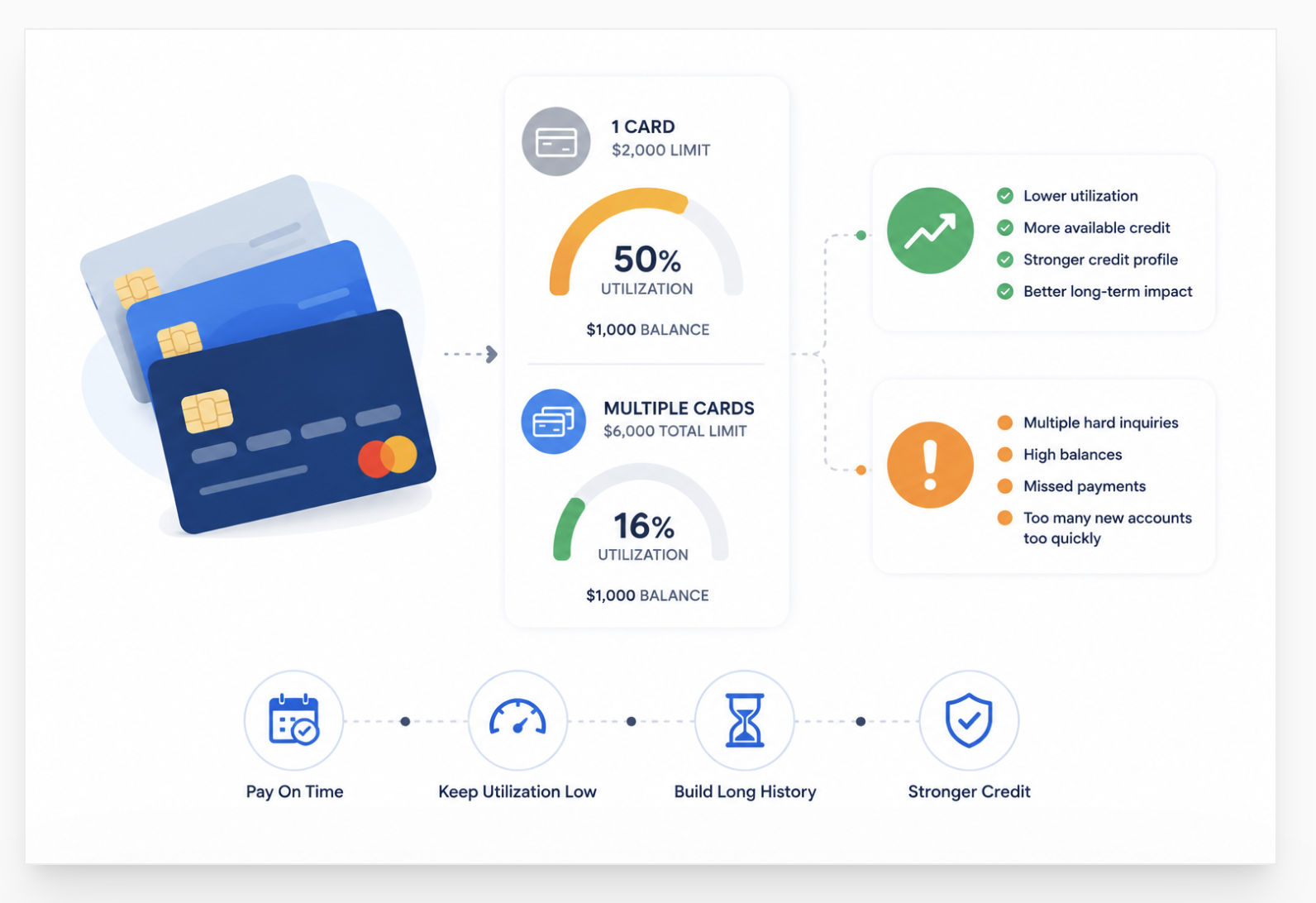
When Multiple Credit Cards Help Your Credit
Multiple credit cards help your credit when they increase total available credit and lower your utilization ratio while all payments stay on time. Adding a card without adding debt mathematically improves the ratio that controls 30% of your FICO score. The benefit is real and measurable within one billing cycle.
Here is the simplest version of why multiple cards often help.
Say you have one credit card with a $2,000 limit and a $1,000 balance. Your utilization is 50%. That is high. It hurts your score.
Now you open a second card with a $3,000 limit and carry no balance on it.
Total available credit: $5,000. Same $1,000 balance. Utilization: 20%.
Your score likely rises , not from a new card opening, but from the lower utilization that follows. As Experian's guide on multiple credit cards and your score confirms, the utilization benefit from additional available credit is a primary reason why responsible multi-card holders often score higher than single-card borrowers.
- ✓ Utilization drops when total available credit grows with no added balance
- ✓ Payment history builds across more accounts, thickening the credit profile
- ✓ Older cards strengthen average account age over time
- ✓ Variety of issuers creates a more robust revolving credit history
- ✓ Backup cards reduce the risk of a single account closure damaging available credit
When Multiple Credit Cards Hurt Your Credit
Multiple credit cards hurt your credit when balances grow high across all of them, payments get missed, or too many applications happen in a short period. Opening several cards quickly reduces average account age and stacks hard inquiries, both of which push scores down temporarily. The damage is usually short-term if behavior stays clean. High balances and missed payments cause long-term damage.
There are three situations where multiple cards create real problems.
Too many applications at once
Each credit card application triggers a hard inquiry. Hard inquiries cost 5-10 points each and stay on the report for 12 months of score impact. Opening three or four cards within a few months stacks those inquiry costs and tells lenders you are aggressively seeking credit, which some scoring models read as financial stress.
The temporary score drop from inquiries usually recovers within 6-12 months if no new negative behavior follows. But starting a new lease or mortgage application right after opening several cards can cause problems if the inquiry cluster pushes your score below a qualifying threshold.
Balances grow across every card
Having five credit cards is fine. Having five credit cards each at 60% utilization is a scoring problem. The utilization advantage of multiple cards only exists when the additional cards add available credit without adding proportional balances. Spending to the limit on every card eliminates the benefit and multiplies the damage.
Too many payment deadlines
More cards means more due dates. Missing even one payment costs 60-110 points , more damage than any number of hard inquiries. A person who opens four new cards and misses one payment has worse credit than someone who never opened the cards at all. This is the real operational risk of multiple cards.
- ✗ Multiple applications within weeks create stacked inquiry costs and account-age drops
- ✗ High balances across multiple cards multiply utilization damage simultaneously
- ✗ More payment deadlines increase the chance of a missed payment
- ✗ Opening many cards right before a mortgage application can disqualify or reprice the loan
How Credit Utilization Changes With Multiple Cards
Credit utilization measures what you owe on revolving accounts relative to your total credit limits. Adding a credit card with a new limit and no balance lowers utilization automatically. The benefit holds as long as balances across all cards stay low. Utilization is calculated both per card and overall , a maxed-out individual card hurts even when the overall ratio looks healthy.
Understanding utilization is critical for scoring because it updates every single billing cycle. Unlike a missed payment, which stays for seven years, high utilization can be corrected within 30 days. Pay down balances before the statement close date , not the due date , and the new ratio reports to the bureaus immediately. This makes utilization the fastest lever available for score improvement.
| Utilization Range | Score Signal | Action |
|---|---|---|
| Under 10% | Optimal | Target range for borrowers aiming above 750 |
| 10% to 29% | Healthy | Generally acceptable, minimal score drag |
| 30% to 49% | Caution | Starting to suppress score , reduce if possible |
| 50% to 74% | Hurting | Significant score suppression , address promptly |
| 75% and above | Damaging | Major score drag , treat as urgent |
Do Multiple Credit Card Applications Hurt Your Score
Yes, but temporarily. Each application triggers a hard inquiry costing 5-10 points. The score impact typically lasts 12 months. Multiple applications clustered in a short period compound the cost and can signal elevated borrowing risk. Spacing applications 6-12 months apart minimizes damage. Use soft-pull prequalification tools to compare offers without any score impact before applying.
The hard inquiry is real but often overstated.
A single hard inquiry costs 5-10 points and its score impact fades after 12 months (though it stays on the report for 24 months). For most borrowers, that cost is manageable.
The problem is the cluster effect. Opening three cards in two months stacks three inquiries plus three new account age reductions simultaneously. The cumulative score impact can run 30-50 points in the short term. For a borrower near a key lending threshold , 620 for conventional mortgage, 660 for CalHFA, 700 for competitive auto rates , that cluster at the wrong time costs real money.
The rule that protects you: space applications. Wait 6-12 months between new card applications. Use soft-pull prequalification to screen offers before committing. According to NerdWallet's credit card opening impact analysis, the average score recovers fully from a single hard inquiry within 12 months when no new negative behavior follows. The key is not letting the inquiry land at a moment when the temporary drop changes the outcome of another credit application.
How Many Credit Cards Is Too Many
There is no universal number of credit cards that is too many. The average American holds 3.9 cards. Consumers with 800+ FICO scores average 3 open cards. What matters is whether you can keep all balances low and all payments on time simultaneously. One maxed-out card scores worse than eight well-managed cards.
The question "how many is too many" reflects a common misunderstanding. Credit scoring models do not penalize you for the count. They penalize you for what the count reveals about behavior.
If eight cards all show low balances and on-time payment history, the scoring signal is positive. Eight cards demonstrate long-term credit management across multiple issuers.
If two cards show high balances and one shows a 30-day late, the scoring signal is negative , regardless of how few cards that represents.
The real question is simpler: how many cards can you manage without missing a payment or letting balances climb? For most people, that number is 3-5. For organized borrowers with automated payment systems, it can be higher. For someone already struggling to track one payment, adding more cards adds risk without adding benefit.
As Bankrate's credit card count analysis notes, the optimal number of credit cards is entirely personal. The data consistently shows that higher-scoring consumers hold multiple cards , but what produces the score is behavior, not count.
What Matters More Than the Number of Cards
People focus on card count. Scoring models focus on credit behavior. A borrower with 8 well-managed cards typically scores higher than a borrower with 1 maxed-out card. The scoring system does not see a wallet , it sees data points. Payment history (35%), amounts owed including utilization (30%), length of history (15%), credit mix (10%), and new credit (10%) determine the score. The number of cards shows up inside those factors, but it is never a direct input. What directly controls score is what happens on each account, not how many accounts exist.
The five factors in FICO scoring, ranked by weight, and how card count interacts with each:
| FICO Factor | Weight | How Card Count Affects It |
|---|---|---|
| Payment History | 35% | More cards = more payment deadlines. Autopay on all cards neutralizes this risk. One missed payment on any card is the most damaging single event available. |
| Amounts Owed (Utilization) | 30% | More cards with zero balances = lower overall utilization. This is the primary benefit of multiple well-managed cards. |
| Length of Credit History | 15% | Opening new cards reduces average account age temporarily. Existing cards continue aging. Over time, multiple old cards strengthen this factor. |
| Credit Mix | 10% | Having both revolving (cards) and installment (loans) accounts signals broader credit management. Multiple cards of the same type adds limited mix benefit. |
| New Credit | 10% | Each new application triggers a hard inquiry. Multiple recent applications cluster in this factor and can temporarily signal elevated risk. |
Different scoring models weigh factors differently, which matters when comparing your consumer app score to what a lender sees. VantageScore 3.0 , the model most free apps show , uses a similar factor structure to FICO but with different weighting. Mortgage lenders use FICO 2, 4, and 5. Auto lenders use FICO Auto Score. The number of credit cards is never a direct variable in any of these models. What the cards do to utilization, payment history, and account age is what counts.
The last factor worth naming: payment history matters more than card quantity , and autopay is the simplest way to protect it across any number of cards. Set autopay to the full statement balance on every card. Every card then contributes positive payment history automatically. The number of cards becomes irrelevant from a payment perspective when the system handles every deadline without manual intervention.
Does having multiple credit cards hurt your credit?
Not automatically. Multiple credit cards often help credit by increasing total available credit and lowering utilization, which controls 30% of the FICO score. Problems occur when applications cluster in a short period (stacking hard inquiries), balances grow high across all cards simultaneously, or payments get missed. The number of cards matters far less than how each card is managed.
Is it better to have one credit card or multiple?
From a pure credit score perspective, multiple cards managed well often produces stronger scores than a single card. The utilization benefit , more available credit reducing the ratio , is the primary reason. Additionally, multiple accounts thicken the credit file and strengthen payment history across more tradelines. The downside is operational: more cards mean more payment deadlines, more statements to monitor, and more risk of a missed payment if the system is not automated.
How many hard inquiries is too many?
Each hard inquiry costs 5-10 points and its score impact lasts 12 months. FICO research indicates that 6 or more inquiries in a 12-month period is associated with elevated credit risk compared to borrowers with 0-2 inquiries. However, the exact threshold depends on the overall credit profile. A borrower with a thin file is more affected by multiple inquiries than a borrower with a deep 10-year credit history. Space applications 6-12 months apart whenever possible to minimize cumulative inquiry impact.
Do credit card companies see how many cards you have?
Yes. When you apply for a new card, the issuer pulls your credit report and sees every open account, the balance and limit on each, and your payment history across all of them. Multiple open revolving accounts in good standing often strengthen an approval decision. Multiple open revolving accounts with high balances and recent lates raise the lender's risk assessment. The full picture of how you manage existing cards directly influences whether the next application gets approved.
Want to Know What Is Actually Hurting Your Credit?
Sometimes the problem is not card count. It is utilization, a reporting error, a collection, or an inaccurate entry suppressing your score below where your real payment behavior would place it. A free 3-bureau audit shows exactly what each bureau currently reports so you know the real cause before spending time solving the wrong problem.
Get My Free 3-Bureau Audit → Secure · 2 minutes · No credit card required-
Credit Utilization Ratio , How It Works and How to Lower It The utilization ratio is why multiple credit cards often help more than hurt. This covers how the ratio calculates across individual cards and in aggregate, the exact payment timing that changes what the bureau receives, and the specific utilization targets that correspond to each FICO score tier from Fair through Exceptional.
-
How to Avoid Interest on a Credit Card Multiple credit cards produce their full benefit only when balances stay low. This covers the grace period mechanism that eliminates interest charges entirely, the statement close date versus due date distinction that changes what your utilization looks like to the bureaus, and the autopay setting that protects both payment history and utilization simultaneously across every card.
-
FICO Score vs Credit Score , What Is the Difference The score on your free app when you check your multiple-card utilization is not the same score a mortgage lender sees when they pull your file. This covers the scoring model versions used for each lending category, why the factor weights differ between consumer and mortgage FICO models, and how to find the score that actually determines your rate on the next application you care about.