

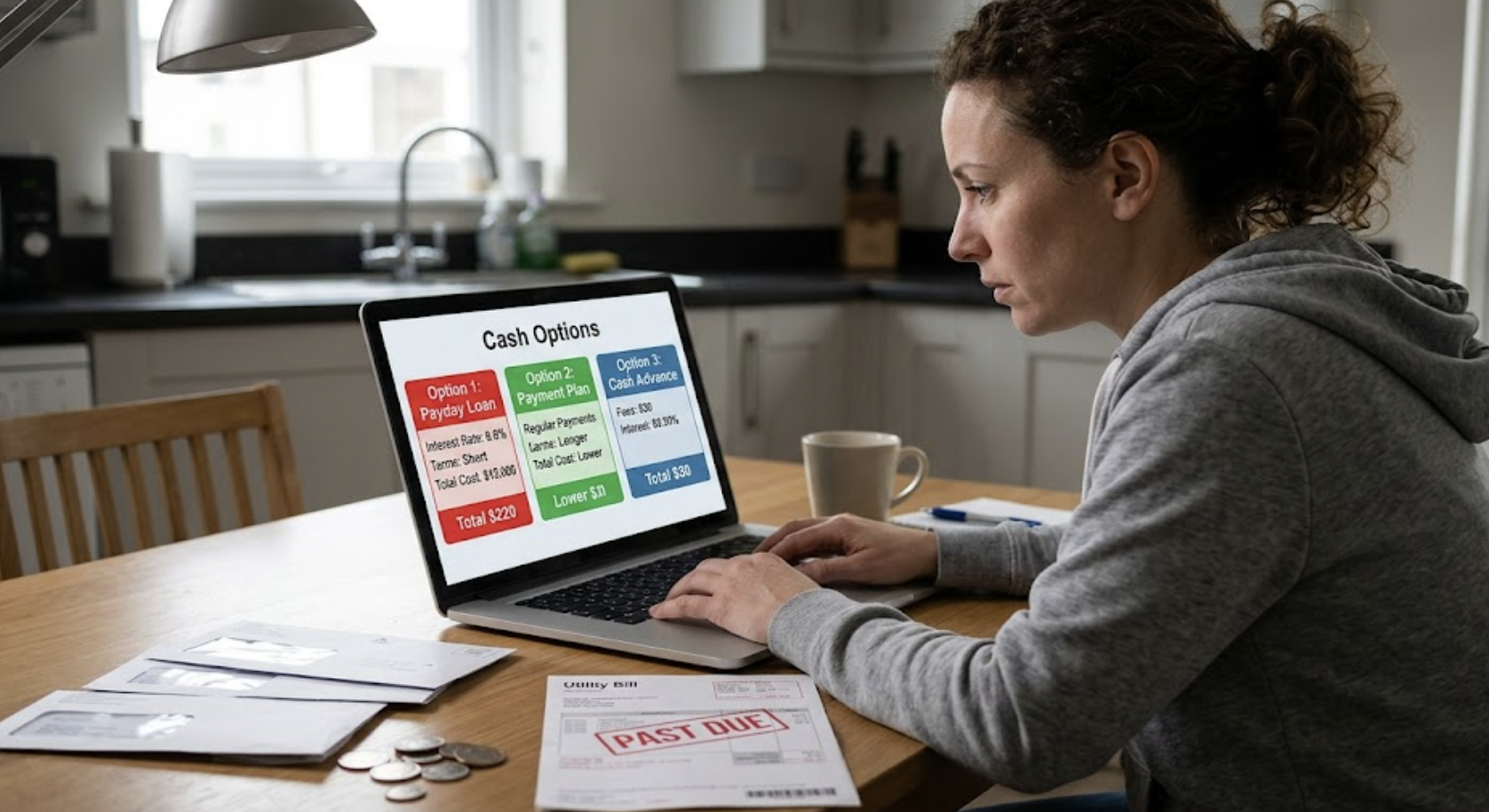
There are emergency cash options that won’t destroy your credit. However, not all of them are structured the same. Some options provide short-term relief without affecting your credit unless you default. Others can lower your score immediately through hard inquiries, high utilization, or missed payments. The difference comes down to how the option is reported and managed.
According to the Consumer Financial Protection Bureau, high-cost short-term borrowing often leads to repeat usage, which increases the risk of missed payments and long-term financial strain. That pattern shows up often in credit files.
In actual cases we handle, the damage usually does not come from needing cash. It comes from how the cash was obtained. Payday loans, maxed-out cards, and poorly timed borrowing tend to create new negative activity. On the other hand, structured options such as payment plans or controlled use of existing credit tend to limit impact when used correctly.
This article breaks down which emergency cash options are safer, how each one affects your credit, and what to avoid if your goal is to solve the problem without adding new damage.
Emergency Cash · Bad Credit Loans · Payday Loan Alternatives · Fast Money Without Destroying Credit · Credit Score Impact by Loan Type
Updated April 2026 · Written by the team at ASAP Credit Repair USA · Sources: Federal Reserve Survey of Household Economics 2024, NerdWallet emergency loans guide, Fortune/Bankrate Emergency Savings Report 2025, CFPB payday loan research, NCUA PAL loan guidelines
- According to the Federal Reserve, 36% of Americans in 2024 could not cover a $400 emergency expense with cash or savings. You are not alone in this situation.
- Paycheck advance apps like EarnIn and Dave let you access up to $750 of wages you already earned - no credit check, no interest, available in minutes.
- Credit union PAL loans ($200 to $2,000) are the best credit-building emergency option: low APR, 1-6 month terms, and reported to credit bureaus.
- Payday loans average 391% APR, do not report positive payments to bureaus, and frequently lead to collections that damage credit for 7 years.
- Many creditors have unadvertised hardship plans. A 5-minute phone call can defer a bill, reduce a payment, or pause a collection with no new debt created.
- Before applying for any loan, check your credit report for errors. A removable error could be holding your score below the threshold for better loan rates right now.
Why Emergency Cash Decisions Matter for Your Credit
According to NerdWallet's emergency loan research, payday loans, title loans, and pawnshop loans are consistently the most expensive emergency options, with APRs often exceeding 200% to 400%. Yet they are the ones most visible, most marketed, and most accessible to people with low credit scores - exactly the people who can least afford the consequence of defaulting on them.
The Federal Reserve's 2024 Survey of Household Economics found that 36% of adult Americans could not cover an unexpected $400 expense using cash or a credit card they pay off immediately. As reported by Fortune's coverage of Bankrate's 2025 Emergency Savings Report, 27% of U.S. adults have no emergency savings at all, and more than one-third have more credit card debt than savings. That is not a small group of people in financial crisis. That is a large portion of working Americans making do with what they have.
This guide ranks every emergency cash option from least to most damaging to your credit, so you can make the best choice available to you right now.
Emergency Cash Options Ranked: Safest to Most Damaging
| Option | Typical Cost | Credit Impact | Speed | Who Qualifies |
|---|---|---|---|---|
| Paycheck Advance App | $0 to $8 express fee | None | Minutes to 3 days | Anyone with direct deposit job |
| Employer Paycheck Advance | $0 (deducted from next check) | None | Same day to 3 days | Full-time employees; varies by employer |
| Hardship Plan / Bill Deferral | $0 (interest may still accrue) | None | Same day (phone call) | Any customer who calls and asks |
| Credit Union PAL Loan | Under 28% APR; $20 max fee | Builds credit | 1 to 3 days | Credit union members (1+ month) |
| Personal Loan (online lender) | 8% to 36% APR | Soft pull (no impact to check) | Same day to 2 days | 580+ credit score in most cases |
| 401(k) Loan | Prime rate + 1% (paid to yourself) | None (if repaid) | 3 to 5 days | Active 401(k) participants |
| Credit Card Cash Advance | 24% to 36% APR + 3-5% fee | Raises utilization | Immediate (ATM) | Existing cardholders with available limit |
| Payday Loan | 391% avg APR | Severe if defaulted | Same day | Anyone with a paycheck; no credit check |
| Title Loan | 300% avg APR | Severe + risk of vehicle loss | Same day | Vehicle owners with clear title |
The Safest Emergency Cash Options (Use These First)
1. Hardship Plans and Bill Deferral (Cost: $0)
This is the most underused option in a financial emergency. Most people do not know that creditors - utilities, medical providers, landlords, car lenders - often have hardship programs that are never advertised. You have to call and ask. The script is simple: "I am experiencing a financial hardship right now. Do you have any payment deferral or hardship programs available?"
We have seen clients defer two months of car payments, get medical bills cut by 40% through hospital charity care, and pause utility shutoffs for 30 to 60 days just from one phone call. Zero new debt created. Zero credit impact. The call takes five minutes.
2. Paycheck Advance Apps (Cost: $0 to $8)
Apps like EarnIn, Dave, and Brigit let you access wages you have already earned before your payday arrives. EarnIn lets you pull up to $150 per day or $750 per pay period. No interest. No credit check. Standard delivery is free (1 to 3 days). Express delivery costs a small fee, typically $2 to $8 depending on the amount, and arrives within minutes.
This is not a loan. You are accessing your own money early. There is no credit check, no hard inquiry, and no reporting to credit bureaus. It will not hurt your score or help it. It simply gets you through a cash gap without creating debt.
The limitation: you need a job with regular direct deposit. If you are self-employed, work gig jobs with inconsistent income, or receive benefits rather than wages, most of these apps will not work for you.
3. Credit Union PAL Loans ($200 to $2,000 at Low APR)
A Payday Alternative Loan, or PAL, is a small loan offered by federal credit unions. The NCUA caps the interest rate and limits the application fee to no more than $20. Loan amounts run from $200 to $2,000 with repayment terms of 1 to 6 months. You must have been a credit union member for at least one month to qualify.
The PAL is the best credit-building emergency option available. Unlike payday loans, PAL payments are reported to the three major credit bureaus. Every on-time payment builds your credit history. And unlike payday loans, the interest rate is contained by federal rule.
How to Get Emergency Cash with Bad Credit
If you have a score in the 630 range, personal loans are a real option - not just theoretically, but practically. Several online lenders approve borrowers in this range and fund the same or next business day. Our guide on getting a personal loan with a 630 credit score covers which lenders accept this range, what rates to expect, and how to use soft-inquiry prequalification to check eligibility without any impact to your score before you formally apply.
That 30-day membership wait matters. If you do not have a credit union account yet, join one today even if you do not have an emergency right now. You are building eligibility for the future. Many credit unions have low or zero minimum opening deposits.
Personal Loans: Use Soft-Inquiry Prequalification
Online lenders like Upstart, LendingPoint, and Avant offer prequalification with a soft inquiry - meaning you can see your rates and approval odds without any hit to your credit score. If you like what you see, apply. The hard inquiry then happens during the formal application, and it typically drops your score 5 to 10 points, which is minor compared to the benefit of a legitimate loan with a structured repayment plan.
Before you apply for any loan, it is worth knowing what is on your credit report right now. Errors, outdated collection accounts, and wrong late payment dates can push your score below the threshold for better rates. Our breakdown of the most common credit issues to fix before applying for a loan shows exactly what lenders see, which negative items carry the most weight in their decision, and what can be addressed in 30 to 60 days before you apply.
Options That Help in the Short Term but Need Caution
Credit Card Cash Advance
If you have a credit card with available credit, a cash advance gives you cash at any ATM immediately. The downside: cash advance APRs are typically 24% to 36%, and interest starts accruing immediately - no grace period like regular purchases. There is also usually a 3% to 5% upfront fee. So a $500 cash advance might cost you $15 to $25 immediately, plus daily interest until it is paid.
This is still far better than a payday loan. A $500 payday loan at 400% APR due in two weeks costs about $100 in fees alone. The credit card advance at 28% APR costs about $6 in interest over the same two weeks. Use the credit card first.
401(k) Loan
If you have money in an employer-sponsored 401(k), you may be able to borrow up to 50% of your vested balance, capped at $50,000. You repay yourself with interest, so the interest cost stays in your retirement account. There is no credit check and no credit bureau reporting. If repaid on schedule, there is no tax impact and no credit impact.
The risk: if you leave your job while the loan is outstanding, you typically must repay the full balance within 60 to 90 days or it becomes a taxable distribution with a 10% early withdrawal penalty if you are under 59.5. Only use this if your job is stable.
What's the Worst Emergency Cash Option? Payday Loans
Here is what 391% APR looks like in real money. You borrow $300 in an emergency. The fee is typically $15 to $30 per $100 borrowed. At $20 per $100, that is a $60 fee due in 14 days alongside the $300 principal. Total due: $360. If you cannot pay the full $360 on payday, you roll it over for another $60. Two months later, you have paid $120 in fees on a $300 loan and still owe $300.
As Investopedia's payday loan analysis documents, payday loan borrowers often pay more in fees than they originally borrowed when they roll loans over multiple times. States have tried to cap rates, but in states without caps, APRs can exceed 600%. The industry specifically targets people in financial crisis who have limited alternatives.
If you already have a payday loan on your credit report from a past default, that is a disputable item if the reporting contains errors. Our practice sees incorrect reporting dates, wrong balances, and re-aged payday loan entries constantly. If you want to understand what options exist for larger loan amounts after you have improved your credit, our guide on how to get approved for a $20,000 loan covers what lenders look for at larger amounts, what credit score range unlocks competitive rates, and how to prepare your credit profile before applying for a significant loan.
How to Get Emergency Cash Fast: Step by Step
- Call every company you owe and ask about hardship programs. Start here, every time. It costs nothing and the answer is either yes or no. Utilities, medical providers, car lenders, and landlords all have programs. Ask specifically: "Do you have a hardship deferral or payment plan I can apply for today?"
- Open a paycheck advance app right now if you have a W-2 job with direct deposit. Download EarnIn, Dave, or Brigit. Connect your bank account. Check your eligible advance amount. This takes 10 minutes and you could have money available today.
- Check your credit union for a PAL loan. If you are already a member, call or log in and ask about emergency loan options. If you are not a member, join one today and note your 30-day membership clock for future emergencies.
- Prequalify for a personal loan with a soft inquiry. Visit LendingPoint, Upstart, or Avant. Enter basic information. See your rate and approval estimate with zero impact to your credit score. Only formally apply if you like what you see and the monthly payment fits your budget.
- Sell something fast before taking high-cost debt. Post unused electronics, clothing, furniture, or tools on Facebook Marketplace, OfferUp, or eBay. Most local sales happen within 24 hours. Raising $200 to $500 this way creates zero debt, zero interest, and zero credit impact.
Your Credit Score Is the Key to Better Emergency Options
The higher your credit score, the better emergency cash options you qualify for and the lower the interest rate you pay. A free 3-bureau audit shows exactly what is on your Experian, TransUnion, and Equifax reports - including errors that may be keeping your score below the threshold for better loan rates right now. Many clients find disputable items in their first audit that shift their score enough to qualify for a personal loan or credit card instead of a payday alternative.
Get My Free Credit Audit → Secure · 2 minutes · No credit card requiredFrequently Asked Questions
What are the best emergency cash options that won't hurt my credit?
The safest emergency cash options are paycheck advance apps (no credit check, no credit impact), employer advances, and calling creditors to request hardship plans. For borrowing that also builds credit, a credit union PAL loan is the best option - low APR, NCUA-regulated, and reported to credit bureaus. Personal loans with soft-inquiry prequalification are the next step, with same-day or next-day funding possible for scores in the 580 to 640 range. Payday loans and title loans are last resort only due to triple-digit APRs and collections risk.
How do I get emergency cash with bad credit?
With bad credit, start with options that require no credit check at all: paycheck advance apps, employer advances, hardship deferral plans, selling items, or local assistance programs through 211.org. If you need to borrow, a credit union PAL loan after one month of membership is your best option. Online personal lenders like Upstart and LendingPoint approve scores in the 580 to 620 range, though rates are higher. Avoid payday and title loans - they are the most expensive options and the most likely to cause further credit damage through collections.
What is the fastest way to get emergency money?
The fastest no-cost option is a paycheck advance app. EarnIn and Dave can release funds in minutes for a small express fee if you have a job with direct deposit. A credit card cash advance is also immediate if you have available credit - it requires no application and works at any ATM. For borrowing without existing accounts, online personal lenders fund within one business day after approval. Payday loans are fast but cost 391% average APR and should be a last resort, not a first step.
Does a personal loan hurt your credit score?
Applying for a personal loan causes a hard inquiry that may lower your score 5 to 10 points temporarily. However, most lenders let you prequalify with a soft inquiry at zero credit impact. If approved, your on-time monthly payments build positive credit history, which is 35% of your FICO score. A personal loan you pay on time will ultimately help your credit more than the inquiry hurts it. The key is to only apply for a loan you can comfortably repay - a missed payment drops your score far more than the initial inquiry.
Should I use a payday loan for an emergency?
Only as an absolute last resort. The average payday loan APR is 391%. Most lenders do not report on-time payments to credit bureaus, so paying it back on time does not build your credit. If you cannot repay and it goes to collections, it appears on your credit report for 7 years. Before a payday loan, exhaust: hardship plans, paycheck advance apps, credit union PAL loans, employer advances, and personal loans. If a payday loan is unavoidable, borrow the minimum you need, pay it in full on the original due date, and never roll it over.
-
Can Debt Take Money from My Bank Account? If you are considering emergency borrowing because of debt collectors, this explains exactly what collectors can and cannot do to your bank account, what steps legally have to happen before a levy, and what income is protected even after a court judgment.
-
Living Paycheck to Paycheck: Which Bills to Pay First? When money runs short, the order you pay your bills matters more than most people realize. This covers which obligations are most dangerous to miss first, how payment order affects your credit, and how to build a bill priority system that protects your housing and credit while you catch up.
-
Can Payday Loans Hurt Your Credit Score? A deep dive into exactly how payday loans interact with your credit report - when they appear, how long they stay, what the default pattern looks like on your report, and what options exist to remove or dispute payday loan collection entries from your credit history.
Emergency Cash Options: What to Use vs Avoid
Safer Options (Lower Credit Impact)
- Payment plans with existing creditors
- Employer paycheck advances
- Credit union small-dollar loans
- Using available credit with low utilization
Higher-Risk Options (Can Hurt Your Credit)
- Payday loans with high fees
- Title loans tied to your vehicle
- High-interest cash advances that increase utilization
Choose options that limit new debt, avoid high fees, and do not add negative activity to your credit report.
Final Thoughts
Emergency cash can solve an immediate problem, but the structure of that solution determines what happens next. Some options create a short-term bridge. Others create a longer-term debt cycle.
The goal is to avoid adding new negative activity to your credit report while covering the expense. Options that limit reporting impact or avoid new debt entirely reduce that risk.
Before choosing, look at how the option affects your credit, not just how fast it provides cash.