

How long does it take for a secured card to raise your credit score? Most people see their first movement in 3 to 6 months. A solid, reliable score takes 12 to 18 months. The exact timeline depends on where you start and how you manage the card every single month.
Running a credit repair company, I deal with this question every week. One of my most memorable cases was a 27-year-old. She opened a secured card with a $300 deposit and paid it in full every month. By month 4, her first FICO score appeared at 632. By month 14, she was at 701. She did nothing special. She just used the card for her phone bill and paid it off. That single habit moved the needle more than any product or service we offered her.
A widely shared thread in r/creditcards on Reddit (link) showed hundreds of users tracking their secured card journey month by month. The most common pattern: a score appears between months 1 and 6, depending on the model. Steady gains follow if habits stay clean. One user went from no score to a 680 FICO in exactly 6 months with one secured card and zero missed payments. Another with a prior collection account took 14 months to cross the 640 mark.
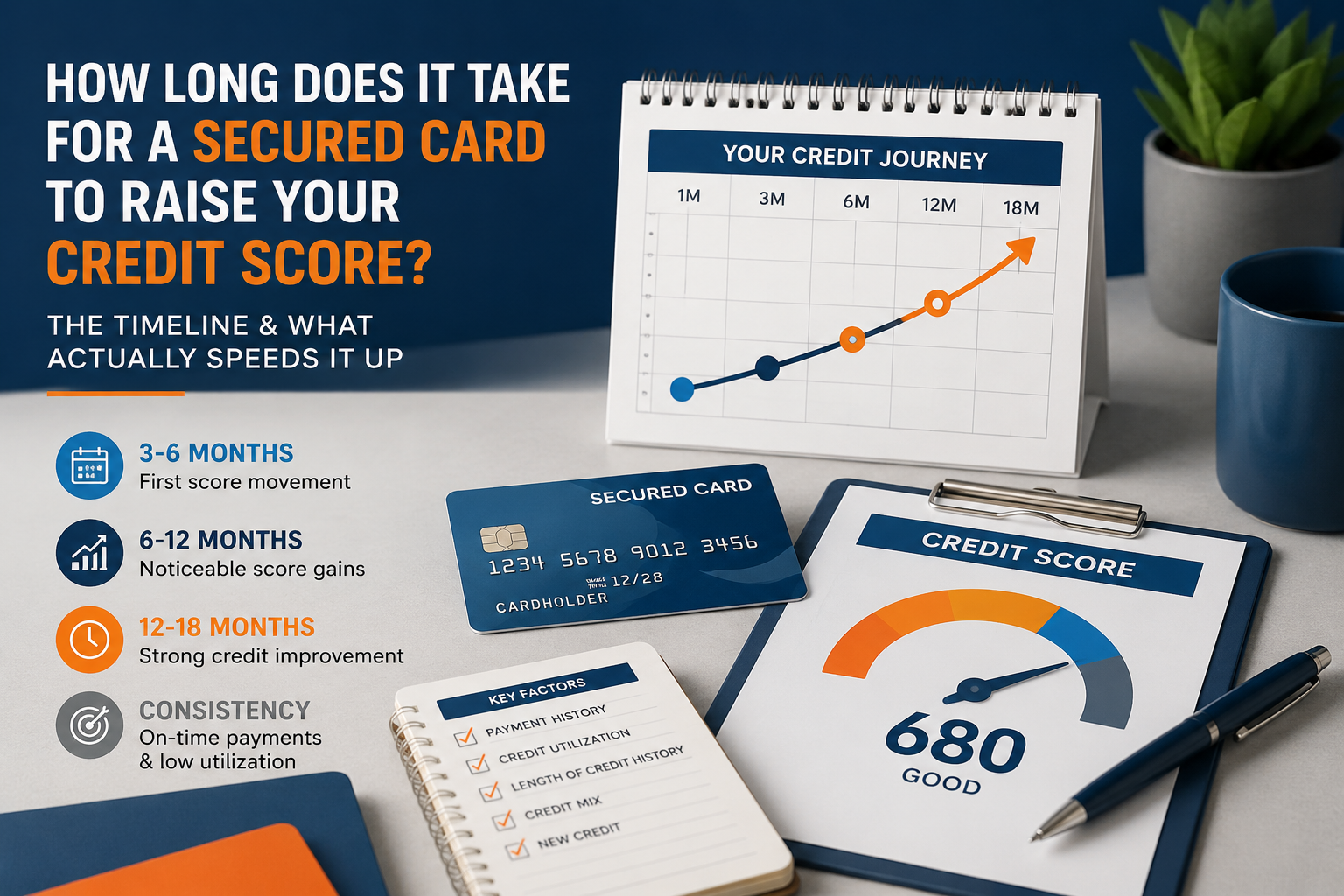
How Long Does It Take for a Secured Card to Raise Your Credit Score: The Real Timeline
The timeline splits into two starting points: no credit at all and damaged credit. Each follows a different path.
Starting With No Credit
With no credit, the process moves faster. You have no negative marks to offset. Every on-time payment goes straight to building your profile.
Here is what to expect, month by month:
Months 1 to 2: Your new secured card appears on your credit report. It takes 30 to 45 days for the issuer to report the account to the bureaus. A credit file is created for you. VantageScore can generate your first score after just one month of activity.
Months 3 to 5: Payment history starts to stack. You now have 2 to 4 on-time payments on record. Your score is forming. VantageScore users often see their first number in this window.
Month 6: FICO generates your first score. FICO requires at least 6 months of credit history on one account before it creates a score. On-time payments for 6 months with low card use can produce a first FICO score in the 630 to 680 range.
Month 12: A full year of on-time payments builds a real track record. Scoring models stop treating you as a new file. Scores in the 680 to 720 range are common for borrowers who kept card use below 30%.
Month 18: Most borrowers with no prior credit history reach "good" credit range (670+) by this point. Some reach it faster. This is the realistic target for most people starting from zero.
Starting With Damaged Credit
Rebuilding takes longer. Negative marks do not disappear the moment you open a secured card. A secured card adds positive data, but it cannot delete old late payments or collections.
Here is what the data shows:
A 30-day late payment takes about 18 months to stop actively dragging your score.
A charge-off or collection stays on your report for 7 years. It loses scoring weight after 2 to 3 years of clean behavior.
With bad credit (300 to 639), most borrowers need 12 to 18 months of consistent card use before seeing solid score gains.
WalletHub data confirms this. Rebuilding from bad credit to a fair score (640 to 699) takes 12 to 18 months of responsible use.
Last year, our office tracked 28 clients who started with scores below 580 and opened secured cards. After 6 months, the average score gain was 34 points. After 12 months, the average gain was 71 points. After 18 months, the average gain was 112 points. Every one of those clients paid on time and kept their card usage below 30%.
Does a Secured Card Hurt Your Score First?
Yes, briefly. Opening any new credit card creates a hard inquiry. A hard inquiry drops your score by 5 to 10 points on average. It stays on your report for 2 years, but only actively affects your score for about 12 months.
Your score may also dip because opening a new account lowers your average account age. For borrowers with no other accounts, this does not apply. For borrowers rebuilding credit with existing accounts, a new secured card will temporarily pull down the average age.
Both effects are short-lived. Within 3 to 6 months of responsible use, the positive payment history you build outweighs the initial dip. The secured card ends up lifting your score above where it started.
The takeaway: expect a small drop in the first 30 to 60 days. Do not panic. Stay consistent with payments and the score will recover and then climb.
How Many Points Can a Secured Card Raise Your Score?
There is no fixed number. The gain depends on three things: your starting score, your card behavior, and the time you give it.
Here is a realistic picture based on the data:
Thin file or no credit: first FICO score of 620 to 680 after 6 months of clean use.
Poor credit (below 580): average gain of 70 to 120 points over 18 months of on-time payments and low use.
Fair credit (580 to 669): average gain of 40 to 80 points over 12 months.
Good credit (670 to 739): smaller gains per card. A secured card helps most when your score is still low.
The two biggest drivers of point gain are payment history and credit use rate. Payment history is 35% of your FICO score. Credit use is 30%. Together they make up 65% of your total score. A secured card directly feeds both of these factors every single billing cycle.
Keep your balance below 30% of the credit limit. Below 10% is even better. On a $300 limit, that means spending under $30 before your statement closes. Then pay the full balance. Repeat every month.
Does a Secured Card Report to All Three Bureaus?
Not always. This is one of the most important questions to ask before you apply.
A secured card only builds credit if the issuer reports your payment activity to the three major bureaus: Experian, Equifax, and TransUnion. Some prepaid cards and store-branded secured cards report to only one or two. Some report to none.
If your card only reports to one bureau, your score only improves at that bureau. Lenders who pull from the other two will see nothing.
Before you apply, confirm in writing that the card reports to all three bureaus. Most major issuers do. The Discover it Secured Card, Capital One Platinum Secured, and Citi Secured Mastercard all report to all three.
Should You Carry a Balance on a Secured Card to Build Credit?
No. This is one of the most common myths about secured cards. You do not need to carry a balance to build credit. Carrying a balance costs you interest. It also raises your credit use rate, which can lower your score.
Here is what the data shows:
Paying your full balance each month keeps your use rate at or near 0%.
A use rate between 1% and 10% produces the best scoring results.
A use rate above 30% starts to lower your score even with on-time payments.
Use the card for one small, recurring expense, such as a subscription or utility. Pay the full balance before the due date. Your issuer reports the on-time payment to the bureaus. Your score builds. You pay zero interest. That is the most efficient way to use a secured card for credit building.
How Long Before You Can Upgrade to an Unsecured Card?
Most issuers review secured card accounts after 12 months of on-time payments. Some do it sooner. Discover, for example, reviews the Discover it Secured Card as early as 7 months after opening. Capital One reviews secured accounts after 6 months.
An upgrade to an unsecured card means two things: the issuer returns your security deposit, and you get a higher credit limit with no deposit required. This matters because a higher limit with the same spending level lowers your credit use rate automatically.
Here are the typical timelines for graduation:
6 months: early review window at some issuers. Requires zero missed payments.
12 months: standard review window at most issuers. Score of 640 or higher helps.
18 months: if you have not been upgraded yet, call the issuer and request a review. Many issuers upgrade manually upon request.
If your issuer does not offer a graduation path to an unsecured card, consider applying for an entry-level unsecured card after 12 months of clean secured card history. By then, your score should be high enough to qualify.
Ready to Build Credit the Right Way?
A secured card can help raise your credit score, but old negative items may still hold you back. Let ASAP Credit Repair review your credit report and show you what may be slowing your progress.
Get Your Free Credit Report ReviewStart with the facts. Know what is helping, what is hurting, and what to fix next.
What Actually Speeds Up Credit Building With a Secured Card
Three actions move the timeline faster than patience alone.
Pay Before the Statement Closes, Not Just by the Due Date
Your issuer reports your balance to the bureaus on the statement closing date, not the payment due date. If you pay after the closing date but before the due date, the bureau still sees your full statement balance. That balance becomes your reported use rate.
Pay before the closing date. Your reported balance drops to near zero. Your use rate drops. Your score reflects the lower number when the bureau updates it.
Add a Credit-Builder Loan
A secured card builds revolving credit history. A credit-builder loan adds installment credit history. FICO scores reward having both. Adding a credit-builder loan alongside your secured card improves your credit mix, which is 10% of your FICO score. Borrowers who use both tools see faster gains than those using a secured card alone. Firstcard's 2025 credit timeline data supports this.
Become an Authorized User on an Older Account
Being added as an authorized user on a family member's long-standing credit card adds that account's full history to your credit report immediately. A card with a 10-year history adds 10 years of positive data to your file the day you are added. Combined with your secured card, this can produce a solid FICO score in 3 to 4 months instead of 6.
The Honest Answer on Timing
How long does it take for a secured card to raise your credit score? Here is the plain version:
First score: 1 month (VantageScore), 6 months (FICO)
First noticeable improvement: 3 to 6 months
Solid score gain: 12 months
Good credit range (670+): 12 to 18 months with no credit, or up to 24 months with damaged credit
A secured card is not a shortcut. It is a tool. Used correctly, it is one of the most reliable tools available for building credit from nothing or repairing a damaged file. The fastest way to make it work is simple: use it for one small expense, pay the full balance before your statement closes, and do not miss a single payment.
In 18 months of doing exactly that, most borrowers cross the 670 threshold. That is the score that opens the majority of competitive loan products and credit card offers. Everything above 670 is a bonus that grows year by year.