
How Secure Is Venmo? Safety, Encryption, and Scam Risks, but how secure Venmo is depends almost entirely on how you use it. The app uses AES-256 encryption, SSL certificates, and multi-factor authentication to protect your data. At the same time, Venmo's payment finality, its social-by-default design, and the lack of buyer protection for personal transfers create real windows for fraud. I run a credit repair company, and one of the most unforgettable cases we ever handled started with a Venmo scam that wiped out a client's checking account and tanked their credit when they could not cover a subsequent auto payment.
Real user data backs this up. A widely discussed thread on r/personalfinance shows dozens of users reporting lost funds after falling for reverse-transfer scams, with amounts ranging from $200 to over $3,000. According to Security.org research cited by Yahoo Finance, 83% of Venmo, PayPal, and similar app users experienced a scam or attempted scam in 2024. That number rose 15% compared to the year before.
How Does Venmo Work?
Venmo is a peer-to-peer payment app owned by PayPal. It connects to your bank account, debit card, or credit card and lets you send or receive money using a username, phone number, or email.
Transactions run through Venmo's servers. Venmo holds funds in your Venmo balance until you transfer them to your bank. Standard bank transfers are free. Instant transfers cost 1.75% (minimum $0.25, maximum $25). Credit card payments carry a 3% fee.
Venmo also has a social feed that shows transaction notes by default. This is public unless you change your privacy settings. That social layer is one of the biggest security blind spots most users never think about.
What Security Features Does Venmo Use?
Venmo uses several layers of protection to keep accounts and transactions safe.
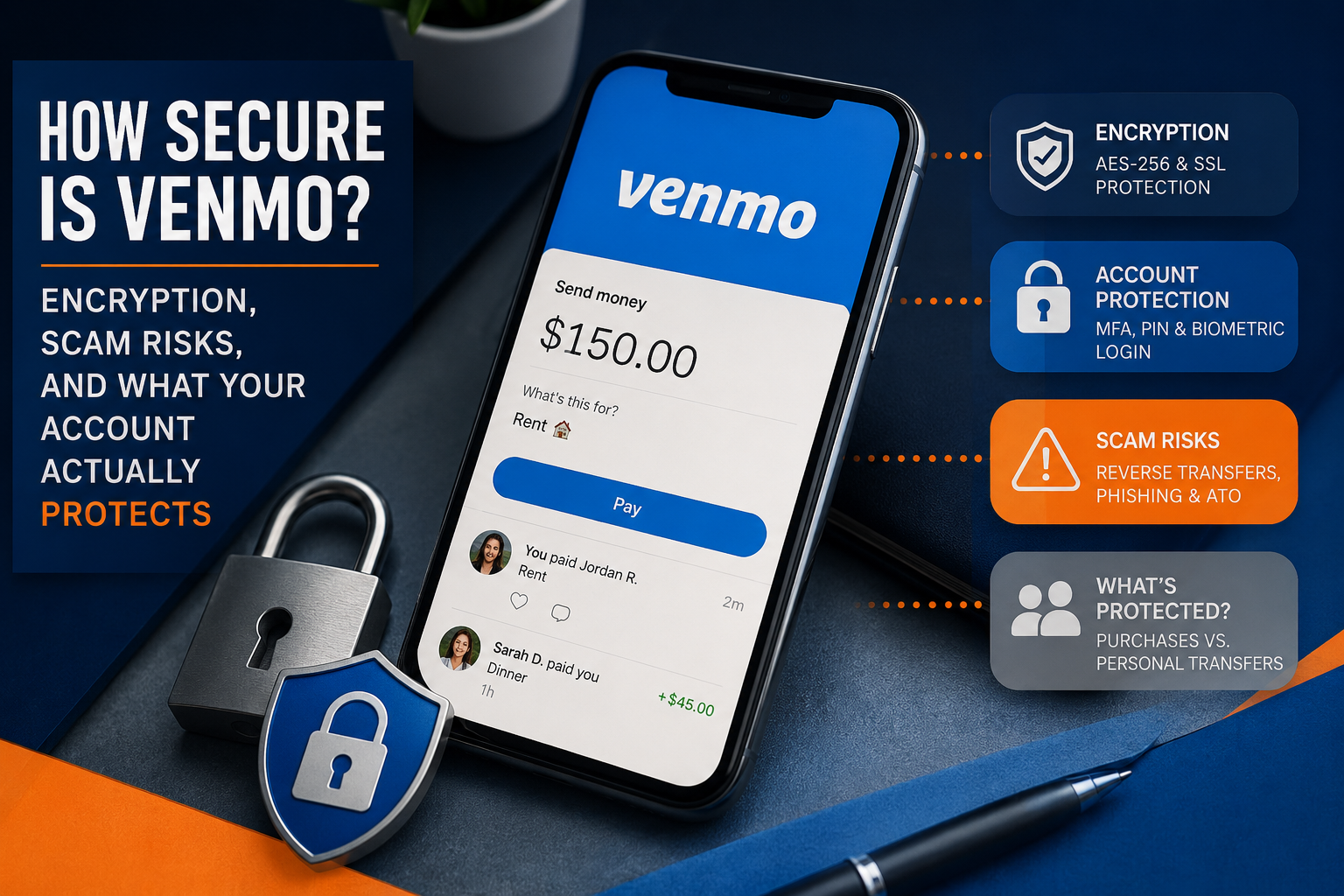
Encryption: Venmo applies AES-256 encryption to stored data and uses SSL certificates to protect data in transit. This is the same encryption standard used by major financial institutions.
Multi-factor authentication (MFA): When you sign in on a new device, Venmo sends a one-time code to your registered phone number. You must enter that code to access the account. Venmo will never call or text you to ask for that code. If someone asks for it, that is a scam.
PIN and biometric login: Users can lock the app with a four-digit PIN or Face ID. Without this, anyone who picks up your phone can open Venmo and send money in seconds.
Device monitoring: Venmo lets you see which devices are logged into your account under Security Settings. You can remove any device you do not recognize.
Fraud monitoring: Venmo monitors account activity for unusual transactions. If something looks suspicious, Venmo may freeze the transaction or contact you.
Purchase Protection: Payments marked as "goods and services" are eligible for Venmo's Purchase Protection program. Personal transfers between friends are not covered.
Is Venmo Secure?
Venmo's technical infrastructure is secure. The platform has not suffered a major data breach. However, Venmo settled a Federal Trade Commission complaint in 2018 over serious security failures. The FTC found that Venmo falsely claimed "bank-grade security" while lacking a written information security program, failing to notify users of password changes, and allowing unauthorized withdrawals without alerts. As part of the settlement, Venmo now undergoes mandatory third-party security audits every two years for 10 years.
Since then, Venmo has significantly improved its security posture. The current threat is less about Venmo's infrastructure and more about user behavior and social engineering. Scammers do not hack Venmo's servers. They hack people.
What Are the Biggest Venmo Scam Risks?
This is where most users get caught. Venmo transactions are near-instant and nearly impossible to reverse once completed. Scammers exploit that finality.
The reverse transfer scam is the most common. A stranger sends you money using a stolen credit card or hacked account. They ask you to return it. You do. Then Venmo claws back the original payment when the real card owner reports fraud. You lose both amounts. This past year alone, we saw this pattern show up in multiple client cases at our firm.
Account takeover (ATO) is rising fast. Experts at Galileo Financial Technologies tracked an increase in phishing, credential stuffing, and ATO attacks across payment apps throughout 2024 and into 2025. Scammers log in with stolen credentials and move funds before the real user notices.
Authentication code scams work like this: a scammer calls posing as Venmo support and tells you there is suspicious activity on your account. They say they need to verify your identity and send you a real Venmo 2FA code, then ask you to read it back. The moment you share it, they own your account.
Prize and non-delivery scams round out the list. Security.org data shows that 23% of payment app users are targeted by prize scams, and 18% face non-delivery fraud, where they pay for an item that never arrives.
Venmo offers no recourse for personal transfers you authorized voluntarily, even when you were deceived.
To recap: Venmo's encryption and MFA are solid, but the platform's instant finality and social-by-default settings make user behavior the biggest security variable.
How Do I Protect My Venmo Account?
Protecting your Venmo account takes about 10 minutes to set up correctly. Here are the actions that matter most.
Turn on two-factor authentication. Go to Settings, then Security, then Two-Factor Authentication. This stops most account takeover attempts cold.
Set a strong, unique password. Do not reuse any password from another account. Use a password manager to generate and store it.
Enable a PIN or Face ID. Go to Settings, then Face ID & PIN. A lost or stolen phone without this protection gives anyone full access to your funds.
Set all transactions to private. Go to Settings, then Privacy, and change your default transaction visibility from "Public" to "Private." Your payment notes reveal who you pay, how often, and for what. That is information scammers use.
Review connected devices. Open Settings, then Security, then Devices. Remove anything you do not recognize.
Turn on notifications. Enable push notifications and email alerts for every transaction. You will spot unauthorized activity within seconds instead of days.
Link a credit card instead of a debit card. Credit card payments have dispute and chargeback protections. Debit card transfers pull directly from your bank, and recovery is far harder.
Only transact with people you know. Venmo's terms state that the app is designed for payments between people who already trust each other. Buying from or selling to strangers on Venmo removes most of your protection.
Does Venmo Refund Money If You Get Scammed?
Venmo does not guarantee refunds for money you sent voluntarily, even if a scammer tricked you. Its policy is clear: once a payment is completed to a registered Venmo account, it cannot be reversed without the recipient's consent.
Unauthorized account access is different. If someone logs into your account and sends money without your knowledge, report it immediately to Venmo support. Venmo investigates those cases and may recover funds if the money is still in the scammer's account.
For goods and services payments specifically marked at checkout, Venmo's Purchase Protection may apply. You must file a dispute within 180 days of the transaction.
If your linked credit card was used fraudulently, contact your card issuer directly. Credit card chargebacks follow federal consumer protection law and offer stronger recovery options than Venmo's internal policies.
Is Venmo Safe Compared to Other Payment Apps?
Venmo sits in the middle of the peer-to-peer payment security spectrum.
Zelle connects directly to your bank account and offers no real buyer protection. Fraud recovery depends on your bank. Zelle has faced congressional scrutiny for fraud losses that exceed $440 million annually, according to a 2022 Senate investigation.
PayPal (Venmo's parent company) offers stronger buyer protections, including dispute resolution and seller protection. PayPal is better for transactions with strangers or merchants.
Cash App operates similarly to Venmo with comparable encryption. It also lacks strong buyer protection for personal transfers.
Apple Pay and Google Pay push payments through tokenization, which means your real card number never travels with the transaction. That reduces one category of fraud risk Venmo does not eliminate.
For friends splitting a dinner bill or roommates paying rent, Venmo's security is more than adequate when you follow the steps above. For buying goods from strangers or handling large sums, use PayPal's goods and services option or a credit card directly.
Quick reminder: Venmo's built-in security features are strong, but the platform does not protect you from scams you authorize yourself. Your settings and your habits are the actual last line of defense.
Worried About Venmo Scams or Fraud?
Payment app scams can drain your bank account and even trigger missed payments that hurt your credit score. At ASAP Credit Repair, we help people recover from financial damage caused by fraud, collections, and identity theft.
Get a Free Credit & Fraud Risk Review
See if suspicious activity, missed payments, or identity theft may already be affecting your credit profile.
No obligation • Secure • Takes less than 2 minutes
What Should You Do If Your Venmo Account Is Compromised?
Act fast. Speed determines whether you recover anything.
Change your password immediately from another secure device.
Remove all unrecognized devices from your account under Settings, then Security.
Contact Venmo support through the app or at venmo.com/contact-us. Report the unauthorized transactions.
Contact your bank if your linked account or debit card was accessed.
File a report with the FTC at reportfraud.ftc.gov. This creates a formal record and helps with any dispute process.
Check your credit report for any accounts opened in your name. A compromised Venmo account sometimes signals broader identity theft.
Venmo's support team operates 24 hours a day. The sooner you report, the higher the chance they can flag or freeze funds before they leave the platform entirely.
Venmo is a well-built app that sits behind solid encryption and legitimate compliance requirements. The risk is not in the code. The risk is in fast, irreversible transactions combined with users who skip their privacy settings and respond to scam messages. Set up MFA, lock the app, make your transactions private, and limit use to people you know. Do that, and Venmo is as secure as any mainstream payment tool on the market.