
A 501 credit score falls into the poor credit range and signals high lending risk to banks, credit card companies, and lenders. Most people with a 501 credit score struggle to qualify for loans, apartments, or low-interest credit cards because lenders see late payments, collections, or high balances as warning signs.
As ya'll know, I own a credit repair company, and we regularly work with people stuck in the low-500 credit score range. One thing I’ve noticed is that many consumers think they are “too far gone” to recover. That is not true. We have seen clients raise their scores by 50 to 100+ points after removing collection accounts, lowering utilization, and fixing reporting errors.
According to a CNBC article, consumers with scores below 580 are statistically more likely to miss future payments. That is why lenders tighten approvals once your score drops into the 500s. The good news is that a 501 credit score can improve faster than most people expect if you focus on the right actions first.
Is a 501 Credit Score Bad?
Yes, a 501 credit score is considered poor under both FICO and VantageScore models. It usually results from late payments, collections, charge-offs, high credit utilization, or limited credit history. With a 501 credit score, approval odds for loans and credit cards are lower, but rebuilding is possible through on-time payments, debt reduction, and credit report cleanup.
Is a 501 Credit Score Good?
No. A 501 credit score is not good. FICO classifies it as Very Poor (300-579). It falls in the bottom tier of the scoring scale and closes most traditional credit products. The one thing 501 does: it clears the FHA loan minimum of 500 by 1 point, making a mortgage technically accessible , but with a 10% down requirement and limited lender participation.
A 501 score sits in the lowest FICO tier. Only about 16% of US consumers score in the Very Poor range overall, and the 500-519 band represents a small portion of that group.
The score tells lenders that this borrower carries elevated risk. Most traditional products close at 501. But the number is not permanent and it is not final. It reflects a combination of factors , payment history, utilization, account age, credit mix, and recent inquiries , that change as behavior changes.
Understanding the full credit score ranges and what each tier means helps put 501 in context. The next meaningful threshold is 580, which opens FHA 3.5% down financing. The threshold after that is 620, which opens conventional mortgages. Both are achievable from 501 within a reasonable timeframe.
What Can I Get With a 501 Credit Score?
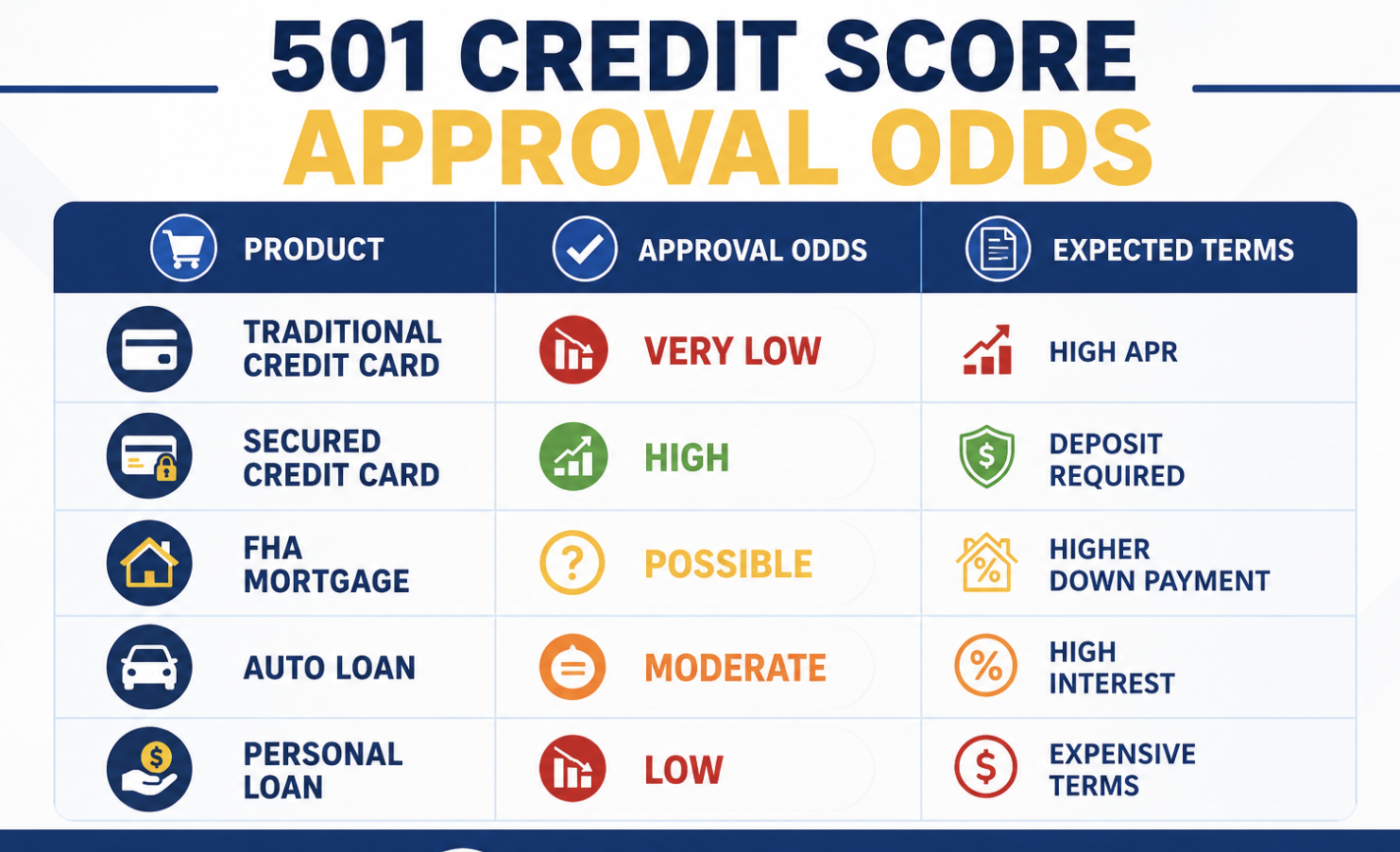
A 501 credit score gives access to FHA mortgages with 10% down, secured credit cards, credit builder loans, subprime auto loans at high APRs, federal student loans, and some apartments with larger deposits or co-signers. Most traditional bank products, unsecured credit cards, and competitive rate loans close at 501.
| Product | Access at 501 | Key Detail |
|---|---|---|
| FHA Mortgage (10% down) | Technically open | 501 is 1 point above the FHA floor. Down payment is 10% (not 3.5%). Fewer than 5% of FHA lenders approve below 580 in practice. Manual underwriting required. |
| Secured Credit Card | Open | Requires a refundable deposit of $200-$500. Reports to all 3 bureaus. Best credit-building tool available at 501. |
| Credit Builder Loan | Open | Available at most credit unions and via Self, Credit Strong. Adds installment history monthly. Deposit held and returned at term end. |
| Federal Student Loans | Open | No credit check required for most federal student loans. Available regardless of score. |
| Subprime Auto Loan | Limited | Buy-here-pay-here dealers and subprime lenders may approve. APRs run 20-35%+. Traditional banks unlikely to approve at 501. |
| Apartment Rental | Possible with conditions | Most landlords require co-signer or larger security deposit at 501. Private landlords more flexible than large property management companies. |
| Unsecured Credit Card | Closed | Major issuers require 580-620 minimum. Some store cards may approve but carry high APRs and low limits. |
| Conventional Mortgage | Closed | Fannie Mae and Freddie Mac require 620 minimum. 501 falls 119 points short. |
| Personal Loan (bank) | Closed at most banks | Traditional bank personal loans typically require 620-660. Subprime online lenders sometimes consider 580+. |
Credit Cards for a 501 Credit Score
Secured credit cards are the primary credit card available at 501. They work differently from standard cards: you deposit money upfront, that deposit becomes your credit limit, and you use the card like any normal card.
The deposit is not spent. When you close the account in good standing, the full deposit returns. What the card produces during the time it is open is monthly positive payment marks on your credit report , the most valuable thing you can add at a 501 score.
Secured cards that work at 501
- Capital One Quicksilver Secured , No minimum credit score listed. Reports to all three bureaus. $200 minimum deposit. Automatic credit limit review after 6 months.
- Discover it Secured , Accepts applicants with no credit or poor credit. 2% cash back on gas and dining. Reports to all three bureaus. Automatic graduation to unsecured after 7 months of responsible use.
- OpenSky Secured Visa , No credit check required at application. No bank account required. $200 minimum deposit. Reports to all three bureaus monthly.
- Chime Credit Builder , Linked to a Chime checking account. No minimum credit score. No interest charges. Reports to all three bureaus.
The card you open matters less than what you do with it. Use it for one small recurring charge , a streaming subscription or a small grocery run. Pay the full balance before the statement close date every month. Keep the balance below 10% of the limit at statement time. That produces the maximum credit-building outcome from a secured card.
As Bankrate's secured credit card analysis notes, secured cards that report to all three bureaus and allow graduation to unsecured status after on-time payment history build the strongest long-term credit profile for borrowers starting in the Very Poor range.
Loans for a 501 Credit Score
FHA mortgages
A 501 score technically qualifies for FHA financing , the program's floor is 500. The down payment requirement at 501 is 10%. On a $300,000 home, that means $30,000 down rather than the $10,500 required at 580+.
The practical difficulty at 501 is lender participation. Most FHA lenders set their own minimums above the HUD floor of 500. In practice, finding a willing FHA lender at 501 requires shopping a larger number of lenders. Credit unions and smaller community lenders are more likely to participate at the 500-579 range than national banks.
Per NerdWallet's 2026 FHA loan requirements guide, borrowers between 500 and 579 must meet additional underwriting requirements including a DTI below 43% and proof that compensating factors exist in the file. Manual underwriting applies , automated underwriting systems frequently decline below 580.
Auto loans
Traditional banks and credit unions rarely approve auto loans at 501. Buy-here-pay-here (BHPH) dealers and subprime auto lenders sometimes approve. APRs run 20-35% or higher at this score level. A 36-month loan of $12,000 at 30% APR carries a monthly payment of approximately $508 and total interest of $6,288 , nearly $6,000 more than the same loan at 10% APR.
If transportation is urgently needed and a 501 score is the current reality, a BHPH loan that reports to credit bureaus is better than a BHPH loan that does not. Confirm bureau reporting before signing any auto loan at 501.
Personal loans
Standard bank personal loans close at 501. Subprime online lenders including OppLoans and Upstart sometimes approve borrowers below 580 using income and employment data as primary qualification factors. APRs at 501 typically run 20-36% or higher. Federal student loans remain accessible regardless of credit score and represent the cleanest installment loan option available at 501.
What Else Can a 501 Credit Score Get You?
Apartments and rentals
Landlords vary widely on credit score requirements. Large property management companies often set floors at 580-620. Private landlords are more flexible and more likely to consider the full application , income, rental history, references , alongside the score.
Strategies that help at 501: offer a larger security deposit (1.5-2 months instead of 1), provide references from prior landlords, show bank statements demonstrating stable income, and apply to private landlords rather than large corporate rental companies. Some areas have nonprofits that help renters with poor credit find willing landlords.
Bank accounts
Credit scores do not directly determine bank account approval. Banks use ChexSystems, a separate consumer reporting agency that tracks negative banking history , overdrafts, unpaid fees, fraudulent activity. A 501 credit score alone does not close a bank account. Past negative banking activity in ChexSystems does. If standard banks decline, second-chance checking accounts from credit unions and some fintech banks (Chime, Varo) do not use ChexSystems screening and are accessible regardless of score.
Utilities and phone plans
Utility companies sometimes require a security deposit from applicants with scores below 580. Phone carriers may require a deposit or limit access to postpaid plans. Prepaid plans remain fully accessible regardless of credit score and carry no deposit requirements.
How to Improve a 501 Credit Score
The fastest path from 501 to 580 is three simultaneous actions: dispute inaccurate entries across all three bureaus, reduce credit card utilization below 10% before the next statement closes, and open a secured card that reports to all three bureaus. Running all three at the same time compresses the timeline from 6 months to 60-90 days for most borrowers.
Go to AnnualCreditReport.com. Pull Equifax, Experian, and TransUnion separately. Identify wrong dates, wrong balances, duplicate accounts, and accounts you do not recognize. File disputes at each bureau where the inaccuracy appears. Each bureau has 30 days to investigate. A removed inaccurate collection produces 30-60 points in one dispute cycle. ASAP Credit Repair's analysis shows approximately 38% of files in the 480-540 range contain at least one disputable inaccuracy.
Timeline: 30-45 days | Cost: Free | Potential gain: 30-60 points per removed itemUtilization controls 30% of the FICO score. The bureau receives whatever balance appears on your monthly statement. That statement closes 20-25 days before the due date. Pay before the statement closes, not after. Getting every card from high utilization to below 10% produces 20-40 points within one billing cycle. This is the fastest lever available with no dispute process or time delay.
Timeline: One billing cycle (25-35 days) | Potential gain: 20-40 pointsA secured card with a $200-$500 deposit starts building payment history from month one. Use it for one small charge monthly. Pay the full balance before the statement close date. This adds a positive account to a file that may have few positive tradelines , and each on-time payment mark builds the payment history factor that controls 35% of the score.
Timeline: First positive mark in 30-35 days | Builds 12 positive marks per yearOne 30-day late payment costs 60-110 points and stays on the report for seven years. At 501, losing 60 points from a missed payment pushes the score to 441 , territory where even secured cards become harder to get. Autopay set to the full statement balance eliminates that risk across every account simultaneously. Do not rely on memory when the stakes are this high.
Timeline: Set up today | Protects score from first monthAsk a parent, spouse, or trusted friend with a credit card at least 3 years old, low utilization, and clean payment history to add you as an authorized user. Their account history posts to your report within one statement cycle. This adds positive account age, available credit, and payment history to a file that may have very little of any of these at the 501 level. Potential gain of 20-50 points within 30-60 days from this one action.
Timeline: 30-60 days | Cost: Free | Potential gain: 20-50 pointsFor borrowers working toward 745 and above, the gap from 501 to that tier requires sustained consistent behavior over 12-24 months. Understanding what a 745 credit score looks like and what it takes to reach it shows exactly what on-time payments, low utilization, and a clean file look like once the rebuild is complete.
As Rocket Mortgage's FHA loan guide explains, the score threshold of 580 is a meaningful milestone for any borrower targeting homeownership. Every action taken from 501 should target 580 first , that is where the financial reward most directly materializes through lower down payment requirements and broader lender access.
How Long Does It Take to Improve a 501 Credit Score?
The timeline from 501 depends primarily on one question: is the score accurate or suppressed by inaccurate entries?
If inaccurate entries drive the score, disputed removals can produce 30-60 points within 30-45 days. A 501 score with two inaccurate collections removed can reach 580 in a single dispute cycle.
If the score accurately reflects credit history, the timeline runs longer. Consistent on-time payments and lower utilization typically move the score 40-80 points within 6-12 months. Combined actions , disputes, utilization reduction, secured card addition, and authorized user strategy , compress that timeline.
The realistic targets from 501:
- 580 in 3-6 months , achievable for most borrowers through combined action. This is the primary target because it opens FHA 3.5% down.
- 620 in 6-12 months , opens conventional mortgages and significantly more lending options.
- 670 in 12-18 months , enters the Good tier where rate premiums begin shrinking across all products.
- 740+ in 24-36 months , Very Good territory with near-best rate access requires sustained clean behavior and aging account history.
Is a 501 credit score good or bad?
A 501 credit score is bad by FICO's classification. It falls in the Very Poor range (300-579) and places the borrower in the bottom 2-3% of U.S. consumer scores. It closes most traditional lending products. The one significant access point it provides: FHA mortgage financing with a 10% down payment, since 501 clears the FHA floor of 500 by 1 point. The score is recoverable. Most borrowers at 501 reach 580 within 3-6 months of targeted action.
What can I do with a 501 credit score right now?
With a 501 score right now, you can open a secured credit card, apply for a credit builder loan, access federal student loans, apply for FHA financing (with 10% down and a willing lender), and use BHPH auto dealers for transportation if needed. The most valuable use of the next 30 days at 501 is pulling all three bureau reports, disputing inaccurate entries, and opening a secured card , three actions that all contribute to score improvement simultaneously.
How many points can I realistically improve a 501 credit score?
Borrowers at 501 with inaccurate entries on their report can see 50-100 points of improvement within 30-60 days through successful disputes. Borrowers with accurate negative history typically see 40-80 points in 6-12 months through consistent on-time payments, lower utilization, and new positive accounts. A 79-point improvement from 501 to 580 , the FHA 3.5% down threshold , is achievable within 3-6 months for most borrowers who take simultaneous action on all available levers.
Why is my credit score 501?
A 501 credit score usually traces to one or more of these causes: multiple late or missed payments, one or more collection accounts or charge-offs, very high credit card utilization (often above 80%), a thin credit file with few accounts, a recent bankruptcy or foreclosure, or inaccurate negative entries that do not accurately reflect your payment behavior. In many cases, more than one cause applies simultaneously. Pulling all three bureau reports identifies which specific factors and accounts drive the number.
Is Your 501 Score Accurate , or Is It Suppressed?
Approximately 38% of files in the 480-540 range contain at least one inaccurate entry. A suppressed score at 501 can reach 560-600 with a single dispute cycle , no payments, no waiting, just removing what does not belong. A free 3-bureau audit shows exactly what each bureau reports right now.
Get My Free 3-Bureau Audit → Secure · 2 minutes · No credit card required-
Line of Credit , What It Is and How It Works A line of credit is one of the products that becomes accessible as a 501 score rebuilds toward 620 and above. This covers how revolving lines of credit differ from installment loans, what score and income levels most lenders require, and how responsible use of a line of credit contributes to the credit mix factor that controls 10% of the FICO score.
-
Why Can't I Open a Bank Account A 501 credit score does not automatically prevent a bank account from opening , but ChexSystems records of past negative banking activity can. This covers the difference between credit scores and ChexSystems screening, which banks use each system, and what second-chance checking accounts provide for borrowers who need a banking relationship while their credit score rebuilds.
-
Credit Score Brackets , What Each Range Means for You A 501 score sits in the Very Poor bracket. This covers every bracket from 300 to 850, what specific lending products open and close at each bracket boundary, and the exact point thresholds , 500, 580, 620, 670, 740 , where the most significant financial changes occur as a score climbs from the bottom of the scale toward exceptional territory.